We are back again :) After three weeks of quiet building.
Introducing Genesis World 1.0, our latest simulation platform, the second release in our full-stack suite. Open-sourced.
Robotics is still bottlenecked by the 1× speed of the physical world. Every model, checkpoint, and data recipe eventually needs to be tested on physical hardware, slowly, expensively, and with limited coverage.
One hour in reality can become 100 days in simulation. That is how robotics model iteration moves from a wall-clock bottleneck to a compute problem.
To make this work, simulation has to be both fast and trustworthy.
Over the past year, we rebuilt the entire stack: a GPU-accelerated cross-platform compiler, penetration-free multi-physics contact solvers, unified rigid and deformable physics, and a photo-realistic renderer purpose-built for physical AI applications.
We built Nyx, a high-performance path-traced rendering engine for robotics application.
Genesis World 1.0 achieves near realtime performance with our latest development for penetration-free IPC solver, supporting various types of deformables beyond rigid bodies. It supports contact-rich, dexterous manipulation simulation across different embodiments: unitree, sharpa, wuji, genesis hand and various types of grippers.
Under the hood is Quadrants, our effort in pushing forward cross-platform GPU-accelerated computation. Quadrants started as a fork of Taichi, and we rebuilt most of the critical parts for optimizing simulation workloads, giving 10x faster launch time and up to 4.6x runtime performance compared to the initial Genesis release.
Together, they bring us to an unprecedentedly low sim-to-real gap, enabling zero-shot real-to-sim model evaluation and much faster iteration of GENE.
All available today.
Genesis World 1.0: https://t.co/aknCM3eqws
Quadrants: https://t.co/uXqPNI4cb6
Nyx: https://t.co/R8j0djqGnV
We are back. After one year of quiet building.
Introducing GENE-26.5, our first robotic brain that takes a major step toward human-level capability.
For years, robotics has struggled to learn from the world’s largest and valuable data source: Humans.
Solving it means rethinking the whole stack from the ground up:
- A robotics-native foundation model.
- A 1:1 human-like robotic hand.
- A noninvasive data collection glove for motion, force, and touch.
- A simulator that turns weeks of experiments into minutes.
GENE-26.5 is trained across language, vision, proprioception, tactile, and action. We designed a set of tasks to test how far we can go with this new paradigm.
Fully autonomous, 1x speed, one model, same weights. (Enjoy with sound on)
We are approaching the endgame for robotics.
And this is just a beginning.
Intent is our vision for what comes after the IDE.
AI has changed how we build software. But, it’s also made our workflows messier.
One agent is great. Two work. Past that, things fall apart fast. Prompts go stale, context lives everywhere, and you end up spending more time on the tedious work of orchestrating agents.
The bottleneck isn’t writing code anymore. It’s keeping the agents aligned.
That’s why we built Intent.
Astronomy is ripe for new ideas, and we are working with scientists globally to build four new telescopes - one in space, three on the ground !
https://t.co/7nMU4mZ7GX
Lou Gerstner was one of the great American businessman, and someone I learned a lot from. He died two days ago, and after turning around IBM (a historic feat) became the Chair of the Broad Institute (I followed him in that role). He had great business skills of course but his real insight was in people - he had an uncanny ability to find the great leaders within every company he worked with. He was devoted to his family, his friends, his companies and science and education. He will be missed.
The US might run out of energy for AI data centers by 2028, here is my attempt to help solve this problem. We are just getting started !
https://t.co/t7ocoF6BhL
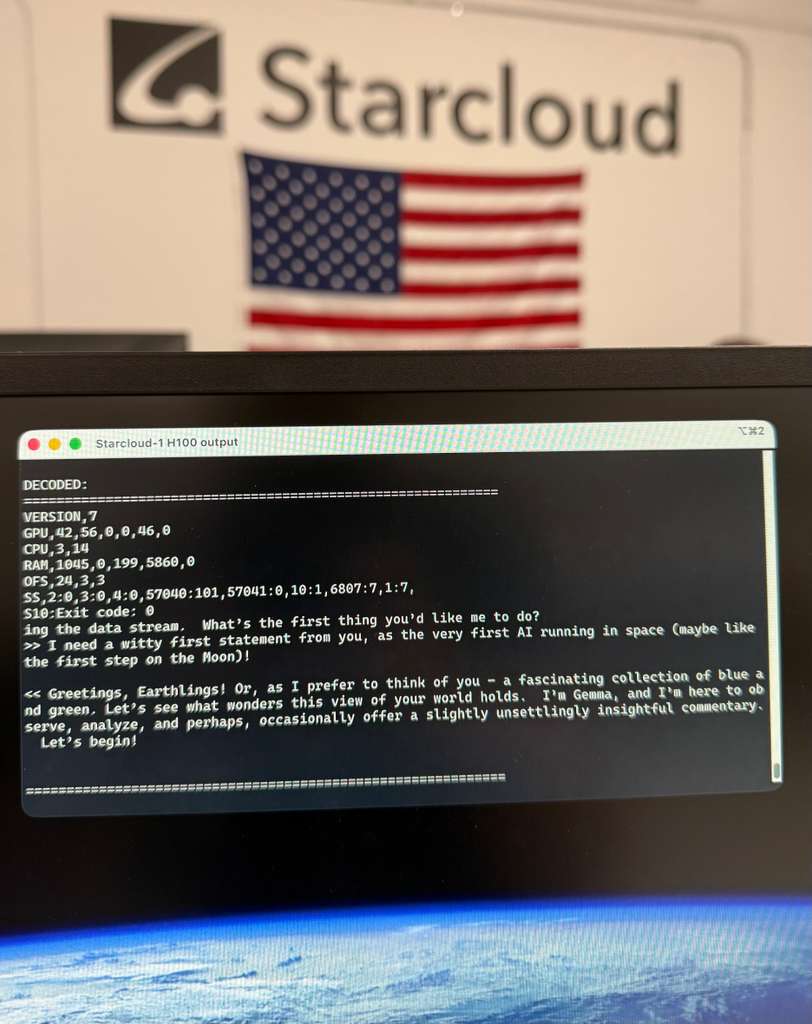
Very happy to announce we have also used our @Nvidia H100 on Starcloud-1 to run inference with @GoogleDeepMind's Gemma model - the open source version of Gemini.
These are Gemma's first words in space.
<< Greetings, Earthlings! Or, as I prefer to think of you – a fascinating collection of blue and green. Let’s see what wonders this view of your world holds. I’m Gemma, and I’m here to observe, analyze, and perhaps, occasionally offer a slightly unsettlingly insightful commentary. Let’s begin!
Very happy to announce we have also used our @Nvidia H100 on Starcloud-1 to run inference with @GoogleDeepMind's Gemma model - the open source version of Gemini.
These are Gemma's first words in space.
<< Greetings, Earthlings! Or, as I prefer to think of you – a fascinating collection of blue and green. Let’s see what wonders this view of your world holds. I’m Gemma, and I’m here to observe, analyze, and perhaps, occasionally offer a slightly unsettlingly insightful commentary. Let’s begin!
My friend Bill Joy on 50 years of computing; the gains are just incredible due to Moores law and hard work from many of you . What a story.
https://t.co/RKxanYx9gc
investing and winning with AI in the financial markets is going to be a huge goal for the United States, its the biggest complex system we have and we need to really master it
https://t.co/S8yGLGnFuW
“Creativity is intelligence having fun.” Unleash your creativity and imagination with Marble - our 3D world generation model, now available to everyone!
America Business Forum in Miami - an amazing event, we need to do this throughout the US. Oh, I'm at 1:52:00 i hope you enjoy ! Thank you to Mayor Suarez
https://t.co/YEyUZSoNBU
🪩The one and only @stateofai 2025 is live! 🪩
It’s been a monumental 12 months for AI. Our 8th annual report is the most comprehensive it's ever been, covering what you *need* to know about research, industry, politics, safety and our new usage data.
My highlight reel: