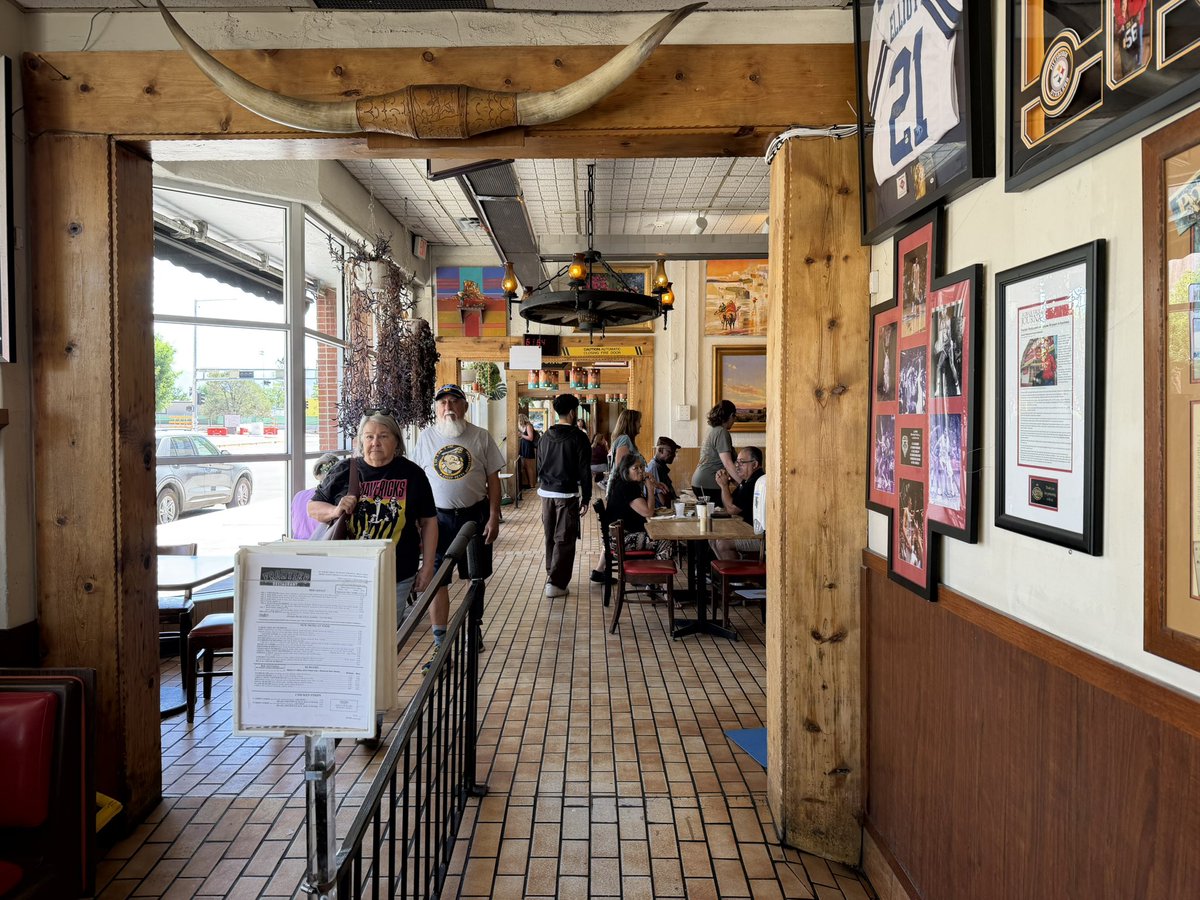
The World Cup hasn’t even started yet and this is already some of my favorite content.
Watching other cultures experience North America for the first time.
This is what it’s all about. 🧵
How a 24-Foot Robot Boat Just Rewrote the Book on Combat Search and Rescue
Yesterday, in the tense waters off Oman near the Strait of Hormuz, two U.S. Army aviators were pulled from the sea—not by a rescue crew risking their lives in a traditional Combat Search and Rescue (CSAR) mission, but by a fully autonomous 24-foot drone boat.
It was the first documented real-world use of an unmanned surface vessel (USV) to execute a personnel recovery at sea. And it happened under fire, in one of the world's most contested maritime chokepoints.
Here's the story—and why this moment may prove to be a genuine turning point in military technology.
What Actually Happened
Early Tuesday local time (around 3 a.m. Oman time / late Monday U.S. time), an Army AH-64 Apache attack helicopter went down while patrolling international waters near the Strait of Hormuz. U.S. officials, including President Trump, confirmed it was shot down by Iranian forces—specifically struck by an Iranian Shahed-series drone, likely a Shahed-139 variant. The two crew members ejected or ditched safely and spent roughly two hours in the water.
Overhead, U.S. MQ-9 Reapers and fighter jets provided top cover. But instead of immediately vectoring in a manned rescue package—standard procedure that would have put more helicopters, aircrew, and rescue swimmers directly into a high-threat zone—the Navy's Task Force 59 dispatched something different: a Saronic Corsair autonomous surface vessel.
The Corsair, already operating in the region as part of the Fifth Fleet's unmanned experimentation unit, located the pilots, let them climb aboard, and motored them to safer waters. From the deck of the drone boat, they were then hoisted by a conventional rescue helicopter.
No additional manned assets had to rush into the immediate danger zone for the initial pickup. The entire recovery was completed without further U.S. casualties.
The Corsair
Built by Texas-based Saronic Technologies, the Corsair is no toy. It is a 24-foot AI-driven USV capable of:
• Speeds around 35–40 knots (roughly 40–46 mph)
• Ranges exceeding 1,000 nautical miles
• Payloads exceeding 1,000 pounds—easily enough for two pilots and their gear
• Fully autonomous navigation, obstacle avoidance, and multi-mission capability, including surveillance, escort, logistics, and now personnel recovery
Task Force 59—the Navy's dedicated unmanned and AI maritime task force, established in 2021—began deploying these specific Corsairs in the Middle East only in late March 2026. They were already proving themselves during operations in and around the Strait of Hormuz.
Yesterday they demonstrated something far more significant: some missions that traditionally required humans in the danger zone can now be performed by autonomous systems.
Why Traditional CSAR Is So Brutal (and Why This Changes Everything)
Combat Search and Rescue has always been one of the riskiest and most asset-intensive missions in the U.S. military playbook.
• You lose an aircraft and crew in hostile territory.
• To get them back, you launch dedicated CSAR helicopters, often carrying special operations personnel committed to recovering the downed crew.
• You need fighter escort, electronic warfare support, tankers, and sometimes ground teams.
• Every asset committed to a rescue becomes another potential target. A mission that begins with one downed aircraft can quickly require multiple helicopters, escorts, tankers, electronic warfare platforms, and recovery personnel. The rescue force itself becomes part of the battle.
• In a place like the Strait of Hormuz—where Iranian drones, missiles, and fast attack craft remain persistent threats—you risk turning a single incident into a much larger engagement.
• It consumes enormous fuel, flight hours, and manpower while disrupting ongoing operations.
And it can take hours—or even days.
This Corsair recovery flipped the script.
The drone boat was already on station, expendable, and posed no additional risk to human life. It handled the "last-mile" pickup autonomously while manned assets remained at safer standoff distances until final extraction was required.
That is a fundamentally different approach to personnel recovery in a contested environment.
The Bigger Picture: Unmanned Systems Are No Longer "Future"
Task Force 59 has been quietly pioneering this concept for years, using low-cost, attritable unmanned vessels for persistent surveillance, mine countermeasures, and maritime security missions. Saronic's boats were designed to operate independently or in coordinated groups within some of the world's most challenging operating environments.
This was not a demonstration this time. It was an operational recovery executed during an active U.S.-Iran confrontation that prompted immediate retaliatory U.S. strikes later that same day.
For the pilots in the water, it meant rescue without waiting for a manned helicopter to run the gauntlet. For the Navy, it validated years of investment in autonomous maritime systems.
What Comes Next?
Expect this capability to scale quickly. More Corsairs—and competing systems—will appear in more theaters. Autonomous personnel recovery packages will likely combine unmanned surface vessels, aerial drones, and manned aircraft into integrated rescue networks. Similar concepts could eventually support casualty evacuation, logistics resupply, and other high-risk missions under fire. The building blocks are already visible.
In short, two pilots made it home because an autonomous vessel reached them first.
For decades, personnel recovery has depended on putting more people into danger to save those already at risk. This incident suggests that assumption may no longer hold.
If this operation proves to be a preview rather than an exception, historians may look back on June 9, 2026, as one of the first moments when autonomous systems moved beyond supporting combat operations and began directly saving lives within them.
Huge credit to the Saronic team, Task Force 59, and everyone who has spent the last five years advancing unmanned maritime capability. Events like this suggest the technology is rapidly moving from experimentation to operational utility.
*Credit to WSJ's Dave Brown for breaking the initial details, and to CENTCOM for the subsequent confirmation.
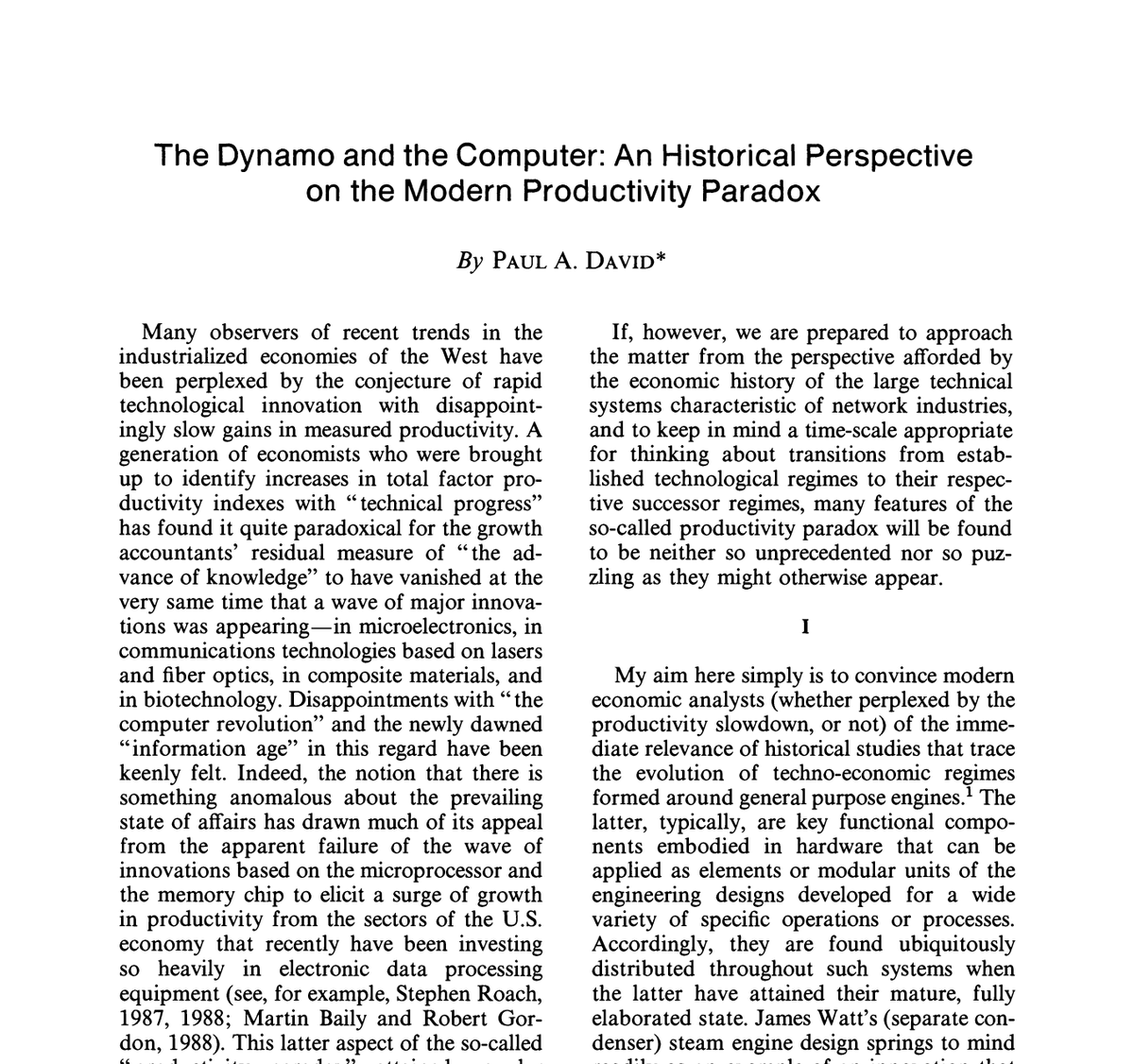
If you've adopted AI at your company but haven't seen any tangible results, read this 1990 article: "The Dynamo and the Computer" by Paul David.
When electricity first arrived, factories that "adopted" it barely got faster. They just swapped the steam engine for an electric one and ran everything else exactly as before: same machine layout, same workflow, same management. Electricity in, no real gains out.
The most common mistake with any new technology is to drop it into the old organization and then declare the transformation done.
The real leap came decades later, when each machine got its own small motor. Suddenly machines no longer had to be lined up around one central drive shaft. They could be rearranged around the actual flow of work.
The productivity gains didn't come from electricity. They came from REDESIGNING THE ENTIRE FACTORY around it.
AI is the same. Bolting it onto your existing process gets you a faster steam engine. The payoff comes when you redesign the work itself.
(link to paper in comments)
When legendary designers Kelly Johnson and Hall Hibbard cooked up the Lockheed P-38 Lightning in the late 1930s, they weren't just building a fighter. They were breaking the mold. They skipped the standard single-engine blueprint for a radical twin-boom layout powered by two supercharged 1,425 hp Allison V-1710 V12s and concentrated all the firepower straight into the nose. No wing gun convergence issues. Just a concentrated buzzsaw of four .50-cals and a 20mm cannon. By the time the D-model rolled out, it became the first U.S. production aircraft to smash past 400 mph in level flight. 1/3
At @ILA_Berlin, we introduce the Airbus U145: an uncrewed, fully autonomous variant of the H145. Optimised for cargo with no cockpit, an integrated nose door, and full autonomy, its first flight is set for late 2026.
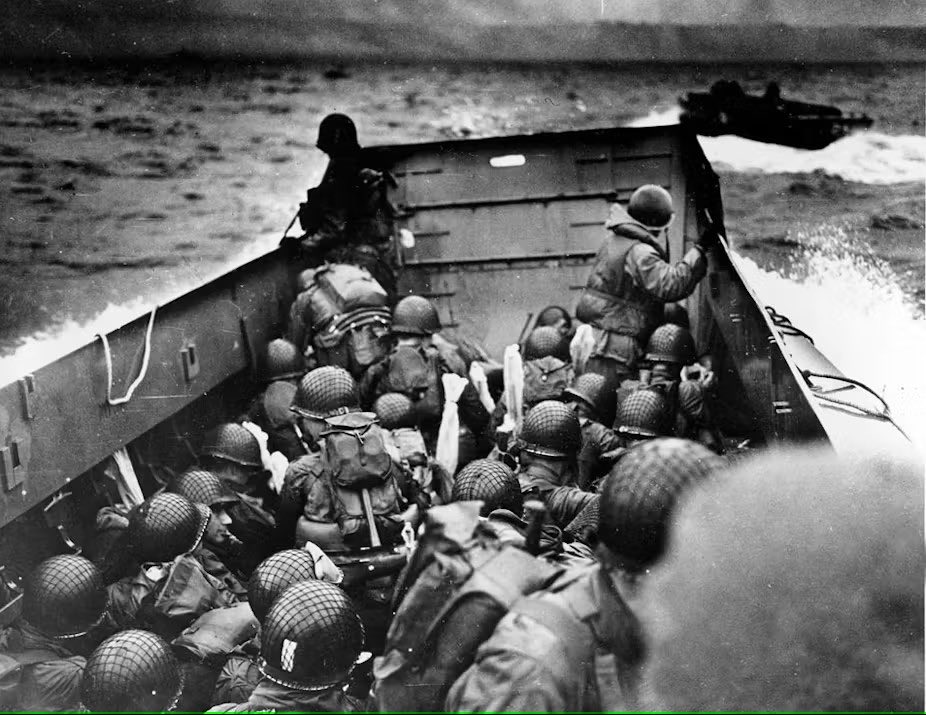
June 6th, 1944.
The English Channel is angry and half the men in the landing craft are seasick. Diesel fumes mix with saltwater and vomit while rifles are checked for the fifth or sixth time by hands that need something to do. Nobody talks much anymore because the jokes have all been told and the bravado has finally burned away somewhere behind the English coast.
You are nineteen years old and carrying more weight than you’ve ever carried in your life. You don’t know it yet, but it’s the most weight you will EVER carry in this life. However long or short it may be.
Your rifle rests across your knees. Your life hangs from a few pounds of steel, wood, and training. Somewhere beyond the gray horizon sits a continent that has spent five years tearing itself apart, and in a few minutes you are going to step into the middle of it.
Across from you sits another kid. He can’t be much older than you. His jaw is clenched. His knuckles are white around his weapon. Neither of you says a word because there is nothing left to say.
Then your eyes drift toward his shoulder.
That red numeral catches your eye: “1”.
You’ve seen it a thousand times before. In barracks hallways, on training fields, in motor pools, and on long marches. It never meant much beyond belonging to the same outfit.
Now it means everything.
Because in a few minutes the world is going to ask something terrible of both of you, and there is comfort in knowing that whatever waits on that beach, neither of you will face it alone.
The historians will eventually reduce this day to arrows on maps and casualty figures. Politicians will give speeches. Journalists will write books. None of that exists inside the landing craft.
What exists is fear, and duty.
What exists is the understanding that courage was never the absence of fear. Courage was always charging into the maelstrom anyway.
The shoreline emerges through the smoke. You can see flashes now. You can hear the distant percussion of artillery. Men stop checking their equipment because there is no point anymore. Whatever mistakes were made are already made. Whatever prayers were going to be said have already been said.
The coxswain throttles down.
The boat grinds forward.
The ramp is about to drop.
Into the abyss.
Overlord.
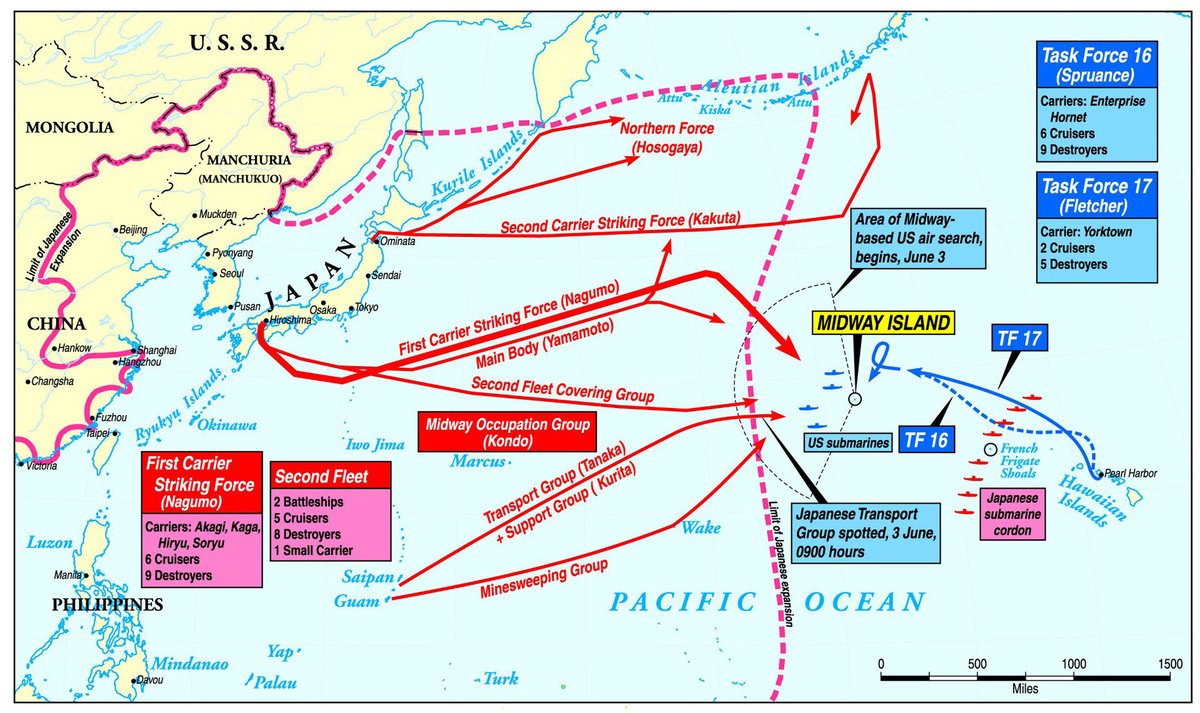
By the morning of June 5, all four Japanese carriers (Akagi, Kaga, Soryu, Hiryu) were gone, effectively ending the Battle of Midway.
Final Tally:
United States losses:
Ships: 1 fleet carrier (USS Yorktown), 1 destroyer (USS Hammann)
Aircraft: ~145–150 destroyed
Lives: ~307–340 killed
Japanese losses:
Ships: 4 fleet carriers (Akagi, Kaga, Soryu, Hiryu), 1 heavy cruiser (Mikuma)
Aircraft: ~248 destroyed (mostly carrier-based, including many elite pilots)
Lives: ~3,057 killed
These three days marked the military turning point in the war ... but more than two years of the most brutal fighting the world had ever seen remained on the horizon. We owe our respect to the brave men of the US armed forces especially Torpedo Squadron 8 (and Ensign Tex Gay), Bombing & Scouting Squadrons 6, Bombing Squadron 3, and the crews of USS Enterprise, Yorktown, and Hornet.
This is very big.
NVIDIA new open humanoid robot reference design built for robotics research.
The NVIDIA Isaac GR00T Reference Humanoid Robot.
The garage robot builders have a friend in NVIDA.
Astute robot companies will be OPEN SOURCE.
On this day, 4 June 1942, the Battle of Midway began.
>4 Japanese fleet carriers sunk
>The core of Japan’s naval aviation shattered
>The strategic initiative changed hands
>The Pacific War transformed
A battle fought beyond the horizon.
Just a few minutes of violence that altered the course of a war.
Before Midway, Japan dictated events.
After Midway, it reacted to them.