At Erika Lodge we observed a small group of stream caimans, a rare species in the Alto Madre de Dios - Manu. This small Amazonian caiman is associated with small watercourses and primary rainforest, highlighting the extraordinary biodiversity still preserved in these forests.
As you arrive, the river gently guides you to Erika Lodge—nestled among palm trees in the heart of untouched forest. Here, every stay is an immersion in extraordinary biodiversity, and a chance to support the conservation of pristine forests directly.
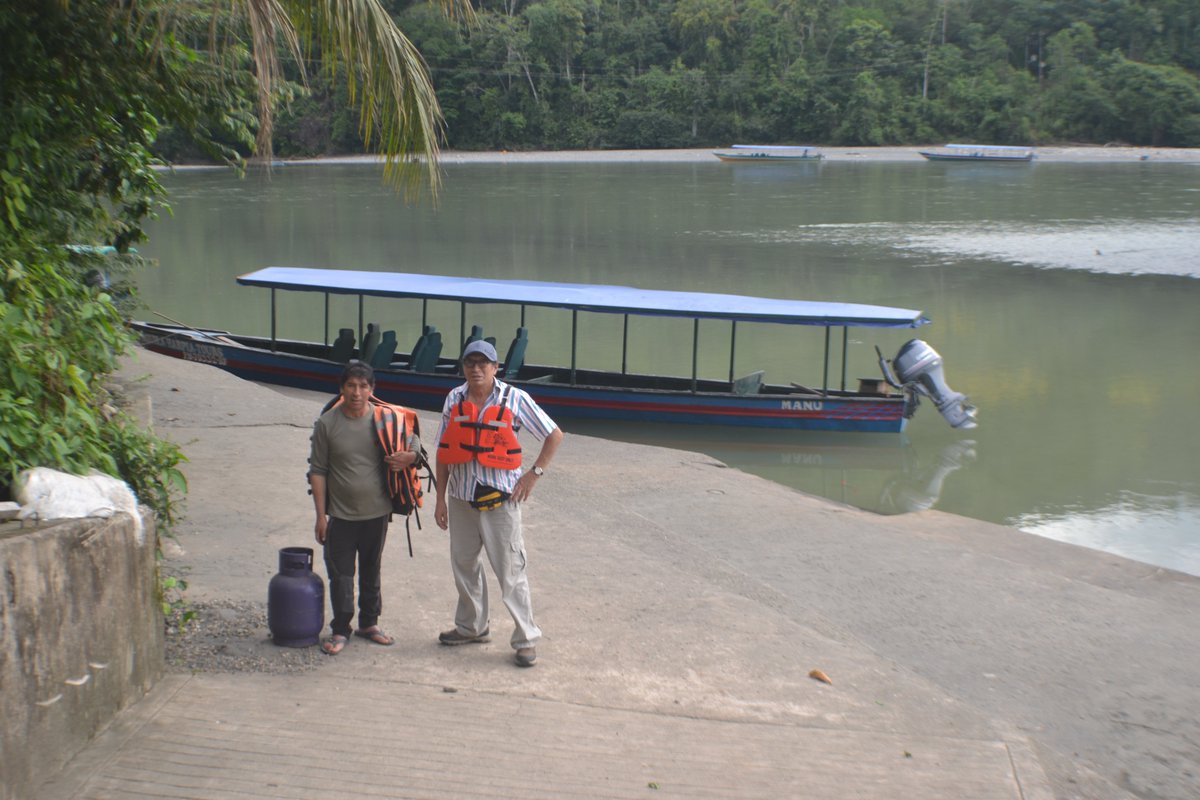
The final 25 minutes of the journey are by boat along the Alto Madre de Dios River, traveling alongside an impressive forest-covered mountain range, often wrapped in mist in the early morning.
A journey where nature sets the pace and announces your arrival at Erika Lodge.
From Atalaya (500 m.a.s.l.), the journey continues by river (boat) for approximately 25 minutes along the Alto Madre de Dios River. This final stretch offers a chance to enjoy the tranquillity of the Amazonian surroundings before arriving at Erika Lodge, located on the riverbank.
During the journey from the town of Pilcopata to the Atalaya river dock, you pass a spot known as “El Mirador”, from where it is possible to admire a unique landscape: the last foothills of the Andes, where the river carves its way downward into the Amazon lowlands.
If you are travelling independently using local transportation, you may stay overnight in Pilcopata to rest and continue early the next morning to the town of Atalaya, approximately a 45-minute journey by local transport to the Atalaya river dock.
The image shows a view of Pilcopata, a place where travelers can find lodging and small hotels, offering a resting point before continuing their journey the next day
Below the cloud forest lies the Selva Alta, a region of valleys where the main settlements along the road are located. These include Chontachaca, Asunción, Patria, Pilcopata, Atalaya, and Salvación. The elevation of this area ranges from 1,500 to approximately 5,000 feet.
The distinctive plumage of the male stands out with its dazzling red hue or bright orange, accentuated by intense contrasts of black and silver. In the region, it is known as "Tunki." This majestic specimen is not only a visual treasure but also the national bird of Peru.
The Andean cock-of-the-rock (Rupicola peruvianus), inhabits the eastern slopes of the Andes mountain range. Along the route to Erika Lodge, it is possible to spot this fascinating bird in the transitional zone between the Cloud Forest and the High Jungle (1,640 to 4,921 feet).
Epiphytic bromeliads grow on tree branches exposed to light and feature a structure at the base of their leaves where rainwater and organic matter accumulate. This creates a habitat where insects, arachnids, as well as frogs thrive.
Epiphytic plants, those that thrive in the heights of trees, find their particular paradise in this environment. They grow sprawling and hanging, adding rich diversity to the landscape, while clinging to branches and seeking the light that penetrates through the dense mist.
Cloud forests are more than mere landscapes; they are invisible water guardians. They function as a mesh that captures tiny moisture particles floating in the atmosphere. As these particles accumulate, they become a crucial water source for life in their surroundings.
Several species of the genus Telipogon (Orchidaceae) are to some extent threatened or endangered in the cloud forests of southern Peru.
Fortunately, Private Conservation Areas are being created in this region to protect the flora and fauna of this region.
More than 100 species of orchids can be found in the cloud forest of this region (4,900 / 6,500 ft), some more common than others. In the photos Sobralia Sp. , Odontoglossum Sp. , Stelis Sp. , Epidendrum secundum.
The cloud forest, on a clear day at 9,500 feet elevation with tree ferns, epiphytes, and mosses. The sponge that catches the waters for the low jungle that goes to the Amazon.
Acjanaco is a pass between mountains in the Andes of southern Peru. From that point (11,600 feet high) the descent to the Amazon basin begins. It's an area where the Andean forests mix with the flora of the cloud forest.
Passing the village of Paucartambo and after an ascending journey of up to 3,560 m.a.s.l. we reach the entrance of the National Park Manu. This place is called Acjanaco, from where it is possible to see early in the morning the cloud forest and the Amazon jungle.