What is happening to the Cedi? Why has the BoG stopped intervening in the market? And is there a cause to be worried?
This article attempts to answer these emerging questions.
https://t.co/FElt9Y4ewd
I’ll be watching Ghana’s president speak in New York this morning as police in Accra continue to detain peaceful protestors against illegal mining.
People are rallying under #FreeTheCitizens after Ghanaian police violently broke up 3 days of #StopGalamseyNow protests
This article explores the stability of the Ghanaian Currency from a historical perspective. It queries why the lessons of currency stability of the pre-independence era have been forgotten by modern Central bankers
#ExchangeRate#CurrencyBoard
https://t.co/17RkbKPbcv
Bawumia who claims to be Economics whizz-kid doesn't even understand this basic economics. Another dumb NPP communicator Dr Bannor also said BoGs printing of over 60billion cedis didn't cause inflation. Hmm this country is lost
#TheUmbrellaChallenge
In case you missed my presentation on TV3 earlier today and haven't heard enough of me discussing why the government's claim of creating 2.3 million public and private sector jobs since 2017 can't be substantiated, here it is. Based on data from five separate government sources, the claim doesn't hold up
This article analyse the performance of the two leading parties based on their economic records in the past 16 years.
Please enjoy the read and stay informed
#TheEconomicDebate#TaleOfTwoParties#NDCvsNPP
https://t.co/QBxGowFzfJ
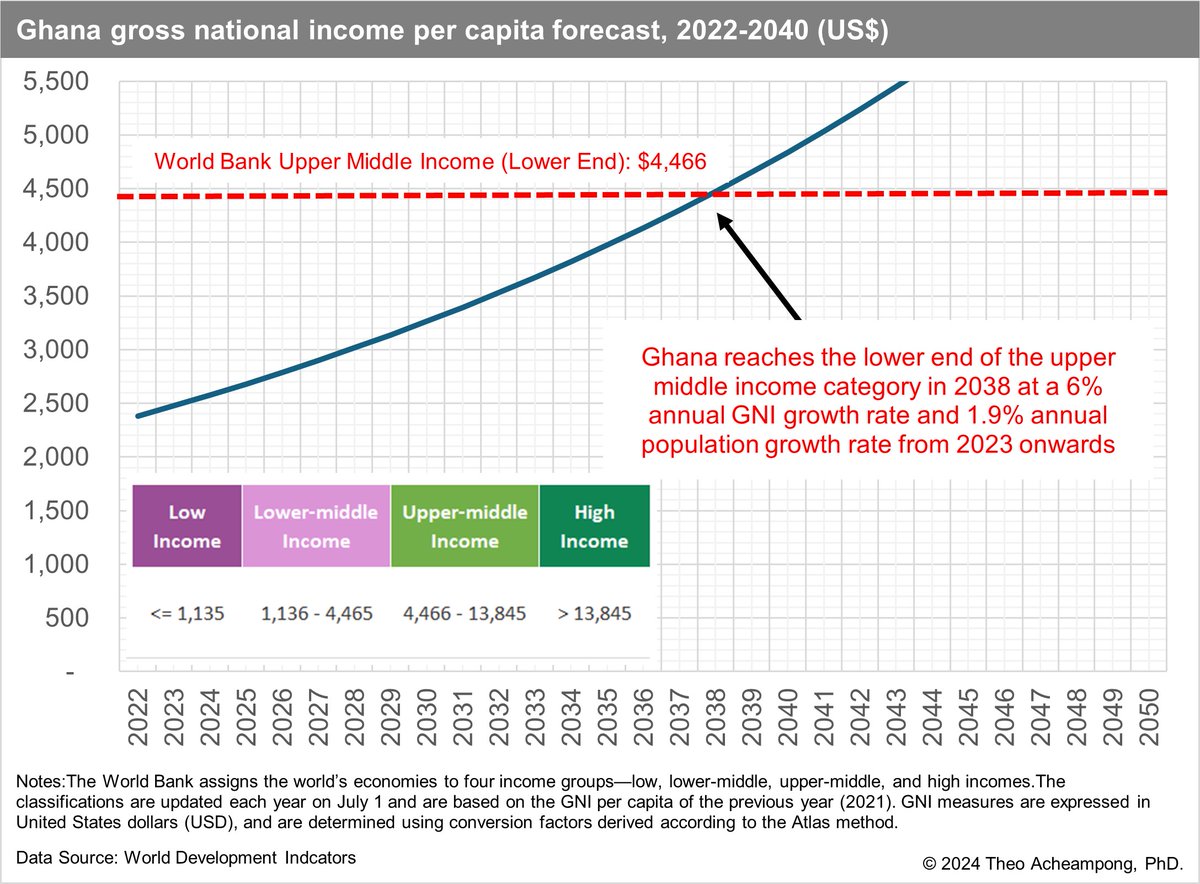
WHEN WILL GHANA BECOME AN UPPER-INCOME ECONOMY?
--------
In an interesting conversation with my good friend @villag_drunkard yesterday, he made the following interesting observation: “Ghana has a GDP per capita of US$2176. Its GDP growth rate is 1.5% and its population growth rate is 2.1%. The population of the country is 31.8 million. Calculate the years it will take to increase GDP per capita to US$4000. I am getting approximately -106 years, meaning at our current growth rate, it’s nearly impossible to double our GDP per capita in our lifetime. Are my numbers right?”
MY RESPONSE
You're right. Ghana has to do a consistent 7% per annum growth rate to get anywhere close to US$5,000 GDP per capita (that is, taking the total value of all goods and services produced in the country and dividing it by the population size in the year in question). To illustrate this further, I decided to pull data from the World Bank’s development indicators, do some projections and plot graphically to appreciate the challenging but not impossible task that our policymakers and Ghanaians must address to create economic growth and translate the gains into improved living standards.
SCENARIOS
In my projections up to 2050, I considered three scenarios: Scenario 1 assumes a 4% annual GDP/GNI growth rate, Scenario 2 assumes a sustained 5% annual growth rate, and Scenario 3 assumes a sustained 6% yearly growth rate. As the latest data shows, the annual population growth rate in all three scenarios is kept at 1.9%.
FINDINGS
1. At a 4% growth rate, Ghana’s gross national income per capita gets close, but it does not reach the lower end of the World Bank’s Upper Middle Income category of $4,466 GNI per capita. In essence, the country will remain a lower-middle-income country by 2050.
2. At a 5% growth rate, Ghana will become an upper-middle-income country by 2043.
3. At a 6% growth rate, Ghana will become an upper-middle-income country by 2028.
CONCLUSION
Some Chinese Miracle is needed to significantly improve economic well-being in the next 15 years. Ghana's GDP needs to grow by 7% to 10% annually to drastically reduce inequality.
First, a massive agricultural revolution and value addition (serious agribusiness) is needed, coupled with major public works programmes, especially transport infrastructure and connectivity (digitalisation).
But I worry that this may not be attainable, given the entrenched nature of our Fourth Republican politics.