MIT is offering FREE Coding Courses 🔥🔥
💻 Computer Science
🔥 Machine Learning
✨ Data Science
📈 Data Analysis
🕹️ Game Design
🧠 Computational Thinking
📱 Mobile UX
🧑💻 Engineering Management
Open this to not miss your chance 🧵👇
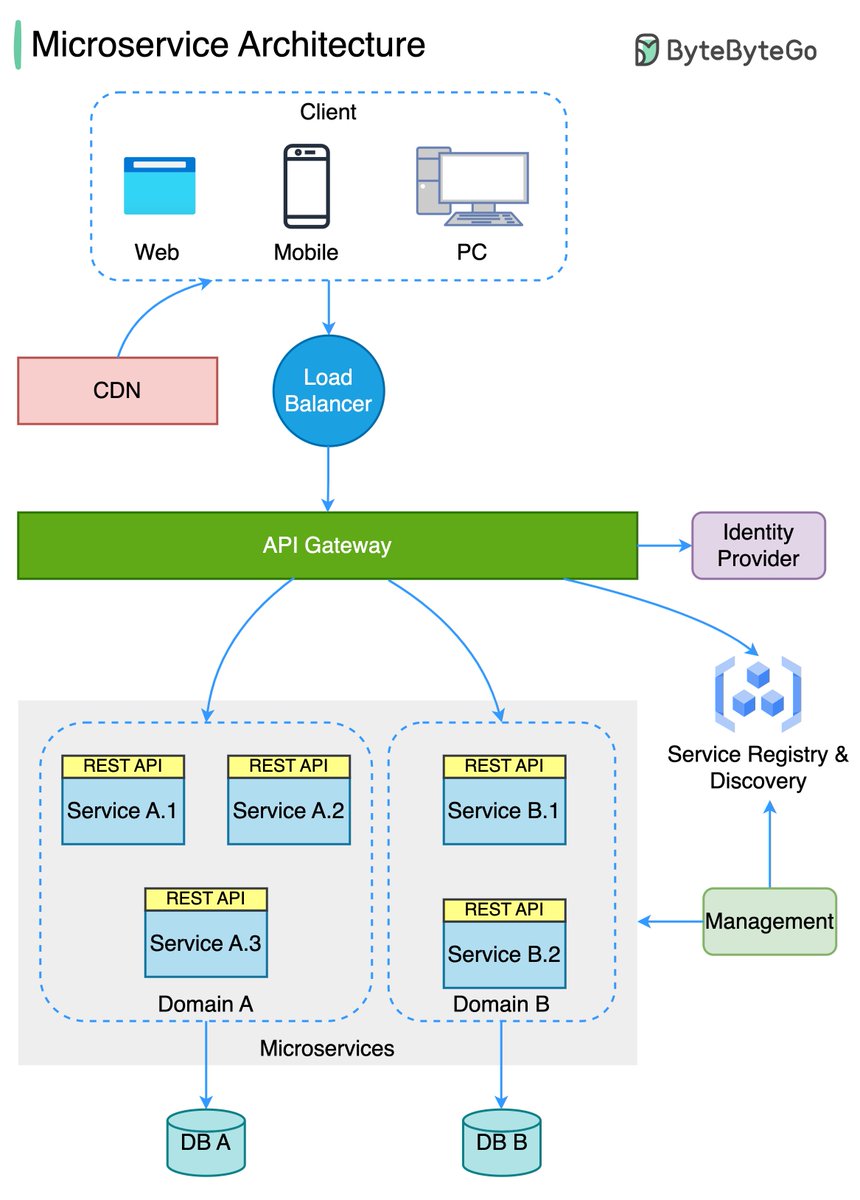
What does a typical microservice architecture look like?
The diagram below shows a typical microservice architecture.
🔹Load Balancer: This distributes incoming traffic across multiple backend services.
🔹CDN (Content Delivery Network): CDN is a group of geographically distributed servers that hold static content for faster delivery. The clients look for content in CDN first, then progress to backend services.
🔹API Gateway: This handles incoming requests and routes them to the relevant services. It talks to the identity provider and service discovery.
🔹Identity Provider: This handles authentication and authorization for users.
🔹Service Registry & Discovery: Microservice registration and discovery happen in this component, and the API gateway looks for relevant services in this component to talk to.
🔹Management: This component is responsible for monitoring the services.
🔹Microservices: Microservices are designed and deployed in different domains. Each domain has its own database. The API gateway talks to the microservices via REST API or other protocols, and the microservices within the same domain talk to each other using RPC (Remote Procedure Call).
Benefits of microservices:
- They can be quickly designed, deployed, and horizontally scaled.
- Each domain can be independently maintained by a dedicated team.
- Business requirements can be customized in each domain and better supported, as a result.
Over to you: 1). What are the drawbacks of the microservice architecture?
2). Have you seen a monolithic system be transformed into microservice architecture? How long does it take?
--
Subscribe to our weekly newsletter to get a Free System Design PDF (158 pages): https://t.co/FIzCeaWsZV
Top 4 Forms of Authentication Mechanisms
1. SSH Keys:
Cryptographic keys are used to access remote systems and servers securely
2. OAuth Tokens:
Tokens that provide limited access to user data on third-party applications
3. SSL Certificates:
Digital certificates ensure secure and encrypted communication between servers and clients
4. Credentials:
User authentication information is used to verify and grant access to various systems and services
Over to you: How do you manage those security keys? Is it a good idea to put them in a GitHub repository?
—
Subscribe to our weekly newsletter to get a Free System Design PDF (158 pages): https://t.co/FIzCeaWsZV
Seluruh negara di dunia kini menghadapi tantangan yang tak terkira dari berbagai aspek kehidupan global. Ada tantangan dari perubahan iklim, krisis pangan, krisis energi, resesi ekonomi, disrupsi teknologi, dan tak sedikit pula negara yang masih terseok-seok memulihkan diri dari dampak pandemi.
Di tengah berbagai tantangan dan situasi itu, Indonesia tetap melangkah ke depan bersama-sama. Berat sama dipikul, ringan sama dijinjing. Seberat apapun tantangan dan rintangannya, dengan ideologi Pancasila sebagai pondasi, kita bergandeng tangan dan tetap bersatu menuju Indonesia maju.