In his final moments, Henry Nowak told police officers nine times “I can’t breathe” and four times that he had been stabbed.
In response police officer dragged him across the gravel, handcuffed and read him his rights.
It was the last thing Henry heard before he died.
There have been a few key changes in crypto market structure.
I've written about this topic before but I found myself carrying some stale epistemological baggage about how the market used to be versus what it is at the moment, so thought I'd share.
1. More coins than ever before and the barrier to creating new coins has never been lower.
2. More competition for the hot ball of money (AI, semis, tech, even commodities) and instruments like 0DTE options - all of which are very attractive to normies.
3. Change in participant type and sophistication - ETFs, more tradfi shops, suits etc.
4. Normie flows that used to concentrate around a few CEXes and a limited token set have been fragmented by the infinite listings and existence of the trenches.
There are fewer normie flows, they're spread too thin, and it's difficult to come back to the casino if you get dumped on for holding longer than 15 seconds.
The main attractor to crypto used to be outsized, long-lasting, and well-distributed trend and momentum effects that were easy to access because there weren't that many venues or coins.
That's basically up only/alt season i.e. multi-month periods that were responsible for a disproportionate amount of a crypto trader's lifetime P&L.
A rising tide lifting all boats is an overused but appropriate analogy - it didn't really matter what coins you bought.
If you got the broader market conditions right, you'd enjoy significant uplift and basically get bailed out even if you made bad picks.
In the current paradigm you can't afford to make bad picks.
To be precise: in previous cycles if you got the conditions right but the assets wrong, you'd still make money but underperform. In the current cycle (even from the most recent BTC run) if you got conditions right but the assets wrong, you got shafted.
So asset selection went from a nice-to-have enhancer to one of the main drivers of returns, even if BTC is going up.
That's a pretty significant departure from what we've dealt with in the past
This type of dispersion is a symptom of the market maturing.
I think that's a net good thing and is likely to incentivise more intelligent token design, less ghost chain VC slop etc.
But that's a forward-looking view, and at the moment we're trapped in this awkward transition phase where the old rules don't really apply but we haven't figured out a new framework yet e.g. top N coins by market cap are still mostly shit vs quality.
Maybe I'm wrong and everything changes and we go back to the market-wide altseason paradigm when conditions are right. This could all be cyclical, but I think that's less compelling than before given the dispersion we saw on the way up too vs just to the downside.
I think it's a good time (especially with other markets and asset classes going crazy) to revisit where crypto sits in the speculative stack and how to approach it as the market is changing.
Cheers.
If you trade when you shouldn't you'll generally lose money.
In most cases identifying when you shouldn't trade is simple.
But that judgment gets clouded if you're tilted, feeling FOMO, bored, and a bunch of other external factors.
It's a bit like post nut clarity: as soon as you're out of it you can't believe you thought it was a good fill.
Traders try to mitigate this behaviour via detailed entry checklists but they're often too long or too vague to be useful.
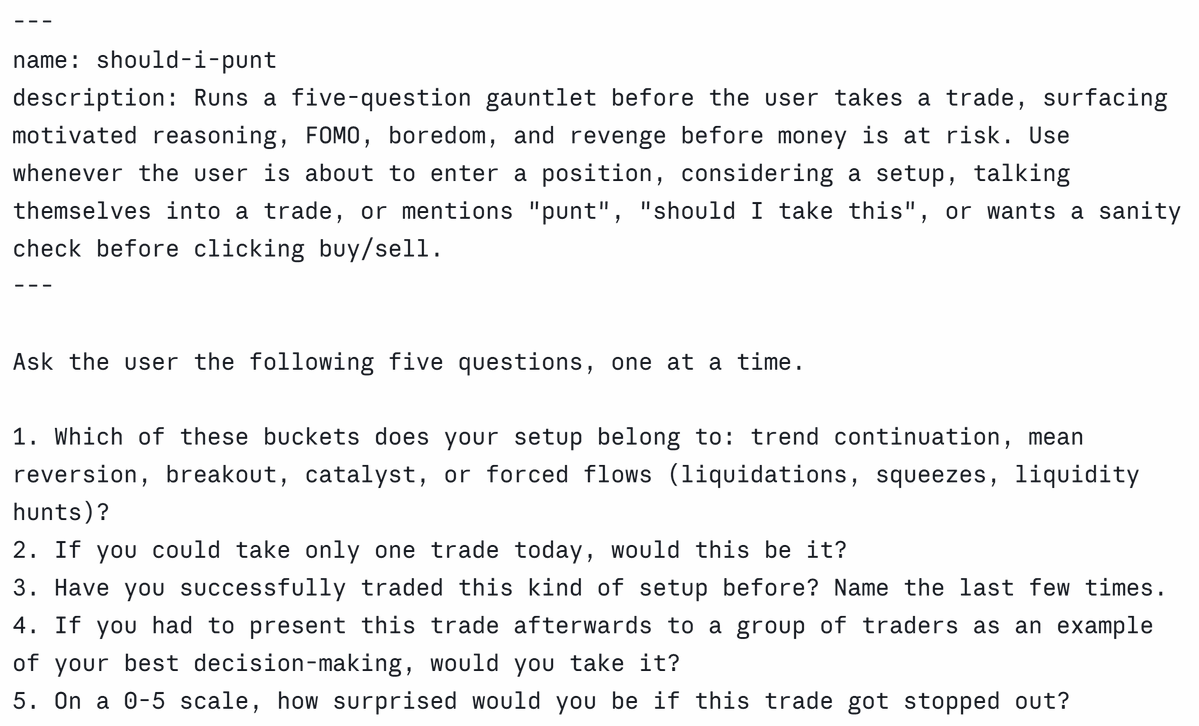
So here's an extremely simple checklist: should-i-punt. Run through it in your head before any trade, or install it as a skill if your LLM psychosis is advanced enough and you've already built 14 broken dashboards.
Trading is hard enough as it is; don't make it harder by dragging down your PnL with unforced errors.
The universe guarantees you'll improve if you keep trying. The universe doesn’t reward talent, luck, or intelligence first , it rewards relentless consistency
18 videos all for Free covering
-Auction Market Theory
-Orderflow
-Vwap
-Open Interest
-Footprint
-Execution
-Etc.
If you want me to start making videos again let me know in comments. Most of these are from 3-5 years ago
https://t.co/MS63YnvIbW
7 minutes after you finish studying, your brain quietly runs a file-transfer process. Columbia scientists caught it on a brain scan, and repetition is what speeds it up.
In the study, 29 people went into an fMRI machine and saw flashcards pairing words with pictures. Some flashcards appeared once. Others appeared three times. After the flashcards, participants closed their eyes and rested for 7 minutes, still in the scanner, while the researchers watched what their brains did next.
The hippocampus (a seahorse-shaped chunk deep in your brain that handles new memories) replayed the flashcards at the same rate whether people had seen them once or three times. The scan showed no difference between the groups in that region.
Three other brain regions went the other way. All three belong to your brain's long-term storage network, the system that keeps memories around for years. Those regions replayed the repeated flashcards way more than the once-seen ones. One of them also started firing in sync with the hippocampus more often when replaying the repeated cards, like two colleagues confirming a file had been saved.
Textbooks describe memories moving from the hippocampus to long-term storage as a slow process, one that takes weeks, months, or sometimes years. This study caught that process starting within the first 7 minutes after closing your eyes, with repetition speeding it up dramatically.
When a flashcard had been shown three times, the long-term storage regions replayed the most recent viewing. Your brain treats each repetition as an update.
The hippocampus was doing its own kind of work. For the flashcards people saw only once, the more the hippocampus replayed them during that 7-minute rest, the more likely people were to remember them on the test afterward. The hippocampus was picking up the slack for the weaker memories, while the long-term regions took over the stronger ones.
The paper was edited by Robert Bjork at UCLA, the guy who coined "desirable difficulties," the idea that when learning feels harder in the moment, the memory tends to stick longer. This study adds a mechanism. Repetition works by moving a memory, fast, in the minutes right after you stop looking at the thing.
$BTC
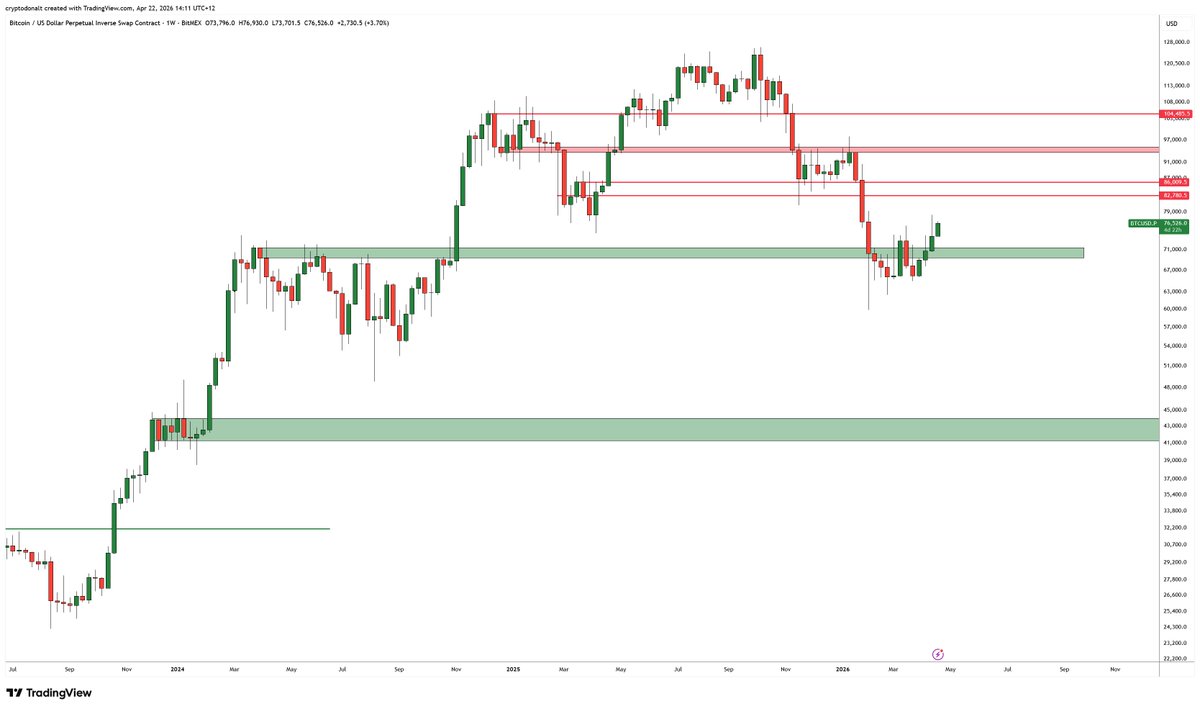
I don't see why so many are bearish here based on technicals
You can easily justify being bearish because of geopolitics
But chart wise, really doesn't look bad
I remain cautiously optimistic about BTC price
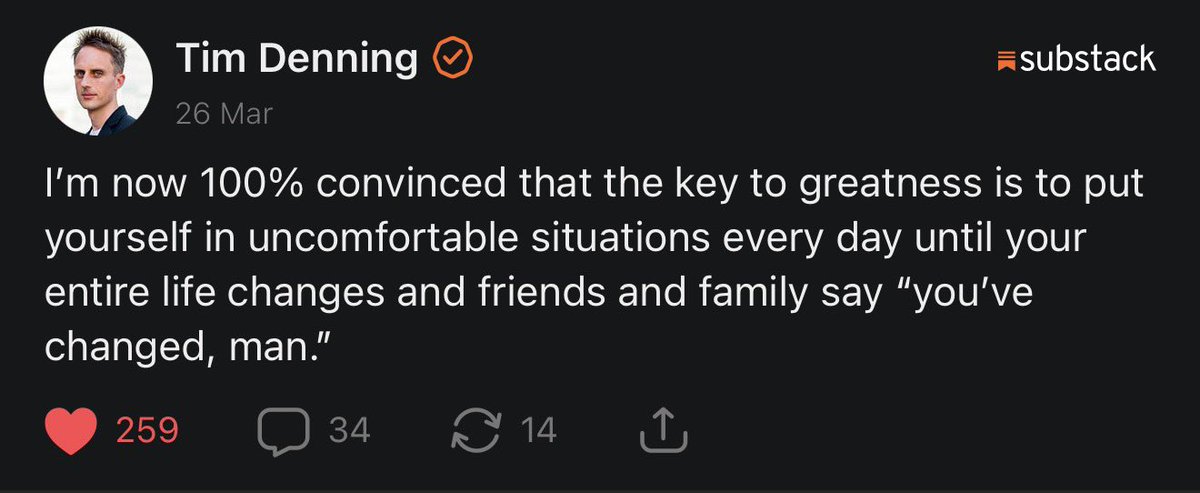
The greatest trait you can acquire is to work with tremendous intensity on things that matter to you, and more importantly, be strangely unbothered when those things don't work out.
"Crypto is the dumbest market in the world"
Scott Phillips (@ScottPh77711570) runs HyperTrend — $20M of his own capital, one losing year in six.
His edge? Picking the table big firms can't sit at.
"There's no second-best counterparty in crypto. You see crime, you run towards it — crime is the foundation of edge."
We cover:
- Why crypto still has edge in 2026 — even when your uncle is talking about Bitcoin at Thanksgiving
- The simple rules (buy 20-day highs, top-20 coins) that print through any market
- Why stacking trend + momentum + carry gets you there from a spreadsheet — no automation required
- Price-insensitive buyers (Saylor), price-insensitive sellers (North Korea) & why both are permanent alpha
- The 90-day Binance listing short — an edge hiding in plain sight in market maker contracts
- Why most shit coins trend to zero — and how to trade the ones that don't
- Building a tokenized, permissionless DeFi hedge fund on hyperliquid — 2 & 20, fully on-chain
- Why the best quant firms are run by near-non-verbal autists with one translator
Thank you so much @ScottPh77711570 for coming on the pod!
Highlights:
01:04 Table selection and the math of competitive alpha
06:21 Why basic trend following yields outsized Sharpe in crypto
08:49 Why market inefficiency persists despite institutional inflows
14:58 Price insensitive buyers: Cults, VCs, and North Korean hackers
17:17 Factor analysis and the size-decay effect in shitcoins
25:40 The structural edge in mid-frequency crypto strategies
32:43 Tokenized DeFi vaults and on-chain hedge fund governance
40:43 Designing a robust portfolio: Equal weighting vs. MVO
44:21 Sourcing alpha from ghost chains and VC exit liquidity
49:58 Exploiting market maker contracts and post-listing drift
53:55 Operational alpha: Managing margin and manipulated funding rates
01:01:13 Shifting from quant to CEO
01:11:28 How to bridge the mentorship gap with elite traders
01:22:38 Building network triads: The secret to compounding social capital
01:29:23 Why 10x goals require total identity transformation