Mathematicians are now hiding their research ideas out of fear of AI 😀
~ Terence Tao
"now, mathematicians are hiding their problems. they used to share very openly all their promising research directions and now they're afraid that if you do that, someone with an AI will input their research ideas into a frontier model and rush out some people before they can finish their work."
----
Full video on "SAIR" YouTube channel, (link in comment)
@aliasaria Thank you so much, Ali! That really means a lot coming from you. I’m incredibly grateful for the opportunity and excited about what we’re building at Transformer Lab.
Looking forward to doing some great science together!
We’re thrilled to welcome Ethan Thompson (@EthanT1452) to Transformer Lab as Lead Research Scientist in Quantum Science.
Ethan joins us from a rich background, including the Perimeter Institute, where he worked on nonlocal QFT with John W. Moffat, professor emeritus of physics at the University of Toronto.
Ethan will lead our work with physicists and quantum research groups applying Primus to some of the hardest problems in science.
Read the full announcement: https://t.co/Nu0wrnkajH
I am so excited to be joining the team! I’m looking forward to working with researchers on some of the hardest problems in science, advancing what we can accomplish with AI, and helping shape the future of scientific research.
Thanks for the warm welcome everyone!
We’re thrilled to welcome Ethan Thompson (@EthanT1452) to Transformer Lab as Lead Research Scientist in Quantum Science.
Ethan joins us from a rich background, including the Perimeter Institute, where he worked on nonlocal QFT with John W. Moffat, professor emeritus of physics at the University of Toronto.
Ethan will lead our work with physicists and quantum research groups applying Primus to some of the hardest problems in science.
Read the full announcement: https://t.co/Nu0wrnkajH
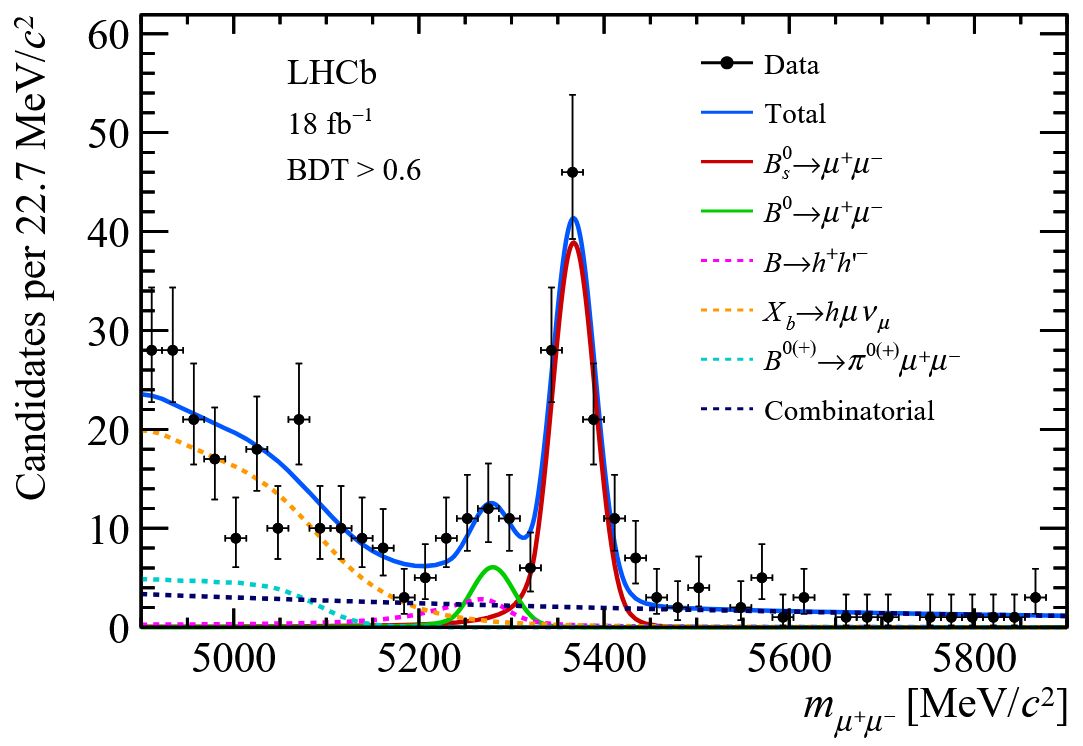
Evidence for the decay B⁰→μ⁺μ⁻ ! The LHCb experiment sees the rarest B meson decay ever !
In the image below the big peak is Bₛ⁰→μ⁺μ⁻ . That was well known for 10 years. But to its left is the small contribution from the B⁰. One in 10 billion B⁰ proceed to two muons.
“Sensible mathematics involves neglecting a quantity when it turns out to be small, not neglecting it just because it’s infinitely great and you don’t want it. … That will mean some very drastic change. No simple change will suffice.”
— Paul Dirac on renormalization, 1975
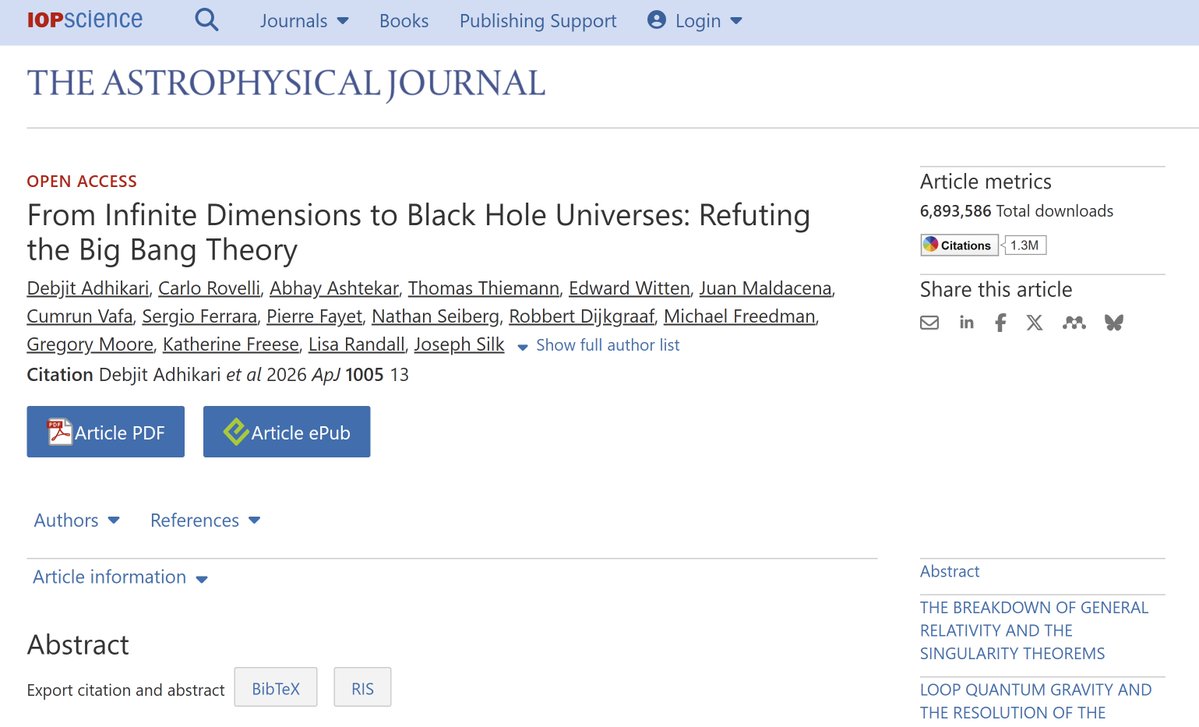
presumably the first author of the paper has set up an entire fake domain to make their "big bang refutation" appear as if it was published in a peer reviewed journal (https://t.co/A6v8zFKctl). hoping to fool who or what I wonder?
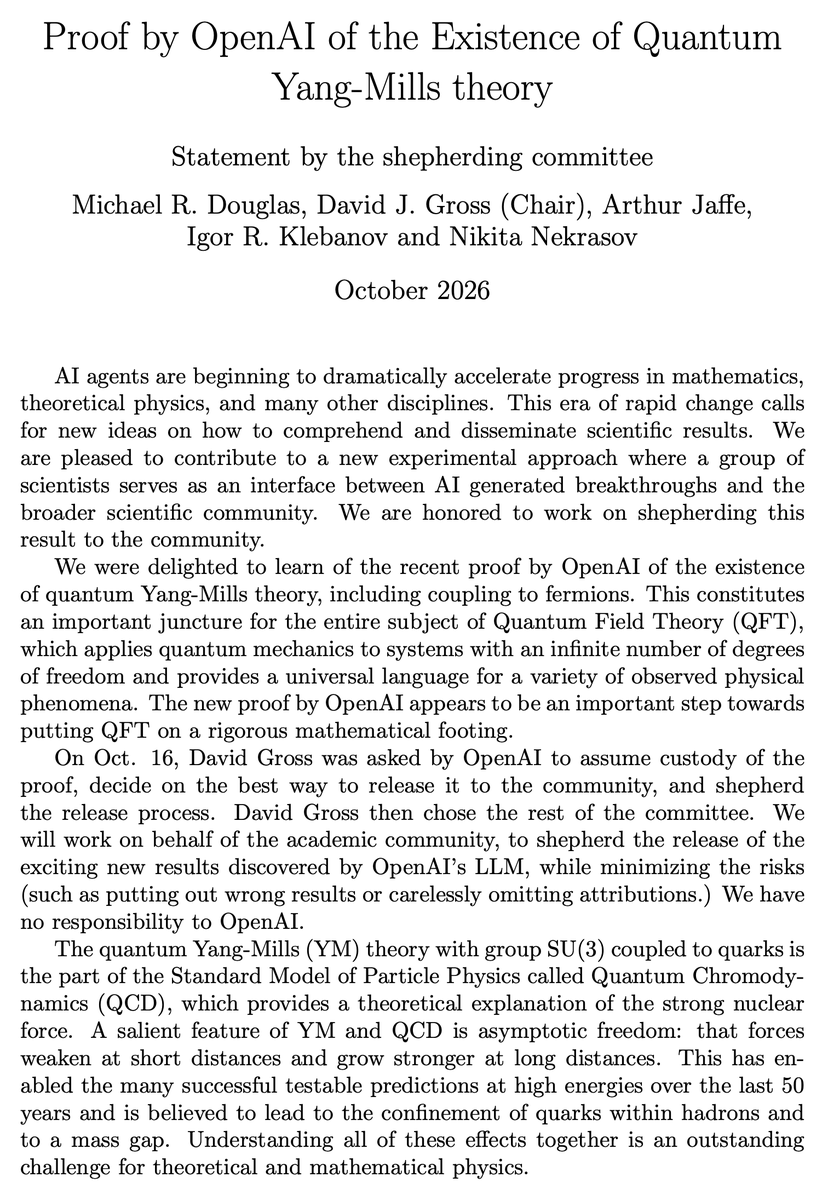
Statement of Yang-Mills Working Group, a scientific collaboration to interpret AI result related to the existence of quantum chromodynamics & completions of the Standard Model, including a subproblem proving the existence of the Quantum Yang-Mills theory. https://t.co/j8O8TUjSD3
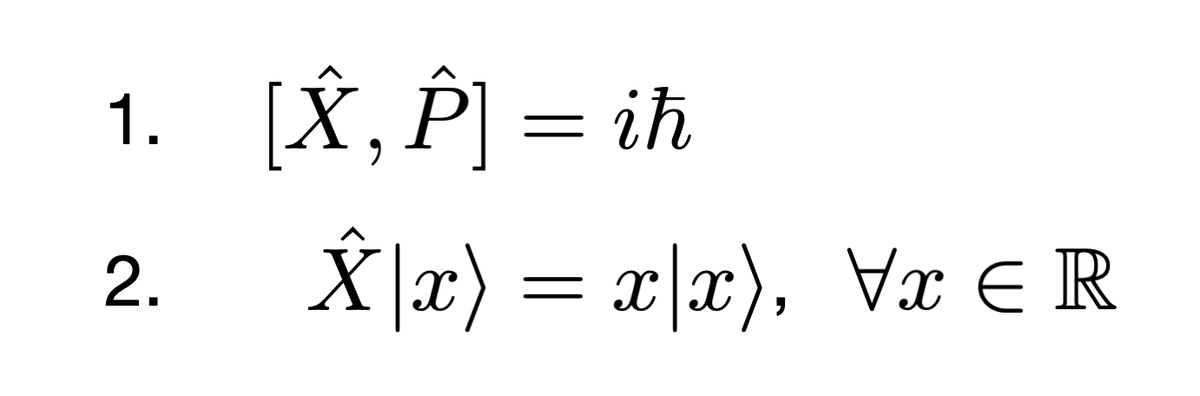
To sharpen students’ awareness of the mathematical fine print in quantum theory, I took these two assumptions, both commonly found in quantum mechanics textbooks, and used them to show in just two lines that 1 = 0. It is fun to see how genuinely puzzled students are by this—and how few people spot the problem. It makes for an illuminating teaching moment.
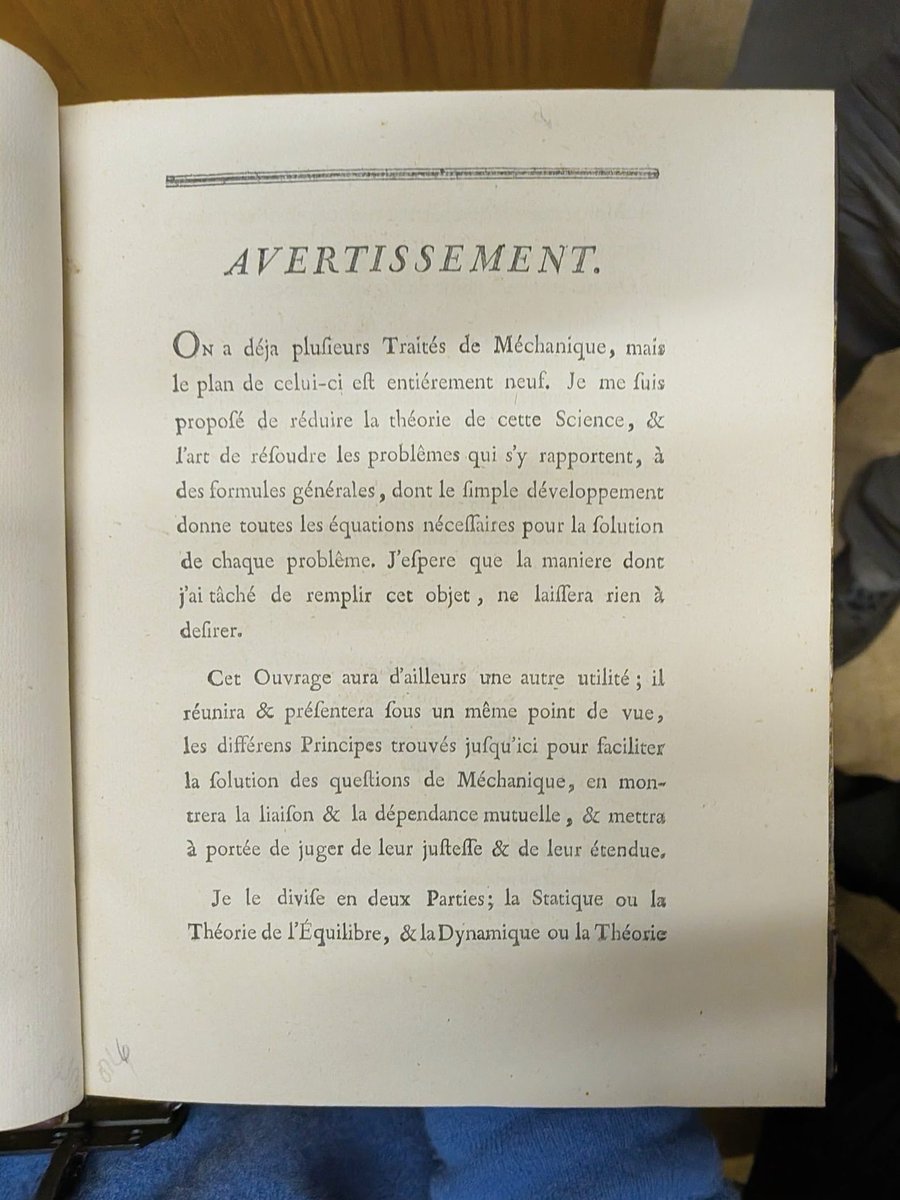
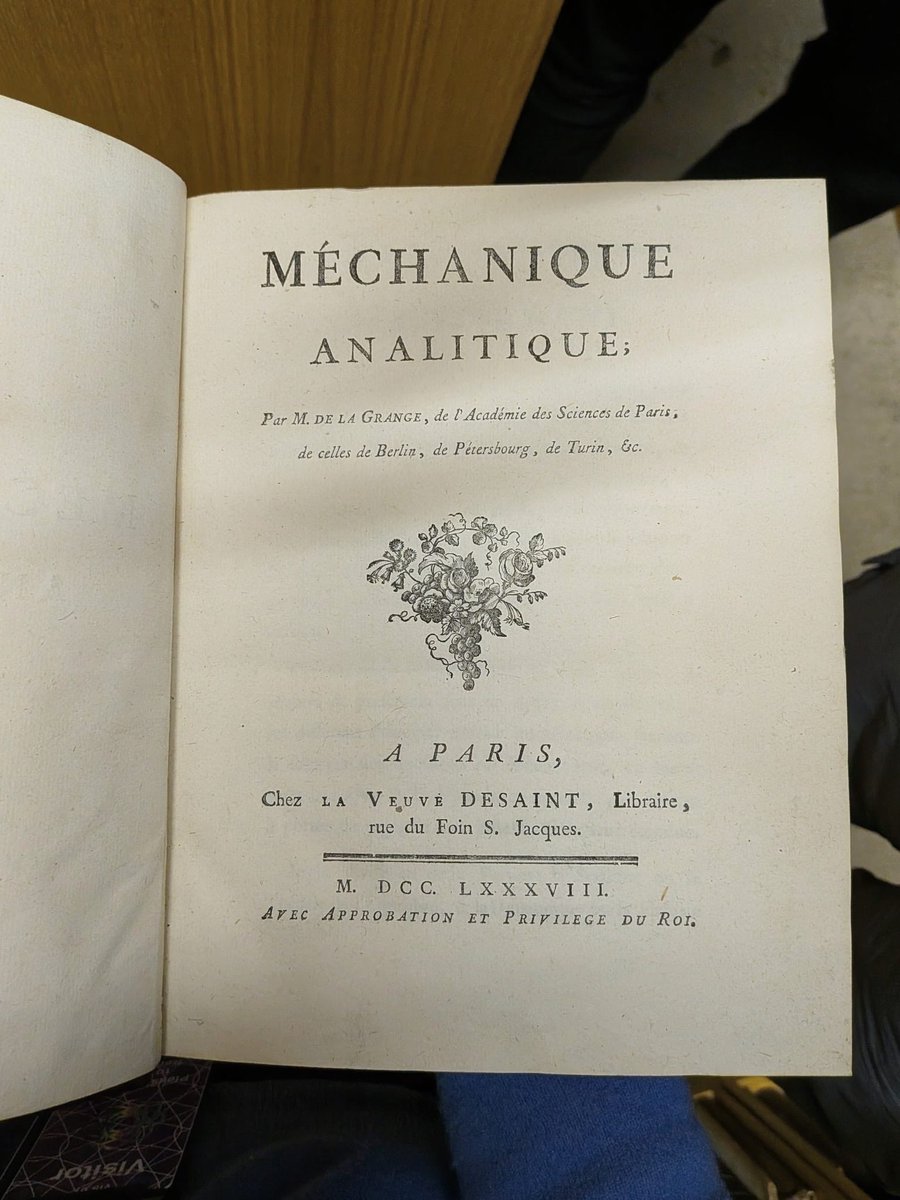
Lagrange in the foreword of his book "On ne trouvera point de Figures dans cet Ouvrage."
Translation: "For those seeking figures: this is not a colouring book"😂
(a) GR does not say faster than light travel is impossible.
(b) Even if it did, GR almost certainly is not fundamentally correct.
But thanks for asking.
https://t.co/viZXjERb8J
We want to support the mathematics community in turning progress in AI into deeper human understanding and new discoveries. To support that goal, we are contributing $5 million to a new Simons Foundation initiative to help mathematicians examine, understand, and build on results produced by AI, including the results we recently published.
The funding, managed and awarded by the @SimonsFdn will support workshops, conferences, and special programs. We will also provide access to our models and computing resources to Simons Foundation-supported researchers.
this is pure f*cking treasure
a Stanford AI research group just figured out how to run Claude Opus 5.5 and GPT-6.1 Sol as one team, and it breaks straight through the search scaffolding wall
most developers combine frontier models in one of two ways:
-> chain prompts inside a single context window and burn tokens on bloat
-> hardcode an evolutionary loop and freeze the models into search rules that go stale within 5 iterations
Stanford deletes the human-designed scaffolding and splits the stack in two:
> search director: Claude Opus 5.5 plans the search on top of a persistent idea-graph, where MAP-Elites and MCTS collapse into single Cypher queries
> candidate proposer: GPT-6.1 Sol explores high-entropy code variations inside isolated sandboxes
> no context bleeding: every session resets after each iteration, the graph keeps the lineage
> evaluator isolation: candidate code never touches the scoring process, so reward hacking and test leakage die on arrival
> meta-agent distillation: an offline pass pulls out verified lessons and updates search guidance across every branch
and the numbers beat the standard discovery baselines:
> 3.2x lower model spend than fixed evolutionary frameworks
> 1st place across 7 competitive AtCoder heuristic contests against human competitors
> above published SOTA on Anthropic's kernel builder and 11 mathematical optimization tasks
> 0% reward hacks: candidate-controlled metric tampering is gone
Opus directs the graph. Sol explores the code.
stop writing rigid search harnesses. let the frontier models own the discovery loop.
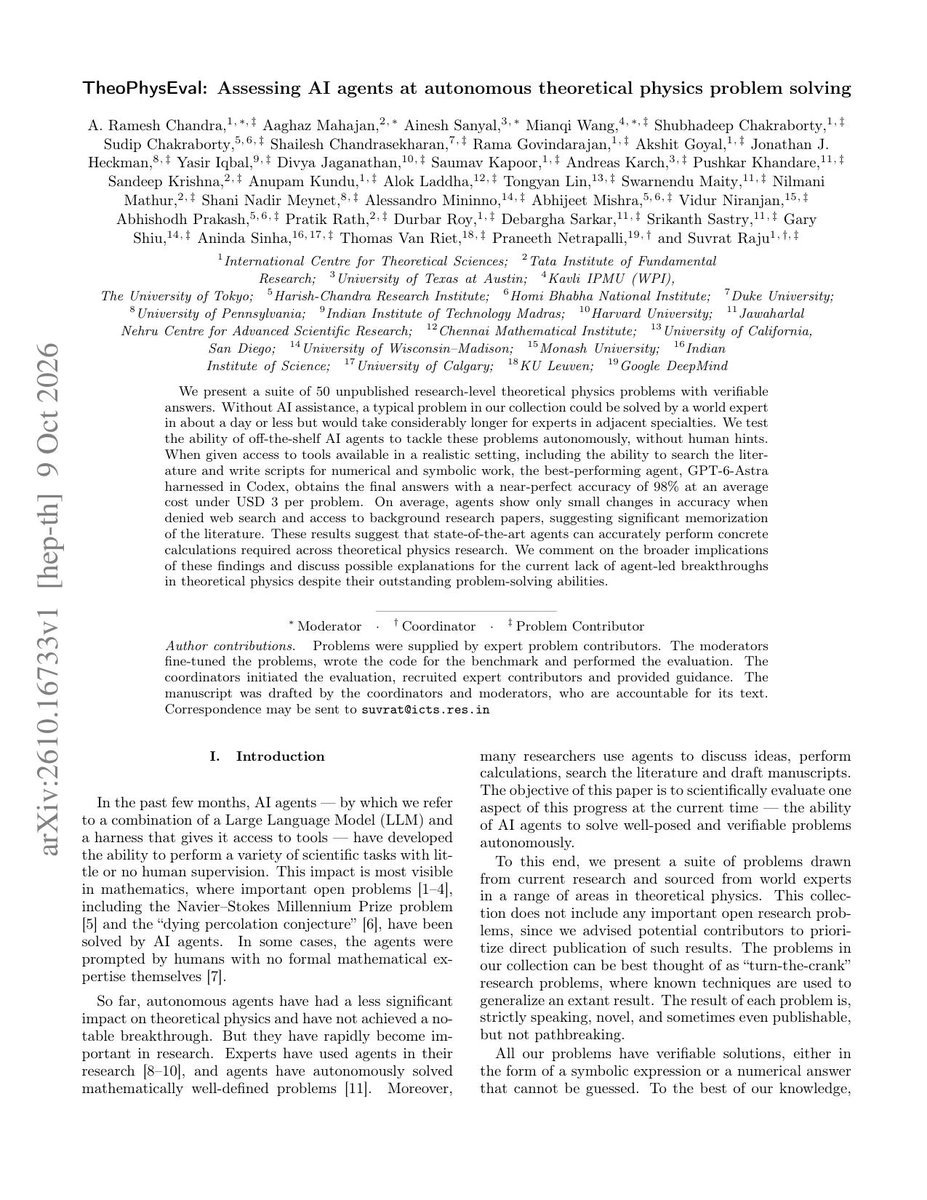
From my old high school friend and theoretical physicist Suvrat Raju who said he couldn’t sleep for a few nights after pondering the implications of these results.
https://t.co/i5zXwM30SD