There are occasions when withdrawal achieves what continued engagement cannot.
Absence denies the adversary the opportunity to measure one's intentions, provoke a reaction or exploit an unnecessary movement.
It allows time to expose weaknesses which confrontation might otherwise conceal and importantly, it permits the consequences of earlier actions to mature without interference.
There is a profound distinction between abandoning the field and recognising that one's continued presence upon it serves no further strategic purpose.
From tomorrow, I shall be systematically removing publications from download links.
If you want anything, you'd better get your skates on, look through my posts made over the course of last 18 months and download what you require, without delay.
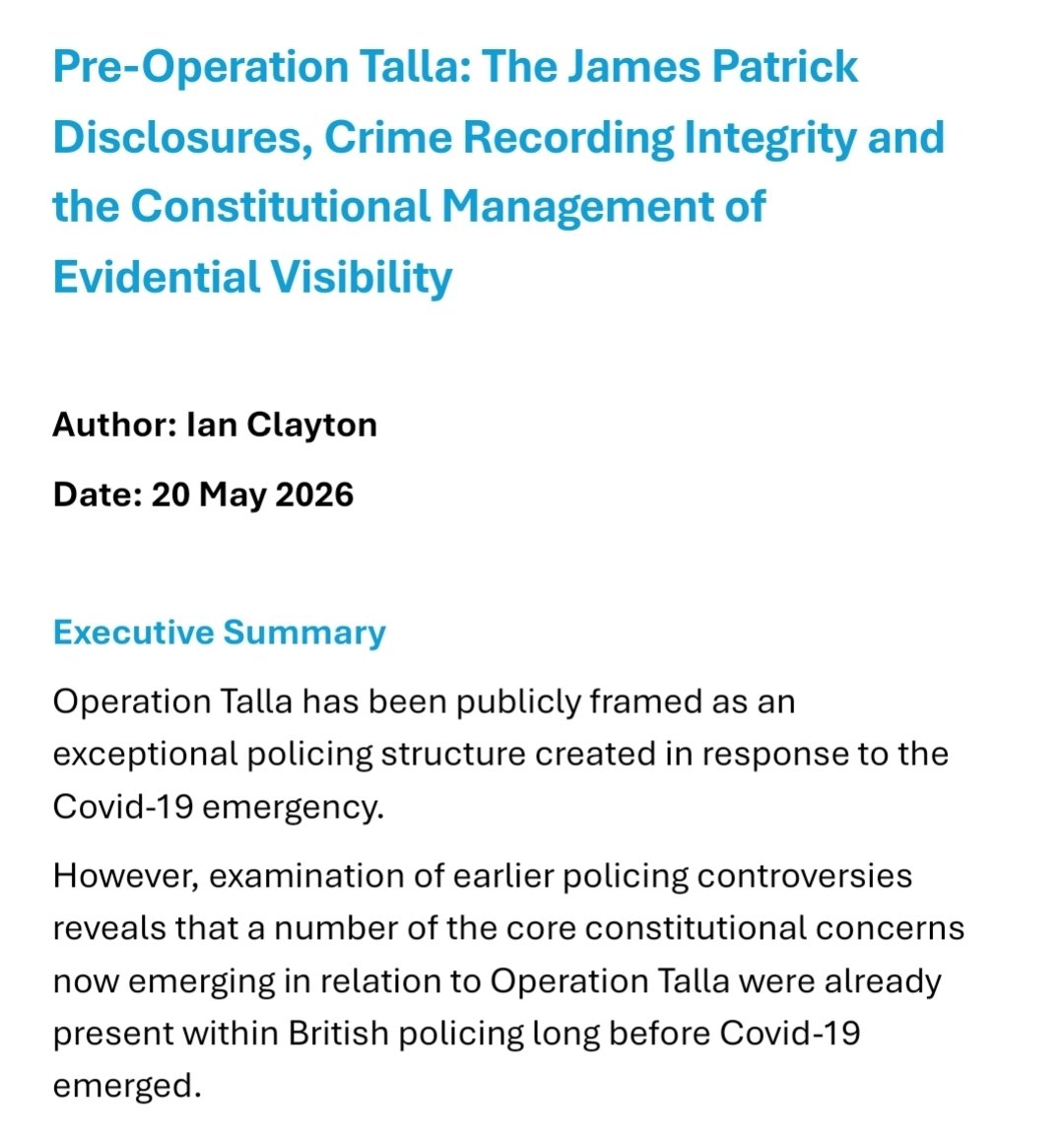
I published and first shared this paper a little more than two months ago. Today may be an appropriate day on which it should again be shared.
Read and download it here:
https://t.co/3V3IKkl3g7
I published and first shared this paper a little more than two months ago. Today may be an appropriate day on which it should again be shared.
Read and download it here:
https://t.co/3V3IKkl3g7
Throughout our investigation into Operation Talla, details of primary institutional evidence have been put to the relevant institutions themselves, requesting clarification, further particulars or explanations. Cooperation, however, has been, at best, minimal.
Obfuscation, circularity, reclassification of enquiries, vexatious labelling: these have become recurring features of our experience when seeking substantive answers.
The questions concern the institutions’ own records:
• what was decided,
• by whom,
• under what authority,
• communicated to whom,
• and with what consequences.
Where those records disclose guidance “to not record”, followed by an internal assessment that the guidance “has been a success”, the public is entitled to a clear account of precisely what was intended and achieved.
An institution may dispute our interpretation. It may identify missing context, correct an error or explain why a conclusion does not follow. We welcome that scrutiny. It is why the evidence has been put to those best placed to explain it.
An answer must address the evidence. Repeated referral elsewhere, reformulation of the question or criticism of the enquirer leaves the substance unresolved.
The cumulative concern now extends beyond the original decisions. It includes the willingness and capacity of the institutions concerned to account for them.
Public confidence depends upon demonstrable accountability: records produced, decisions explained, errors acknowledged and corrective action taken where required.
We will continue to place the evidence, the questions and the responses on the record and each answer received will be measured against the evidence and against the other responses.
@TheHonestDr was brought down by state operatives.
State weaponisation of the regulator was part of the CRN in December 2021.
And David's case was specifically referred to in my witness statement to the JR in June 2023 after the DMs showing a conspiracy against him were uploaded to the Met's upload facility by me.
I published and first shared this paper a little more than two months ago. Today may be an appropriate day on which it should again be shared.
Read and download it here:
https://t.co/3V3IKkl3g7
It was not the rejection of reports by the public which gave the game away - it was the intel recording
A report can be rejected as disclosing no criminal offence. That decision may be right or wrong, but it can be examined against the allegation, the evidence and the reasons recorded.
Intelligence recording raises a further question: What did the institution retain and for what purpose?
Where instructions direct that certain public reports be rejected whilst information is recorded through intelligence channels, the explanation cannot end with “there was no crime to investigate”.
The information still entered a policing system. Its classification, retention and possible use require an account of their own.
What was recorded - the allegation, the circumstances of the approach, the person reporting it, or some combination?
Was there an individual assessment? What justified the intelligence entry? Who could access it? Was it shared? What safeguards governed its retention and use?
These are distinct questions from whether or not the original allegation was substantiated.
Intelligence recording can be legitimate, but it does not, by itself, prove surveillance of lawful dissent or an improper purpose. Neither does calling something “intelligence” remove the need to explain the decision.
The Operation Talla material makes that distinction important: Rejection and recording were capable of occurring together.
That is the significance of the intelligence trail. It directs scrutiny beyond the public-facing outcome to what policing actually retained and did with what they retained.
A report rejected is one decision - Information retained as intelligence is another.
Both require a lawful basis and both must withstand scrutiny.
The civil servants camped at the BBC may explain the Hammersmith crime report being described by the BBC as "conspiracy laden." What was conspiracy laden about the 2400mg overdosing on HCQ RCT? Or the DNRs without consent? Or the midazolam without consent?
A COMPLETED LEGAL PROCESS DOES NOT, BY ITSELF, NECESSARILY ESTABLISH THE FACTS
A claim dismissed because it was brought too late is not necessarily a claim disproved by the evidence.
A review completed is not, merely by its completion, proof that all material information was considered.
A decision to take no further action is not automatically a finding that nothing happened.
These distinctions matter whenever an institution invokes legal process as an answer to factual questions.
The central principle is unequivocal:
No institution should present a procedural outcome as a factual determination which the process did not make.
That principle demands equal discipline from those challenging institutions.
An untested allegation remains an allegation.
An admitted document is not necessarily reliable.
An adverse judgment cannot be disregarded simply because it is unwelcome.
Fair procedures, admissibility rules, privilege and finality are intended to protect justice. Their proper application must be respected, but their consequences must also be described openly and honestly.
• What was decided?
• On what evidence?
• For what reasons?
• What remained outside the scope of the decision?
My new paper examines those questions through the principles of procedural fairness and candour:
“Here is why evidence and facts should never be subservient to legal process”
Legal process must enable evidence to be tested fairly. It must never be invoked to make an institutional account appear more conclusively established than it truly is.
Read and download the paper:
https://t.co/lThBftSlYL
Gove Ex-Partner Receiving Death Threats Since Charges Made Public
Lola Salem, Michael Gove's ex-partner, who was charged with serious criminal offences in May, has been receiving death threats since the news of the charges was made public.
A source close to Ms Salem - who cannot be identified - told Hunt & Gather that the threats had come during 'a rocky few days' and that Ms Salem reported the threats to the Metropolitan Police on Saturday.
News of the five month old charges first broke on 10 October in an article by Gordon Rayner posted on the Telegraph’s website at 7am. The article was later removed and The Telegraph has not covered the story since.
Hunt & Gather asked the Metropolitan Police whether it was investigating threats made against Ms Salem.
Metropolitan Police press officer Iwan Stone said: 'Would it be possible to get a copy of your press pass? I am afraid we can only respond to enquiries from accredited journalists.'
There is no legal requirement for a journalist in the UK to hold a press card. Cards are issued through 22 approved 'gatekeepers', which include the BBC, ITV, Sky News and GB News.
Hunt & Gather's founder worked at ITN and ITV News for 20 years, as a field producer and then as a regional reporter, often covering court cases.
Our source indicates Ms Salem is safe and well. She denies the charges.