. @RentworksEA stands alone as being innovative and dynamic in the provision of rental solutions. It is through their comprehensive industry knowledge that makes them unique in their field. #RentWithRentworks
See more 👉 https://t.co/ORSItWjAke
Our generation is about to experience the biggest wealth transfer in history.
Anyone without a financial plan is will be left behind.
Some topics to focus on so you don’t miss out:
I recently watched the interview by Julians Amboko with KCB's Group CEO, Paul Russo. Julians is one of the best business journalists in the country.
A THREAD 🧵
Story Thread.
When this ring-light influencer asked me to take her out, my next question should have been, “What is your preferred date location?” I should have asked if she fancied a coffee date, a free-event date, a full-chicken date, or a 3-fish-eating date at the Osumos.
Anyway, today, I am tackling carbon credits. For the second time. A slight repetition for you guys to understand how Ruto is selling us or helping us. But I believe in the former. Let's always lean on the truth. No matter the consequences.
Carbon Credits.
A Thread.
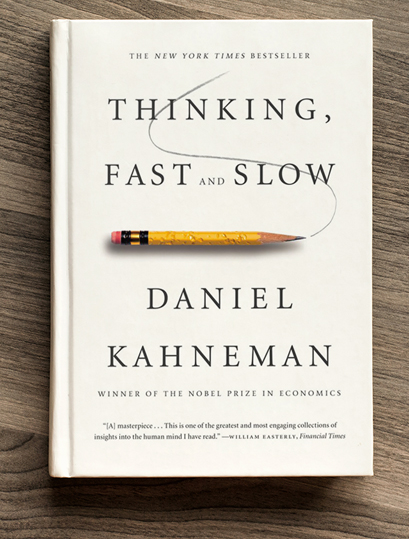
1. Thinking, Fast and Slow
The most comprehensive book on human psychology and decision-making.
Many other books are based on this classic written by Nobel Memorial Prize Winner Kahneman.
The main idea is to explain the decision-making process using two different systems.
If you decide to read two pages of a great book this weekend.
Here you go.
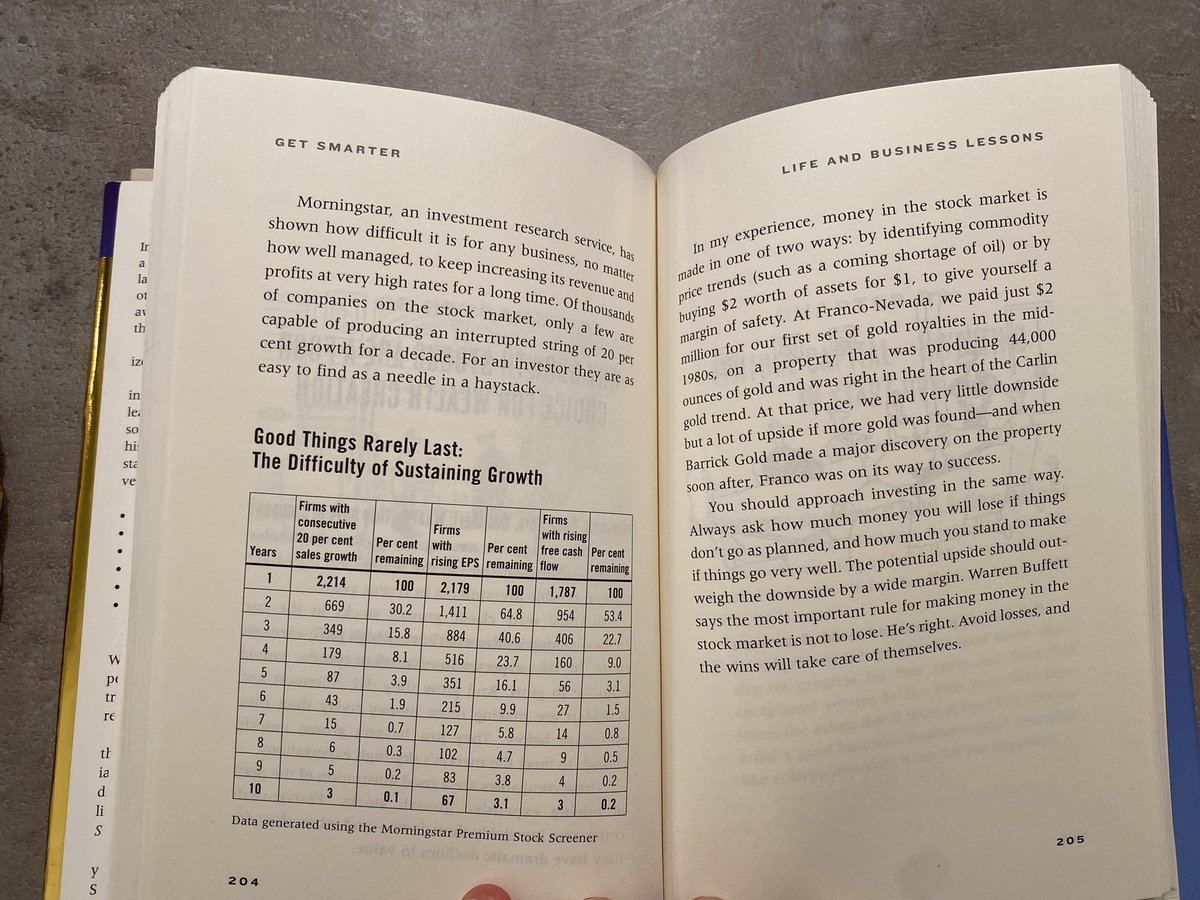
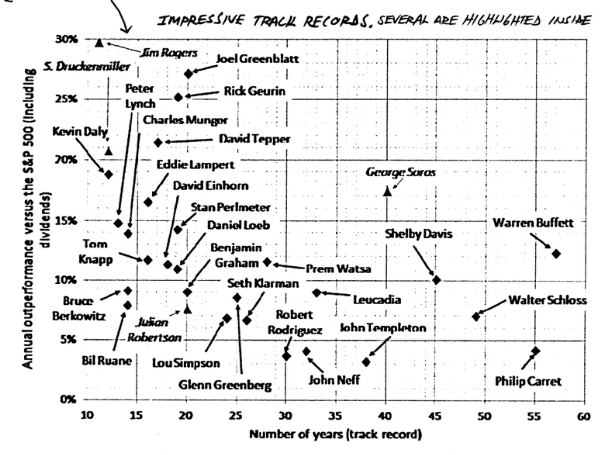
They did a research which shows how difficult it is to keep increasing company’s revenue and profits at very high rates for a long time.
Thank you Mr. Seymour Schulich
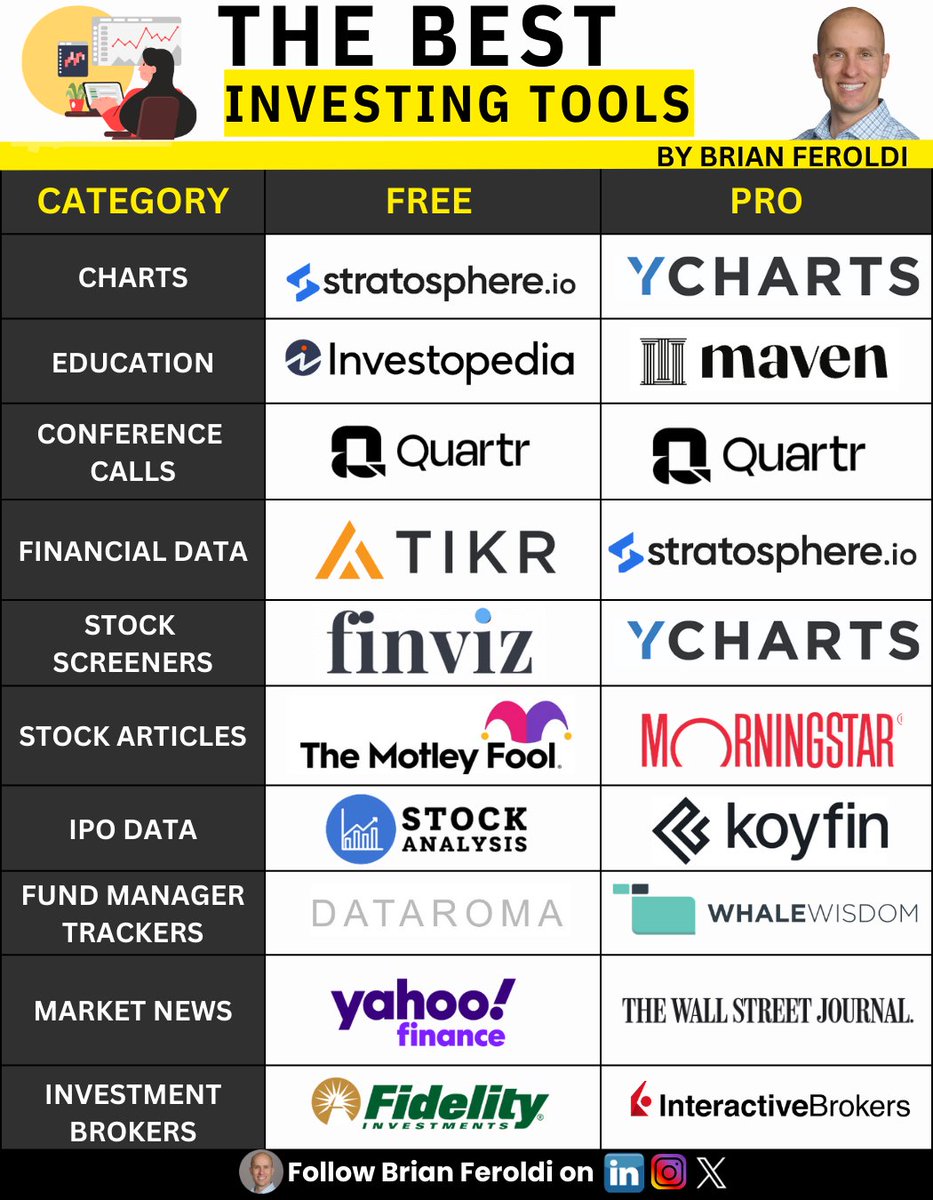
The best investing tools on the internet:
Free & Pro (Paid)
Investors are spoiled.
We have access to information that would have cost thousands just a few decades ago.
Here are the best tools I've ever found:
📊 Charts:
FREE: Stratosphere
PRO: YCharts
🏫 Education:
FREE: Investopedia
PRO: Maven
📲 Conference Calls:
FREE: Quartr
PRO: Quartr
🔢 Financial Data:
FREE: Stratosphere
PRO: Koyfin
💸 Stock Screeners:
FREE: Finviz
PRO: YCharts
✍ Stock Articles:
FREE: Motley Fool
PRO: Morningstar
💰 IPO Data:
FREE: StockAnalysis
PRO: Koyfin
🔎 Fund Manager Trackers:
FREE: Dataroma
PRO: Whale Wisdom
📰 Market News:
FREE: Yahoo Finance
PRO: Wall Street Journal
🖥 Investment Brokers:
FREE: Fidelity
PRO: Interactive Brokers
NOTE: Many of these tools have both free & paid versions, so many straddle both categories.
I keep a list of all the best investing tools, books, podcasts, & resources I've ever found in a Google sheet.
Want free access?
Get it here: https://t.co/c1plnrkQ5w
Follow me @BrianFeroldi for more content like this.
What's your favorite investing tool?
Many strategies can outperform the market.
The 4 best-known are:
- The High-Quality Business Strategy
- The Special Situations Strategy
- The Growth at a Reasonable Price Strategy
- The Classical Value Strategy
Here are some of my Thoughts on these Strategies👇
Overview:
The (Concentrated) High-Quality Business Strategy is what most investors associate with Buffett.
It's probably the dominant strategy among value investors today. At least if we look at the big players.
You own a concentrated portfolio of 5 to 8 stocks consisting of high-quality businesses. High quality means growing cash flows, competitive advantages, and a strong balance sheet.
The Special Situations Strategy was popularized by Joel Greenblatt's book "You can be a Stock Market Genius."
It's about finding situations where businesses are misprized due to different circumstances.
Those could be spin-offs, restructurings, mergers, or anything out of the ordinary.
Most successful investors started out in this field and achieved their greatest returns during that time.
Even Buffett, he used to call them "workouts."
The (Diversified) GARP Strategy is similar to the High-Quality approach, though it focuses more on growth than historical financial strength and track records.
This characteristic makes it a more diversified approach since growth-focused businesses expect their financial power to come in the future.
Thus, they offer less downside protection than highly profitable companies close to maturity.
The Classical Value Strategy seems to be a little outdated. However, there are still investors who practice it.
It's about finding a dollar for fifty cents. Companies that sell below their liquidation value.
Opportunities became less over the years after stock screeners made the search process easier and lured in more investors.
They still exist, but they often come dressed up as a special situation, making them belong into the category we already discussed above.
Let's talk Pros and Cons and what strategy one should use:
1. Individual Fit
Which one of these matches your personality and investment philosophy?
First of all, it's about your take on market efficiency.
If you believe that there are no inefficiencies in large-cap stocks, the high-quality business and GARP approach is already limited.
Yes, there are smaller companies that match the profile, but the number of opportunities is significantly lower.
And the more limited your opportunities, the harder it gets.
On the flip side, once you find a great business at a great price, it can be a long-term position.
You only need a handful of good investment ideas. In special situation investing, the turnover is a lot higher.
You can compound faster and at higher rates, but you also need to find a lot more good ideas.
You need more time, a better understanding of the financial details, and look out for value traps and downside risks when a situation doesn't turn out as planned.
Downside risks are often higher than with the other two approaches.
2. The Right Time
Over the past decade, you would've outperformed almost every fund and index by owning just the largest US-tech companies.
Yes, this info comes a little late, and there is no guarantee this will go on.
However, businesses have changed dramatically over the last decades, and there's a reason big tech grew like very few other businesses ever have.
Network Effects, winner-takes-it-all-markets, and the disability to efficiently regulate highly innovative firms made these companies more successful than ever.
And this is a trend that is unlikely to stop and it benefits the high-quality and GARP approach investors.
Eventually, there will be other companies at the top. But the general trend of oligopolies and monopolies probably remains.
These were some thoughts on the above-mentioned strategies.
There's a lot I couldn't mention here.
I'll write an article for my Newsletter with more details on each strategy for everyone interested.
What's your Investment Strategy?
15 Biases that distort our Decision Making in less than 2 minutes:
1. Confirmation Bias - We interpret new information as confirmation of our existing beliefs.
2. Availability Bias - We tend to rely on information that comes to our mind easily/the quickest.
3. Action Bias - We favor action over inaction. That's why we sell or buy prematurely.
4. Overconfidence - We overestimate our own knowledge and ability.
Paradoxically, we feel more knowledgeable the less we know.
5. Survivorship Bias - This is a sample bias that occurs when we assess only successful outcomes and disregard failures.
6. Self-Serving Bias - Our failures are situational, but our successes are our responsibility.
7. Low-Risk Bias - We tend to reduce small risks to zero, even if we can reduce more risk with another option.
8. Commitment Bias - We avoid decisions that contradict things we have said or done in the past.
9. Dunning-Kruger Effect - The less you know, the more confident you are. The more you know, the less confident you are.
10. Anchoring - Our judgment is heavily screwed by the first information we are given about something.
11. Hindsight Bias - In retrospect, events seem more predictable than they actually were.
12. Loss Aversion - Losses weigh twice as much as the equivalent gain.
Result -> we reject gambles with positive expected values.
13. Halo Effect - You either like or dislike everything about someone or something. Nothing in between.
14. Cause-Effect Fallacy - We love to see cause-effect relationships where none exist.
15. Recency Bias - We tend to put too much weight on recent events.
Biographies are a fantastic way to learn about People, Business, Strategy, and Life in general.
Here are 8 Biographies of the most successful Businessman, Investors, and Thinkers of all time:
10 Mental Models that will level up your Thinking:
1. First Principle Thinking - Rethink the problem from the ground up.
Separate the underlying facts from assumptions made based on them.
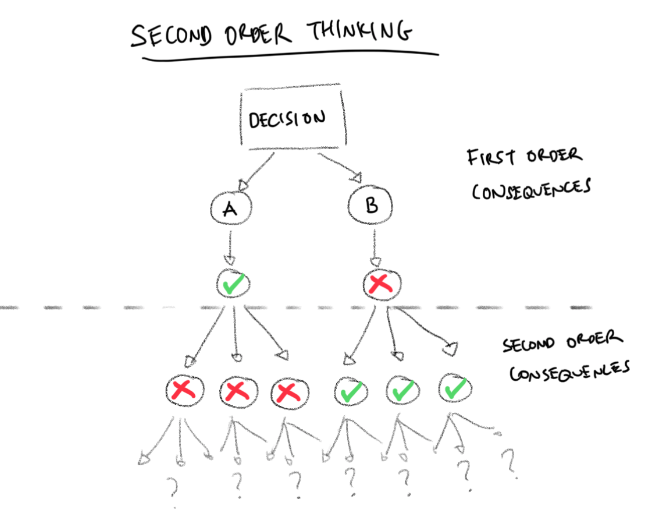
2. Second-Order Thinking - Instead of thinking about the immediate consequences, think about the second-level consequences.
3. Inversion - Look at the problem at hand from the endpoint instead of the starting point.
Don't ask: "What do I need to do?" Ask: "What must I avoid?"
4. Opportunity Costs - Think about the costs that arise because you decide in favor of one option and thus against every other option.
5. Randomness - Keep in mind that there aren't always cause-effect relationships.
Lots of stuff is random.
6. Leverage - “Give me a lever long enough and I shall move the world.” - Archimedes
7. Margin of Safety - Assume that your assumptions can be wrong and plan with a safety margin.
8. Occam's Razor - Always start with the simplest explanation, the one based on the least assumptions.
Then move to the other explanations if wrong.
9. Law of Diminishing Returns - Up to a certain point, additional units offer more value.
But there's a turning point where additional units offer less and less value, and costs rise.
10. Niches - Specializing is an effective way to success. Use it and choose a niche where you become an expert.
What Mental Model helps you the most?