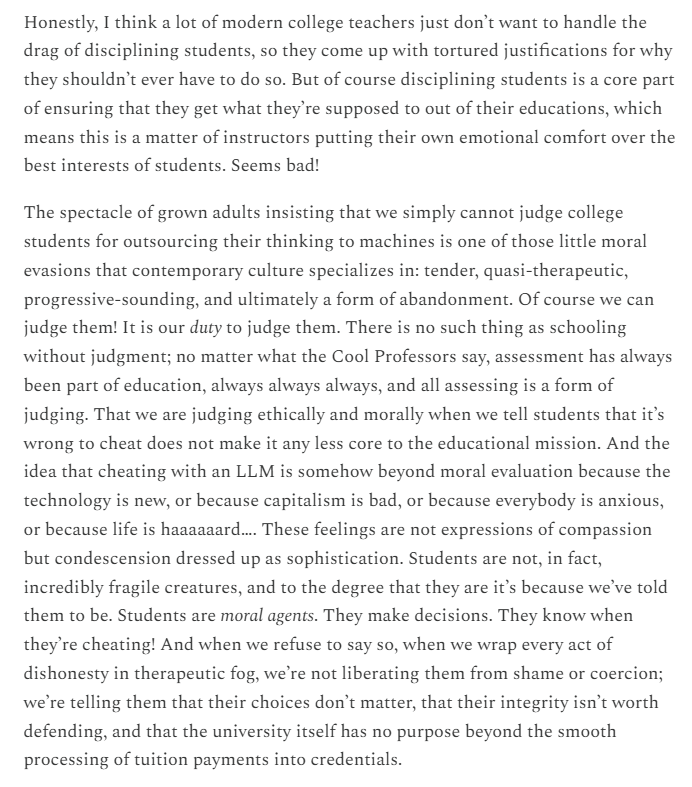
This essay, straight into my veins. Are educators taking the permissive postures many have adopted because that's what's actually best for *students*? Or is it because it's what's easiest for *us,* and most flattering to the self-image we want to project?
Is the approach we adopt for our students the same as we apply to our own children (pretending as if they're not morally responsible for anything, holding them to no standards, excusing any bad behavior, failing to push or discipline them for anything)? Likely not. For good reason.
Knowledge is the foundation for critical thinking.
In this episode, I talk with Robert Peal about why a knowledge-rich curriculum matters and why critical thinking is an outcome of building knowledge, not the starting point.
🔗 Link below
#ChalkandTalk#CriticalThinking #KnowledgeRich #Education
🎙️ New episode is live!
I talk with Robert Peal bout what makes West London Free School one of the top performing schools in England.
🎧 Link below to listen
New poll from @educprogress:
In Oregon, a supermajority of voters across party lines support increasing the proportion of the education budget dedicated to gifted and talented education.
Excellence in education is a unifying issue. Bureaucrats, not voters, stand in the way.
There was never a point at which the public supported the elimination of academically advanced classes. Residents of blue states overwhelmingly oppose it. Despite this, Experts spent generations building the dogma that it was not only pedagogically sound but a moral necessity.
Does ability grouping only help top students? 📚
We talk about how the framing around ability grouping needs to change. It can help all students, not just a select few.
🔗 Link below
This is a must-read piece by @greg_ashman on "conceptual understanding"—the goal everyone claims but can't really define or measure. My definition: it's the thing students supposedly gain when taught using certain methods (e.g., inquiry, multiple strategies, productive struggle) that are otherwise ineffective. That's why arguments about it go nowhere.
The term is defined to be the outcome of a preferred teaching method so you're not debating evidence, you're debating something that's essentially defined to be the thing that everyone should want.
"In about 10 minutes of gameplay, he spent less than 30 seconds answering math questions.... the game didn’t pause to diagnose where he went wrong or guide him to the correct answer."
This is ~ed tech~ with all the downsides and literally none of the potential upsides 😵💫
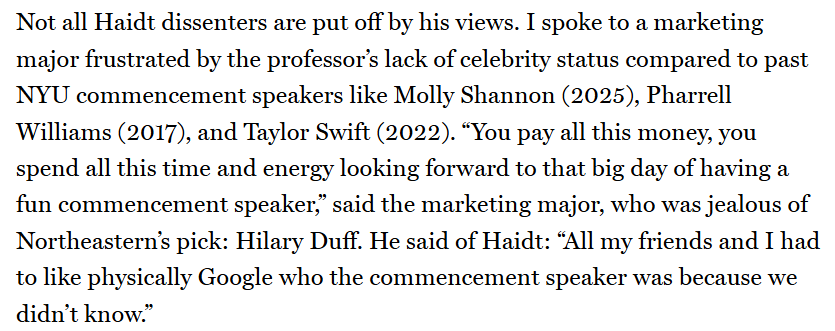
Thanks to my friend and co-author @glukianoff for laying out what we actually wrote in The Coddling of the American Mind, and applying it in response to seven arguments made by those who objected to my selection as a commencement speaker:
https://t.co/3pGmtJp6NC
⚠️ Instead of responding to the arguments, critics sometimes label concerns as politically motivated—changing the subject instead of addressing the evidence. I talk to David Shuck about why this happens.
🔗 Link below
Such a great episode, and such a great host! A huge thanks to @rastokke for featuring @educprogress on Chalk & Talk.
This is a great chance to hear us discuss our recent work and how dodgy ideas get defended in ed. It was a pleasure to take part!
Check out the CEP on the newest episode of Chalk & Talk!
Thomas and David join Anna Stokke to discuss how convictions become obstacles to evidence-based practices in education.
🎧Watch or listen to the podcast at the links below!🔗
Thanks to @rastokke for a great episode!
Thomas and I were so glad to join you! Displacing bad ideas about math instruction gets tricky fast when convictions come into play. High-quality research needs more champions!
🚨New episode now live! Thomas Briggs and David Shuck join me to discuss why bad education ideas can persist—even in the face of evidence.
We unpack flawed advanced math placement decisions, San Francisco's detracking experiment, the New York math briefs controversy, discussing what went wrong and why.
Link below 👇
@rastokke great job team, we have to keep getting the word out - seems like even relatively high-information parents still have little idea https://t.co/7047tYauB6
Thousands of capable students are being blocked from advanced math—not because they lack ability, but because of flawed placement systems.
In this episode, I talk with Thomas Briggs and David Shuck about how this happens. 📚
🔗 Link below
🎙️ New episode drops tomorrow! I talk with Thomas Briggs and David Shuck about why ineffective education practices persist.
We talk about San Francisco's failed math detracking, the New York math briefs controversy, and more examples of education policy gone wrong.
Sharing preliminary results from my Missouri research below the district level. Using school-centered AFQT catchments, I see a related aggregate pattern: within poverty tertiles, workforce readiness generally rises with married/couple-family context.
Calvin & Hobbes is the not-so-secret literacy, vocabulary, and independence book all kids need. Every classroom and school library should have copies of this!