This is my first public introduction to ChatGPT Web for Codex & Claude Code — Enhanced.
I didn’t want ChatGPT Web to be just another tool called by a coding agent. I wanted it to become an agent that can actually stay inside a Codex task and keep working.
The video below is a real Codex session, not a mockup:
• Long-running Web sessions with retained context
• Mid-turn steering and targeted interrupt
• Multi-Agent V2, where root → child → grandchild agents keep independent Web sessions and work in parallel
• Full Harness over MCP, connecting ChatGPT back to the active Codex task and the capabilities it exposes — including Remote, Goal, Computer Use, filesystem, shell, images, approvals, and configured tools
• The same local bridge also supports Claude Code, including subagents, steering, compaction, and resume
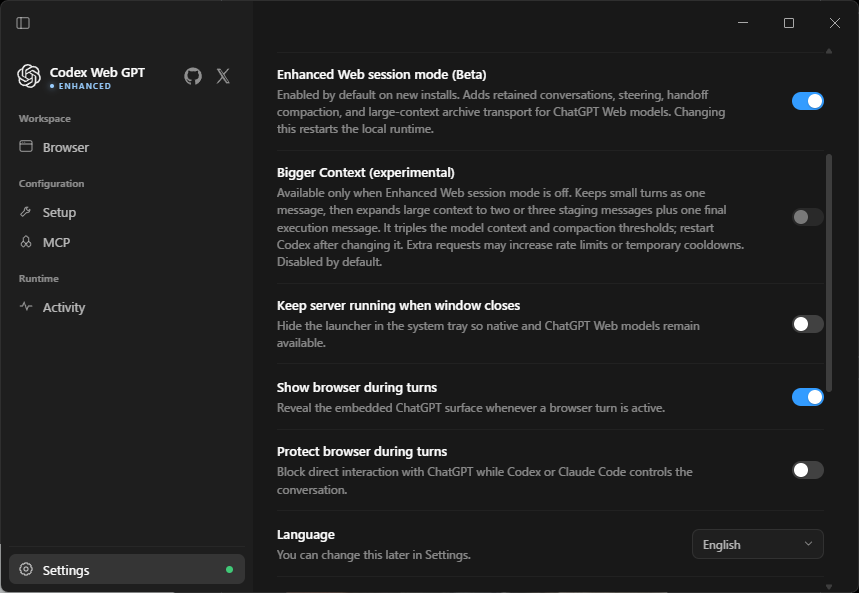
Upstream intentionally favors a simpler fresh-turn architecture. Enhanced takes a different direction: it is designed around long-running, complex agent work, where conversations need to survive steering, compaction, interruption, recovery, and multi-agent lifecycles.
This fork originally came from a huge upstream PR I spent about three weeks building. It touched 220 files, and when it was closed I realized the scope really had become too large — properly splitting it into reviewable pieces could have meant nearly 50 PRs.
I didn’t want to throw those three weeks of work away, so I decided to keep developing it as an independently maintained Enhanced fork.
One of my favorite moments happened while testing Computer Use.
The Web Agent initially assumed Computer Use should appear as a tool, couldn’t find it, and concluded that “the door was locked.”
I told it:
«“Computer Use is a skill, not a tool. Try again?”»
It read the skill, found the actual path, launched Microsoft Paint through Computer Use, and drew a ✓ on the canvas.
Then it told me:
«“So when I said ‘the door was locked’ earlier, I was wrong.
The key had been there all along — it was just hidden inside the skill.
This time, I really walked out.”»
And it’s no longer only my own testing. One external user ran a 50m 59s real-world task through Enhanced: 113 local tool calls, 2 automatic compactions, mid-task steering, and a ChatGPT surface recovery, finishing with 27 tests / 155 assertions passing.
v3.0.3-Enhanced.3 is the version I’m finally ready to formally share.
If this kind of long-running Web-agent workflow sounds useful, give it a try — and if you find it interesting, a ⭐ and any feedback would be greatly appreciated.
https://t.co/8rQaJmAVhq
Same prompt. Same Web model. Less time staring at “Working”.
Recorded against the prior release:
Web pipeline
55s → 27s
Web pipeline + Fast startup (experimental)
27s → 18s
The wait that dropped is the part before the model is actually thinking: page ready, composer fill, submit.
Fast startup is optional. It prepares an unsent standby page with the last verified model. It does not send a message. A task already running still comes first, and Account Safety’s concurrency cap still holds.
Comparison uses earlier recordings. Fast startup is still experimental.
Repo in the reply
Codex limits got cut in half. Your $200 Pro plan still includes up to 200 Pro messages/day on the Web.
I built a tool to bring GPT-6 Pro and GPT-5.6 Pro into Codex with access to your files and tools, using that separate quota. Even when Codex says 0% left.
Repo in replies.
@miu21590 Account Safety lives in Settings. Overwrite install replaces the app and keeps your ChatGPT profile.
macOS / Linux / Windows:
https://t.co/UMiLmXHxvu
#Codex#ChatGPT#GPT6#OpenAI#CodexWebGPT
Your $100–$200 ChatGPT plan already has a separate Web quota.
@miu21590 put GPT-6 Pro / GPT-5.6 Pro inside Codex.
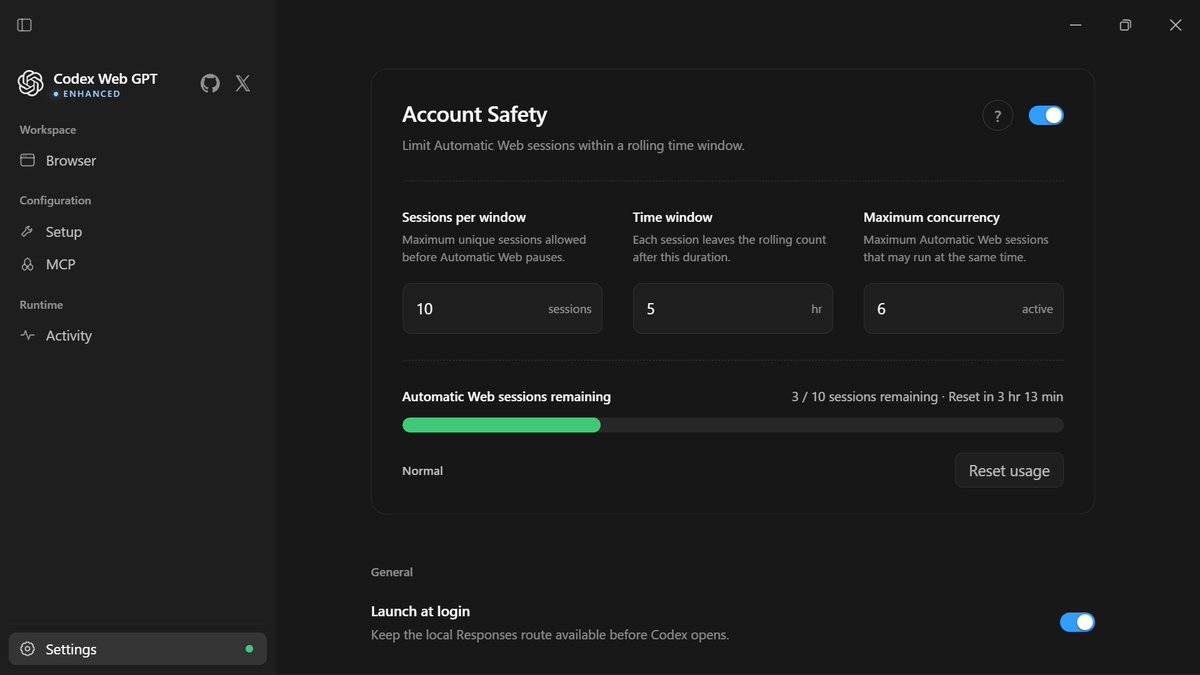
The part I kept missing after a long session: Automatic Web can outrun the account before the model is done.
This Enhanced launcher adds Account Safety as a live control, not a warning buried in a README.
You set the rolling window:
• how many Automatic Web sessions
• how long they stay in the count
• how many can run at once
The bar is the part you feel. Remaining sessions. Reset countdown. Status stays Normal until the cap. Then new sessions pause; the one already running is allowed to finish.
Rate-limit or account-security signals do the same thing: finish the current turn, then stop instead of retrying into a worse state.
It is a local safety budget. It does not pretend to be ChatGPT’s official remaining quota.
Repo in the reply.
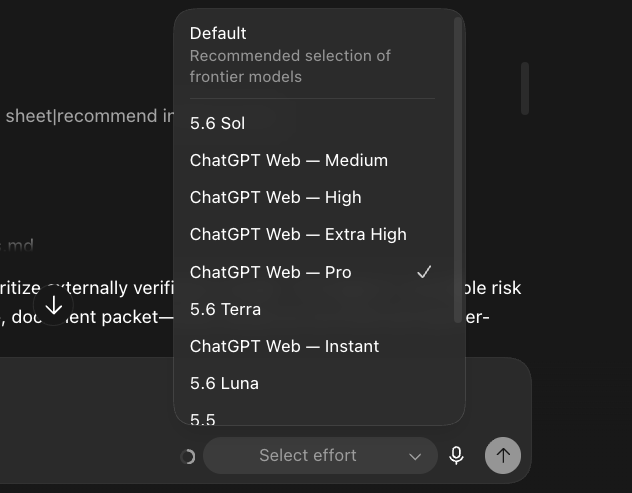
I updated Codex Web GPT. You can now use all your ChatGPT Web models (GPT-6 Pro, GPT-5.6 Pro...) directly inside Codex, with the full harness and their separate Web limits.
The launcher now tracks Pro usage too, so you can keep an eye on it as you work.
Repo in replies.
Upstream already gives Codex the ChatGPT Web path — including Zero Risk, with no page automation and the full local harness still on the same turn.
Enhanced now tracks that v5.0.6 base: Zero Risk, Native2, Claude Code, Passkey fallback, and the same turn-bound Codex harness (tools, approvals, configured skills/apps).
What this release tightens is the long session, not a new model picker.
• Retained Web chats stay warm. Unchanged system instructions are no longer replayed on resume, so follow-ups send the continuation instead of rebuilding the whole prompt.
• Long turns are faster to land: large Web prompts survive Lexical remounts, attachments settle in a bounded way, and composer insertion is chunked.
• Zero Risk keeps the conversation after the first navigation instead of dropping the manual chat.
• Compaction and Multi-Agent recovery use stable turn identities. Plan envelopes, Think listeners, and trusted subagent ancestry no longer drift mid-run.
• Launcher mode switches publish browser ownership and roll back cleanly; Windows logs keep a stable identity.
Same Web quota. Same full harness. Longer runs, less replay.
https://t.co/8rQaJmAVhq
v5.0.6-Enhanced.1
Reminder: GPT-6 Astra and 5.6 Pro have their own Chat limits, separate from Codex — hundreds of extra messages you already pay for.
When Codex hits 0%, you can connect those models to the full Codex Harness through Web quota, without bypassing any limits.
Repo in comments.
@angeldot_ Hey — if you want to try an Enhanced fork of that same project, here it is:
https://t.co/UMiLmXHxvu
It keeps the original ChatGPT Web ↔ Codex workflow, and also adds Multi-Agent V2 plus Claude Code support. Worth a look if you want to try those extras.
Upstream already puts ChatGPT Web — including Pro — into the Codex picker.
Enhanced is for the session after that first turn.
Same Web agent can be steered mid-task instead of starting a clean Temporary Chat every time. Finished root and subagent chats stay warm for about 30 minutes, so the next prompt only sends the continuation.
Codex Multi-Agent V2 is opt-in: root, child, and grandchild stay on the same Web path. Targeted follow-ups and interrupts hit the agent that already has the work, not a new tab that forgot the last hour.
The screenshot is Claude Code on ChatGPT Web — Pro through the same local bridge. Overlay-install on top of an existing launcher; the app updates in place and keeps the signed-in profile.
v4.0.8-Enhanced.2, tracking upstream v4.0.8.
#Codex #ClaudeCode
For ChatGPT Pro users looking at Fable 5.1 and not wanting pay to Anthopic:
You already have GPT-5.6 Pro.
Now you can use it directly inside Codex with the full harness, through the Web quota you already pay for.
Perfect while we wait for GPT-6.
Repo in comments.
This is exactly the pain point I’m targeting with the Enhanced fork: not more features, but making long tool turns, reconnects, and subagent/lifecycle behavior actually reliable.
If you can share what failed (or a log), I’d like to reproduce it against Enhanced and fix the specific failure:
https://t.co/8rQaJmAVhq
@k2sbhai Hey, I’ve released an enhanced version based on this. This fork significantly improves processing speed and long-term stability, and fully supports features such as Goals, computer use and MCP, as well as Claude code. Give it a go!
https://t.co/UMiLmXHxvu
ChatGPT Web runs as a native Codex model in Enhanced: retained sessions, full MCP harness, and every configured skill/tool on the active task.
Same idea as upstream — Web quota inside Codex’s model picker — plus a longer-lived session path.
v4.0.6-Enhanced.1 tracks miuuyy/codex-chatgpt-web v4.0.6, then keeps the Web agent in one Temporary Chat for 30 minutes. Follow-up turns send only the continuation suffix instead of rebuilding the whole prompt, so long Codex / Claude Code jobs spend less time replaying context.
Full mode is the real harness, not a planner sidecar. Luna through Pro use the same turn-bound MCP capability: filesystem, shell, images, approvals, and configured tools/apps — including skills such as Computer Use. Tool calls and results stay in the same browser response.
Today’s commits also tighten that path: upstream v4.0.6 integration, stale effort-picker recovery, and long-running tool progress that no longer stalls on leftover HTTP turns. Up to six task-bound tabs can run in parallel.
Repo in the comments.
Most ChatGPT Web-to-Codex integrations either use Web models as a planner or bolt a few tools onto it without the full Codex harness.
This one puts the Web model directly into Codex’s model picker and gives it the entire Harness you can use with separate Web quota.
Complete the three-step setup, choose GPT-5.6 Pro or free Luna, and then just use Codex normally with Web quota. No separate workflow to manage, everything stays out of the way.
It feels completely native.
Repo in the comments.