🧑🏫Ever tried reverse engineering code with ChatGPT?
An incredible feature that's changed my coding game
It’s about making it 10X faster for you.
Dive into this thread for a simple example, and imagine the endless possibilities! 👇🧵
Here are my results developing a local @HeyGen_Official solution.
Works with any audio and video pair as long as the face is directed towards the camera.
Made the switch from A1111 to ComfyUI recently and, honestly, there's been a bit of a learning curve.
While I'm still finding my groove, diving into tutorials and community forums has been a lifesaver.
Anyone else tried ComfyUI and felt the same? Would love some pro tips! 💡
🚀 Starting a project with AI-generated 3D assets?
Beware of common pitfalls:
over-reliance and under-optimization.
My advice? Always refine and review.
AI gives us a head start, but the finish line is ours to cross. Saved this tip? Let me know!
Introducing TinyLlama🦙
Undoubtedly one of the most impressive LLM projects I've seen recently!
-- 🌟 Introduction --
The ambitious TinyLlama project aims to pretrain a 1.1B Llama model on 3 trillion tokens – yes, 3 trillion! 🚀
The idea is to achieve this goal within "just" 90 days using 16 A100-40G GPUs 🚀🚀 with proper optimization.
The training commenced on 2023-09-01, and you can witness its convergence live (find the link below).
-- 🏛️ Architecture --
They've adopted the exact architecture and tokenizer as Llama 2. This means TinyLlama can seamlessly integrate into numerous open-source projects built upon Llama.
Furthermore, TinyLlama is compact, with only 1.1B parameters. This compact design enables it to cater to various applications that require limited computational and memory resources.
-- 📚 Dataset --
The dataset consists of 3 trillion tokens sampled from a mix of 70% Slimpajama and 30% Starcoderdata, with the GitHub subset of Slimpajama excluded.
-- ⚙️ Optimizations --
They're utilizing a variety of fancy optimization techniques such as flash attention 2, fused layernorm, fused swiglu, fused cross-entropy loss and fused rotary positional embedding.
These optimizations result in a throughput of 24k tokens per second per A100-40G GPU, achieving 56% model FLOPs utilization (an incredible feat! 💯).
This has the potential to be a game-changer for end devices, as the 4-bit-quantized TinyLlama-1.1B's weight only occupies 550MB of RAM! 💥
-- 📊 Status --
They'll release intermediate checkpoints according to the schedule provided below. The first released checkpoint is already in competition with StableLM-Alpha-3B & Pythia-1B.
-- 🔗 Links --
In the meantime, you can track the live cross-entropy loss via this link: https://t.co/KTpJoYRsze
Find the repository here: https://t.co/2Q1GV7ozAN
@minchoi I've observed lately that some of my posts get boosted late in the week, even 72h after I posted it. But this usually happens during weekends which is weird for me
AI will reshape the workplace...
ChatGPT is leading the way with the Enterprise version, and this is big
It's not just speeding up tasks, it's about building entire company workflows using LLMs with their own data
Here I leave some key points 👇
1. Enterprise-Grade Security: One of the most compelling features is the robust security measures. Your data is yours, and OpenAI ensures it stays that way. SOC 2 compliance and encryption are the cherries on top.
2. Unlimited GPT-4 Access: Imagine a world where you're not bound by usage caps. ChatGPT Enterprise offers unlimited, faster access to GPT-4, allowing for more extensive data analysis and longer context windows.
3. Customization and Scalability: From shared chat templates to free API credits, the customization options are endless. Plus, the admin console makes it easy to manage team members and gain usage insights.
So, what's your take on AI-driven enterprise solutions like ChatGPT Enterprise? Do you see them as the future of business productivity, or are they just another cog in the machine?
I'd love to hear your thoughts.
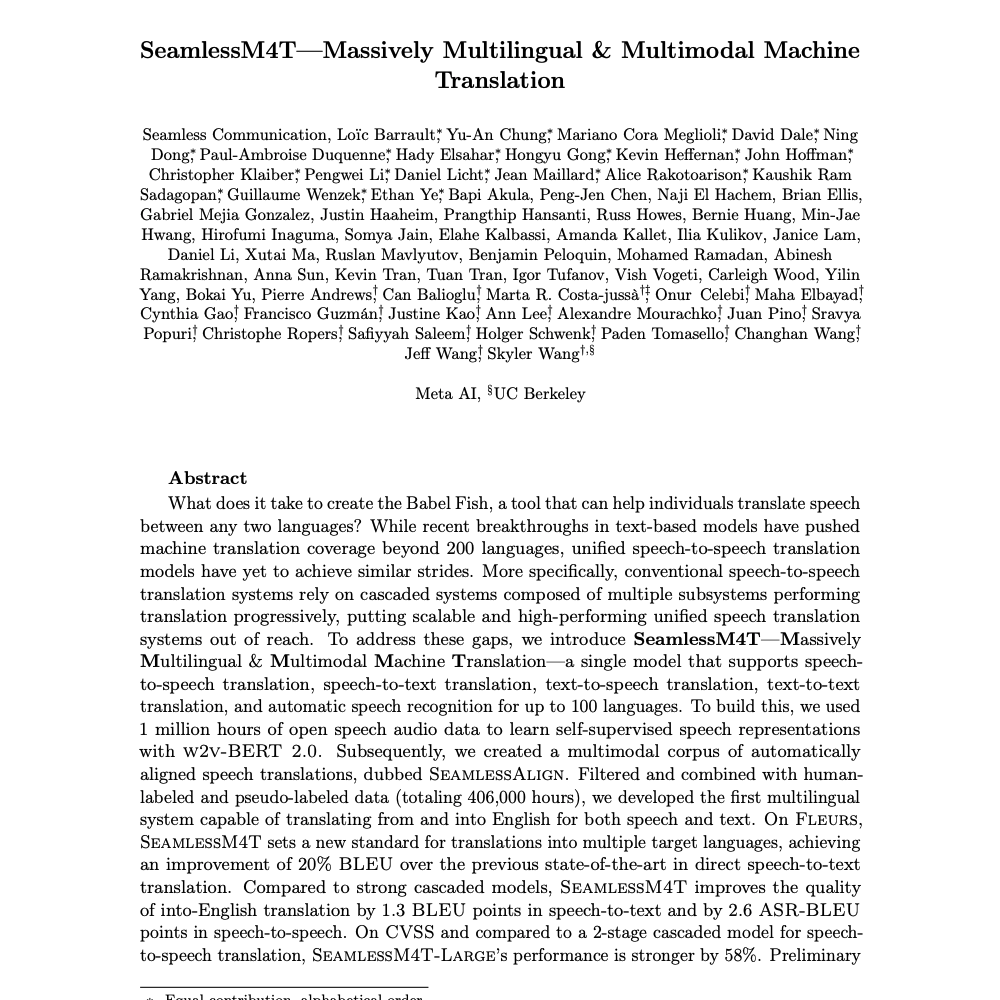
In the interest of open science and sharing our research, we've published a paper outlining the work on our recently released SeamlessM4T all-in-one multilingual & multimodal translation model.
Read the full paper ➡️ https://t.co/B6mf3QUbav
@Kotaku It's not a problem with AI, it's a lack of QA control and diligence
I took the opportunity to recreate the artwork for the Fallout series using AI alone, including the text
It took 1 hour and the result is significantly superior
If their work wasn't awful you would not notice...
In light of Google's Project Magi, I see a great opportunity for digital marketers. As Google transitions towards a more conversational and transactional interface, I believe that those who can quickly adapt and optimize for this new format will be at the forefront of the next wave of digital marketing.
Here are some interesting facts about Magi:
1. Conversational Interface: Aims to make search more like a chat, providing tailored answers.
2. Direct Transactions: Users can make purchases directly on Google, integrating with Google Pay.
3. Evolution of Ads: The advertising model may shift to a cost-per-acquisition approach.
4. SEO Implications: A new form of SEO will emerge, focusing on product and service optimization for Project Magi.
@OneTrueNikolai Don't you think that a custom prompt could add your personal touch in your writing? Because sometimes I feel like the lack of feelings in a text is just a lack of information in the prompt
In my years of observing the tech landscape, I've rarely been as surprised as when I witnessed Google underestimate the capacity required in the AI revolution.
Their early forays, like the MEENA model, were nothing short of impressive, but seemed to miss the mark in predicting the computational explosion that was on the horizon.
This allowed competitors like OpenAI with the GPT series, to carve out a significant niche for themselves.
For me, watching a pioneer like Google fail like this was a reminder of the fast-paced nature of the tech world. Now they are on the backfoot but ready to recover the leadership in the AI world, here are some key points:
1. Google's Gemini project is on track to surpass GPT-4's total pre-training FLOPS by 5x by the end of the current year, with a clear path to achieving 20x by the end of the following year.
2. Infrastructure Efficiency: One of Google's primary advantages is its unbeatably efficient infrastructure, which will play a crucial role in the rapid development and deployment of advanced AI models.
3. Viperfish (TPUv5) Ramp: Google's Viperfish, the TPUv5, is an example of their commitment to staying ahead in the AI hardware race, ensuring they have the computational power to support their AI projects.
4. Google's iteration velocity for Gemini models is noteworthy, indicating their commitment to continuous improvement and adaptation in response to the evolving AI landscape.
5. Google's training systems for the Gemini project are robust, ensuring that the models developed are of the highest quality and can compete with or surpass existing models in the market.
What do you expect from Google and Gemini in the AI landscape?
Curiosity.
That's what's fueled my journey in AI content creation.
The drive to explore, understand, and create new possibilities.
What's the one trait that's helped you succeed?