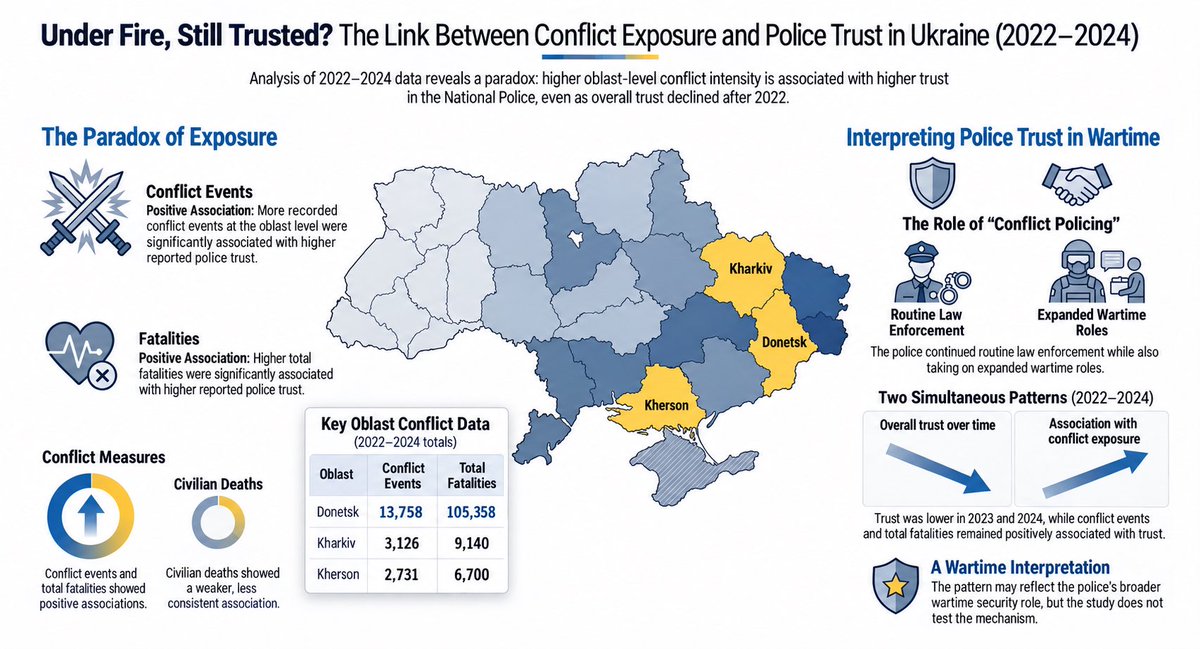
Now available, via @EvidenceBaseJnl is my broadside against replication as a panacea against CCJ’s rising legitimacy crisis. There’s a way out. But it requires we accept a rational agent, driving debate.
https://t.co/WwPOC2tGPf
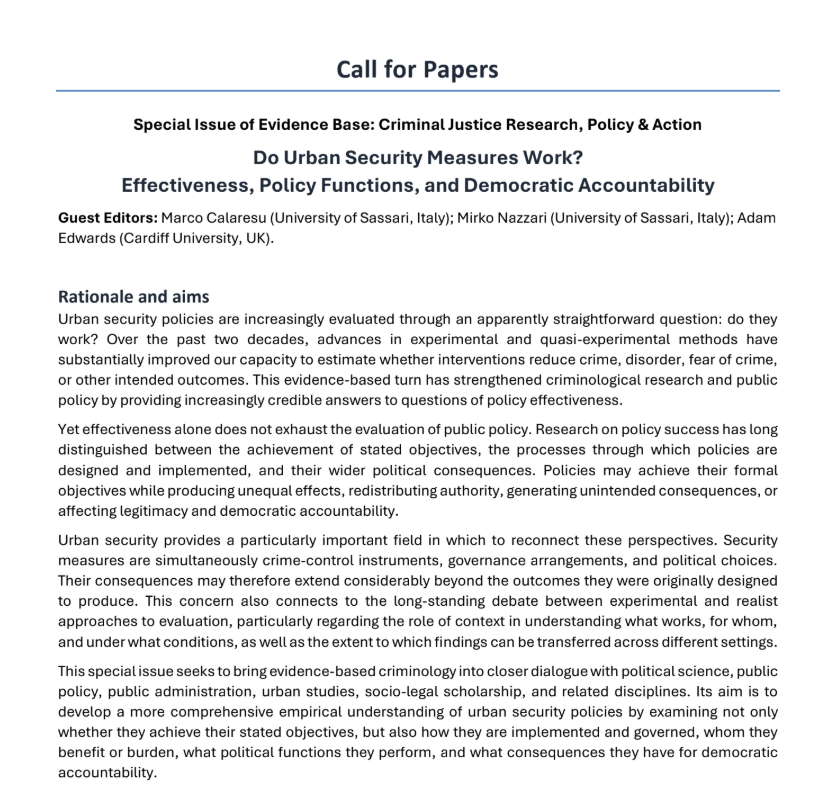
Call for Papers: "Do Urban Security Measures Work? Effectiveness, Policy Functions, and Democratic Accountability," Evidence Base, Special Issue
How do we know whether urban security measures work? What else do these policies do, and who is held accountable for their outcomes?
We welcome empirically grounded contributions from across disciplines, regions, and methodological traditions. We’re especially interested in comparative research that examines how different policing traditions, legal frameworks, and systems of government shape what these policies do and how their success is judged.
Extended abstracts (800–1,000 words) are due 28 February 2027.
Read the full call and submission instructions → https://t.co/bq40YfCcK5
@EvidenceBaseJnl
Adapted offenders, pathological police?
My new article highlights an asymmetry in criminology: we typically explain offenders' threat sensitivity and mistrust as adaptations to dangerous environments, but often attribute similar police orientations to dysfunctional occupational culture(s).
I argue for “ecologizing” police orientations recognizing--as many have before--that while most of policing is mundane, it can be dangerous. I further argue that efforts to reform police cultures and orientations may struggle to produce durable change if when they overlook the functions these serve in the task ecology.
https://t.co/aTqPwYxQU0
Pleased to announce @CarlenaOrosco will be joining @EvidenceBaseJnl as Managing Editor in Charge of Reviews.
This move will help EB become EVEN MORE efficient (thx @DrLornaFerguson) at getting papers through the submission process (esp. bc Carlena is a keener).
I'm not jumping into this specific debate but I need to be very clear here from an editor POV. Using AI for many journals is a considered breach of academic integrity and legal confidentiality. Always check the publishers policy on AI use for peer reviews.
Major publishers and COPE explicitly ban it as this is giving away an author’s unpublished intellectual property to a commercial data bank. Taylor & Francis for @EvidenceBaseJnl notes clearly: "editors and peer reviewers must not upload files, images, or information from unpublished manuscripts into Generative AI tools. Failure to comply with this policy may infringe upon the rightsholder’s intellectual property." Find here: https://t.co/oxkTmjmz1r
Call for eyes again: Anyone willing to review a manuscript on mass shooters?
Also, if you are willing to be added to our reviewer pool more generally, please do get in touch with your research interests - we have several fab manuscripts coming through, and diverse expertise is welcome to review and improve submissions. DM or email: [email protected].
@EvidenceBaseJnl@ProfLauraHuey
6/6 We have no confidence in the efficacy of sex offender treatment programs because of poor research quality and a general unwillingness for thousands of existing programs to publish their outcomes. We can and must do better.
@EvidenceBaseJnl
https://t.co/qbxpxGd02U
1/6 When we reviewed the literature on sex offender treatment program evaluations (and found them severely lacking in rigor), one problem was the implication that if a program worked somewhere decades ago, it is "evidence based" and should work elsewhere today.
One of the things I like about @EvidenceBaseJnl is our commentaries. I am wondering, though, whether it would be useful to have a debate section. Someone writes a commentary & we invite 1 or 2 others to reply. 🤔