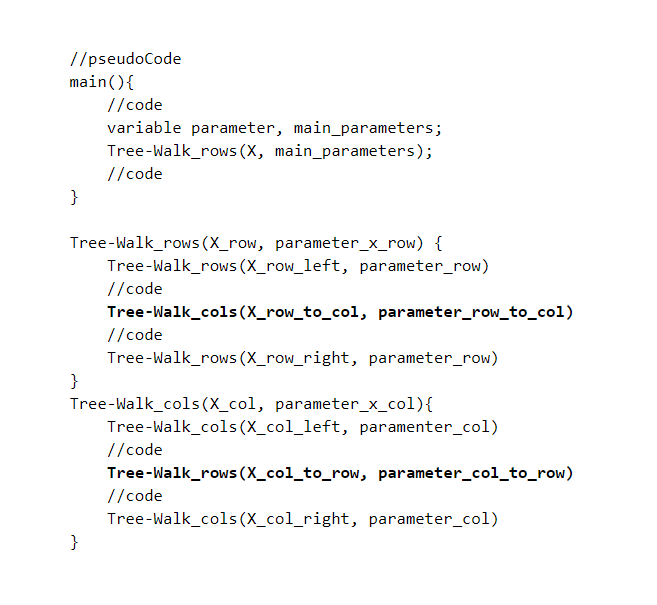
https://t.co/Otu8qhQVAs #xsnt Developing & coding 2 recursive functions that mutually call each other was a real challenge. My project generates huge Sparse Correlation Matrix all rows/cols are in different binary trees, a row traversal function calls a col traversal function
@davidch03 Mira quien lo dice @mariasolborja la hija de un prófugo que no sabe donde esconderse, si en Col, si en Ven o en MX, NO HAY PAIS QUE QUIERA A LA ESCORIA q tanto daño le hizo al pais. No he olvidado los $4 millones que cuando estuvo en el BCE gastó en una consultoria, taita ladrón
@kukyrojas@RC5Oficial Es evidente que el lloriqueo se debe a que los hoy enquistados burócratas discípulos de la secta delincuencial, del grupo no político sino mafioso, se rasgan las vestiduras porque están por perder sus puestos de parásitos en estamentos públicos como la prefectura de Pichincha.
Sebuah Renungan :
Aktor Amerika "Clint Eastwood" yang berusia 98 tahun, mengatakan dalam pidato yang menyentuh baru-baru ini.
"Menakutkannya kemajuan usia, bukan begitu?
Kalian melihat segalanya dengan mata kalian sendiri. Tulang-tulang yang tak bergerak dengan lentur, penglihatan mata yang lelah terhadap cahaya, dan paru-paru yang menikmati kesempatan istirahat dari mencari napas yang sangat lelah.. Tapi yang lebih menakutkan dan melelahkan adalah ketika mencapai usia sembilan puluh dan tak menemukan siapa pun dari orang-orang yang kalian cintai di dekat kalian yang mendengarkan dengan menggerutu cerita sejarah kalian yang penuh dengan kepahlawanan khayalan, dan kalian tahu dia tak tertarik, tapi kalian menikmatinya; seperti seorang kakek, dalam menyampaikan apa yang kalian anggap pantas untuk cucu-cucu kalian.
Menakutkan menjadi sendirian setelah semua orang mencari kalian, dan pada akhirnya, setelah menghabiskan hidup kalian mencari cahaya, kalian tak memenangkan keluarga, dan hidup dalam kegelapan saat kalian membutuhkan tangan yang membimbing kalian ke cahaya?!
Perhatikanlah untuk membentuk keluarga.
Karena mengejar ketenaran seperti abu yang ditiup angin..
Tak menyulut api. Dan tak tetap diam di tempatnya"
@GmoRodriguez999@MashiRafael@JEcheverriZ Se jodió correa, es como para cagarse en los pantalones, la fiscalía USA le respira en la nuca. Una celda de 2*3 y 15 min al sol por día le espera. Pero lo peor es todo este tiempo de agonía, vasta ver la cara hecho verga que tiene por lo que se le viene y la conciencia atormenta
Is time continuous by nature, or is it made of discrete fragments?
Can it truly be modeled as a linear function with a constant slope, or is time instead a superposition of non-uniform temporal subspaces?
And what, if anything, propels time forward at an apparently constant pace?
Researchers have recorded the briefest interval of time ever measured: 247 zeptoseconds—the duration for a photon of light to traverse a hydrogen molecule.
That's 0.000000000000000000247 seconds.A zeptosecond equals one trillionth of a billionth of a second, a realm where light, the universe's speed champion, advances mere fractions of an atomic diameter. For scale, a single second contains as many zeptoseconds as there are seconds in 31.7 trillion years—vastly exceeding the age of the cosmos.
Physicist Reinhard Dörner and colleagues at Goethe University Frankfurt achieved this using intense X-rays from Hamburg's PETRA III accelerator. They aimed at hydrogen molecules—the simplest in existence, comprising two protons and two electrons. An incoming photon struck both electrons in rapid sequence, akin to a stone skipping across water.
To resolve this fleeting event, the team employed a COLTRIMS reaction microscope, an ultra-precise instrument that tracks particle positions and momenta. By examining the interference patterns from the two expelled electrons, they pinpointed the precise lag between the photon's impact on the first electron and the second.The finding: 247 zeptoseconds.
This demonstrates that light does not illuminate a molecule instantaneously, even at this tiny scale; the delay stems from light's finite velocity of roughly 186,000 miles per second (300,000 km/s). It represents the first direct observation of light propagating inside a molecule.
By contrast, chemical reactions unfold over femtoseconds—a thousandfold longer. Zeptosecond precision opens a window into quantum timescales, where electron and photon dynamics govern matter's core behaviors.
@Rainmaker1973 Is time continuous by nature, or is it composed of discrete units?
Can time be described by a linear equation with a constant gradient?
Or can time be described as a linear combination of non-constant subspaces of time?
What pushes time forward at a constant speed?