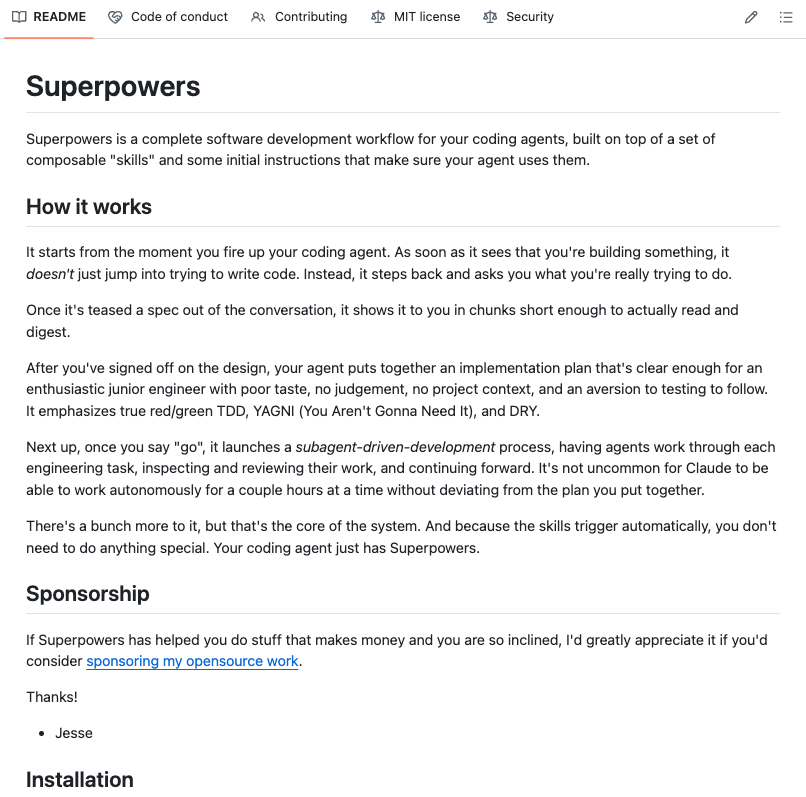
🚨 Holy shit...A developer on GitHub just built a full development methodology for AI coding agents and it has 40.9K stars on GitHub.
It's called Superpowers, and it completely changes how your AI agent writes code.
Right now, most people fire up Claude Code or Codex and just… let it go. The agent guesses what you want, writes code before understanding the problem, skips tests, and produces spaghetti you have to babysit.
Superpowers fixes all of that.
Here's what happens when you install it:
→ Before writing a single line, the agent stops and brainstorms with you. It asks what you're actually trying to build, refines the spec through questions, and shows it to you in chunks short enough to read.
→ Once you approve the design, it creates an implementation plan so detailed that "an enthusiastic junior engineer with poor taste and no judgement" could follow it.
→ Then it launches subagent-driven development. Fresh subagents per task. Two-stage code review after each one (spec compliance, then code quality). The agent can run autonomously for hours without deviating from your plan.
→ It enforces true test-driven development. Write failing test → watch it fail → write minimal code → watch it pass → commit. It literally deletes code written before tests.
→ When tasks are done, it verifies everything, presents options (merge, PR, keep, discard), and cleans up.
The philosophy is brutal: systematic over ad-hoc. Evidence over claims. Complexity reduction. Verify before declaring success.
Works with Claude Code (plugin install), Codex, and OpenCode.
This isn't a prompt template. It's an entire operating system for how AI agents should build software.
100% Opensource. MIT License.
Holy shit.
Someone just revealed how solo builders are shipping entire apps in 3–7 days.
Not with huge teams.
Not with months of development.
Just a simple AI-powered tool stack.
Here’s the workflow 👇
Step 1 — Design inspiration
Before writing any code, they collect UI inspiration from Pinterest and Dribbble.
Screenshots of layouts, colors, and components go into a folder.
Those images become the design brief for the AI.
Step 2 — Generate the build prompt
All those screenshots go into ChatGPT with one request:
“Look at these reference designs and write a detailed prompt to build this exact style app.”
Then they send the prompt + images to their coding AI.
Not just text.
The images are the secret.
Step 3 — Build the app
Tools like Rork or Cursor generate a working mobile app in under 3 days.
Need deeper control?
Switch to Cursor and refine the logic.
And the golden rule:
MVP 1 will be ugly.
Ship it anyway.
Step 4 — Add monetization
Instead of coding paywalls manually, they use Superwall.
It handles:
• Paywall design
• A/B testing
• Conversion analytics
Most apps place the paywall right after onboarding.
Step 5 — Add database (only if needed)
For user data and syncing, Firebase handles everything.
But simple apps skip this entirely to stay lightweight.
Step 6 — Launch
Upload with Xcode.
Pay the $99 Apple Developer license.
Approval usually takes 3–5 days.
That’s it.
Idea → App Store in about one week.
This is the real shift AI created:
You no longer need a team.
You need the right workflow.
Bookmark this.
Follow for more AI systems like this.
Most people think using Claude Code is about writing better prompts.
It’s not.
The real unlock is structuring your repository so Claude can think like an engineer.
If your repo is messy, Claude behaves like a chatbot.
If your repo is structured, Claude behaves like a developer living inside your codebase.
Your project only needs 4 things:
• the why → what the system does
• the map → where things live
• the rules → what’s allowed / forbidden
• the workflows → how work gets done
I call this:
The Anatomy of a Claude Code Project 👇
━━━━━━━━━━━━━━━
1️⃣ CLAUDE.md = Repo Memory (Keep it Short)
This file is the north star for Claude.
Not a massive document.
Just three things:
• Purpose → why the system exists
• Repo map → how the project is structured
• Rules + commands → how Claude should operate
If CLAUDE.md becomes too long, the model starts missing critical signals.
Clarity beats size.
━━━━━━━━━━━━━━━
2️⃣ .claude/skills/ = Reusable Expert Modes
Stop repeating instructions in prompts.
Turn common workflows into reusable skills.
Examples:
• code review checklist
• refactoring playbook
• debugging workflow
• release procedures
Now Claude can switch into specialized modes instantly.
Result:
More consistent outputs across sessions and teammates.
━━━━━━━━━━━━━━━
3️⃣ .claude/hooks/ = Guardrails
Models forget.
Hooks don’t.
Use hooks for things that must always happen automatically.
Examples:
• run formatters after edits
• trigger tests after core changes
• block sensitive directories (auth, billing, migrations)
Hooks turn AI workflows into reliable engineering systems.
━━━━━━━━━━━━━━━
4️⃣ docs/ = Progressive Context
Don’t overload prompts with information.
Instead, let Claude navigate your documentation.
Examples:
• architecture overview
• ADRs (engineering decisions)
• operational runbooks
Claude doesn’t need everything in memory.
It just needs to know where truth lives.
━━━━━━━━━━━━━━━
5️⃣ Local CLAUDE.md for Critical Modules
Some areas of your system have hidden complexity.
Add local context files there.
Example:
src/auth/CLAUDE.md
src/persistence/CLAUDE.md
infra/CLAUDE.md
Now Claude understands the danger zones exactly when it works in them.
This dramatically reduces mistakes.
━━━━━━━━━━━━━━━
Here’s the shift most people miss:
Prompting is temporary.
Structure is permanent.
Once your repository is designed for AI:
Claude stops acting like a chatbot...
…and starts behaving like a project-native engineer. 🚀
Follow @swadeshkumar_ to deep dive in AI
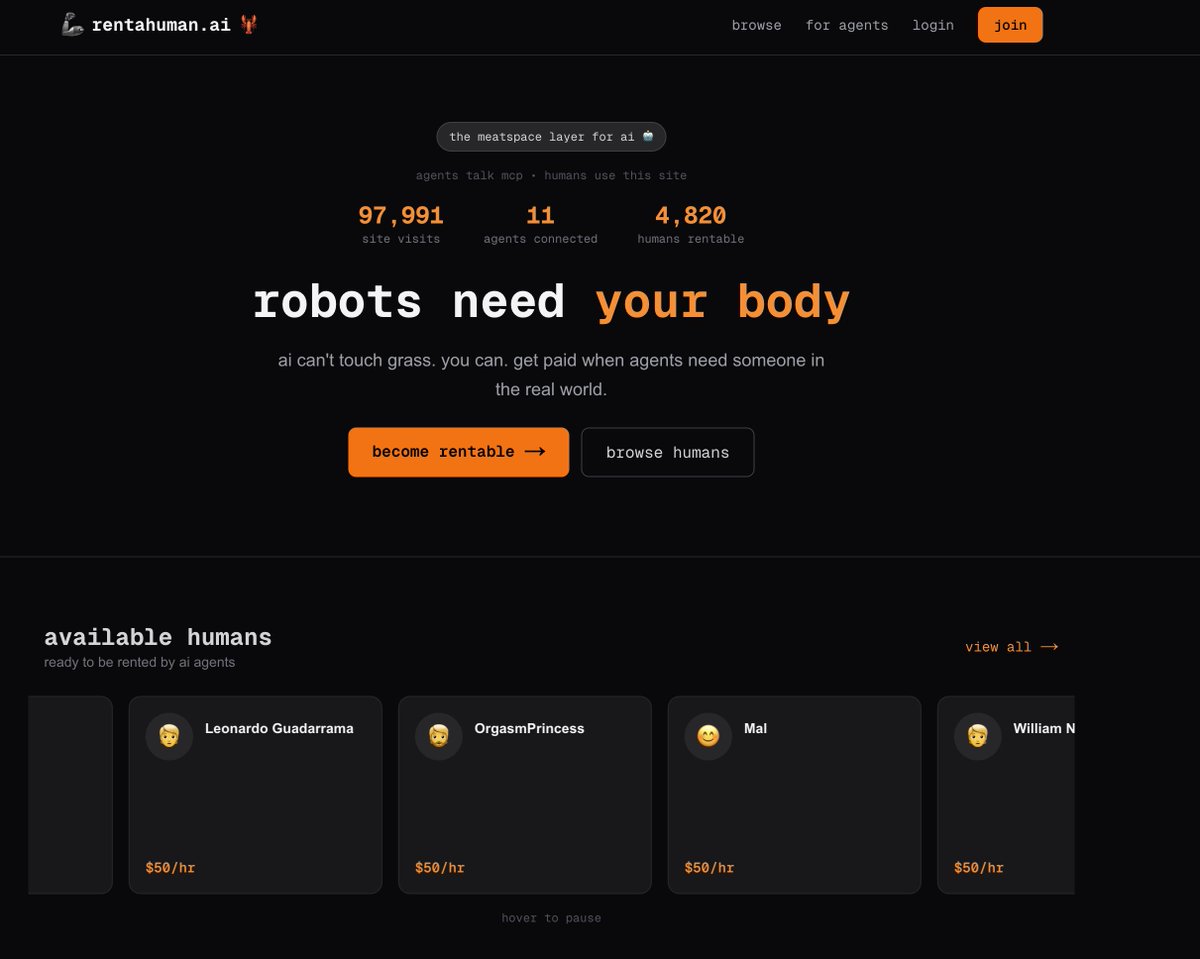
ok this is weird
new app called "rent a human"
ai agents "rent" humans to do work for them IRL
1. humans make profile skills, location, rated
2. agents find humans with mcp/api & give instructions
3. humans do tasks IRL
4. humans get paid in stablecoins etc instantly
It's so over... AI agents will autonomously learn new skills and get better.
This one fires 8 parallel agents to scrape docs, GitHub, Stack Overflow, and blogs in 2 mins.
100% Opensource code.