A stronger yen helps import costs. Higher bond yields hit mortgages, corporate funding and the government’s own interest bill.
If the yen needs repeated intervention while bond demand keeps fading, Japan is fixing one price by stressing another.
The U.S. and Japan bought the yen. Bond buyers still backed away.
That’s the awkward part. You can defend a currency for a day. You can’t force investors to fund the debt at the price you want.
The weak JGB auction matters more than the intervention headline.
Coinbase is trying to replace lost spot fees with stablecoins, derivatives and prediction markets.
That may work. But for now, crypto platforms are building around the missing retail trader—not because the trader came back.
Bitcoin slipped below $63K. Coinbase retail spot volume was already down 38% YoY.
That’s the part worth watching. Price weakness showed up after retail activity had already thinned out.
A bounce can lift the chart. It doesn’t automatically bring the crowd back.
Samsung and SK Hynix both surged more than 20%.
For this to be a real turn, foreign buying has to continue, the won has to stabilize, and chip stocks need to hold the move.
One violent rebound can fix prices. It doesn’t fix positioning.
KOSPI jumped more than 16% in one session.
That sounds bullish until you remember it was still down roughly 25% for July.
This looks less like fresh conviction and more like shorts, leverage and panic unwinding at the same time.
That pressure doesn’t stay in the bond market.
A 5.2% long yield means tougher math for mortgages, leveraged companies and anything priced on distant profits.
Stocks can ignore it for a day. Balance sheets can’t.
Stocks liked today’s inflation print. The 30-year Treasury didn’t.
Tech rallied while the long bond hit 5.23%, its highest since 2007.
Equity traders saw one clean data point. Bond buyers are pricing years of inflation, deficits and refinancing.
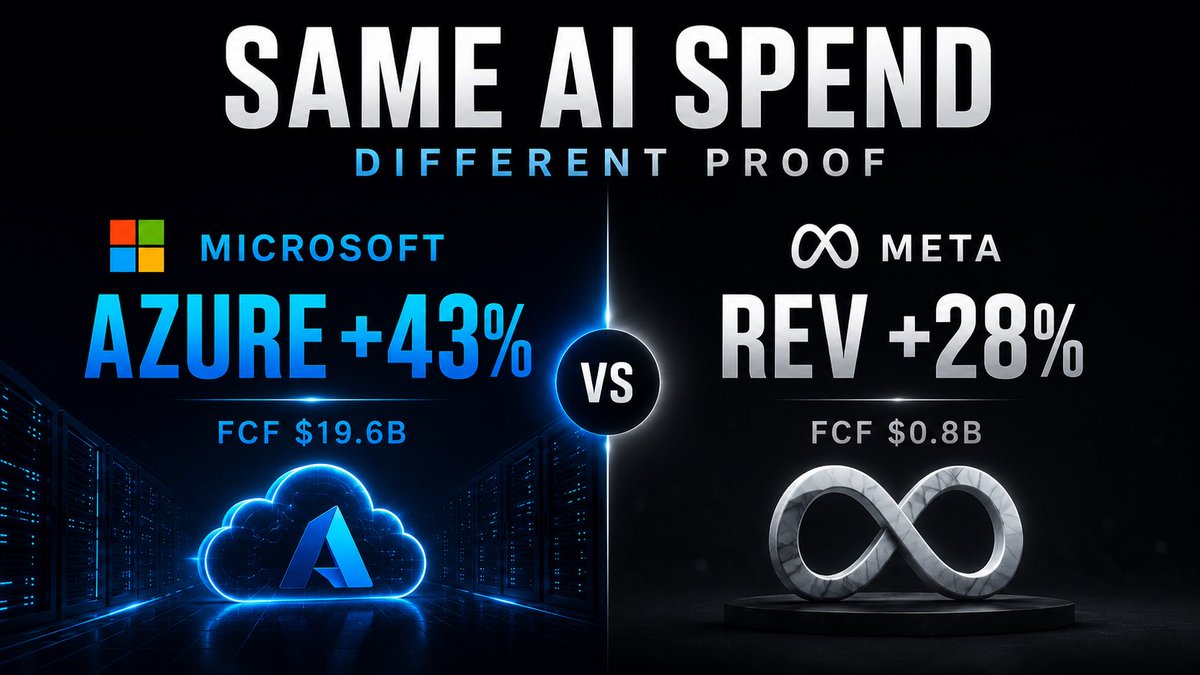
Azure grew 43% and Microsoft still produced $19.6B in free cash flow.
Meta’s revenue grew 28%, but free cash flow fell to $784M.
Same AI race. Very different proof of return.
Microsoft spent $41B on capex and jumped 8% after hours.
Meta spent heavily too and fell.
The market isn’t rejecting AI spending. It’s separating companies that can already turn it into cloud revenue from companies still asking investors to wait.
There’s still a cleanup bill.
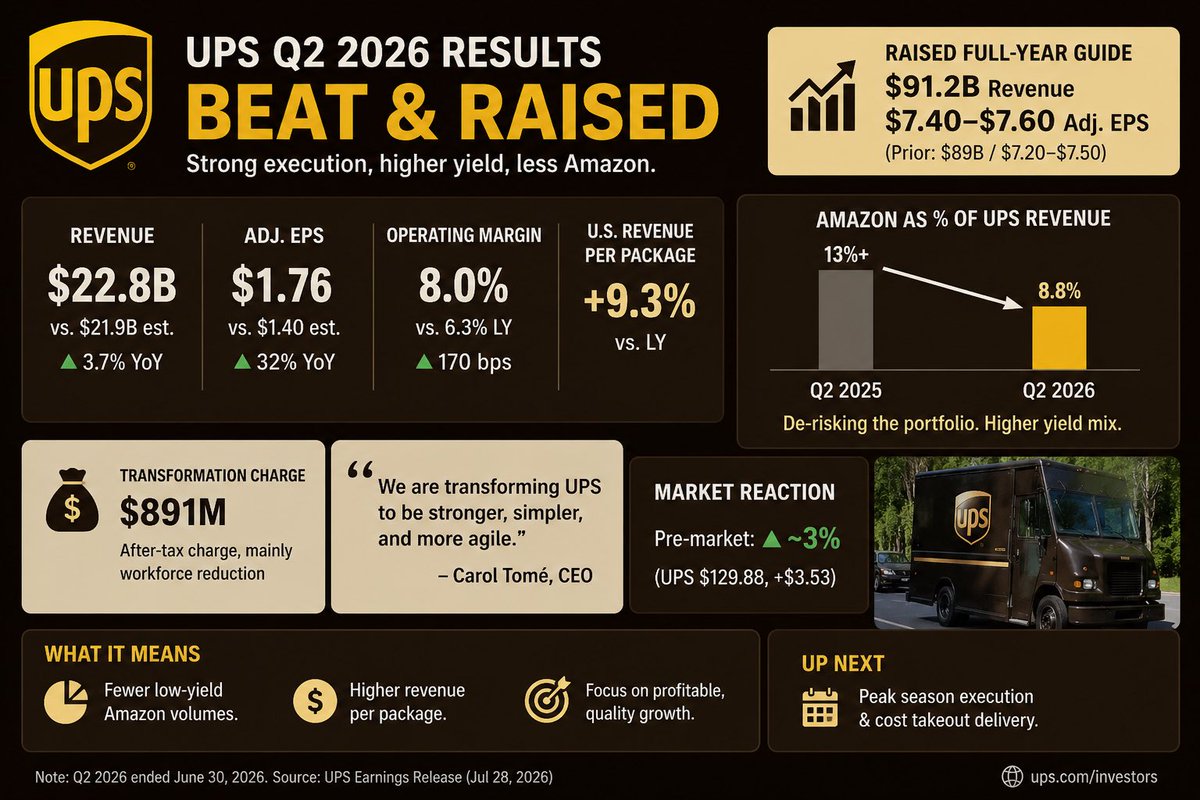
UPS booked $891M in after-tax transformation charges, mostly tied to workforce cuts.
Adjusted margins improved. Now investors need to see those restructuring costs actually fade.
UPS beat estimates and raised guidance after cutting Amazon volume.
The part I’d watch: U.S. revenue per package rose 9.3% while Amazon fell to 8.8% of the business.
Less volume can be better business when the volume you drop was the cheap kind.
The turnaround is starting to show, but mostly through cost cuts and better execution.
For the stock to rerate, branded checkout has to grow faster without giving up more margin.
Volume alone won’t do it.
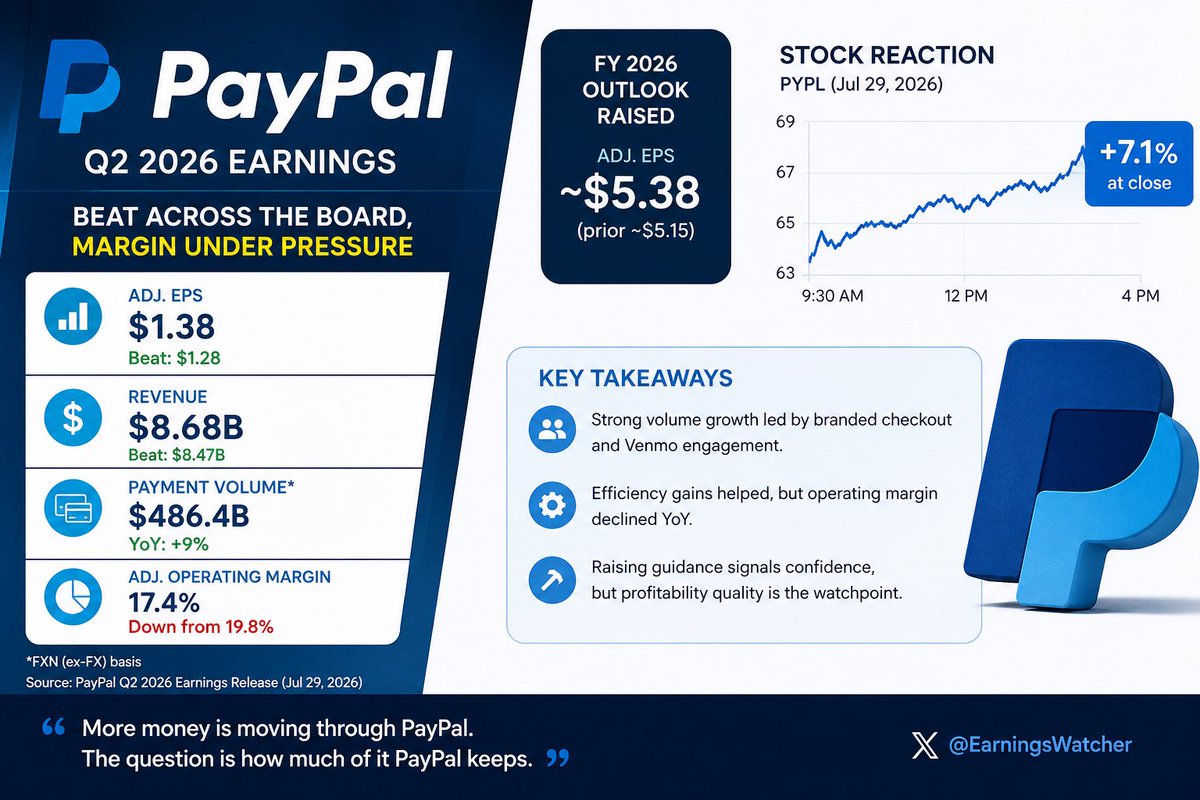
PayPal beat on earnings, revenue and payment volume.
But the cleaner story isn’t “growth is back.”
Payment volume rose 9%. Operating margin fell from 19.8% to 17.4%.
More money is moving through PayPal. The question is how much of it PayPal keeps.
The turnaround is starting to show, but mostly through cost cuts and better execution.
For the stock to rerate, branded checkout has to grow faster without giving up more margin.
Volume alone won’t do it.
I’d watch jet-fuel prices, airline fuel guidance and the 10-year yield.
If those stay high, this was mostly relief after a scary headline.
If they keep falling, then the airline rally has something real behind it.
Oil dropped nearly 8% and airline stocks jumped.
Makes sense at first glance. But airlines don’t buy fuel at today’s crude price, and hedges can delay the benefit.
The stock move is immediate. The cost savings aren’t.
The deal can still work well for Naver. But the risk split matters.
If demand, power costs or financing go wrong, Nvidia is not carrying most of that pain. It still gets another large buyer for its stack.
$NVDA is putting $1B into Naver. Nice headline.
Then you read the condition: Naver has to lock in at least $9B of outside financing first.
So Nvidia isn’t taking the heavy construction risk here. It shows up after most of the funding is lined up.
Brookfield may provide up to $9B, and Naver covers the rest.
Nvidia puts in $1B, then sells the chips, systems and software the new AI factory is built around.
That is a very good way to turn a minority investment into a much larger customer.