My new paper explores the dynamical stability and habitability of the nearby HD 20794 system. The outer planet follows a highly eccentric orbit through the habitable zone, raising exciting questions for climate, architecture, and future HWO observations. https://t.co/FjVQwDGX4i
Without giving anything away, the end scene of "Hunters" season 2, episode 6 may be one of the most beautifully haunting things I've ever scene on television. Never forget!
If you've had a long day, go outside after sunset and admire the view of our beautiful planetary companions Venus and Jupiter toward the west, along with the first quarter moon overhead. It's soothing for the soul!
The universe is likely filled with Mars-size planets, more so than Venus and super-Earth size planets. So what does Mars teach us about the evolution of planetary habitability, and the detection prospects for its exoplanet cousins? https://t.co/zlpjb7bKJX
I'm happy to share my new paper, in which I explore early Venus as a climate puzzle: how rotation, obliquity, eccentricity and a fainter young Sun shaped insolation and seasonal forcing before its greenhouse end state. https://t.co/CMCKVTTmE4
@barrygoldman1 Fair point. Venus is only “hostile” from the narrow perspective of things that enjoy breathing, not being crushed, and not roasting at 735 K.
Venus is blazing in the western evening sky right now, and every time I look at it I’m struck by the contrast. To the eye it is serene and beautiful, yet the surface is one of the most hostile known locations. That visual tension is one reason I find Venus is so interesting.
Venus advocacy is also exoplanet advocacy. Every improvement in our understanding of Venusian climate history, atmospheric loss, surface–atmosphere coupling, and volcanism sharpens how we interpret terrestrial exoplanets.
Congratulations to our Chief of Space Policy, Casey Dreier, and Director of Government Relations, @JackKiraly, on receiving the 2026 Harold Masursky Award for Meritorious Service to Planetary Science, presented by the Division for Planetary Sciences of the @AAS_Office. 🎉
This award recognizes outstanding service to planetary science and exploration — and there's no better example of that than their work advocating for NASA science funding.
Learn more about the award here: https://t.co/hCBgID7dAw
I'm extremely proud of my friend and colleague, @michelle_hill63, for her brilliant work in investigating the effects of planet size on sustainability of atmospheres and habitability. https://t.co/Y6g0RcyfPk
When astronauts, unions, advocates, and the broader space community speak with one voice, Congress listens. We joined @Astros4America , @AAS_Office, @UCSusa, and 20+ organizations in sending a joint letter to Congress: reject the proposed 46% cut ($3.4 billion) to NASA's Science Mission Directorate.
If enacted, this proposal would terminate more than 50 missions and eliminate 2,000+ civil service positions. It would be the smallest inflation-adjusted NASA science budget since 1984.
The space community is united in opposing it. And early signs suggest Congress is listening. The House has already moved to hold NASA's topline flat, and the Senate looks to follow.
Read the letter in full: https://t.co/xb7JhxUPaV
As we move toward direct imaging and better atmospheric characterization of rocky exoplanets, Venus becomes even more important. We are going to need robust spectral and physical intuition for worlds that are cloudy, hot, chemically complex, and not remotely Earth-like.
A big reason I advocate so strongly for Venus missions is that Venus is not a niche topic. It sits right at the intersection of planetary interiors, atmospheres, climate evolution, and exoplanet interpretation. The Venus story improves a huge fraction of planetary science.
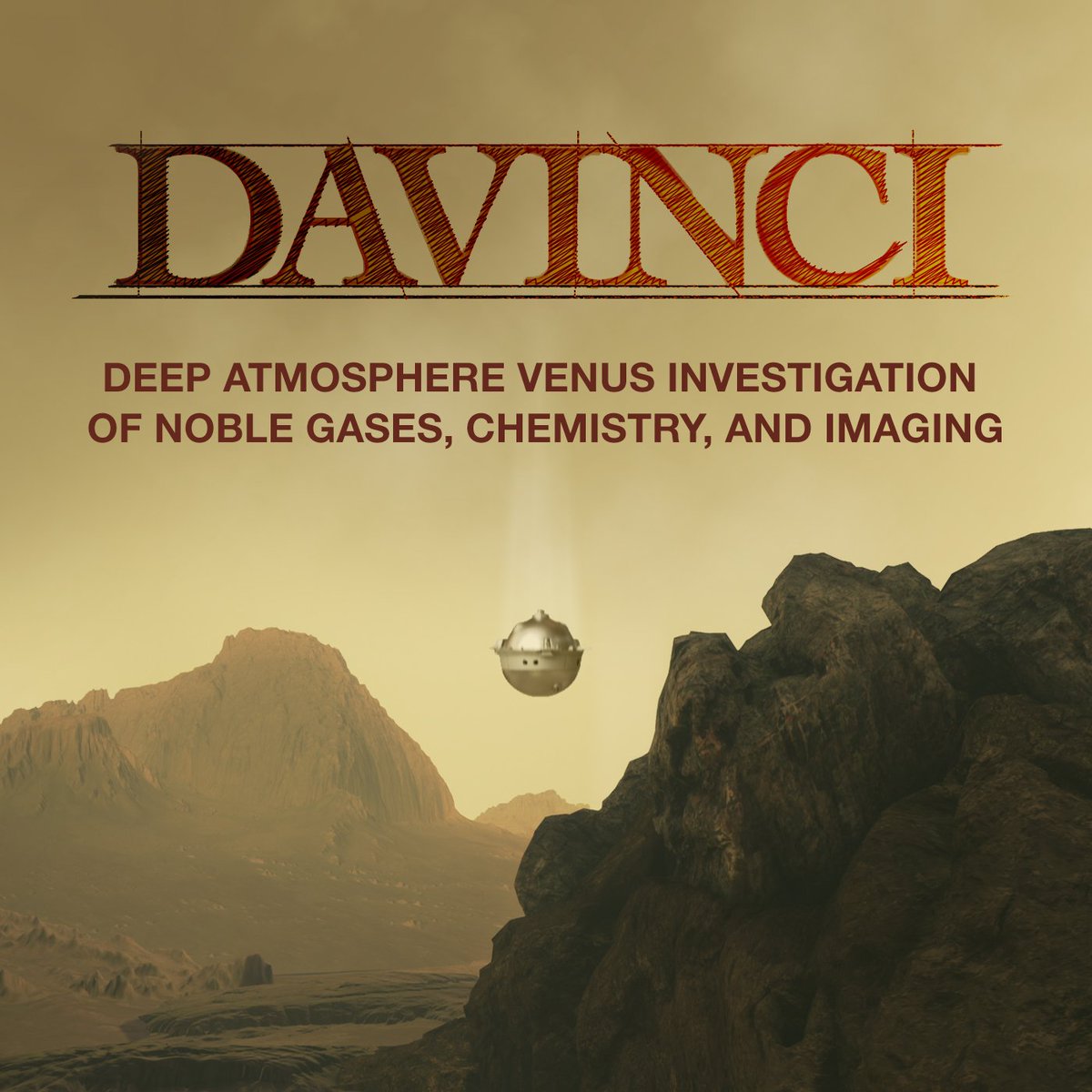
Venus’s atmosphere is a time capsule under pressure. Noble gases, isotopes, and trace chemistry can tell us whether Venus followed a fundamentally different path from Earth, or whether it began more clement and then changed profoundly over time. DAVINCI will provide the answers!
One of the many things I love about EnVision is the mindset: Venus is a connected system. Interior, surface, atmosphere, and climate evolve together. To understand why Venus and Earth diverged so dramatically, we have to study those links directly.