Tomorrow is the day.
ExoLabs goes live, May 6th, 14pm - 17pm UTC.
the privacy layer Ethereum has been missing is launching. shield your assets, move privately, own your onchain presence completely.
notis on 🔔
https://t.co/iw6hE4EWu9 (MVP)
@VitalikButerin nullifiers at scale aren't a burden on Ethereum.
they're an argument for more specialized, optimized state. restrictive structure enabling decentralization at extreme scale is exactly the right framing.
Keyed nonces are not just a way to add stronger in-protocol support for privacy solutions. They are also a potential first foray into a new state scaling strategy for Ethereum: create new types of storage that are more optimized for handling categories of use cases that we care about, with restrictions on their use that make them usable at extreme scale while preserving the protocol's decentralization.
Let's zoom in on this case (in-protocol nullifiers). Let's say we get to 2000 TPS of privacy-preserving transactions onchain, for eight years. Then we get 2^11 tx/sec * 2^25 sec/year * 2^3 years = 2^39 [ie. 500 billion] nullifiers stored onchain (the challenge with nullifiers is that they are fundamentally not possible to prune).
It's actually far easier to keep Ethereum decentralized if we have 500 billion nullifiers onchain in a dedicated nullifier store, than if we just let them grow in the current state. The reason is that the more restrictive structure of nullifiers (only used to check validity, and we can require the nullifier ID to be explicitly specified in the tx) enables more decentralized ways of handling them. This includes:
* Sharding: each node (incl builders) can hold a small percentage of nullifiers, and make sure to have a connection to an honest peer in each other shard
* Bloom filters: see this somewhat wacky idea here for reducing the VOPS requirement for nullifiers to ~8 bits per nullifier: https://t.co/M2HgDru1NV
Both techniques are not possible to use for dynamically accessible state. And so builders would have to download the full 16 TB to become viable (not just optimal, viable!), and privacy protocol users would not be able to use FOCIL without providing a Merkle branch proving that their nullifier is unspent, and there would be very few nodes capable of providing such a branch...
Zooming back out, the moral of the story is that fully dynamic state is much harder to handle at extreme scale (tens to hundreds of TB) than state that is more controlled and restricted in how it can be used. And so if we can move the majority of usage into these more specialized forms of state (which we can make much cheaper in terms of gas), then we can keep Ethereum decentralized, and highly scalable, and keep the fully dynamic state available for applications (eg. defi) that really need its full functionality.
Privacy as the default, not an afterthought.
Verify what needs to be verified without exposing everything behind it.
ExoLabs builds the same principle into how your assets move.
ZKPass is built on Ethereum.
@zkPass is a privacy-preserving identity protocol letting users prove information about themselves without revealing the underlying data.
It enables secure verification of credentials onchain while keeping personal information private by default.
ExoLabs: Technical Overview
ExoLabs is a privacy layer built on Ethereum.
It introduces a different way to handle value onchain, one where you don’t have to expose everything just to use the system.
At its core, ExoLabs separates three things that are usually tightly coupled:
ownership, state, and visibility.
1. Core Architecture
ExoLabs is built around three main components:
Token Adapter (Entry / Exit Layer):
This is the bridge between public assets and private state.
- handles shield (public → private)
- handles unshield (private → public)
- normalizes token values across different decimals
- ensures only supported tokens are accepted via a registry
Privacy Pool (Private State Layer):
This is where assets live once they’re private.
- funds exist as commitments, not balances
- no direct link between deposits and withdrawals
- uses a Merkle Tree to track valid state
- supports private transfers between commitments
Wrapped Privacy Token (vToken Layer):
This is the internal accounting layer.
- minted when assets are shielded
- burned when assets are unshielded
- always normalized to 18 decimals
- never directly exposed to the user
2. Shield Flow (Public → Private)
1. User calls shield(token, amount, commitment)
2. Token is transferred into the adapter
3. Amount is normalized
4. vTokens are minted into the pool
5. A commitment is created and stored
At this point:
- funds are no longer tied to the user’s wallet
- ownership exists only through the commitment
3. Private State Model
Instead of balances, ExoLabs uses:
commitment = hash(secret + amount + randomness)
What this means in practice:
- no readable balances on-chain
- no visible ownership mapping
- no traceable transaction flow
4. Private Transfers
Transfers don’t move tokens, they update state.
- old commitment → invalidated
- new commitment → created
- no visible sender or receiver relationship
Result:
- transfers are fully unlinkable
- transaction graph analysis breaks down
5. Unshield Flow (Private → Public)
To exit the private layer:
1. user generates a zero-knowledge proof
2. calls unshield(...)
3. contract verifies:
~ commitment exists
~ It hasn’t been spent (nullifier check)
4. vTokens are burned
5. original asset is released
Important:
- there is no link between deposit and withdrawal
- the system verifies validity, not identity
6. Zero-Knowledge Layer
ExoLabs uses zero-knowledge proofs to validate:
- ownership of funds
- correct state transitions
- no double-spending
All without revealing:
- wallet address
- transaction history
- balances
7. Key Design Principles
Non-custodial
users control how they enter and exit.
Unlinkability by default
there’s no transaction graph to reconstruct.
Minimal trust surface
the contracts enforce rules, no intermediaries.
Selective exposure (future layer)
privacy when you want it, compliance when you need it.
8. What ExoLabs Solves
Most on-chain systems expose:
- wallet identity
- financial behavior
- strategies in real time
ExoLabs removes:
- unnecessary visibility
- forced transparency
- dependence on custodial privacy tools
Summary
To be clear, ExoLabs is not just about hiding transactions.
It changes how value exists onchain:
- from balances → to commitments
- from traceable flows → to private state transitions
- from exposure → to control
ZK Proofs Humanized
zero-knowledge proofs sound complicated, fortunately the idea behind them isn't.
"prove something is true without revealing what's behind it" that's it.
ExoLabs uses ZK proofs so your transactions can be verified on Ethereum without exposing your identity, your balance, or your history.
The chain knows it's valid, nobody knows it's you.
This is what makes ExoLabs different from everything that came before. no trusted third party, and no custodian holding your assets while you access privacy.
Just cryptography doing exactly what it was built to do.
"verifiable without being visible".
you've spent this whole time on Ethereum exposed and just didn't have a choice.
now you do.
ExoLabs is live. connect your wallet, shield your assets, move privately, unshield whenever you feel like it. zero-knowledge proofs handling everything underneath. no custodian touching your funds. no one seeing what you're doing.
your balance. your transactions. your business.
come see what control actually feels like.
https://t.co/91xaOaDMiY
most of web3 was built for transparency and funny how nobody stopped to ask who that actually serves.
transparency without control isn't a feature. it's just exposure with better branding.
you already know this.
ExoLabs is the answer.
a privacy layer on Ethereum that puts how your value moves back in your hands.
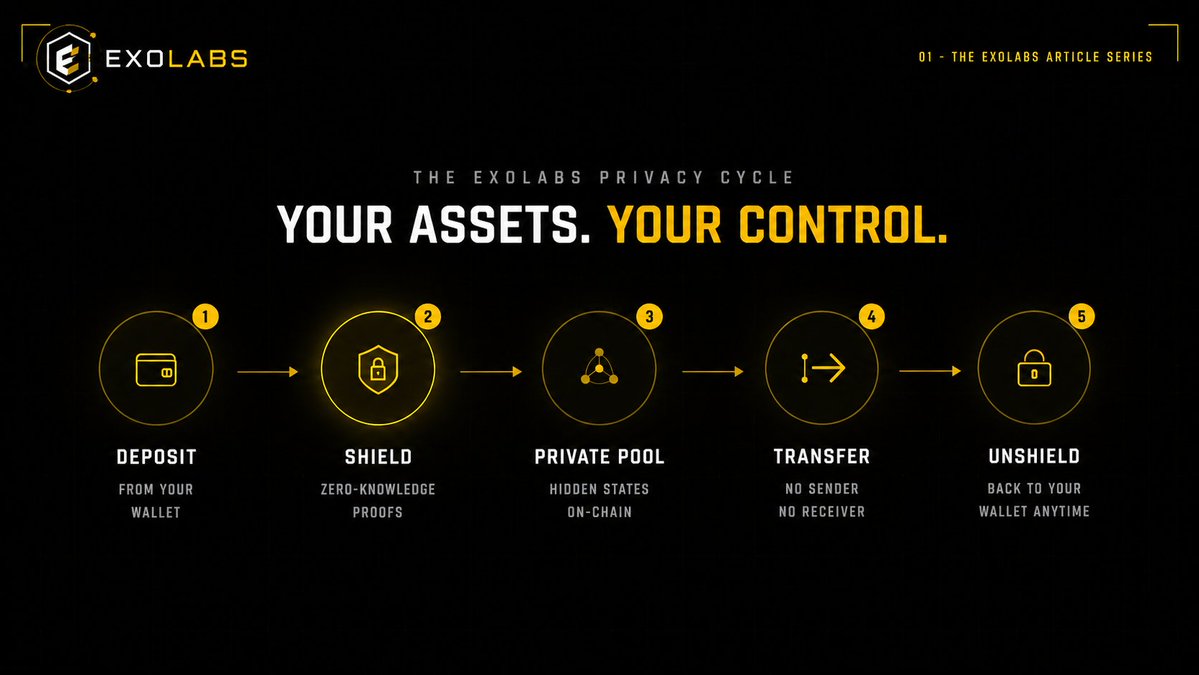
• deposit from your wallet
• shield using zero-knowledge proofs
• move assets through a private pool
• transfer without linkability
• unshield anytime back to your wallet
no custodians, middlemen and no unnecessary exposure.
privacy was never about hiding, it's about deciding what is yours to share.
this is what we shipping.
41 kidnappings of crypto holders in France in 3.5 months of 2026.
Why?
🥖 French tax officials selling crypto owners' data to criminals (Ghalia C.) + massive tax database leaks.
Now the state also wants IDs and private messages of social media users.
More data = More victims.
private data that slipped into the wrong hands and that's all it was.
information that was supposed to stay private and didn't.
and this is the part nobody talks enough about.
every step you take onchain leaves a print, your holdings, history and identity, all of it sitting there.
most of the time nobody cares. until someone does.
you see! you don't get to choose who's watching, that's the conversation we need to be having.
privacy is not extra, neither a feature you add when you feel like it.
it should be at every layer of your onchain footprint.
now this just made it impossible to ignore.
🇫🇷 LATEST: Pavel Durov claims 41 crypto-related kidnappings in France in early 2026 were fueled by data leaks exposing users’ information.
He warns Telegram could exit France over concerns about government access to private data.
Every trade you make onchain is visible. every wallet you've touched is traceable. every strategy you run is readable.
That's not decentralization. that's a surveillance layer with extra steps.
We got tired of it, so we built ExoLabs.
Here's what we're fixing:
⦁ your identity exposed every time you transact
⦁ your financial strategy readable by anyone in real time
⦁ custodians you're forced to trust just to access basic privacy
ExoLabs is a privacy layer on Ethereum. shield your balances, move assets privately, unshield whenever you want. zero-knowledge proofs under the hood, no custodians, no middlemen and no exposure.
"not everything onchain needs to be visible, ExoLabs gives you control over what stays private."
https://t.co/6JHmkoJdhr
Tag along, we're just getting started.