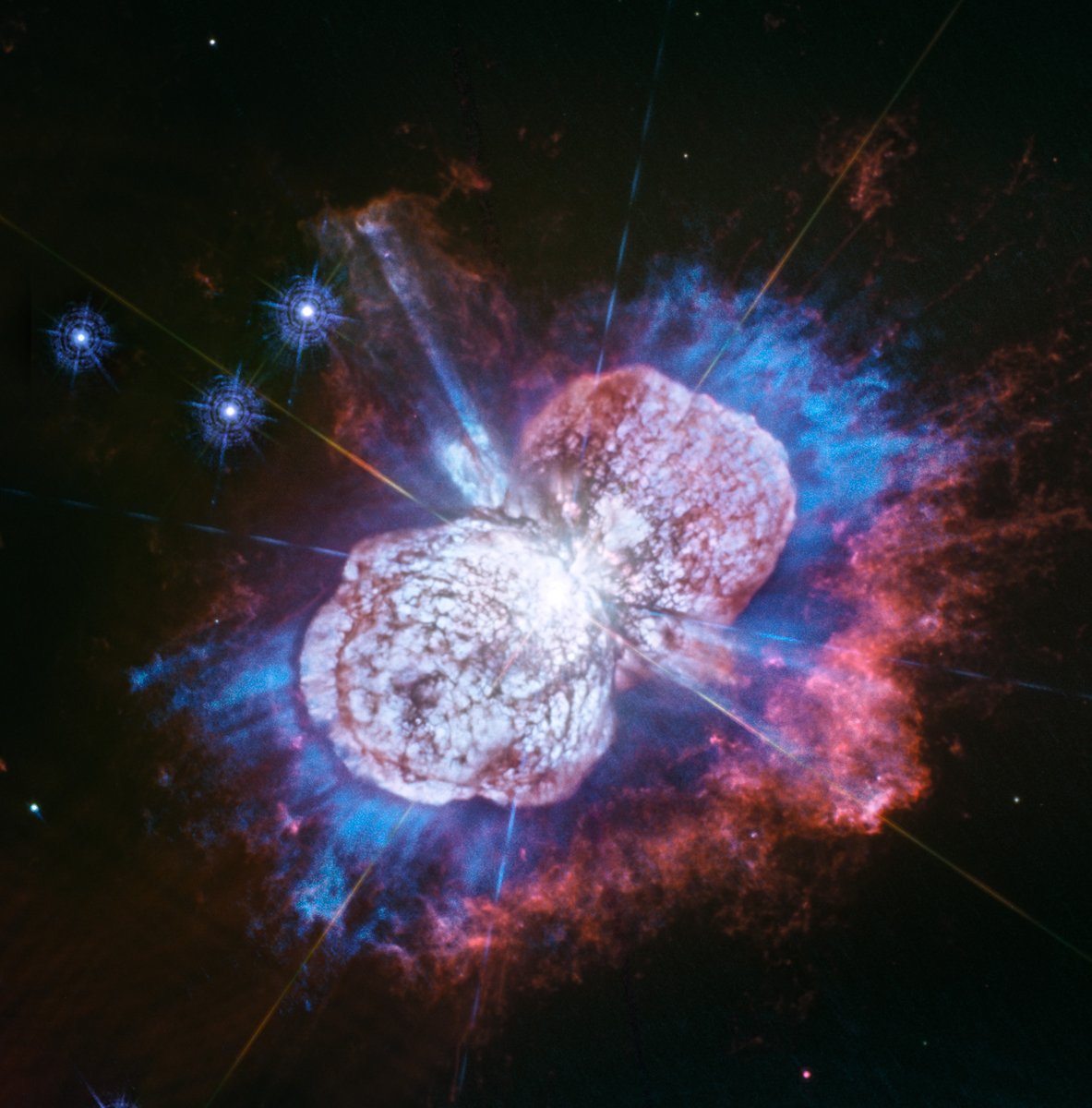
The hottest 'normal' stars we observe are blue hypergiant stars which are many times more massive than our sun. Eta Carinae is 7500 light-years away and about 35,000 K (degrees) - about 10 times hotter than the sun!
The Higgs relates to the origin of mass. Astronomy tells us most mass is not like what we see, there is other ‘dark’ matter. We don’t know if that gets its mass from the Higgs. So astronomy and particle physics tryr to understand the nature of true reality. We have a lot to learn
The first exoplanet discovered was in orbit round the star 51Pegasi. But it wasn't found by us, but by our colleague Didier Queloz and Michel Mayor who were both at Geneva at the time.They were awarded the Nobel prize this year for that discovery.
Most stars leave behind a remnant star – white dwarf, neutron star, black hole – when they die, so the total number is increasing slowly. But space-time acceleration means the fraction of the Universe we can see is shrinking. Our visible Universe has fewer visible stars.
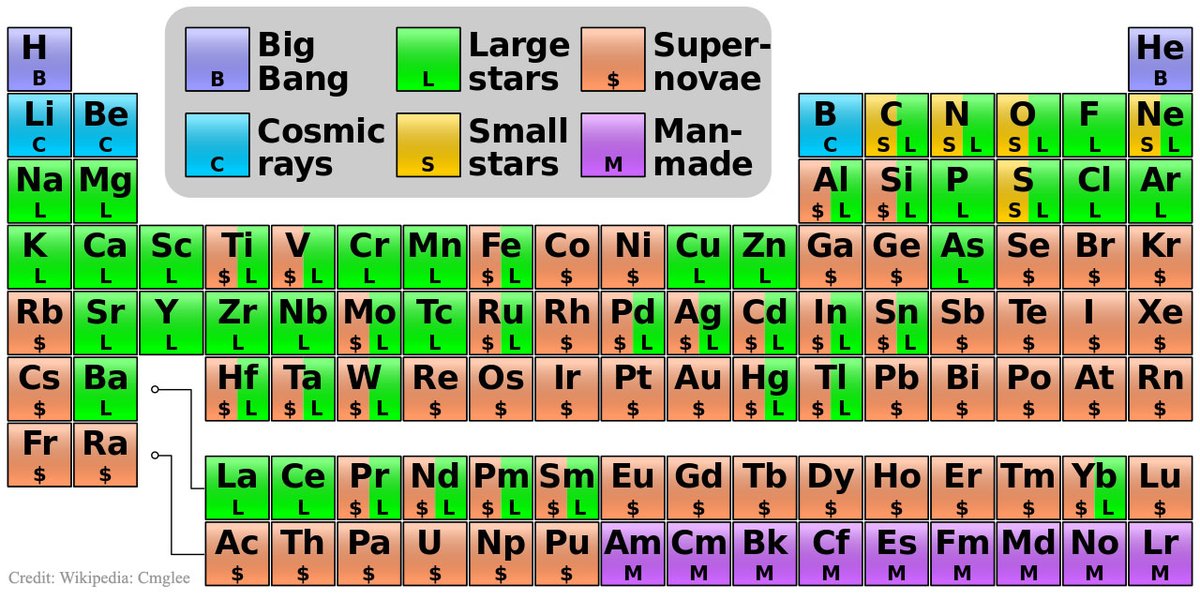
Fusion of elements heavier than iron requires energy to be added. When a star explodes as a supernova, lots of energy is suddenly available to form heavier elements. Other processes inside evolved stars also allow atomic nuclei to capture neutrons and form heavy elements. AH
Many other (exo-)planets have atmospheres - they form naturally after a planet is born, but are sometimes stripped away. We can use their chemical signatures to look for planets with atmospheres similar to Earth, in a quest to find exoplanets that can host life as we know it
@Ginger_gringo@royalsociety In terms of what that tells us about the early Universe, there is not that much that we can learn from individual galaxies that are so far away (look at the picture of GN-z11, the red blob in the box, it isn't great!)
@Ginger_gringo@royalsociety Hi Jimbo. Good question, at the moment the galaxy that we have detected that is furthest away is called GN-z11. We are seeing it at a time when the Universe was around 3% of its current age. There are different ways to define distance in an expanding Universe, but it is far away!
The short answer: we don’t know, because we can’t recreate such extreme conditions in a lab. Astronomers study the masses and radii of pulsars, which are rapidly rotating neutron stars, to see how strongly their cores can be squeezed, and infer the state of the material
An incomplete analogy is the surface of a ballon. Imagine this as a 2D space (ignoring the fact that it is embedded in a 3D space). As the ballon inflates the space between two points increases but the surface of the ballon is not expanding into anything. It's just stretching.2/2
The Universe is everything there is so there is nothing outside it into which it could expand. The best way to think about the cosmic expansion is to imagine that, as time passes, the space between galaxies increases. 1/2
In the Milky Way about one star is born each year. When the Milky Way was young maybe 10 stars were born each year. This really just tells us how short is a year compared to the age of the Universe. GG
We don't know, as we only know a very small fraction of all the stars in the universe. Within our galaxy and its satellites we find stars that are as massive as 60x the mass of the Sun, and stars near the their life that are so big they would fill the Earth orbit around the Sun
The Universe is everything there is so there is nothing outside it into which it could expand. The best way to think about the cosmic expansion is to imagine that, as time passes, the space between galaxies increases. 1/2