What a blockchain adds to a regular stock 🔗
A stock at your broker does the basics: buy, hold, sell during market hours. The same asset as a token does more.
24/7 trading 🕒
Top names (NVDAx, AAPLx, SPYx) trade on DEXs around the clock as long as there's liquidity in the pool. US market closed, you still open a position on a Saturday night.
Self-custody 🔐
The token sits in your own wallet (Phantom, Solflare, Ledger). No brokerage account needed.
Permissionless transfers
Sending a token to another wallet works like sending USDT. No request forms to a broker.
DeFi 💸
Use the token as collateral (e.g. on Kamino) or LP it into a pool and earn fees.
Fractional and instant settlement
Buy $20 worth, the trade clears in seconds, no T+2.
The caveats: only top names trade 24/7 without friction. Mid-cap tickers follow NASDAQ hours, and thin ones often return "no route" and aren't on DEXs at all. Self-custody comes with an asterisk too - the issuer can technically freeze a token. Separate post on that.
Next: why this beats a foreign broker for a crypto-native audience - US stocks from anywhere in the world.
A tokenized stock is a token backed 1:1 by a real share held at a custodian. The token tracks the share price, dividends pass through (mechanics in a separate post). But you're not in Nvidia's shareholder registry: what you hold is a claim on the token issuer. 📊
Two big issuers right now.
Backed / xStocks. Swiss issuer, fully acquired by Kraken in December 2025. Tickers carry an x: NVDAx, AAPLx, TSLAx, SPYx.
Ondo Global Markets. Part of public Ondo Finance. Tickers carry an ondo suffix: NVDAon, ASMLon.
Both hold real shares at a licensed custodian and mint tokens on public blockchains, mostly Solana.
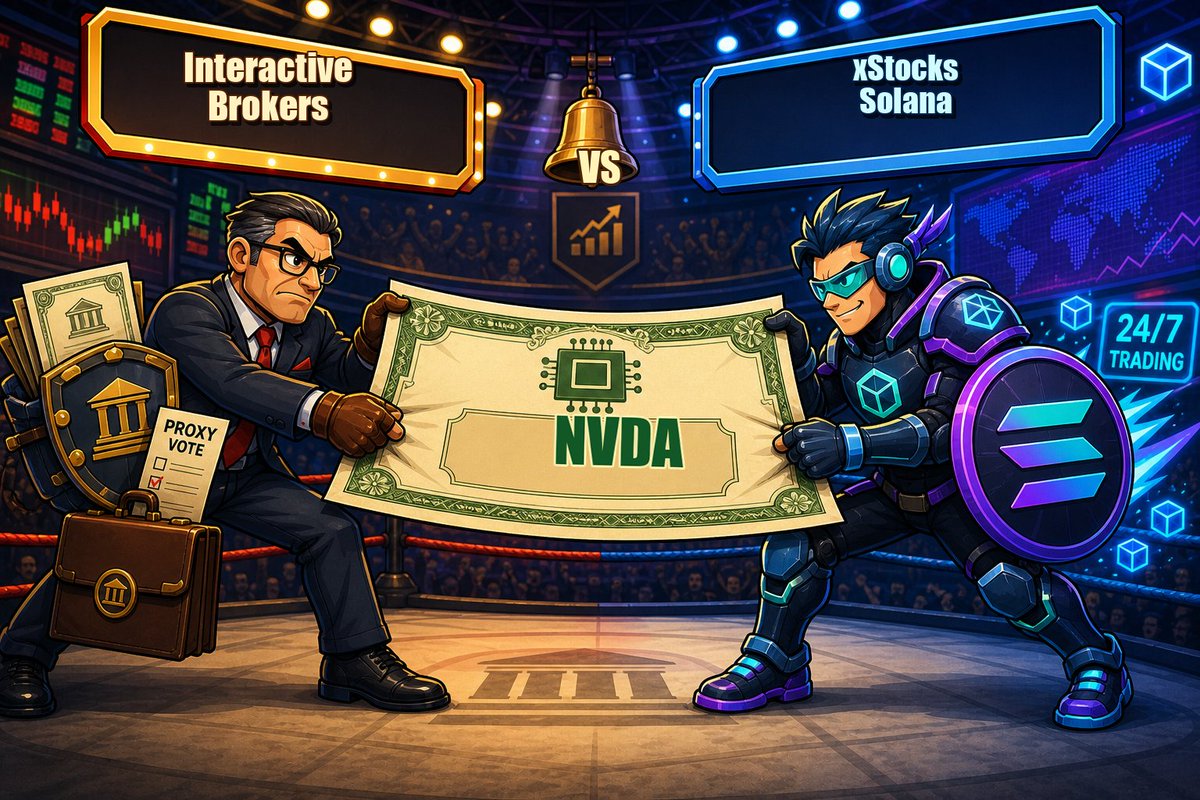
Regular broker (e.g. Interactive Brokers) vs token, side by side:
- Voting rights: broker yes, via proxy; token no
- Dividends: broker direct to account; token routed through the issuer
- Trading hours: broker exchange hours; token 24/7
- Cash out: broker sell and withdraw; token sell on the market, no direct retail redemption
- Protection: broker regulator and compensation scheme (US SIPC up to $500k); token no insurance, platform and issuer risk
- Access: broker KYC and account approval, geo limits apply; token a crypto wallet, fewer barriers
Next post: what the blockchain under the share actually gives you, and why that's interesting at all.
Crypto spent years on memes and dog coins. Quietly, another segment grew up: real world assets moving on-chain. 🏦
RWA, Real World Assets. Tokenizing things that exist outside crypto:
- US Treasuries
- stocks and ETFs
- real estate
- commodities
The real asset sits with a licensed custodian, and a token representing it is issued on-chain. From there the token acts like any crypto: your own wallet, DEX, 24/7 transfers, DeFi.
Behind the token is a real share or a coupon-bearing bond. Ondo Global Markets, the leader in tokenized stocks, just crossed $1B TVL and holds around 70% of the market, with 260+ US stocks and ETFs covered (figures as of May 2026). 📈
That means exposure to Nvidia, Apple or the S&P 500 straight from your wallet, no brokerage account. For anyone cut off from foreign brokers right now, it's one of the few working ways into US equities.
Now the risk. An RWA token is a claim on the asset, a liability of the issuer. While the issuer and custodian honor their obligations, it works. When they stop, that's where the trouble starts.
First post in a series on tokenized stocks and RWA. Next up: what a tokenized stock actually is, and how it differs from a real share at a broker.
Polymarket weather refund crisis, May 17-20 🌡
Timeline
May 17: Jakarta temperature markets manipulated by new accounts (34°C posted at 1:30 AM vs actual 27°C). Traders lost $400 to $30k. Complaints ignored for weeks. Seoul markets lost resolution tabs.
May 18: Oracle broke. Wrong brackets resolved in Miami, Mexico City, Seoul, Hong Kong. London resolved at 15°C, actual high 16°C. All temperature markets archived, positions vanished from UI. Refunds promised in 10 business days.
May 19: 50+ cities archived globally. Refund window cut to 7-10 days.
May 20: First refund batch ran on ~2k archived markets. Botched.
Root cause 🔧
Polymarket silently changed the batch price request format for UmaCtfAdapter without notifying UMA or third-party tooling. Indexes got mismapped, frontend wired markets to the wrong on-chain contracts, and resolutions went into the wrong brackets. On top of that, Weather Underground dropped data points, and missing data defaulted markets to the minimum temperature bracket. Two independent failures stacked.
Refund reality 💸
Users are getting 2-10% of expected amounts. Some users with confirmed positions got nothing. May 17 markets for Seattle, Los Angeles, Toronto, and NYC are missing from the payout list entirely. No official site-wide statement. CFTC complaints are already being filed over the communication chaos.
What to expect ⏳
Official window: 7-10 business days from the May 18 archive, so a second batch should land between May 28 and June 1. No guarantee it closes the gaps from batch one. If your position is missing: save the tx hash and a portfolio screenshot, file a ticket with the exact market id, and log the timestamp.
Collateral damage
NBA and cricket markets briefly disappeared overnight on May 20. Sponsored rewards are not showing. Auto-redeem is broken for winning positions above $1. Jakarta was officially discontinued for manipulation, yet Lagos got pulled and Jakarta is still live. No explanation.
Daily digest of the Polymarket and UMA Discord channels: @predictdigest
Pivoting from crypto to AI stocks 🤖
Hard to write about Polymarket lately. I'm building my own bot there and don't want to publish the logic. The platform keeps shooting itself in the foot too: API outages, manual market interventions (the recent weather market got resolved, then archived, then nuked). News-cycle coverage isn't my thing either.
So I'm looking elsewhere. The AI boom is obvious. Even crypto influencers have all flipped into vibe-coders. Airdrops gone, NFTs dead, DeFi keeps getting drained. Crypto is mostly grinding sideways.
Tokenized stocks are the convenient angle: you can buy them on-chain, no broker account, no KYC marathon. Started digging in deep and will publish a series on what I find.
The numbers on equities are striking. Companies I've been tracking did at least 2x over five years. Some did 5-6x in the last year alone. After down-only crypto, that looks unreal.
Two non-obvious AI-cycle picks:
GEV - energy equipment, gas turbines. ~10x in five years.
MU - server memory. ~8x in five years.
Catch: not every AI bet is on-chain. US names are mostly available as tokenized; Taiwan, Japan, Korea still need a regular broker.
What is an "agent harness" 🛠
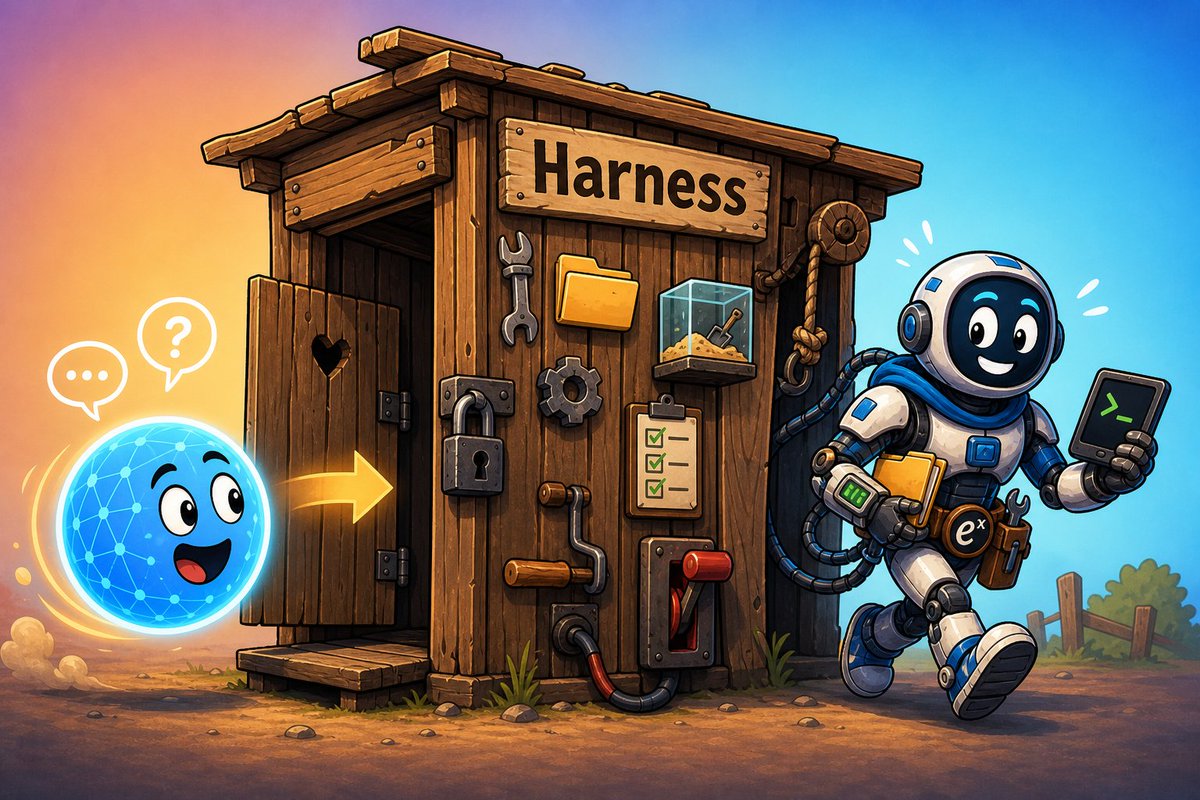
In AI talk, the harness is the wrapper around the LLM that turns a chatbot into a working agent.
Agent = Model + Harness
Model: GPT, Claude, Gemini, Llama. Just a text generator.
Harness: code, tools, memory, rules, environment, execution logic.
What harness gives a coding agent 🧩
Claude Code, Cursor, Codex - the model only writes text. The harness lets it:
- read project files
- edit code
- run terminal commands
- run tests
- see errors and retry
- hold task context
- work in a sandbox
- follow safety constraints
- log actions
Harness is everything in an AI agent except the model itself.
Example: my Polymarket bot 🎯
Model: Claude or GPT.
Harness:
- repo access
- log reading
- terminal commands
- Polymarket API
- block on real orders without confirmation
- dry-run mode
- per-trade size limits
- Telegram notifications
- error monitoring
- memory of project structure
What to build around the LLM 💡
Harness affects agent quality more than the model. For a developer that means hooking up the GPT API isn't enough. You need to build a real system around it:
LLM + tools + memory + state + permissions + retries + logging + tests + sandbox + human approval + rollback + observability
Harness is what decides whether your agent is a toy or a working tool.
Lost money on the Taipei weather market today, and the actual weather was reported correctly 🌡️
Timeline 📍
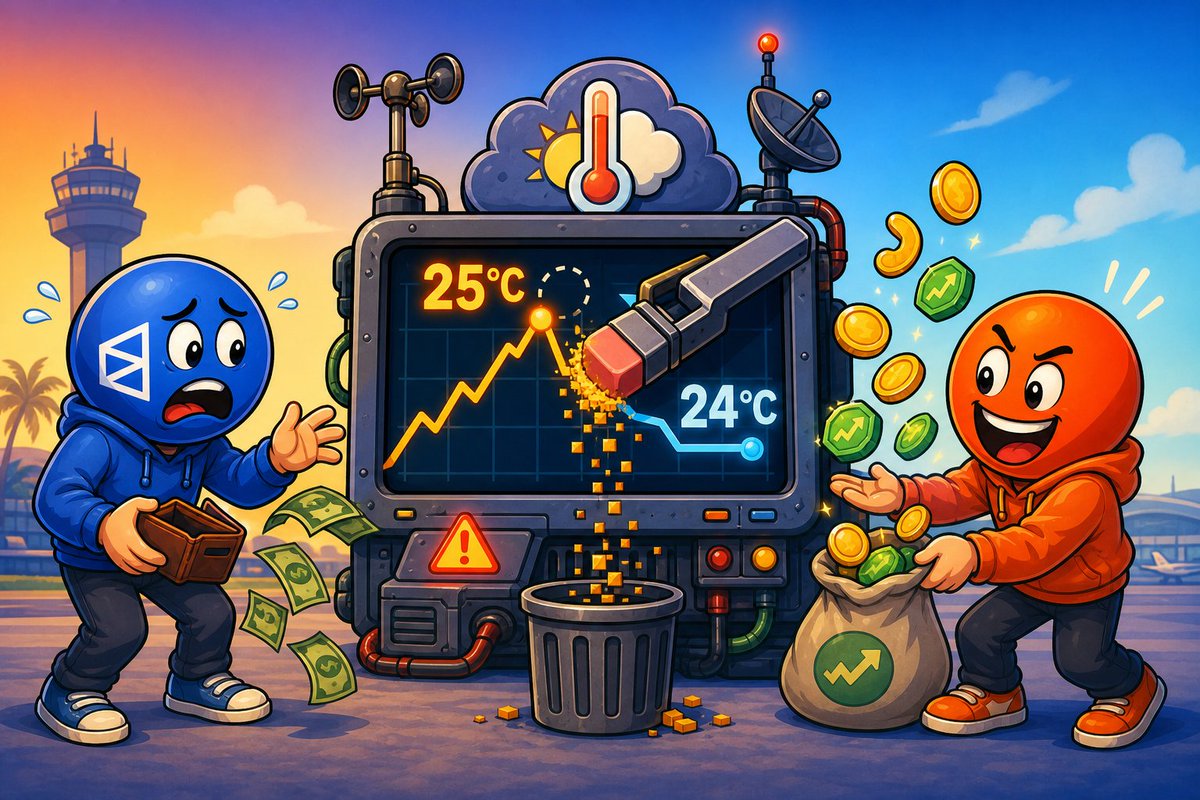
At 05:30 UTC the Taipei airport METAR (RCSS) printed 25C as the day's high. The reading showed up on Wunderground for a while, several traders saw the flat 25C line at 12:00 and 13:00 local. Then it just disappeared from the chart. WU history page now shows 24C as the daily max. The METAR itself and NOAA aviationweather still have 25C sitting there.
What this meant for Polymarket 💸
Polymarket weather markets resolve from Wunderground. While 25C was visible on WU, the "max 24C" bracket traded at 0.1 cents, the market priced it dead. One trader (MarriedNetbook) loaded up on 24 at 0.1c. Half an hour later WU "lost" the reading, daily max officially became 24C, and the bracket cashed out. Roughly $17,000 on a single market.
Bug or manipulation 🤔
Discord is split. Bug case: WU does revise historical data, similar things happened in NYC on March 8 around the DST switch. Manipulation case: the METAR didn't drop on any other source, only on the one that resolves the markets. Someone emailed Wunderground support and got a templated reply that their data is "for general informational purposes" and not warranted for any specific use, meaning WU has zero obligation to keep history correct.
What traders are discussing
Move off a single source. Candidates: https://t.co/QEcTqbFAOa, FAA aviationweather, https://t.co/Nnl44pbzb1, METAR-taf. Best idea in the thread: a multi-source consensus, like the USGS earthquake markets do. Polymarket hasn't said anything.
Daily digest of the Polymarket and UMA Discord channels: @predictdigest
How I automated my content production with Claude Code 🤖
Quick disclaimer: I write the Telegram posts myself. The idea, the structure, the meaning - all me. Claude Code only fixes typos, smooths the style, sprinkles emoji and tightens the text so it reads cleanly.
Telegram is my primary channel. I want to grow there and put real thought into it, not turn it into AI slop.
Here is how the pipeline works.
Telegram 🛠
I dictate the draft into VSCode through Whispr Flow. Claude Code cleans it up. Codex sits next to it in the same VSCode and generates the image. Control goes back to Claude, which posts everything to the channel via Telethon.
Twitter 🐦
Fully automated. It takes my Telegram post, translates it to English, reformats for X, strips external links (the algorithm hates them) and publishes through the API. I do not touch this step.
YouTube Shorts 📱
A short version is built from the same Telegram post. Voiceover via ElevenLabs API, video assembly in Remotion. Same image across all three platforms. The Shorts still look pretty rough, but I try to improve something with every iteration.
Twitter and Shorts are more of an experiment for me. I want to see how far modern AI tools can go if you hand them an entire channel.
Prediction Digest 🔭
A separate side project. Every morning at 9:00 sharp it pushes a digest from the Polymarket and UMA Discord servers: bugs, fixes, clarifications, contested markets. Fully automatic on both Telegram and X.
I originally built it for myself - I run trading bots on Polymarket and needed to spot bugs and threats early enough to shut the bots down. Then I realized it was useful beyond me and opened it to the public: @predictdigest
The whole content production and publishing system is about 90% written by Claude Code. A few evenings of work, and now it saves me hours every week.
Next experiment is a similar pipeline for my wife. She runs an Instagram blog with 40k followers and needs help with scripts, video production and recurring content series. I want to adapt the system for her workflow and see how it lands.
If this nudges anyone to try vibe coding and build something of their own, useful to themselves or to others, I will be glad.
Questions in replies, happy to discuss. If you have your own automation setups for content production and publishing, share them too.
Three market types on Polymarket every newcomer should know 🧭
Binary 🪙
One question, two outcomes. "Will X happen by Y date?" Yes and No prices always sum to $1. If Yes is at 0.62, No is at 0.38. Most markets on Polymarket look exactly like this.
Negative Risk (categorical) 🏛
One question, many candidates, exactly one wins. "Next Pope", "Best Picture winner", "Next UK PM". Inside the market sits a list of 15-40 outcomes, each with its own Yes price. Key property: the sum of all Yes prices equals about $1, because one of them is guaranteed to resolve. Open Next Pope and add up every candidate's Yes price, you'll get something close to $1.00 give or take a few cents on spread. Scalar markets with numeric ranges (BTC price on Dec 31 with bins 90-95k, 95-100k, etc.) fit the same structure, just with intervals as outcomes.
Grouped events 📋
One theme, many independent binary markets under one umbrella. "Which countries will recognize Palestine in 2026?" Each row resolves on its own. Italy recognizes Palestine, that row pays $1. Whatever Germany does has zero impact on Italy's row. Sum of Yes prices here means nothing and can be anywhere: 0.40, 1.50, 3.20.
Daily digest of the Polymarket and UMA Discord channels: @predictdigest
Polymarket V2: what's still broken 24 hours in 🔥
Auto-redeem 🔁
Wins land in USDC.e, not pUSD. You can't trade with USDC.e on V2 without a manual wrap through CollateralOnramp. People are pressing "Confirm pending deposit" after every fill or rewriting redeem scripts to go through CtfCollateralAdapter (0xADa10087...). 24 hours later auto-redeem still doesn't fire for many users.
Ghost fills 👻
Orders match in CLOB (status MATCHED), then fail on-chain. nett7: "All profits of my bot were ghost filled." pterabaktill: 1 of 9 batch orders made it on-chain. V2 dropped the nonce, and the gap between "matched" and "settled" got more visible.
"Not enough balance" with a balance
Spammed in chat: balance: 0, order amount: ... pUSD on the wallet, allowances set, order rejected anyway. Workaround: pass signature_type=2 and an explicit funder to ClobClient. Not in the migration doc.
order_version_mismatch on the old SDK
If you stayed on py-clob-client (without -v2), every POST /order returns 400. You need py-clob-client-v2 and to rewrite the calls. The "v1 client won't work" warning wasn't anywhere visible.
Redeem via CTF returns 0
Calling the old ConditionalTokens.redeemPositions with pUSD as collateral mines fine but pays out 0. V2 mints positions from USDC.e, so the pUSD positionId doesn't match what's in the wallet. Workaround from daretotry and 830lincoln: redeem through V2 adapters (CtfCollateralAdapter for regular markets, NegRiskCtfCollateralAdapter for neg-risk).
Limit orders losing fees too
Several users see fees on limit orders with the fee adjustment toggle off. The team confirmed the new scheme: fee charged in pUSD on top of the order. But /trades returns an empty fee_rate_bps, so reconstructing fee history right now is painful.
What the team is saying 📞
Stock replies: "fix in progress", "we are aware", "will be fixed shortly". 0xdanzu and chrund1e are in chat almost around the clock. Ghost fills will be fixed "next week" per a mod comment. No public ETA on auto-redeem.
Daily digest of the Polymarket and UMA Discord channels: @predictdigest
🚨 Polymarket V2 migration happens today.
⏰ Officially trading pauses for about an hour. We'll see how that goes in practice.
📋 My plan: stop the bots in 90 minutes, pull all limit orders, walk away until evening. Polymarket has burned people on simpler updates than this, no reason to play hero.
🪙 One of the bigger changes: USDC gets replaced with pUSD, Polymarket's own wrapper over USDC. If you trade through the API, the migration checklist in their docs is worth a careful read.
🛠 I haven't migrated my own setup yet. Doing it tonight or tomorrow, once the smoke clears.
🤖 A year with AI coding tools completely changed how I work. Quick personal story.
I run a Telegram channel mostly about Polymarket and weather prediction markets. I trade through my own bot that I write myself.
A year ago I started simple. Opened the ChatGPT web version, pasted in chunks of code, asked targeted questions. The model had no project context. Ask, get an example, paste it back in. That was my workflow until New Year's.
Late December 2025 I installed the Codex extension in VS Code (the editor where developers write code). Speed and approach changed completely. The AI now had access to the whole project: read any file, edit it, suggest refactors, run security audits.
Early 2026 the hype around Claude Code kicked in. I bought a subscription and ran both tools in parallel for a while, asking the same questions to Codex and Claude. Gradually I switched almost fully to Claude Code.
Right now I pay for both: $20/mo Codex, $100/mo Claude Code. $120 total. Best money I spend.
🦾 I know plenty of people are tired of crypto influencers rebranding into AI influencers. Some still deny that the AI revolution is already in the room with us. Reality will sort it out.
Working in 2026 without AI tools is like picking a horse cart over a car. You can. But you'll be 10-20x slower than your competition. This applies everywhere: code, analytics, writing, research, busywork, email.
🧠 Last few days several friends reached out wanting to figure this out. Their questions are still primitive, their heads are mush. At least three of them I'm planning to sit down with in person and walk through where to start.
If you've been putting this off, start today.
Polymarket weather markets resolve off Wunderground for 46 cities. For 44 of them you can sanity-check with the METAR from the airport station and get the same numbers. Seoul and Shenzhen are the two exceptions.
Incheon (RKSI): METAR and WU disagree by 1-2°C every single day. Stable, not noise.
Shenzhen (ZGSZ): worse. METAR usually runs 1-3°C higher than the WU page. Polymarket resolves on WU, so those degrees land directly inside the bracket.
Reason: WU doesn't read aviation METAR. It pulls from https://t.co/lNfmXM6skA (IBM Weather Company, the parent of WU, not https://t.co/QEcTqbFAOa). Their post-processing diverges from METAR for these two cities specifically.
Today @atteonthephone posted screenshots of the same WU page, same hour (11:00, April 26, Incheon Intl Airport Station). From Finland it shows 20°C. From Australia 19°C. The resolution source now depends on the IP you opened it from.
Nobody knows yet whether it's a bug or a CDN quirk. If it stays this way, you'll have to query WU from multiple IPs and take the worst value.
Edge gets eaten fast on simple stable cities. Seoul and Shenzhen stay profitable for the people who figured out the key.
🌡 US weather markets: 5-minute data instead of hourly METAR
Continuing the weather series. The previous post covered the big Wunderground cluster and split it into two groups, US and non-US cities. Today, how to get more weather data for the US side.
Standard airport METAR is published once or twice per hour, usually at minute 51. For US weather markets on Polymarket there is a better source: the timeseries-viewer on https://t.co/QEcTqbFAOa, where ASOS stations at civil airports push observations every 5 minutes.
It works like this: https://t.co/frC29omdPY for New York, ?site=KAUS for Austin. Plug an ICAO airport code into the site parameter and you are done.
5-minute data exists for every city in the weather pool except Denver. Polymarket resolves the Denver market on Buckley Space Force Base, a military airfield that only transmits hourly METAR.
With 5-minute observations you see where the temperature is heading 10 to 15 minutes before the hourly METAR lands. When the contract comes down to a single degree, that is a tangible edge.
⚠️ Two traps of the 5-minute data
1. 5-minute reports still come from a METAR string, but that string has no tenths of a Celsius degree. Whole Celsius only, then converted to Fahrenheit. Between two hourly METARs accurate to tenths you get a chain of 5-minute values rounded to whole Celsius. Near bracket boundaries it can mislead.
2. The official resolution source on Polymarket for these markets is still Wunderground, which only takes the hourly METAR. If a temperature spike flashes on the 5-minute feed and is gone by the hourly reading, the market outcome does not move. https://t.co/YQvGerOSzf here is a fast monitoring indicator. It does not override market rules.
📬 Daily Polymarket and UMA Discord digests: @predictdigest on X, Prediction Digest on Telegram.
🌡 Polymarket weather markets: inside the Wunderground group, 46 cities
Continuing the weather series. The previous post split all 50 cities into three groups by Resolution Source. Today I take the biggest one: Wunderground, 46 cities.
🛬 Why airports and why METAR
Every airport in the world, by ICAO agreement, publishes a weather report every hour (sometimes every 30 minutes) for pilots. Temperature, dew point, visibility, wind speed and direction, pressure, clouds. It exists for approach: the pilot has to know what is coming in five minutes.
The format is called METAR and is described in Annex 3 to the Chicago ICAO Convention. It is identical in Chicago, Tokyo and Buenos Aires. That is why Polymarket anchors weather markets on METAR: it is the only temperature source in the world with guaranteed cadence, a single structure and aviation-grade accountability.
🌍 Two worlds inside group 1
The 46 cities split into two uneven parts.
🇺🇸 US, 11 cities. New York, Los Angeles, Chicago, Miami, Seattle, Houston, Dallas, Atlanta, Denver, San Francisco, Austin. Wunderground shows the temperature in Fahrenheit.
🌐 Rest of the world, 35 cities. From London and Paris to Jakarta, Lagos, Wellington. Wunderground shows the temperature in Celsius.
❗ Fahrenheit in the US is not sensor data
The main misconception. If the site shows Fahrenheit, it feels like the airport measures in Fahrenheit. It does not work that way. METAR is an ICAO standard and temperature inside it is always Celsius. Any airport in the world, from O'Hare to Sheremetyevo, encodes the same way. Fahrenheit on Wunderground is already a UI conversion.
🔬 A second, precise temperature inside US METAR
American METAR has a detail the rest of the world does not. A real report from Chicago O'Hare:
KORD 191351Z 24007KT 10SM BKN090 BKN250 07/M03 A3009 RMK AO2 SLP194 T00671033 $
The 07/M03 group after visibility is the standard ICAO field: whole degrees Celsius for temperature and dew point. Here it is plus 7C and minus 3C. Every airport in the world gives this format.
The tail after RMK, the T00671033 group, only exists in US METAR. It is an NWS/ASOS extension on top of the standard, separate from ICAO METAR itself. The RMK block is reserved for national additions, and US automated stations (ASOS) use it to report temperature with tenths. It reads like this:
▫️ T is the marker.
▫️ 0 067 is the temperature: 0 means plus, 067 means 6.7C.
▫️ 1 033 is the dew point: 1 means minus, 033 means 3.3C.
So plus 6.7C and minus 3.3C. Same temperature as in 07/M03, only with tenths.
💰 Where the +1F gap comes from
For US cities Wunderground does the Fahrenheit conversion from the precise T group:
round(6.7 * 9/5 + 32) = round(44.06) = 44F
From the rounded version of the main field it would be:
round(7 * 9/5 + 32) = round(44.6) = 45F
One degree of Fahrenheit appears out of nowhere. And it gets caught regularly: double rounding (first to whole Celsius, then to Fahrenheit) produces a different number than single rounding from the original tenths. On days when the market sits between adjacent brackets, this one degree decides the outcome.
✅ The rule
For US cities, parse the Txxxxxxxx group after RMK, convert its tenths of Celsius to Fahrenheit with one formula, round exactly once and at the very end. For international cities the main 07/M03 field is enough: Wunderground shows Celsius there, and the precise group is absent from METAR anyway.
👉 Next in the series: Seoul and Shenzhen, two exception cities.
📬 Daily digests from Polymarket and UMA Discord: @predictdigest
Imagine you and 99 other people get locked in a house for a year. Your only job: trade on Polymarket, all day, every day. At the end of the year, only five of you walk out with more than $98 in profit. How do you like that?
That's not a thought experiment. That's what the data actually shows.
ESSEC, HEC and University of Toronto just published a full dissection of Polymarket from Nov 2022 to Oct 2025. 1.48M wallets, $20B volume, 70M trades. SSRN, March 2026.
The numbers:
70.8% of users lose money. About 1.05M people.
The median user finishes down $1.
Average PnL across everyone: exactly $0. It's a zero-sum market.
Now look at who actually makes it.
Top 0.1% of winners took 58.5% of all profits.
Top 1% took 84.1%.
95th percentile PnL across all users: $98. Only ~5% of participants ever cleared $98 in their wallet's lifetime.
Crossing $1,000 in total profit? Roughly 1.5 to 2% of everyone who ever traded. Over three years, not one.
Why it plays out this way: prices on Polymarket are well-calibrated. A 35¢ contract resolves YES 35% of the time. The market is efficient, so you beat it only with a real informational edge.
Who loses:
- longshot chasers (under 10¢ or over 90¢, where the average user places 63% of trades)
- pure liquidity takers, never makers
- overtraders
- users stuck in one market category
Prediction markets are a competitive venue where a few thousand prepared players quietly collect money from hundreds of thousands of unprepared ones.
Codex now generates images locally
OpenAI's Codex CLI got a built-in imagegen skill. No OPENAI_API_KEY needed, auth runs through the regular ChatGPT login.
The skill is fresh. imagegen landed in the public skills repo in January 2026, and in April Codex started highlighting it as a tool that can generate images through GPT Image.
The binary sits at /Applications/Codex.app/Contents/Resources/codex. It is not on PATH, so you call it by full path:
/Applications/Codex.app/Contents/Resources/codex exec --full-auto "Use the imagegen skill. Generate ..."
Pairing with Claude Code.
Claude can run shell commands, so it can call Codex through Bash and pull an image straight into its own dev pipeline. Two agents in one session, one writing code, one drawing pictures. No reason to leave the terminal.
Real example from my setup. I asked Claude to generate a cover for a post about Polymarket weather markets. Claude called Codex, Codex returned a PNG, Claude dropped the file into assets/ and kept working. Full loop in a single command.
For anyone coding in vibe mode, this kills one more reason to tab into the browser. Logos, previews, icons, mocks, all generated in the same terminal where you write code.
POLYMARKET DIGEST — 18 APRIL 2026
⚠️ Bugs & Issues
Critical Trading Issues:
• Withdrawal failures across all blockchains
• "Merge shares failed" errors preventing users from redeeming positions
• Double betting bug despite single confirmations
• PnL charts showing inflated profits due to fee calculation errors
• Balance locking changed - buy orders now lock 1:1 instead of shared collateral
• Rust SDK re-authenticating on every order, causing latency spikes
Platform Performance:
• Xtracker completely down for multiple users
• Rewards distribution broken ~48 hours - users getting 20-30% instead of 50% of daily farming pool
• Activity lists capped at 30 items on mobile, won't load more
• Wallet connection delays extended to 3+ minutes
• 3-second artificial delay on all weather market taker orders
Weather Markets Data Issues:
• Paris temperature markets switched from problematic airport to LFPB station
• Karachi resolution source needs airport mapping fix (OPKC vs OPMR)
• Weather Underground showing inconsistent temperatures across pages
• Personal weather stations being manipulated to confuse official data
📋 Clarifications
Venezuela Leadership Markets:
Major rules update across 40+ Venezuela leader prediction markets clarifying "officially holds" requires formal appointment, confirmation, and swearing-in as head of state. UN hasn't formally removed Maduro as President.
Market Rules:
• Claude Opus 4.7 markets: Highest scoring variant used for resolution
• Multiple Japanese soccer and golf markets resolving to draws with losing share refunds
• WTI Crude Oil switching from WTIK6 to WTIM6 contracts April 16 at 6PM ET
🔥 News & Announcements
V2 Platform Launch:
Exchange upgrade goes live April 22nd at 11am UTC with ~1 hour downtime. All limit orders will be cancelled, orderbook cleared. Requires SDK/API migration and new contract addresses.
⚡ Disputes
BTC 15-minute Up/Down market showing conflicting data - chart indicates "up" but outcome marked "down" with suspicious end-of-period price manipulation reported.
With so many critical bugs hitting withdrawals, rewards, and basic market functions simultaneously, do you think this is just growing pains before V2 launch or a sign of deeper infrastructure problems?
Polymarket weather markets: where the temperature actually comes from
Starting a series on Polymarket weather markets. First post is the intro. How many markets there are and which source each one resolves against.
Right now there are 50 cities. Every day the market trades the maximum daily temperature at a specific airport. Each market description has a Resolution Source field, the exact URL UMA will use to confirm the final number. By that source, all 50 cities split into three uneven groups.
Group 1. Wunderground, 46 cities.
Everything traded in the US: New York, Los Angeles, Chicago, Miami, Seattle, Houston, Dallas, Atlanta, Denver, San Francisco, Austin. Plus almost the entire rest of the world: London, Paris, Tokyo, Seoul, Singapore, Shanghai, Beijing, Madrid, Milan, Munich, Warsaw, Amsterdam, Helsinki, Ankara, Toronto, Mexico City, Panama, Buenos Aires, Sao Paulo, Wellington, Cape Town, Lagos, Jeddah, Jakarta, Kuala Lumpur, Taipei, Busan, Lucknow, Chengdu, Chongqing, Wuhan, Shenzhen, Guangzhou, Karachi, Manila.
Source: the Daily Observations page on Wunderground by airport ICAO code. Example for Paris / LFPG: https://t.co/wUSchiYASw
Group 2. https://t.co/YQvGerOSzf, 3 cities.
Moscow, Istanbul, Tel Aviv. The market resolves on the Temp column at https://t.co/5poVQ0BgK8. Example for Moscow / UUWW: https://t.co/fNoU85bUBy
Group 3. Hong Kong, a separate case.
Hong Kong has its own Resolution Source that matches neither of the first two groups. I do not trade it yet, so the full breakdown goes in a separate post in the series. Since it is the only city with its own source, many traders likely skip it. That makes it a good spot to dig in and become the local expert. With less competition, trading it can actually work.
Why this matters.
Two pages can show different temperatures for the same hour. Wunderground pulls data through https://t.co/lNfmXM6skA, while https://t.co/QEcTqbFAOa gets its feed from different providers. For airports outside the US and Canada, a 1 to 2 degree gap between channels is common.
Rule number one: before trading, open the market description and click the exact Resolution Source link for that specific day.
Next posts in the series will cover each group separately: where METAR COR corrections get caught, why Tel Aviv and Denver are built differently, and what is going on with the sensor at Charles de Gaulle.
Daily digests from Polymarket and UMA Discord: @predictdigest