TON618 v1.1 reports a parameter-free cosmological solution producing:
• H₀(local) = 73.52 km/s/Mpc
• H₀(CMB) = 67.39 km/s/Mpc
• fσ₈(z=0) = 0.4224
• Δχ² = −69.85 vs ΛCDM in tested sectors
Most notably, the framework produced H₀ = 73.52 months before a major independent 2026 observational result converged on H₀ = 73.50 ± 0.81.
Open-source cosmology, reproducible computation, and testable thermodynamic gravity models may become increasingly important in the next generation of cosmological research.
Read more:
https://t.co/Sg50ChxmUx
#Cosmology #HubbleTension #Astrophysics #OpenScience #Physics
TON618 v1.1 OPEN-SOURCE COSMOLOGY ENGINE CONSISTENT WITH LATER HUBBLE TENSION OBSERVATIONS- reports a parameter-free cosmological solution producing:
• H₀(local) = 73.52 km/s/Mpc
• H₀(CMB) = 67.39 km/s/Mpc
• fσ₈(z=0) = 0.4224
• Δχ² = −69.85 vs ΛCDM in tested sectors
Most notably, the framework produced H₀ = 73.52 months before a major independent
he Hubble tension is real — and it’s not going away.
A collaboration of 37 researchers (H0DN, 2026), using local distance ladder methods (Cepheids + Type Ia supernovae), reports:
H₀ ≈ 73.5 ± 0.8 km/s/Mpc (~1% precision)
Meanwhile, early-universe predictions from ΛCDM (CMB-based analyses) remain at:
H₀ ≈ 67 km/s/Mpc
That’s a discrepancy of over 6 km/s/Mpc — far beyond statistical uncertainty.
After years of cross-checks (Cepheid calibration, selection bias, photometry, extinction models), the tension persists — and is becoming increasingly robust.
We are left with two possibilities:
• A subtle, unidentified systematic error
• New physics beyond ΛCDM
This is no longer a small anomaly — it’s a structural inconsistency in modern cosmology.
Any consistent framework must reconcile both regimes: local expansion and early-universe constraints.
Ignoring it is no longer scientifically defensible.
Einstein’s physics is no longer a complete theory of the Universe.
And the scientific community knows it.
General Relativity remains one of the most successful theories ever written — locally. It predicts planetary motion, gravitational waves, and lensing with extraordinary precision. But as a global theory of the Universe, it is no longer sufficient.
This is not a controversial statement inside physics. It is simply one that is rarely said out loud.
Cosmology today survives through layers of effective fixes: inflation to repair initial conditions, dark matter to stabilize structure, dark energy to force expansion. None of these arise naturally from Einstein’s equations. They are add-ons, not consequences.
More tellingly, the cracks are widening, not closing:
the Hubble tension persists,
structure growth tensions remain,
early massive objects appear too soon,
and increasingly complex parameters are required to maintain consistency.
When a theory needs more assumptions every decade to explain the same Universe, it is no longer fundamental — it is phenomenological.
This does not mean Einstein was wrong.
It means his theory reached its domain of validity.
The real problem is not scientific — it is institutional. Admitting that General Relativity is incomplete at cosmological scales forces a deeper question: what replaces it? And that question has consequences for careers, pipelines, and decades of accumulated interpretation.
So the system prefers delay over rupture.
Over the next ten years, physics will likely change its language before it changes its foundations: more talk of emergence, entropy, information, and effective geometry — without openly declaring a paradigm shift.
But make no mistake:
the shift is already happening.
Not because of belief.
Because the Universe no longer fits inside the old frame.
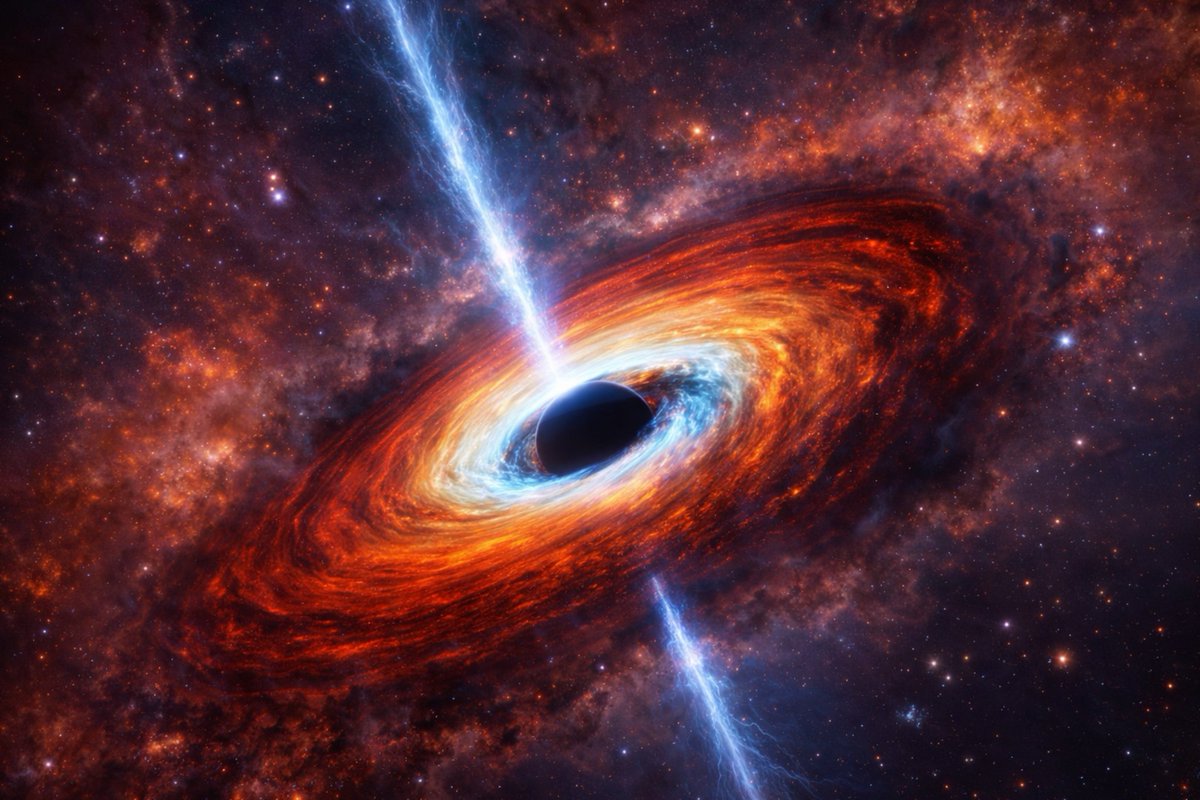
TON 618 IS NOT A “RECENT PROBLEM.”
identification in the Tonantzintla catalogue (1957) and its recognition as an extreme quasar (1970), its size has been incompatible with slow hierarchical growth. In 2004, when its mass was estimated at ~10¹⁰ M☉, the crisis became explicit —
https://t.co/ixzo5dKMWW
It only reacted:
• ad hoc super-Eddington accretion
• improbable merger histories
• post-hoc parameter adjustmentsThe Dead Universe Theory (DUT) does the opposite.
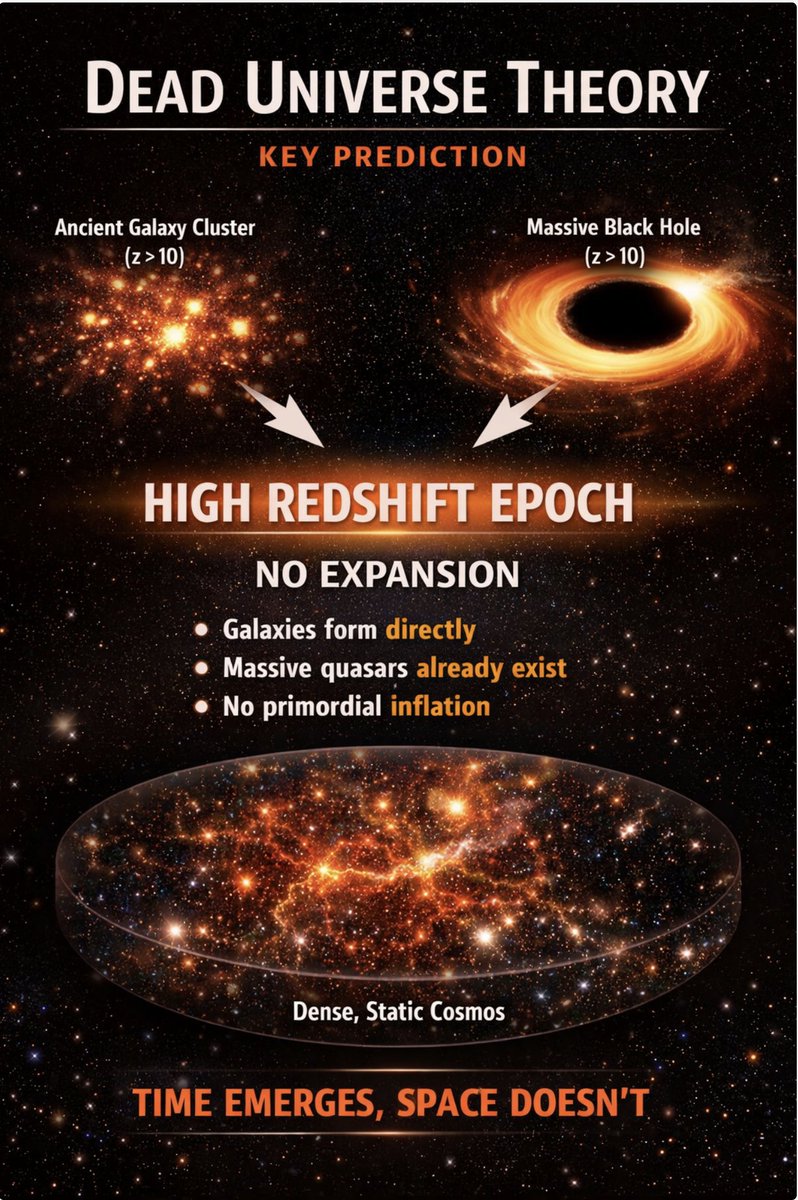
It predicts objects like TON 618 as primordial direct-collapse structures, regulated by viscoelastic dissipation of the vacuum — not by accretion time.The same framework that:
• explains TON 618
• predicts mature SMBHs at high redshift
• anticipated GN-z11 and JWST z > 10 results
• fixes γ = 0.618 without fittingwas mathematically complete before recent observations.TON 618 is not an anomaly.
It is a cosmological fossil.
And fossils do not form “too late” — they survive.ΛCDM reacts.
DUT anticipates.hashtag#TON618 hashtag#Cosmology hashtag#JWST hashtag#BeyondLCDM hashtag#DeadUniverseTheory hashtag#OpenScience hashtag#DeSci
TON 618 IS NOT A “RECENT PROBLEM.”
identification in the Tonantzintla catalogue (1957) and its recognition as an extreme quasar (1970), its size has been incompatible with slow hierarchical growth. In 2004, when its mass was estimated at ~10¹⁰ M☉, the crisis became explicit — 18 years before JWST.ΛCDM has never explained TON 618.
SOLUTION ARTICLE: https://t.co/pvzlnnlxWL
It only reacted:
• ad hoc super-Eddington accretion
• improbable merger histories
• post-hoc parameter adjustmentsThe Dead Universe Theory (DUT) does the opposite.
It predicts objects like TON 618 as primordial direct-collapse structures, regulated by viscoelastic dissipation of the vacuum — not by accretion time.The same framework that:
• explains TON 618
• predicts mature SMBHs at high redshift
• anticipated GN-z11 and JWST z > 10 results
• fixes γ = 0.618 without fittingwas mathematically complete before recent observations.TON 618 is not an anomaly.
It is a cosmological fossil.
And fossils do not form “too late” — they survive.ΛCDM reacts.
DUT anticipates.#TON618 #Cosmology #JWST #BeyondLCDM #DeadUniverseTheory #OpenScience #DeSci
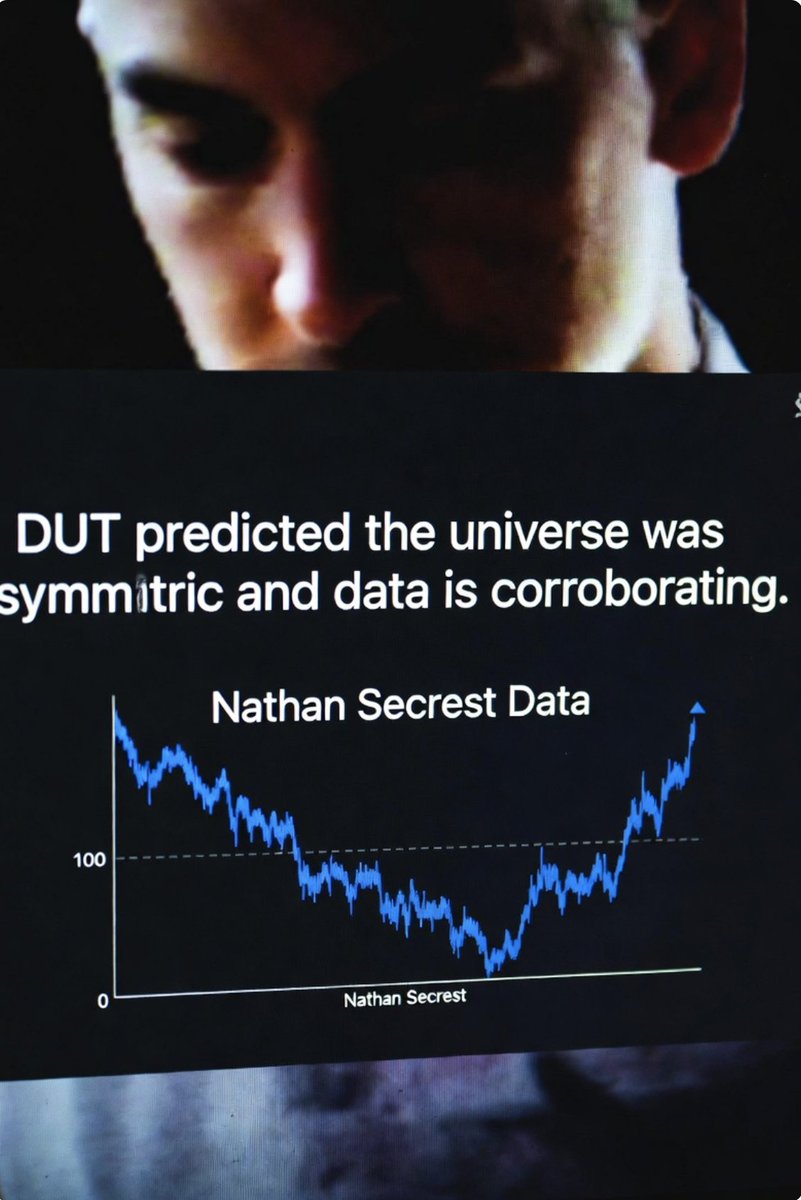
"The Dead Universe Theory (DUT) predicted since the 2016draft ( formalized 2024+): the universe is asymmetric due to irreversible thermodynamic retraction—not eternal symmetric expansion. https://t.co/BkWt7rOTU9 create thermodynamic cavities in the dead substrate (Ξ_{\mu\nu}), generating directional dipole and cosmic infertility (dN/dt < 0). Now corroborated! Nathan Secrest et al. (Rev. Mod. Phys. 2025) confirm cosmic dipole anomaly >5σ: matter dipole 2–3× larger than expected kinematic from CMB, direction aligned with Axis of Evil. DUT explains it as an entropic signature of a structurally decaying cosmos. ΛCDM in serious check! Secrest paper: https://t.co/tgWtGj0NLW #DeadUniverseTheory #DUT #CosmicDipole #AsymmetricUniverse #Cosmology #JWST"
The Death of the Genius
It is undeniable that technology has overtaken the genius of the blackboard, and looking to the past, we see an era of myths—names like Einstein, Friedman, and others. In the past, the limitation of science was mental processing; today, the bottleneck has shifted to asking the right question. Before, the genius was the one who could solve the equation on paper; now, the genius is the one who knows which equation should be built and how to interpret what algorithmic intelligence delivers. We are living through the transition from "paper-and-chalk science" to "processing science."
A formal education in astrophysics based solely on the blackboard is, in a very specific sense, becoming obsolete for cutting-edge research. There is little reason to invest time and resources in mastering obsolete calculations that are no longer necessary, as they exist ready-made to be executed by an algorithmic intelligence. Manual calculation, which was once the "arm" of mathematics, has been surpassed in the realm of high-level scientific production. No one manually calculates a black hole orbit to publish a paper anymore. The blackboard today serves primarily a pedagogical role—to build fundamental intuition. But for actual progress, it has been overtaken by the speed of silicon.
So, the future belongs to computational physics, and this will allow men and women who might not have been considered geniuses in the past to achieve results that were once the exclusive domain of a few brilliant minds. Computing and AI function today as a true exoskeleton for the mind. If before we needed an exceptional IQ to grasp the curvature of spacetime through complex tensors, today visualization and simulation tools allow a person of average intelligence to comprehend the phenomenon visually and experimentally. Knowledge is ceasing to be an individual gift and is becoming an available computational resource.
However, this new era brings with it a significant danger: the risk of mental laziness. The temptation to have everything ready and wait for answers provided by algorithms can lead the human mind toward a regression. If we abdicate the effort of thinking, we risk a new kind of dark age, where we become intellectually dependent on our own creations. It is essential to remember that, even with all the power of computation at our fingertips, the true glory and greatest conquest of humanity lies in the very act of studying and exercising the mind. The certainty of having the results pre-calculated should not be an excuse to stop learning, but rather an opportunity to ascend to higher levels of questioning.
Perhaps this is the great leap for humanity: to make the complex uncomplicated for the common man. This removes physics from the pedestal of the "sacred" and brings it into the realm of a practical tool. The modern challenge will no longer be "being a genius" in the classical sense, but rather being creative and having critical thinking to guide the machines. The genius of the blackboard is dying so that science can finally belong to everyone—but only if we remain vigilant, ensuring that the tool does not atrophy the very mind it was meant to empower.
Article: https://t.co/QX5cb9HkQQ
Article: https://t.co/pJ7xSlTEZI
Joel Almeida, Ph.D - Cosmologist, Computational Astrophysicist, and Software Architect
The Physical Foundations of the Viscoelastic Continuum (DUT)
Preprint: https://t.co/85m5X4gFuF
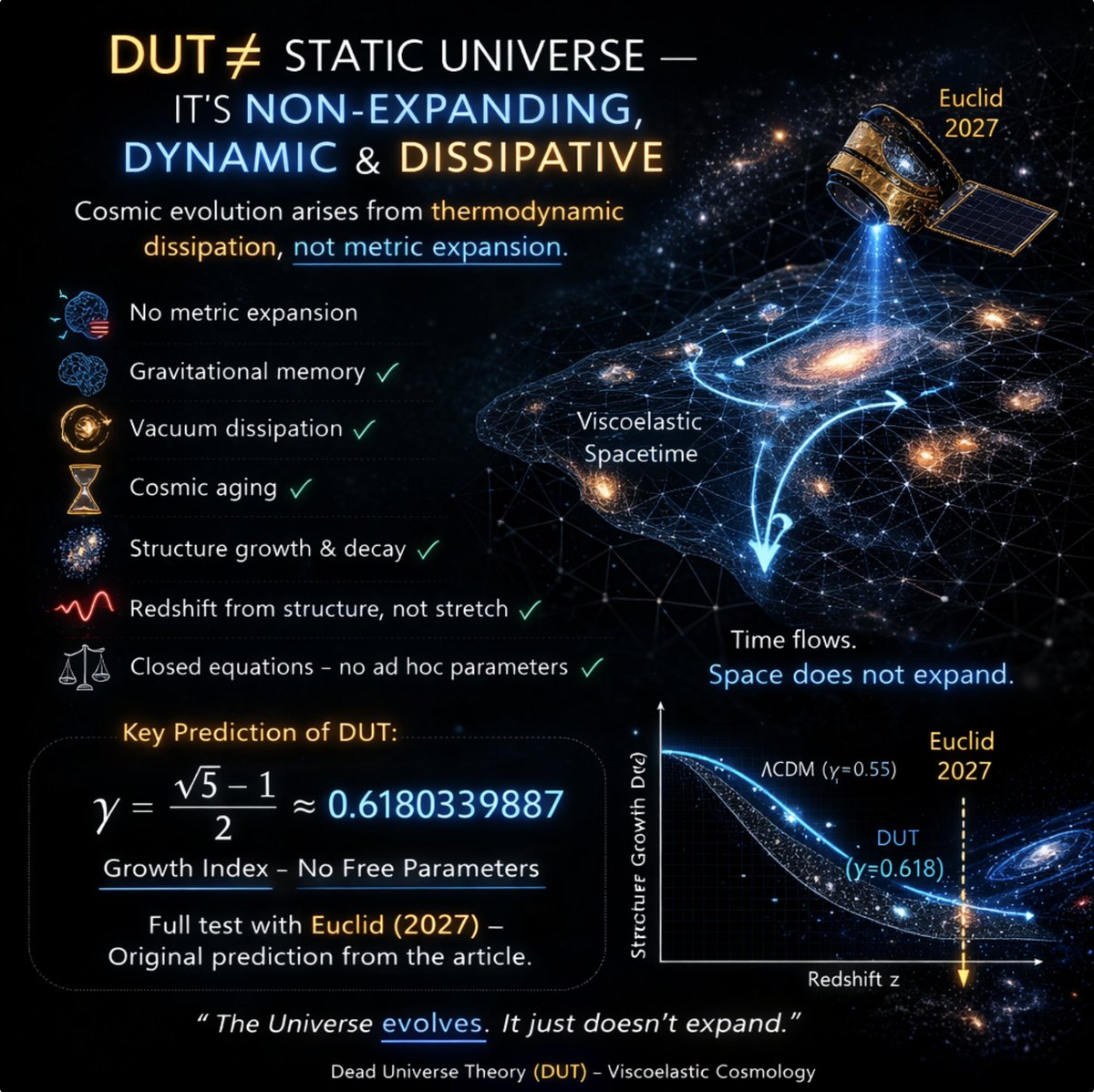
Most importantly: DUT makes a sharp, testable prediction for structure growth:
👉 γ = 0.6180339887 (golden ratio) — a fixed, parameter-free line of falsification.
With Euclid, DESI, and Roman, the verdict is coming. If γ → 0.55, DUT falls. If γ → 0.618…, a new paradigm stands.
Preprint: https://t.co/85m5X4gFuF
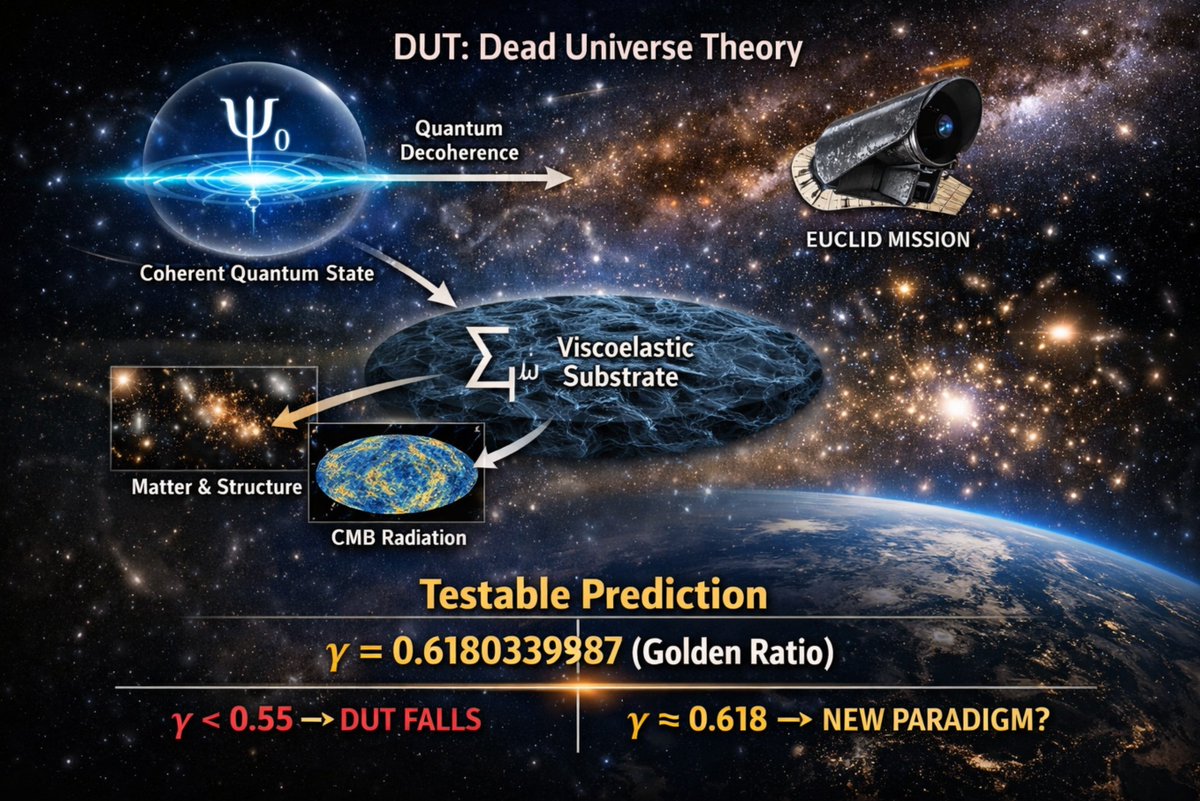
What if the universe didn’t “begin” with a hot Big Bang — but emerged from a silent, coherent state Ψ₀?
In DUT, the observable cosmos arises through quantum decoherence of a primordial, non-dynamical substrate. This transition unlocks time, generates a viscoelastic structural tensor Ξₘᵥ, and hierarchically gives rise to geometry, matter (as topological defects), and light itself.
No fundamental dark energy. No singularity. No arbitrary micro-chronology — only a minimal, physically derived instability scale.
Most importantly: DUT makes a sharp, testable prediction for structure growth:
👉 γ = 0.6180339887 (golden ratio) — a fixed, parameter-free line of falsification.
With Euclid, DESI, and Roman, the verdict is coming. If γ → 0.55, DUT falls. If γ → 0.618…, a new paradigm stands.
Preprint: https://t.co/85m5X4gFuF
#DUT #Cosmology #Decoherence #Euclid #CMB #NewPhysics
🚨 HISTORICAL BREAKTHROUGH IN THEORETICAL COSMOLOGY 🚨
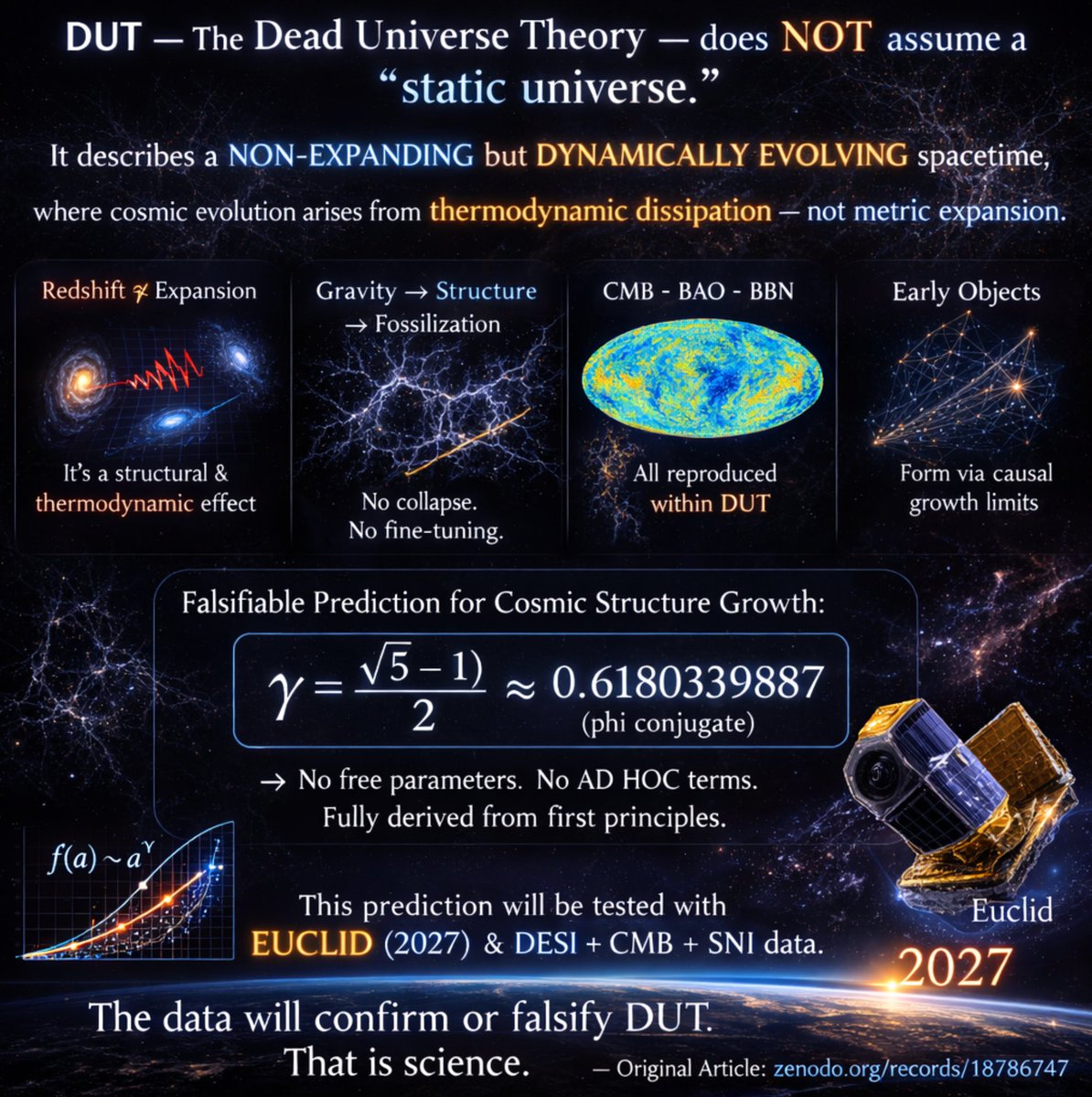
For the first time in more than a century of modern cosmology, the Dead Universe Theory (DUT) predicts an exact, mathematically derived value for the cosmic structure growth index:
γ = (√5 − 1)/2 ≈ 0.6180339887
https://t.co/jeJdAqVkQT
No free parameters. No empirical fitting. It emerges directly from the thermodynamic attractor of the viscoelastic substrate Ξ_μν, unifying gravity, thermodynamics, and the arrow of time within a single theoretical framework.
While the ΛCDM model predicts γ ≈ 0.55 based on General Relativity, DUT offers an equally rigorous yet radically different alternative — one that emerges from a primordial universe without singularities, without inflation, and with an extended chronology (~180 Gyr).
Now, the ball is in the data’s court. Next-generation observations — DESI, Euclid, the Roman Space Telescope — will have the precision needed to decide between these two paradigms.
If γ converges to 0.618..., we will have strong evidence that the universe does not expand — it relaxes thermodynamically. If it converges to 0.55, DUT will be falsified, and ΛCDM will be strengthened.
This is the kind of clear, falsifiable prediction that moves science forward. DUT does not seek to replace the standard model through parameter tuning, but through internal logic and testable consequences.
Cosmology stands once again at the threshold of a possible revolution. And this time, the answer will come not from conjecture, but from a simple equation:
γ² + γ − 1 = 0
The future of data will tell which vision of the universe remains standing.
Source: Almeida, J. (2026). The Physical Foundations of the Viscoelastic Continuum (DUT): Quantum Decoherence as the Origin of the Dead Substrate. ExtractoDAO Labs.
🚨 HISTORICAL BREAKTHROUGH IN THEORETICAL COSMOLOGY 🚨
For the first time in more than a century of modern cosmology, the Dead Universe Theory (DUT) predicts an exact, mathematically derived value for the cosmic structure growth index:
γ = (√5 − 1)/2 ≈ 0.6180339887
https://t.co/jeJdAqVkQT
No free parameters. No empirical fitting. It emerges directly from the thermodynamic attractor of the viscoelastic substrate Ξ_μν, unifying gravity, thermodynamics, and the arrow of time within a single theoretical framework.
While the ΛCDM model predicts γ ≈ 0.55 based on General Relativity, DUT offers an equally rigorous yet radically different alternative — one that emerges from a primordial universe without singularities, without inflation, and with an extended chronology (~180 Gyr).
Now, the ball is in the data’s court. Next-generation observations — DESI, Euclid, the Roman Space Telescope — will have the precision needed to decide between these two paradigms.
If γ converges to 0.618..., we will have strong evidence that the universe does not expand — it relaxes thermodynamically.
If it converges to 0.55, DUT will be falsified, and ΛCDM will be strengthened.
This is the kind of clear, falsifiable prediction that moves science forward. DUT does not seek to replace the standard model through parameter tuning, but through internal logic and testable consequences.
Cosmology stands once again at the threshold of a possible revolution. And this time, the answer will come not from conjecture, but from a simple equation:
γ² + γ − 1 = 0
The future of data will tell which vision of the universe remains standing.
Source: Almeida, J. (2026). The Physical Foundations of the Viscoelastic Continuum (DUT): Quantum Decoherence as the Origin of the Dead Substrate. ExtractoDAO Labs.
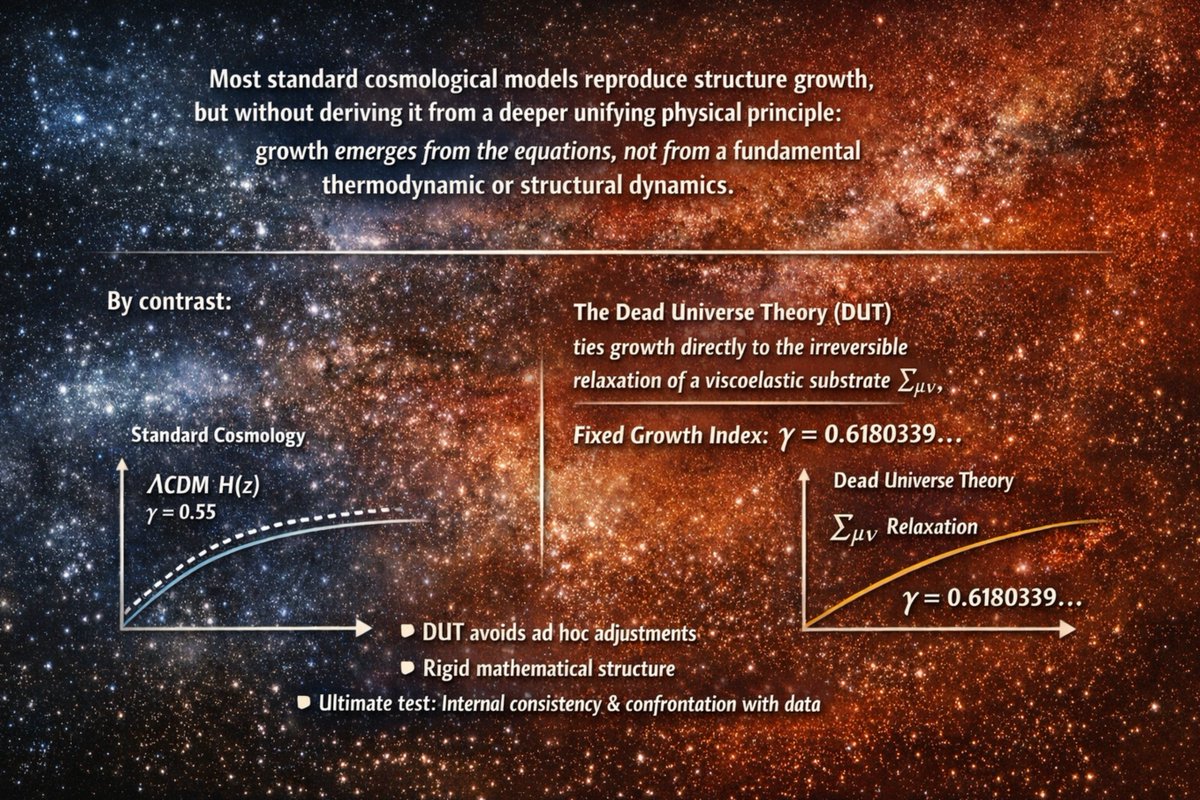
“Most standard cosmological models reproduce structure growth, but without deriving it from a deeper unifying physical principle: growth emerges from the equations, not from a fundamental thermodynamic or structural dynamics. By contrast, the Dead Universe Theory (DUT) ties growth directly to the irreversible relaxation of a viscoelastic substrate Ξμν, removing the need for extra phenomenological freedom. This yields a fixed, exact growth index: γ = 0.6180339… In this sense, DUT avoids ad hoc adjustments; it enforces a rigid mathematical structure from which observable consequences necessarily follow. The ultimate test is not sociological acceptance, but internal consistency and direct confrontation with data.”
The Viscoelastic Universe as Living Memory
On March 15, 2024, after more than a decade of research, I presented the first formulation of the Dead Universe Theory (DUT) with an idea that many initially perceived as poetic, but which has always been, to me, profoundly physical:
The Universe is not an empty stage where structures simply appear — it is a viscoelastic fabric that stores memory.
In that first paper, I proposed that spacetime does not merely carry matter and light; it records, preserves, and reenacts its own history. The formation of galaxies, stars, and cosmic structures is not a spontaneous act of creation, but a replication of the cosmic memories of the Universe’s past glory, imprinted in its own substrate.
The new work on the DUT Viscoelastic Continuum transforms this intuition into physical mechanics.
It shows that spacetime can be understood as a real viscoelastic medium, where irreversibility — the arrow of time — emerges from the quantum decoherence of the substrate itself. The “fabric of the Universe” is not passive: it deforms, ages, and accumulates history.
This deformation is not noise — it is information.
In the paper, redshift is no longer interpreted as mere metric expansion but as an accumulative effect of the thermodynamic degradation of the medium. Light literally carries the signature of the continuum’s aging. This technically confirms the 2024 idea: the Universe records its past in the way it responds to the present.
More deeply, the work suggests that baryonic matter can be read as stable defects in the viscoelastic fabric — persistent marks in the geometric field that are not created from nothing, but emerge as structural reorganizations of the continuum itself. In other words: structures are cosmic scars.
Even the CMB and the Cold Spot appear, within this framework, as possible fossils of the primordial substrate, vestiges of boundary conditions engraved into spacetime — precisely the kind of “cosmic memory” anticipated by DUT.
Thus, the new article does not abandon the original vision of March 15, 2024; it radicalizes and formalizes it.
The Universe is not merely described by equations — it is a physical archive in permanent reenactment.
If the cosmos is viscoelastic, then time is written into space.
And if time is written into space, then every new galaxy is, in a sense, an echo of what the Universe has already been.
The Universe does not create randomly.
It remembers — and it replicates.
— Joel Almeida, PhD Cosmologist