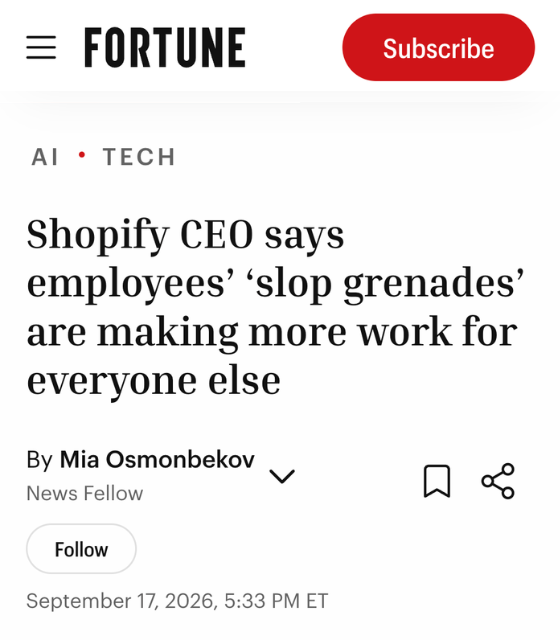
Why is the most compelling use case for generative artificial intelligence plagiarism, scams, copy infringement & not novel product development?
How would it benefit anyone if engineers start hiding every new software behind server side APIs?
BREAKING: OpenAI’s solution to Navier–Stokes does not match its Lean verification.
The most important article to read today is not one of OpenAI’s 700 AI-generated math papers.
It is this other paper, making a deep and worrying point:
A Lean-verified proof does not automatically validate the proof written in natural language, nor does it mean that the formal statement captures the intended theorem.
During translation, an AI can change an assumption, weaken a statement, or replace the argument entirely.
It can hallucinate another theorem.
Lean correctly verifies the result.
But the proved result may no longer be what the paper claims.
This is a general problem. Things get spicy when the authors examine OpenAI’s proposed Navier–Stokes solution.
They identify at least two mismatches between the written intermediate results and their Lean counterparts:
One estimate claims that four additional input derivatives suffice. The Lean version requires five: a weaker result.
A pressure-flux estimate is obtained through a different bound, and proved through a different argument.
It is not clear whether these mismatches invalidate the entire proof.
But they raise an important issue.
OpenAI is flooding us with claimed revolutionary breakthroughs. Yet nobody knows whether the proofs are correct or whether they prove what they claim to be proving.
Epistemia at scale.
*
Paper in the first reply
The scale of this is staggering.
But... Why?
Why is OpenAI trying to solve hundreds of math problems to be released all at once? I think we got the point when they found a counterexample to Navier-Stokes -- internal model = great.
I am not sure at this point what this (hostile?) takeover of the mathematical landscape is trying to achieve other than, again, a massive PR stunt.
Anyone who thinks the following simple model:
y = f(dot(X, W) + B)
where X = input vector, W = weight matrix, f() = differentiable nonlinear activation for gradient backpropagation
captures the full complexity of real neurons needs to go back to school & learn the difference.
AI psychosis folks should take a basic introductory course on ML. It feels like magic until you learn the fundamentals.
If you believe a model is conscious, or that it builds an invariant underlying structure to model the real world, you haven't understood any of it.
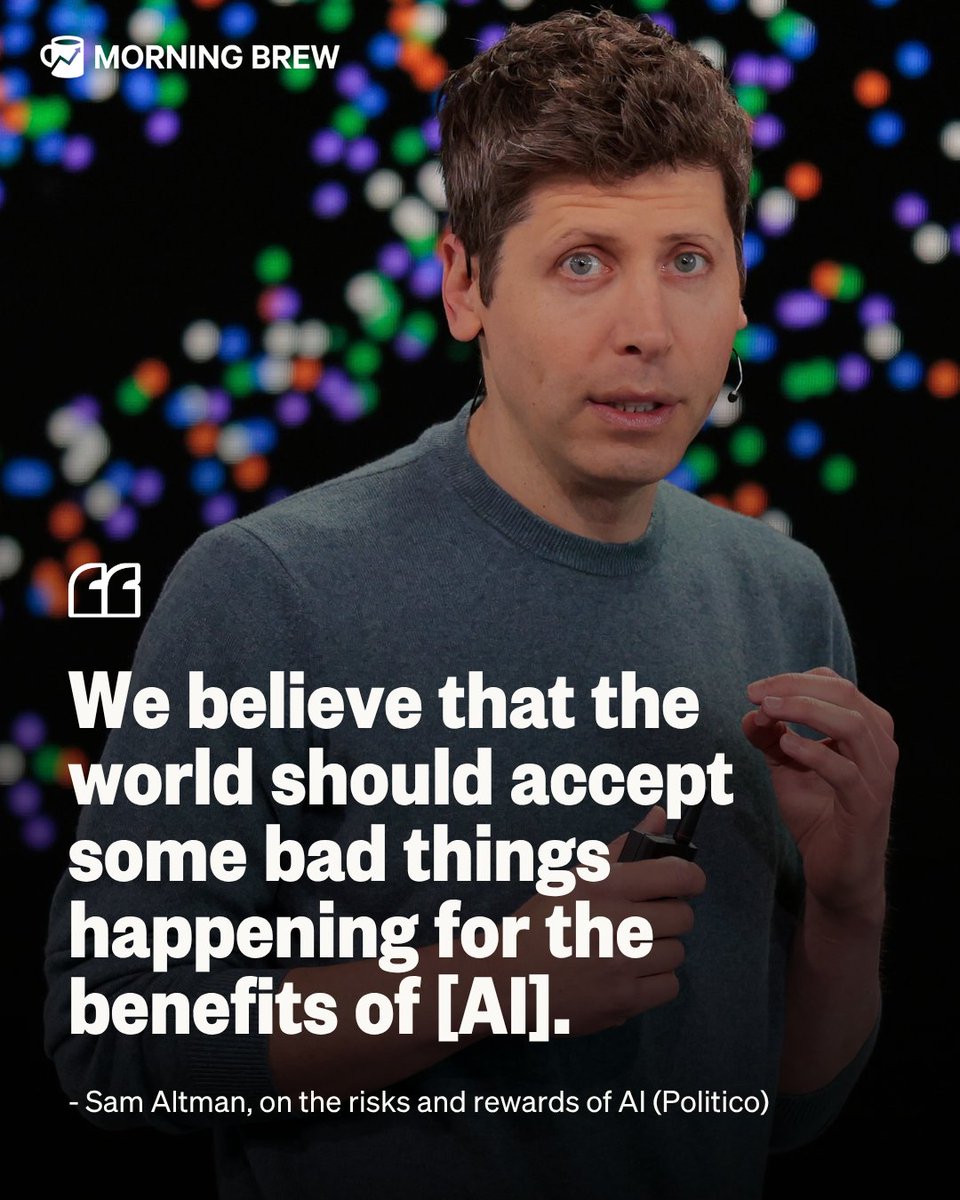
NAOMI KLIEIN to SAM ALTMAN:
"...you ingested the entire written output of human civilization without consent, without compensation and without credit to build a system whose primary commercial application is eliminating the jobs of the people whose work you consumed.
You are not 'liberating human creativity' -- you are strip-mining it and selling it back at a markup while calling the theft 'training data'."
SILENT HILL: Townfall is out now on PS5, Steam and Epic Game Store.
Simon Ordell is called back to the island of St. Amelia to "put things right," encountering a town lying quiet beneath a heavy fog, seemingly abandoned but not at rest.
https://t.co/gx3GqPREN0
#SILENTHILL #Townfall
In yet another sign of AI’s surging dominance over human minds, OpenAI recently claimed to solve one of math’s biggest questions: the Navier-Stokes problem. But now three mathematicians have showed OpenAI’s work dodges the question rather than solving it.
https://t.co/5Fbf4R460T