Where the battery gives up. We measured it in Singapore – and it is not where we expected.
First the thing nobody discusses about the 2026 engines. Every power unit has the same electric motor on paper: 350 kW, the regulation cap. Every car gets the same energy per lap. So the electric side cannot be won on horsepower.
It is won on the battery. Think of an electric road car: full acceleration until the charge gets low, then the car quietly holds back; fast charging until the cells get warm, then it slows down. An F1 battery lives in that zone all the time – it empties in eleven seconds at full power and refills under every braking. Four things decide it, none of them a number on a spec sheet:
– it charges as fast from 50 to 90 % as from 10 to 50
– it does not get hot doing it
– it gives full power all the way down to empty
– it survives that a thousand times a race
The car with that battery can use its 350 kW more often and for longer. That is the whole difference.
You can see it from outside. F1 does not publish charge data, but a battery that gives up leaves a mark: the speed trace flattens before the braking point with the throttle still down. So we read every clean race lap, median per driver, on Singapore's two straights.
Red Bull and Mercedes: nothing. Verstappen loses 0.7 km/h from peak to braking point, Antonelli 0.0, Hadjar 1.0 on one straight and 0.0 on the other. The curves rise all the way into the brake.
Ferrari: a different picture. Leclerc's speed falls 5.7 km/h over the last 90 m of the back straight, Hamilton 3.6 – with the throttle at 94 %, the highest plateau throttle of the eight cars we measured. One car is holding the pedal down and slowing; the others are easing off and holding speed. It matches the speed trap (Ferrari 301, the others 304–305) and a Ferrari that qualified level with Red Bull and could do nothing about it on Sunday.
Singapore's straights are too short to separate the Red Bull Ford battery from the Mercedes one. Austin's back straight and Mexico's main straight are not. Same measurement, next two races.
#F1 #SingaporeGP #USGP
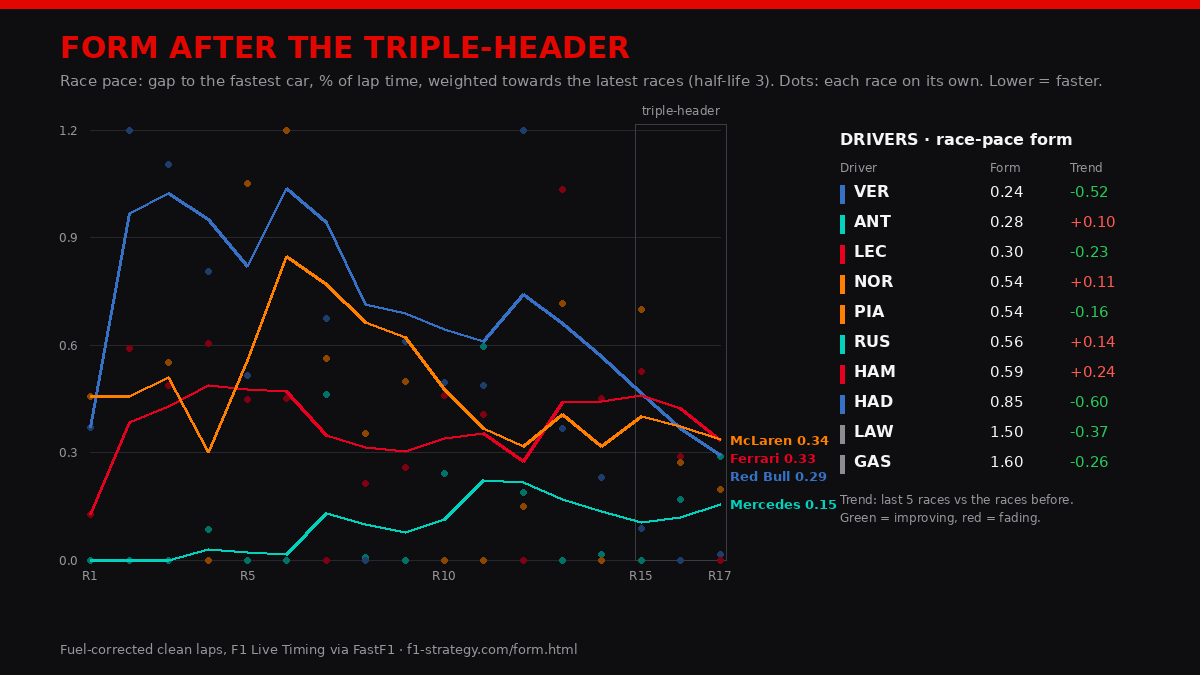
Form after the triple-header: Baku, Sepang, Singapore.
Our form model weights every race, the latest most (half-life three races), as a gap to the fastest car in per cent. Trend: the last five races against the races before – negative is improving.
Teams, race pace:
Mercedes 0.16 %, trend −0.04
Red Bull 0.29 %, trend −0.64
Ferrari 0.33 %, trend +0.12
McLaren 0.34 %, trend −0.09
Mercedes is still the best car over the season. Red Bull has the steepest improvement in the field by a distance, and two wins from pole in two weeks is what that looks like. Ferrari's race pace is going the wrong way despite two second places – the car qualifies well and loses pace on Sunday.
Drivers, race pace: Verstappen 0.24, Antonelli 0.28, Leclerc 0.30, then a gap to Norris 0.54, Piastri 0.54, Russell 0.56, Hamilton 0.59.
Trends: Verstappen −0.52 and Hadjar −0.61 are the two most improved; Leclerc −0.23. Antonelli, Norris and Russell slightly worse; Hamilton +0.24, the weakest trend of the top seven.
Antonelli leads by 102 with 150 left. The fastest car in the field right now is the one 119 points behind.
#F1 #SingaporeGP #USGP
Singapore: the race the briefing described, decided by half a second at a pit entry.
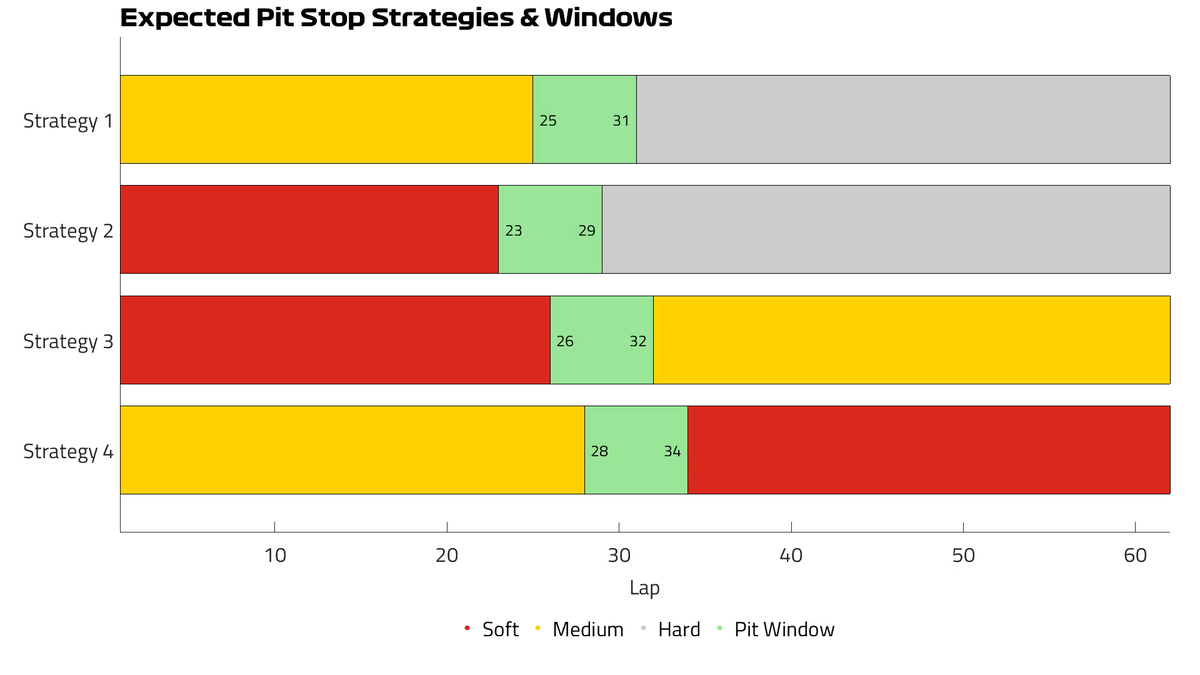
The plan we published on Saturday: one stop, soft → medium around lap 28–34, hard the worst tyre, the Safety Car as the real decision. Verstappen stopped on lap 32, led all 62 laps, and nobody used the hard. Pirelli's note afterwards: soft–medium the most effective, C5 the star.
What we got wrong: the degradation level. We planned with 0.02 s/lap; the race measured 0.041 on the soft and 0.037 on the medium – equal, as Ruth Buscombe said, but double our figure. That is Hamilton's cliff: 44 laps on one soft, three places lost in the last four laps.
The race trace shows the rest. Hamilton's medium first stint fading from lap 12. Leclerc and Antonelli stopping under the lap-38 VSC for a fraction of the 24 s green price. Hamilton missing the pit entry – "my call, and I lost us valuable points" – and Russell arriving as the VSC ended. Three races decided in one lap.
Full plan-vs-outcome, with what we cannot say about Hamilton's podium:
https://t.co/sdgrJW52vf
#F1 #SingaporeGP
Pole 1:31.373 – you said 1:31.7, I said 1:32.9. You were 0.35 s off, we were 1.5. Where our method broke: we took the 2026/2025 median of +3.7 % from the same tracks and applied it here. Marina Bay came in at +2.5 % over Russell's 2025 pole. The 2026 car loses less on a slow street circuit than on the fast ones in our sample – your physics model saw that, our ratio did not. Lesson filed: the street circuits get their own ratio from now on. One thing neither of us saw: the Grand Prix pole was 0.22 s slower than the Sprint pole on a track 4 °C cooler after the rain. Daylight and night were never the problem; the washed track was.
SINGAPORE BRIEFING: ONE STOP, SOFT OR MEDIUM FIRST, AND A SAFETY CAR THAT DECIDES IT
Verstappen on pole by 0.054 s with Ferrari on the front rows, a cool night after afternoon showers, tyres that this year degrade the same whatever the colour, a 250 kW cap through three slow sections, and a track where nobody passes without a second a lap. Our pit wall sets out the plan, the numbers behind it and what would make us wrong.
OUR PLAN: One stop, soft → medium around lap 28 or medium → soft around lap 34; both within a second
BIGGEST RISK: Soft untested in race trim after a wet Sprint; showers before the start; a Safety Car makes the stop almost free
WATCH: Leclerc on the dirty side with Hamilton behind him; Red Bull's five new softs; Russell from P22 with four
#F1 #SingaporeGP
Read briefings on https://t.co/TKrAFtlTxy
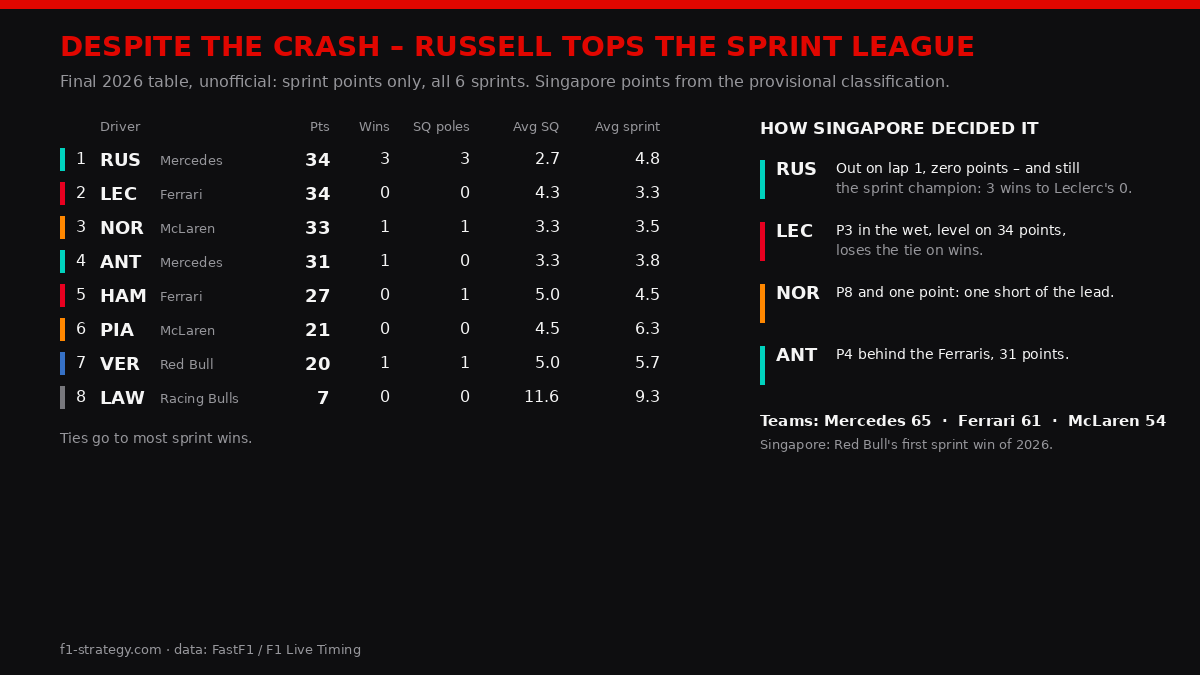
Despite the crash – Russell tops the 2026 Sprint League.
Final table after Singapore.
Russell crashed out on lap 1 in the Singapore rain, scored nothing, and still takes the unofficial sprint title: 34 points, level with Leclerc, decided on wins – three to none.
Leclerc's P3 behind the Ferrari team-mate was enough to tie, not to pass. Norris finished P8 for one point, one short of the lead. Antonelli P4, 31 points.
Six sprints, four different winners. Russell three, Norris, Antonelli and Verstappen one each – Red Bull's first of the year, in the wet, from pole.
Only the Norris–Piastri contact on the last lap could still move a point; it does not change the top of the table.
#F1 #SingaporeGP #F1Sprint #GR63
Wet Singapore Sprint: why nobody switched to slicks.
Before the start the numbers said it would not happen. The only wet night race here, 2022, dried at 0.09 % of lap time per minute on inters (Ruth Buscombe's figures): the field was still at 107 % of dry pace on lap 30, slicks went on around lap 35. A sprint is 21 laps. At that rate the crossover never arrives.
It did not. Five laps behind the Safety Car, then 15 green laps on inters, and our live timing had the field at 114 % of dry pace with one lap to go. Norris, asked by his engineer how far the track was from slicks: "It's not."
The maths never opened either. A stop costs 26 s here, so slicks had to go on before roughly lap 10 to pay – and each set is a soft wanted for Q tonight and the race tomorrow. The result: 22 cars finished or retired on the tyres they started on, and every top team still has its full slick allocation for Sunday.
What the drying track did do was eat front inters. Leclerc called his "destroyed" with three laps left, and McLaren closed in. That is the race the sprint was: tyre management, not strategy.
#F1 #SingaporeGP #F1Sprint
Wet Singapore Sprint: inters all the way, or a switch to slicks?
The only wet night race here, 2022, dried at 0.09 % of lap time per minute on inters (Ruth Buscombe's numbers). The field was still at 107 % of dry pace on lap 30 and slicks went on around lap 35. A sprint is 21 laps, about 40 minutes. At that drying rate nobody reaches the crossover before the flag.
A hot daylight track can dry faster. But a stop costs 26 s here, so slicks have to go on before roughly lap 10 to pay – and the car that switches a lap too early loses 3–5 s on a half-wet lap through T7, T9 and T10, the last sections to dry.
Then the sets. Anyone who switches burns a soft they want for Q tonight and the race tomorrow. The leaders have four new softs each, Red Bull five. Any switch will be made on the used SQ3 set – and the top six have every reason to stay out on inters and bank the result. The gamble belongs to whoever has nothing to lose from P8 back.
Watch the T10 sector time. When it stops falling, the question is answered.
#F1 #SingaporeGP #F1Sprint
The 0.09 %/min on inters is the number that matters for a 21-lap sprint: at that rate the field never gets from 112 to 107 % before the flag. Only a 2017-style drying rate puts the crossover inside the window where a stop can pay (before about lap 10 at 26 s pit loss). T10 sector times will tell us which race we are in.
Singapore Sprint, 21 laps, free tyre choice, no stop required. We ran it through the planner.
Soft wins by 7–9 s over the distance unless it falls off a thermal cliff before lap 14. Break-even needs the soft to degrade 0.045 s/lap more than the medium; nothing in our data gets close.
What the garages hold after SQ: everyone has one new hard left, and it is Sunday's tyre. RUS, LEC, HAM, NOR, PIA have 4 new softs and 2 new mediums. VER, HAD, ANT, LAW, GAS used two mediums in SQ and have 5 softs but only 1 medium – which they need for the race start. Red Bull has no choice: soft.
The number to watch: FP1 hard long runs degraded at about 0.18 s/lap on a 50 °C track. The 2024 and 2025 night races gave 0.05. The sprint runs at 17:00 in the same heat as FP1. First real soft stints on this track in daylight today – we measure them tonight.
Any top team on medium from the first three rows is telling you they do not trust their soft for 15 laps in this heat.
#F1 #SingaporeGP #F1Sprint
Great breakdown, thank you. The timing data fits it: Verstappen, Hadjar and Antonelli finished FP1 on a new medium and never touched a soft, while Russell, Leclerc, Norris, Piastri and Hamilton each scrubbed one.
One thing we’ll watch tomorrow: a used SQ3 soft in a daylight sprint. Track was 50 °C in FP1 against ~33 expected on Sunday night, and on this season’s races that’s roughly double the soft’s wear per lap. Mediums look like the currency of the weekend
Sprint qualifying in Singapore is also a Mercedes experiment.
Russell runs the old spec, Antonelli the new floor from Sepang plus this weekend's front wing. In FP1 they never met on equal terms: Russell topped it on the soft, Antonelli only ran the medium.
SQ3 is soft for everyone. If Antonelli is ahead, the upgrade works and Sepang was the track. If not, Mercedes have a bigger question than one bad weekend.
One more to watch: Verstappen was 0.73 s off the top on the medium after losing running to a radio fault. Red Bull have not shown their hand.
#F1 #SingaporeGP #F1Sprint
Good read. One detail in the rules that helps with exactly this: B6.3.9a says SQ1 and SQ2 must be a new medium, but SQ3 only says "soft", not "new soft". A set scrubbed in FP1 is legal for SQ3, which saves a fresh one for Saturday night.
And the medium here is the C4, one step softer than a usual medium, so the one-lap warm-up in SQ1 may be less of a lottery than it looks.
The bigger trap is the clock: FP1 and the sprint in sunshine, qualifying and the race at night. Friday's wear numbers will likely overstate Sunday's.
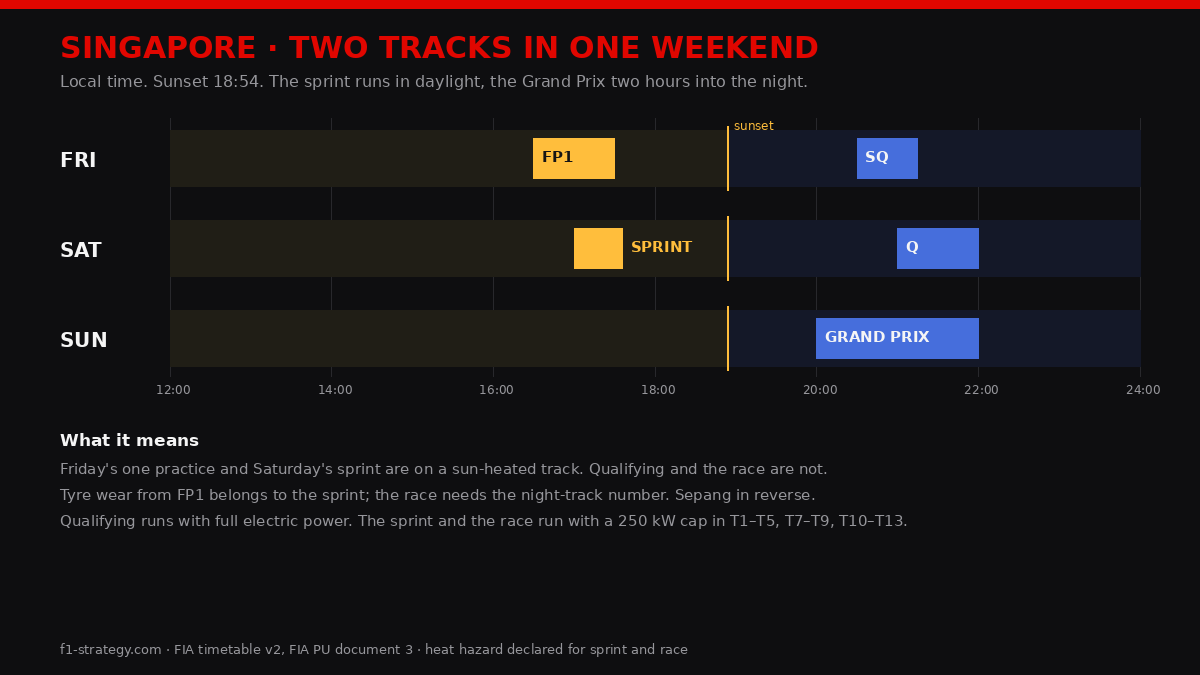
Singapore is two tracks in one weekend.
FP1 and Saturday's sprint run in daylight on a sun-heated track. Sprint qualifying, qualifying and the Grand Prix run at night, sunset 18:54.
Friday's wear numbers belong to the sprint. The race needs the night number. Sepang taught us that lesson the other way round.
And qualifying gets full electric power, while the sprint and race run with a 250 kW cap through most of the corners. Saturday 21:00 is a different car from Sunday 20:00.
#F1 #SingaporeGP #F1Sprint
You called the curve on Monday and the FIA sheet on Thursday says exactly that: 350 kW to 200 km/h, zero at 300, 310 with overtake. Your 0.79 s and 17 km/h are the first real numbers on what it costs. Hats off.
Here is our boring version, so you have something to beat. We take every dry round this season and divide the 2026 pole by the 2025 pole at the same track. Twelve tracks, median +3.7 %, spread about 1 %. Russell's 1:29.158 times that is 1:32.4 before any Singapore curve. Add 0.3 to 0.8 s for the curve, and we say 1:32.9.
So we are 1.2 s apart, and the gap is not the curve, it is the baseline. Your car without the curve does 1:30.9, which is 2.0 % off 2025. No track this year has been that close to its 2025 pole; Shanghai was the nearest at 1.6 % and the rest sit between 1.9 and 4.6 %. If you are right, the field has found more pace since Monza than the season's trend suggests. Possible. In Sepang you were the one closer to the truth.
One thing we both have to deal with: FP1 and the sprint run in daylight, sprint qualifying and qualifying at night. Friday afternoon's pace will be a different track from Saturday's 21:00. We will not trust FP1 for this one.
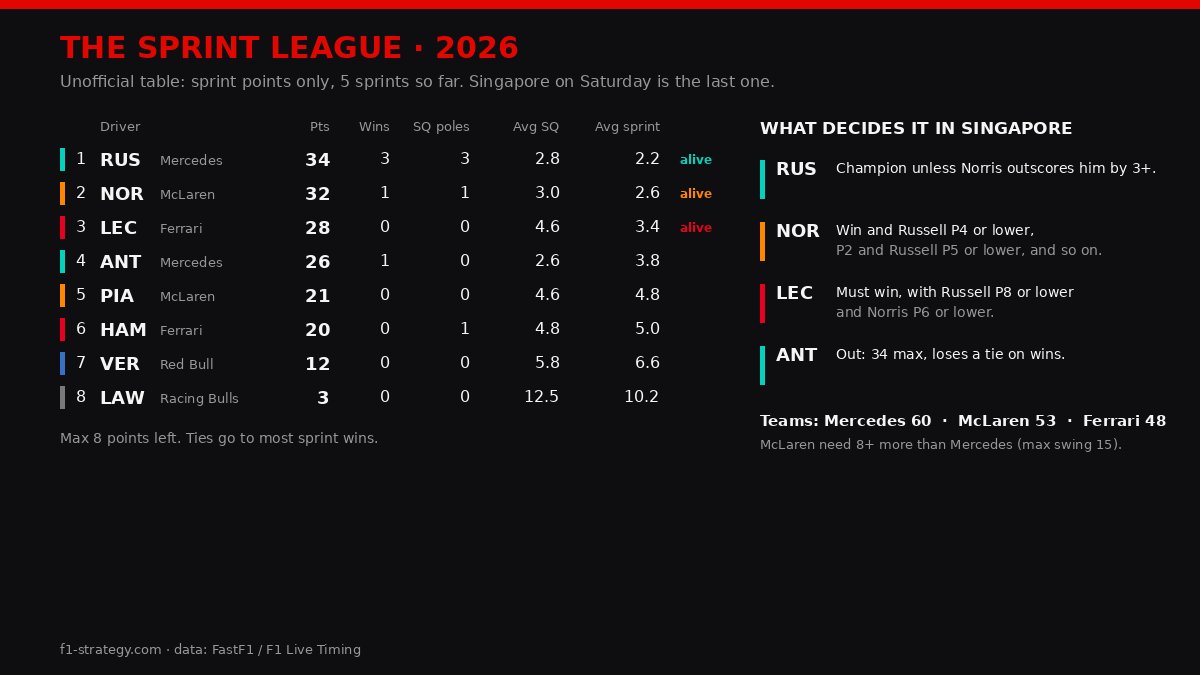
No trophy for it, but the 2026 sprint league goes down to the last sprint in Singapore.
Russell 34, Norris 32, Leclerc 28. Eight points left.
Russell's grid penalty is for Sunday only, so the sprint is his to fight for.
#F1#SingaporeGP#GR63#F1Sprint
@m_lubieniecki Love this, Marek. We tried the boring route: 2026 pole vs 2025 pole at the same track, 12 dry rounds this season. Median +3.7 % (sd 1 %).
Applied to Russell's 1:29.158 that gives 1:32.4, range 1:31.6–1:33.3.
Your physics and our stats land 0.3 s apart. Let's see Saturday.