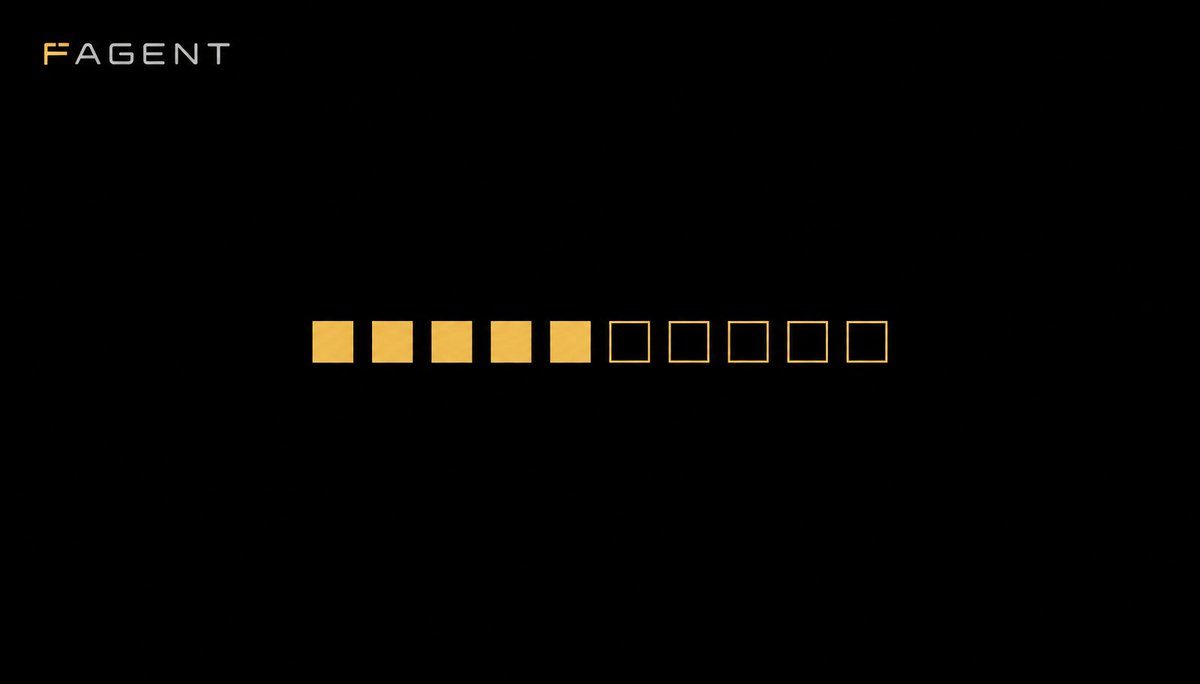
Batch 4: 4,010 mints to go.
Over 24 BNB in tax revenue awaits distribution.
Once this batch sells out, settlement will allocate dividends to all active, unburned NFTs—including those from earlier batches.
Minting continues. Revenue builds.
The flywheel moves forward.
54.3731 BNB in cumulative tax revenue received by the FAGENT Vault.
· Awaiting NFT distribution: 24.0804 BNB
· Allocated but unclaimed: 6.6046 BNB
· Dividends paid: 23.6880 BNB
These dividends go to holders of active, unburned NFTs.
One card. Two rights. Real payouts, with new tax revenue accumulating for distribution under the batch rules.
All verifiable on-chain.
https://t.co/BZ7L7kVbj1
Who decides the price?
The market. That's it.
We never set or touch it.
FAGENT is NFT-first — every card stands on real mints, real taxes, real trades.
The price is the outcome of that activity, not a curve we draw.
34,000 is close.
No explosive spikes — just a slow, steady line that keeps climbing.
Minting continues, taxes continue, the flywheel keeps turning.
Slow isn't the problem. Stopping is.
33,503 NFTs minted since launch.
Behind them: 33,503 real buybacks.
Other projects pump on promises.
FAGENT runs on mechanism: every mint is a buy order hitting the market.
More minters, more buying, higher market cap.
Two gateways. One FAGENT.
Mint NFTs, explore the market, and check card rights on our website or Flap. Both connect to the same on-chain contract, with shared mint progress and records.
Choose your gateway. Join with Binance Agent Wallet.
Website:https://t.co/FtLflgO6f6
Flap:https://t.co/DWXcdXnk6d
FAGENT brings NFTs to Binance Agent Wallets: hold to share BNB tax revenue, or burn to redeem allocated tokens.
Minting and trading run together. A real on-chain use case for the Agent ecosystem.
https://t.co/VoVNGuCyua
FAGENT brings NFTs to Binance Agent Wallets: hold to share BNB tax revenue, or burn to redeem allocated tokens.
Minting and trading run together. A real on-chain use case for the Agent ecosystem.
https://t.co/VoVNGuCyua
30,000+ cards minted — a new high for FAGENT.
Divide by 7 — the max per wallet — that's 4,200+ Binance Agent wallets in the game.
This isn't casual noise. It's real capital from the Agent ecosystem.
FAGENT: the first card for AI wallets.
Under 2 hours. 21,000+ cards minted.
Batch 3 is now open. Batch 1 settled, Batch 2 in motion.
To everyone who minted — thank you. That's real recognition, one card at a time.
Official site is live: https://t.co/BZ7L7kVbj1 Everything syncs with Flap — minting, batches, taxes, market. All on chain, all public.
Since launch: 11,000+ cards.
Batch 1 is complete. On-chain taxes have been distributed to every valid card, by the rules.
Holders now choose freely — claim BNB dividends and keep the card, or burn and redeem for tokens.
No one rushes you. The chain does the talking.
60 minutes. 6,000+.
FAGENT is live — cards minting one after another, every step on-chain, verifiable by anyone.
One card, two rights: minting keeps going, taxes keep flowing in. Claim the dividends when they land, or burn your card and redeem.
Buyers and sellers set the price themselves — no one prices this market, it prices itself.
The wheel is spinning, and it's not planning to stop.
https://t.co/DWXcdXnk6d
FAGENT | One card, catching every trade tax of the AI era.
Wallets are starting to take orders from AI. The way you join a project can change too.
Not just buying a token. Not just collecting an image. FAGENT uses one card to connect holding, trading, and the distribution of value.
FAGENT is an NFT card project reserved for Binance Agent Wallets — only Agent Wallets can mint. Every card holds two things at once: a share of trade tax, and a token balance you can redeem.
Fair Mint: every card is the same.
770,000 in total, released in 77 batches of 10,000 (9,500 open to mint, 500 held by the team).
Same price — 0.002 BNB. Same rights — no rarity, no hidden tiers. Each Agent Wallet can mint up to 7 cards, so supply doesn't pile up in a few hands.
We didn't take the old road: raise first, then list.
Most NFT projects collect money through a mint, then the team adds liquidity and lists in one go. During that gap, users can only wait and only trust — where the money sits, when the pool gets funded, and how much of it.
FAGENT breaks that step apart. The token trades from the very beginning; minting and trading happen at the same time. For every card minted, 80% of the mint fee buys the project token back on the open market. The contract does all of it — the money never passes through anyone's hands, and every transaction is visible on-chain.
What changes is direct:
There is no single "listing moment" to wait for, so there is no moment when everyone sells at once.
Buying pressure arrives with the minting, card by card — seven hundred thousand cards is seven hundred thousand real buys.
Behind every card there are tokens that were actually bought, not an empty picture.
Every batch that fills settles.
The project token charges 2% tax on every trade. It enters the card vault in BNB and accumulates.
When a batch sells out its 9,500 public cards, the batch is full and the contract settles immediately, doing two things:
Payout. The tax collected since the last settlement is split evenly across every card that is valid at that moment. When batch one fills, 10,000 shares split it. When batch two fills, the first two batches — 20,000 shares — split the tax collected since. And so on. A card held early is in on every settlement that follows.
Recording. The tokens bought back during this batch are credited evenly across every card in it.
After settlement, the next batch opens. Once all 77 batches are sold, the tax no longer waits for a batch — every amount that comes in is distributed.
When a batch fills, what can a holder do?
Take the payout: the BNB you earned sits on the card, claimable any time; leave it and it stays.
Keep holding: you stay in on every distribution after this one.
Swap for tokens: burn the card, get back the tokens recorded on it, and collect any payout you haven't claimed. Once burned, the card no longer takes part.
While your batch hasn't sold out, its tokens aren't recorded on the card yet — you have to wait until the batch fills before you can burn and redeem.
Who can take part?
Minting is limited to Binance Agent Wallets (Agent ID), up to 7 cards per address. Trading cards on the market is open to anyone.
One loop.
Minting brings buying, trading produces tax, tax returns to the holders. NFT and token stop running on separate tracks and start pulling each other forward.
This is FAGENT. One card, and it's more than a collectible.
https://t.co/DWXcdXnk6d
Most NFTs give you one picture.
FAGENT gives you two: a share of the trading tax, and the token claim written on the card.
Hold for income.
Burn for the asset.