To avoid a repeat of the R9.5B losses from the 2023 bird flu crisis, the poultry industry is urging agri minister Willie Aucamp to streamline vaccine rules and incentivise farmers to protect local flocks.
https://t.co/5vc63ACq3B
The livestock and poultry industries are the pillars of the South African farming economy. They account for half of our farming fortunes. Supporting these industries will boost our farming sector immensely and is key to transformation goals.
Strict EU compliance rules on meat imports could soon trigger global trade reshuffling. Here is why an upcoming EU restriction on Brazilian meat imports poses a real risk to South Africa’s local meat producers...
https://t.co/jmIWGIExbQ
"Poultry industry leaders and veterinary experts have urged the government to fast-track a practical national bird flu vaccination programme to prevent a repeat of the devastating 2023 outbreaks."
https://t.co/m6UppW90d1
Chicken accounts for over 60% of South Africa’s meat consumption, yet two years of red tape are still blocking mass bird flu vaccination. It’s time to prioritise the vaccination, protect national food security and defend the industry's 100,000 jobs.
https://t.co/1b9G56zmxA
Ghana’s poultry sector was decimated by chicken dumping from the EU. The ultimate irony? The EU is now providing €10M in aid to "help" the very farmers they ruined. Handouts don't fix the problem. True support is equitable and fair trade.
https://t.co/5H0LbPo1WR
Francois Baird, founder of FairPlay, has outlined a critical roadmap for SA's new Agri Minister, Willie Aucamp, to safeguard local chicken production, create jobs, boost trade, and deliver food security.
https://t.co/XlP7DGjE9V
As El Niño strengthens, skyrocketing global fuel and fertiliser prices are compounding the threat to Southern Africa's food security.
https://t.co/RpUVkqGpzE
A harsh El Niño weather pattern is strengthening. Models are predicting significantly drier conditions across Southern Africa into 2027.
https://t.co/RpUVkqGpzE
Bird flu is a direct threat to affordable food. While countries like Australia are proactively executing emergency response plans at the first sign of the H5N1 strain, South African authorities have shown a staggering lack of urgency.
https://t.co/qT1Z6xm1Jy
El Niño, which occurs every few years, brings floods to some parts of the world and drought to others, including Southern Africa. This year’s El Niño is expected to be particularly harsh.
https://t.co/RpUVkqGpzE
The 2026 Budget has arrived, and still, there is no sign of the promised VAT-free chicken. Meanwhile, nearly 29% of SA children are stunted due to malnutrition.
https://t.co/AOeD3rhQnI
Global industrial subsidies has hit $108bn. This distorts markets and creates unfair advantages. FairPlay urges govt to investigate foreign subsidies and defend local businesses. Free trade only works when everyone plays by the rules.
https://t.co/DQVjHwP14Y
South Africa🇿🇦 is opening new export markets for meat in Asia and the Middle East, but producers say billions are being lost because government delays are blocking access to channels that are already open. The Association of Meat Importers and Exporters estimates the industry has lost around R1.5 billion since Qatar suspended South African lamb in mid 2024, despite demand and completed paperwork. Before the suspension, exporters shipped roughly 300 tonnes of lamb per month to Qatar, and similar bottlenecks are affecting trade with Bahrain, Mauritius, Egypt and Dubai. AMIE chair Mark Luff argues it makes little sense to chase new European deals while existing markets remain blocked by slow certification and government to government approvals.
The government is trying to expand access while managing disease risks. Agriculture Minister John Steenhuisen says Jordan, the UAE, Hong Kong and Kuwait remain open under updated certification, and talks are progressing with Qatar, Tunisia, Lebanon, Egypt, Bahrain, Oman and Saudi Arabia. A delegation led by Steenhuisen and Beefmaster Group has been pushing beef, pork and lamb access in Vietnam, Malaysia, Indonesia and Singapore, where Asia already accounts for about 55 percent of South Africa’s 409.6 million dollars in meat exports. Agriculture exports grew 7 percent in the past year and generated a 7.3 billion dollar surplus in 2025. But exporters warn that without faster veterinary certification and market maintenance, new deals will have limited impact on an industry that’s ready to supply but can’t ship.
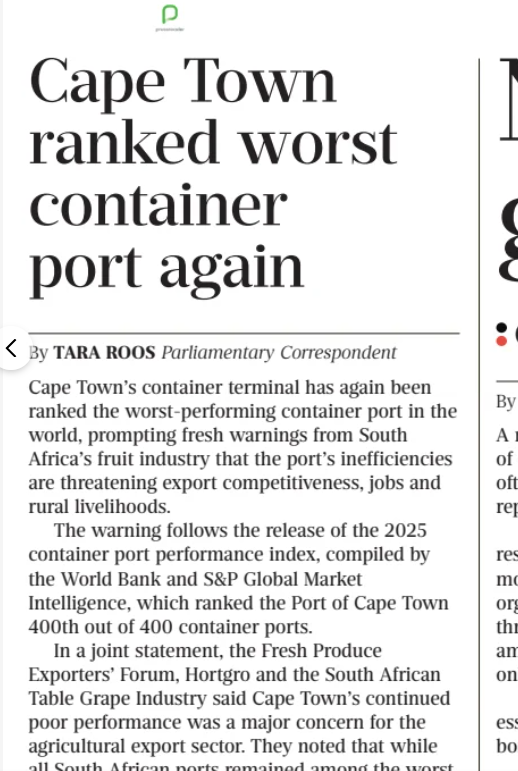
WE NEED TO IMPROVE PORT LOGISTICS. 🇿🇦
Thank you for the excellent piece, @tarathinks and @BDliveSA . I have some additional comments.
In 2025, Transnet, working collaboratively with private-sector organisations and organised agricultural groups, made significant progress across the country. But Cape Town ports require more work.
We mainly saw efficiency improve at the Port of Durban and at the Eastern Cape ports. The various agricultural subsectors, including the citrus industry, benefited from this improvement.
In addition to the ample agricultural output, improved port efficiency boosted South Africa’s agricultural exports, which reached a record US$15.1 billion in 2025, up 10% from 2024.
But this improvement was not consistent throughout the year. The Port of Cape Town experienced delays in its agricultural activities at the end of 2025 and into the start of 2026. This was a peak export period for the table grapes industry.
It was also at a time when the industry had an ample harvest. For example, the figures recently released by the South African Table Grape Industry (SATI) show that the final figures for the 2025-26 table grape season inspected for export were 81.25 million cartons (4.5 kg cartons), a 3% year-on-year increase.
But when these products had to be exported, the Port of Cape Town faced various challenges, including weather-related issues. Some growers and exporters had to move the volume of the crop they would typically export through the Port of Cape Town to the Eastern Cape ports.
For example, the data from SATI shows that the proportion of table grape exports shipped through the Port of Cape Town declined from 91% in the previous season to 76% in the 2025-26 season.
Meanwhile, volumes shipped through Eastern Cape ports increased from 6% of total exports in 2024/25 to 21% this year. While higher export activity at the Eastern Cape ports is generally welcomed, transporting these volumes from remote regions to the Eastern Cape ports typically costs growers and exporters more than via the Port of Cape Town.
What started as one of the best years in the table grape industry ended up as one of the most logistically and cost-intensive seasons. Such inefficiencies provide a lesson that the South African agricultural sector needs to focus not only on widening export markets, but also on consistently working with Transnet to improve port efficiency.
This is a path the industry has taken, and Transnet has been collaborative in working to avoid a challenging season in the future.
Moreover, one of the issues we have discussed in the past, and one that is equally important as a supportive measure for the sector’s growth, is the state of the road network. Investment in road improvements also needs to be a priority, as it weighs on the agricultural industry’s profitability and could slow export activity.
--WANDILE SIHLOBO
South Africa's chicken exports have dropped since the first poultry master plan in 2019.
The industry is ready, competitive, and backed by billions in investment. Now, we need government to clear the runway.
https://t.co/85pFsRNmXS
The updated poultry master plan touted exports as the next phase of industry growth. But the 2026 numbers tell a different story. In each of the first four months of this year, export volumes were lower than in 2025.
https://t.co/7i0QlaUl4k