Political Analyst | Parliamentary Correspondent @BDliveSA | Co-host of The Bill Podcast | #TarasTake on Substack | On Air @CapeTalk | Views Are My Own.
The standout points from the ANC’s 2026 LGE performance:
- Turnout increased by 6.1 percentage points, yet the ANC still lost 812,139 votes.
- Its 4.6 million PR votes are its lowest in any local election since 2000.
- KZN accounted for 53% of its national vote losses.
- The ANC lost 381,335 votes across the eight metros and now leads in just two.
- Its share of the vote declined in 209 of 213 municipalities.
- It won 657 fewer wards than in 2021.
Read my full election analysis on Substack: https://t.co/x1f6B3rkwH
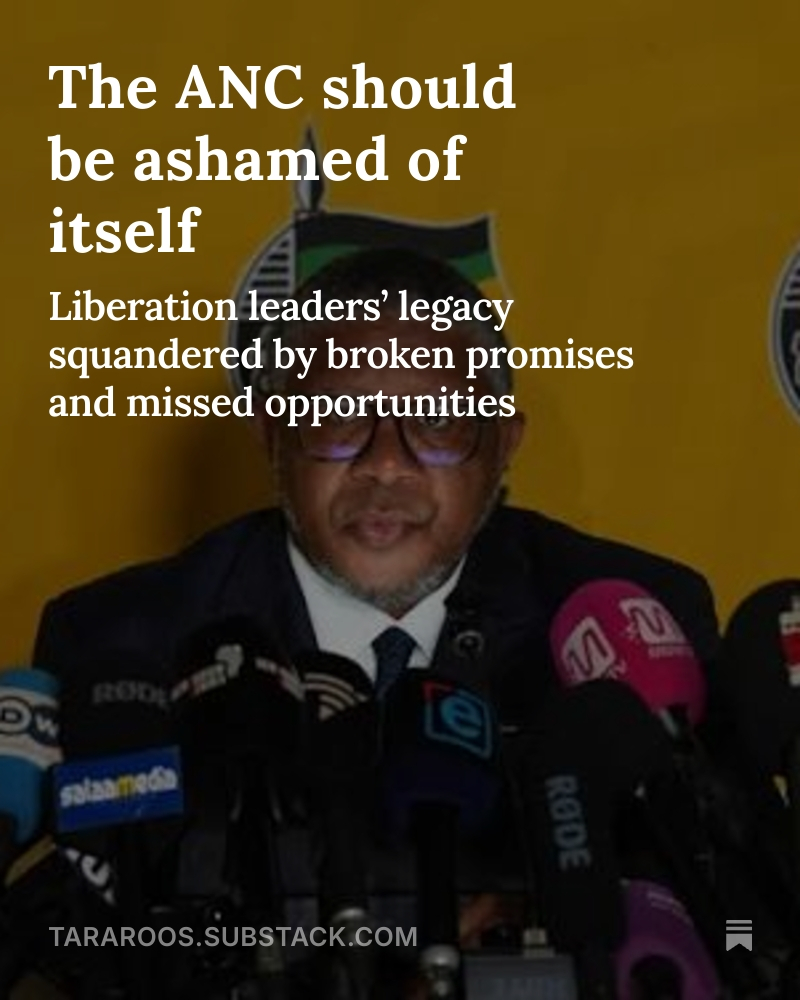
In my latest Tara’s Take, I examine why the ANC’s electoral decline should prompt serious introspection within the party, and why its response to the voters who have turned away from it matters.
Read the full piece: https://t.co/C9K86OuCLN
In my latest Tara’s Take, I examine why the ANC’s electoral decline should prompt serious introspection within the party, and why its response to the voters who have turned away from it matters.
Read the full piece: https://t.co/C9K86OuCLN
Are coalitions just politicians flushing your vote down the toilet? The madness going on roasted and explained with brilliant analyst Tara Roos and legendary comedian Stuart Taylor.
Podcast: https://t.co/gu3Oe4vNQY
STATEMENT: SANEF mourns the passing of eNCA journalist Nabeelah Shaikh. We extend our heartfelt condolences to her family, friends and colleagues.
#SANEF30#NabeelahShaikh
A Primedia+ Original series that brings those who work in the dark out into the light.
Presented by me, produced by @Barbs1301 and shot by @humansnarrative
Cape Town After Dark focuses on the night-shift workers who keep the city running while we sleep. Watch on @PrimediaPlus
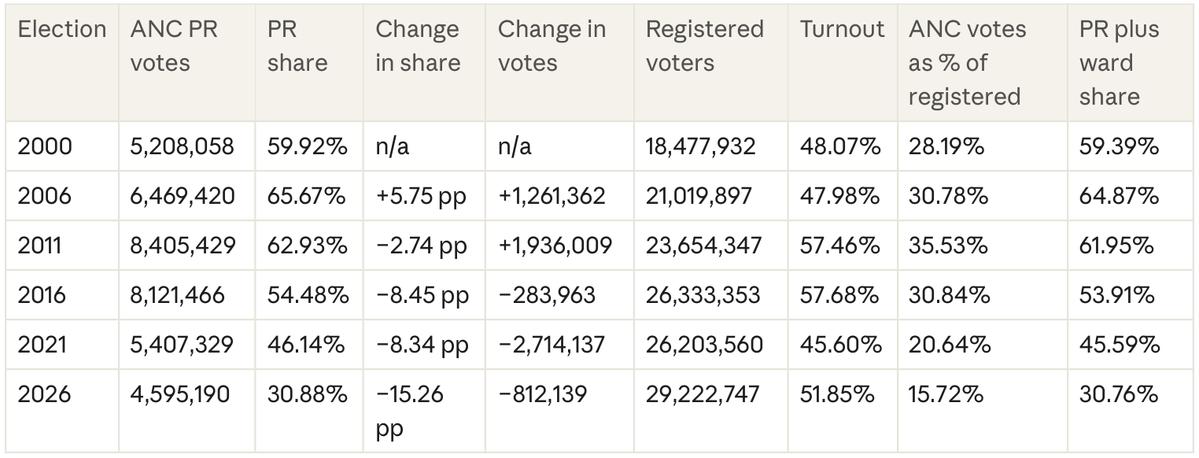
In my latest Tara’s Take, I break down the ANC’s electoral decline, tracing its performance from 2000 to 2026. The numbers tell a stark story: the party’s support has fallen from 35.5% of registered voters in 2011 to just 15.7% in 2026. Fewer than one in six registered voters chose the ANC on 4 November.
Read my detailed election analysis: https://t.co/6cpGsBiuyD
Thank you, South Africa. 🇿🇦
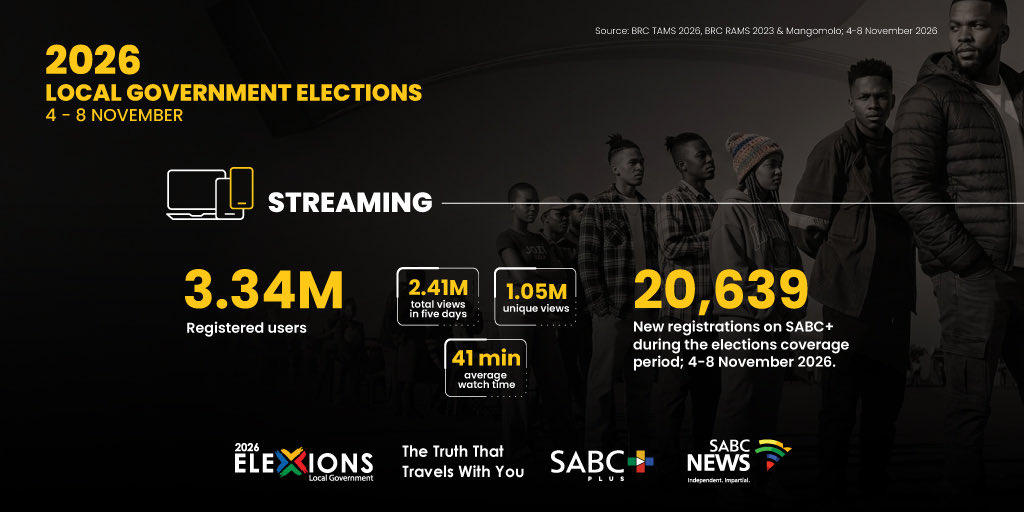
7.86 million of you followed the 2026 Local Government Elections on SABC television and SABC News Channel was the No.1 local 24-hour news channel.
On TV, radio and SABC+, we were there with you.
#SABCElections2026
I am genuinely mind-boggled by the fact that South Africa has more unemployed people than taxpayers, yet the GNU still has no clear direction on how it intends to tackle unemployment.
What the numbers tell us about the ANC's electoral decline:
1. The ANC's share of the PR vote has declined at every election since its 2006 peak of 65.67%
2. Its national PR vote fell by another 812,139 votes between 2021 and 2026.
3. In 2026, fewer than one in six registered voters chose the ANC on the PR ballot.
Read my full analysis of the ANC's 2026 local government election performance here: https://t.co/x1f6B3rkwH
I only provided an analysis of the DA’s performance above because Chris, in the original tweet I quote-tweeted, said I had incorrectly stated that the DA had hardly grown during our SMWX video discussing all parties and their performance. I was simply elaborating on the point I made in the video.
But yes, analysis articles on all parties are coming, starting with the ANC tomorrow!
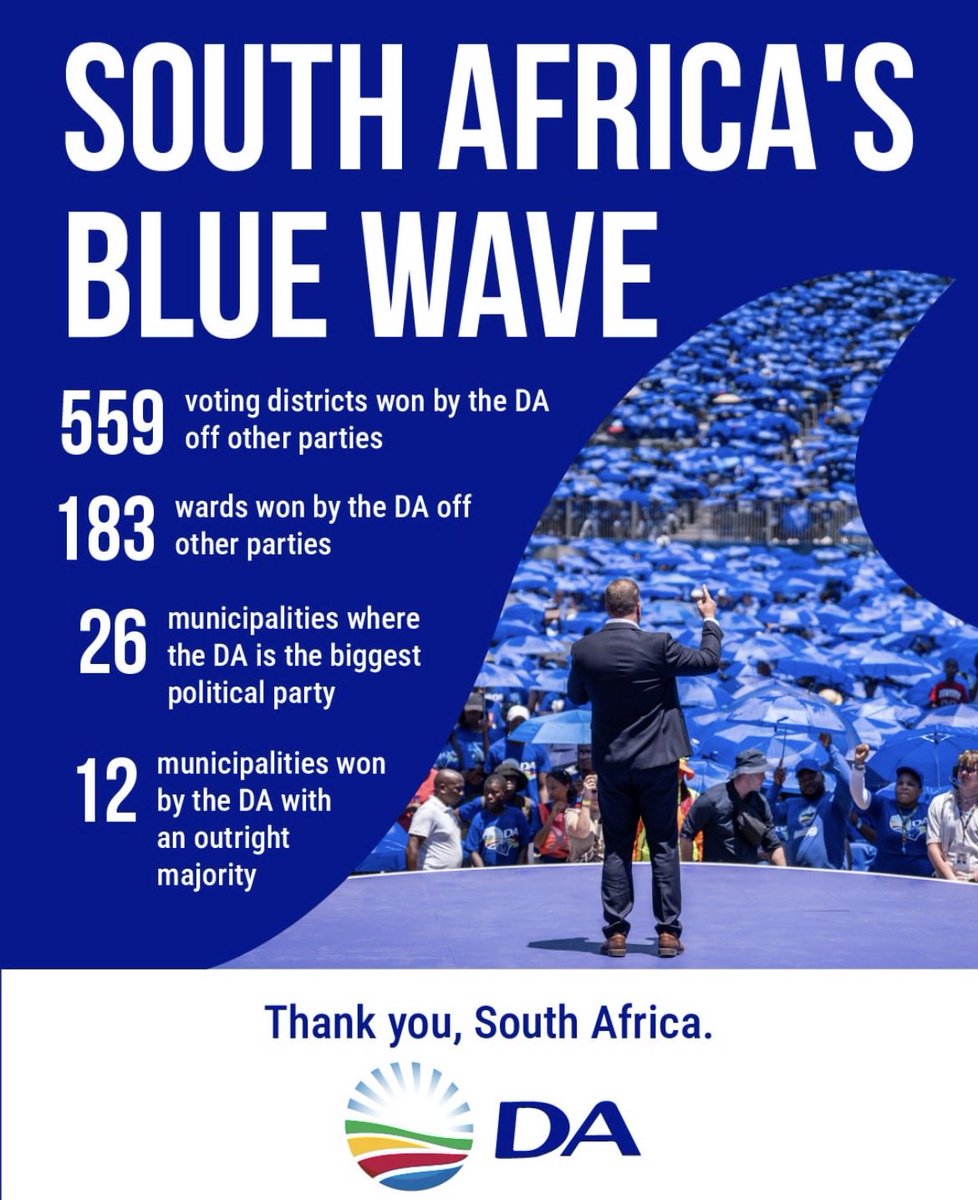
Chris it is all about context, I don’t dispute that the DA has made gains. It has. But winning voting districts, wards and municipalities is not the same as demonstrating substantial growth in national support. The broader numbers tell a more complicated story.
1. Start with the national vote:
DA:
2016: 26.90%
2021: 21.66%
2026: 24.63%
The DA has recovered some lost ground but remains 2.27 percentage points below its 2016 performance. It has still not returned to its previous electoral high.
2. The ANC has lost almost 15 percentage points since 2021, falling from 45.59% to 30.77%. The DA has gained just under three points. The ANC’s decline has not translated into a comparable increase in DA support.
3. The DA’s growth across metros is uneven:
Buffalo City: 19.5% → 16.5%
Cape Town: 58.2% → 56.4%
Ekurhuleni: 28.7% → 30.4%
JHB: 26.5% → 34.6%
Tshwane: 32.3% → 34%
eThekwini: 25.6% → 26.3%
Mangaung: 25.7% → 33.6%
Nelson Mandela Bay: 39.9% → 44.4%.
Its strongest gains are in JHB and Mangaung. It has lost support in Cape Town and Buffalo City.
4. The DA also had outright majorities in 13 municipalities in 2021, compared with 12 in 2026. The comparison of councils controlled shows 19 in 2016, 12 in 2021 and 11 at the time of the latest comparison.
Being the largest party in 26 municipalities is not the same as having an outright majority.
5. There are genuine gains worth acknowledging, particularly among majority-Black voters.
DA support in majority-Black voting districts increasing nationally to 8% (+4).
Across metros:
Mangaung: 17% (+10)
JHB: 13% (+9)
Cape Town: 13% (+7)
Tshwane: 11% (+5)
Ekurhuleni: 10% (+5)
NMB: 9% (+4)
Buffalo City: 5% (+1)
eThekwini: 4% (+2).
These are meaningful gains.
6. The DA also increased its ward vote by approximately 1.08-million votes across 23,353 comparable voting stations. Turnout also increased from 45.9% in 2021 to 52.3% in 2026.
That growth should not be dismissed.
7. But consider where the ANC’s lost support has gone:
ANC: 45.59% → 30.77%
DA: 21.66% → 24.63%
EFF: 10.31% → 6.22%
ActionSA: 2.33% → 5.67%
IFP: 5.64% → 4.70%
FF+: 2.34% → 2.99%
PA: 0.97% → 1.97%
MK: approximately 9.8% in 2026.
The opposition is growing in a fragmented way. The DA has not absorbed the bulk of the ANC’s lost support.
8. So, is there really a blue wave?
The DA has grown, but it has not returned to its 2016 national vote share. It has gained just under three percentage points since 2021, while the ANC has lost almost 15.
The opposition vote is increasingly fragmented, with ActionSA and MK also attracting support.
The question worth asking is not whether the DA has grown. It has. It is why, after such a substantial collapse in ANC support, the DA has not managed to capture a much larger share of that electorate.
Please don’t purposefully misconstrue what I said.
I’m watching SMWX reactions to the electoral outcomes and yet again I’m seeing such false statements being made it’s hard to believe that they are actually being made
@tarathinks
In what world can you make the argument that the DA “hasn’t really grown “
When this happened ⬇️
The ANC has its crutch. The DA has an audition. In my latest Tara’s Take, I look at what both parties have come to rely on, and what this reveals about their political futures.
Read the full piece: https://t.co/DP56gneJwi
The ANC has its crutch. The DA has an audition. In my latest Tara’s Take, I look at what both parties have come to rely on, and what this reveals about their political futures.
Read the full piece: https://t.co/DP56gneJwi
President @CyrilRamaphosa has determined salary increases for public office-bearers for the 2026/27 financial year, effective from 1 April 2026. https://t.co/tQiCjoKYay