My Dad was my best friend. I lost him on March 3rd, 2026. We did everything together from golf, to pool to playing gin. We had so much fun and time just flew by when we were together. I’ll miss you so much Dad. I’ll love you forever! ❤️
https://t.co/OSUbdLaq8f
Both NeXT and 3DFX tried to “do the right thing” with color spaces, and it wound up generally making them look worse than competing options. I didn’t really understand it properly until years later.
It is natural to think that a pixel with a value of 1.0 is emitting twice the photons as a pixel with a value of 0.5, so you can do the obvious linear math to calculate partial pixel coverage, blending a foreground over a background, or interpolating between colors in a texture.
If displays are “linear”, that is correct. NeXT and 3DFX were much closer to linear than other contemporary displays. NeXT had crossover from the deep graphics understanding at Pixar, and 3DFX had the SGI heritage. They did this intentionally.
If you have 10+ bits per channel like the professional rendering systems, linear displays are The Right Thing.
Unfortunately, NeXTStation Colors were 4 bits per channel and 3DFX was 5 or 6 bits per channel, and there… it was not the right thing.
Human eyes aren’t linear intensity sensors. We mostly register relative changes in intensity, so we can tell the difference between 0.01 and 0.02 as a huge doubling, while 0.99 to 1.00 is almost imperceptible.
This distribution of intensities is often referred to as the “gamma” of the display system, but the actual curves like sRGB are a bit more complicated.
If you only have a small number of discrete pixel values, you definitely don’t want to spread them evenly from 0 to 1! If you do, you will have good precision in the brights, but very stark “intensity bands” in the dark colors.
If everything was authored specifically for 3DFX, you would still have the fundamental problem with the dark bands, but more accurate blending and filtering. The problem was that artists made all of their textures in paint programs on conventional non-linear displays, so when they were drawn by 3DFX cards, they got the characteristic “washed out color” look.
You can mathematically correct textures for differences in display gamma, but I didn’t really understand the issue back in the glQuake days, and we were so enthralled by the absolute performance of 3DFX that the color fidelity didn’t get as much attention as it should have.
Even today, tons of games don’t properly handle gamma across their textures and render targets. High resolutions and 24 bit color masks most of it, but you still see it in some slight shimmerings in high contrast textures and edges.
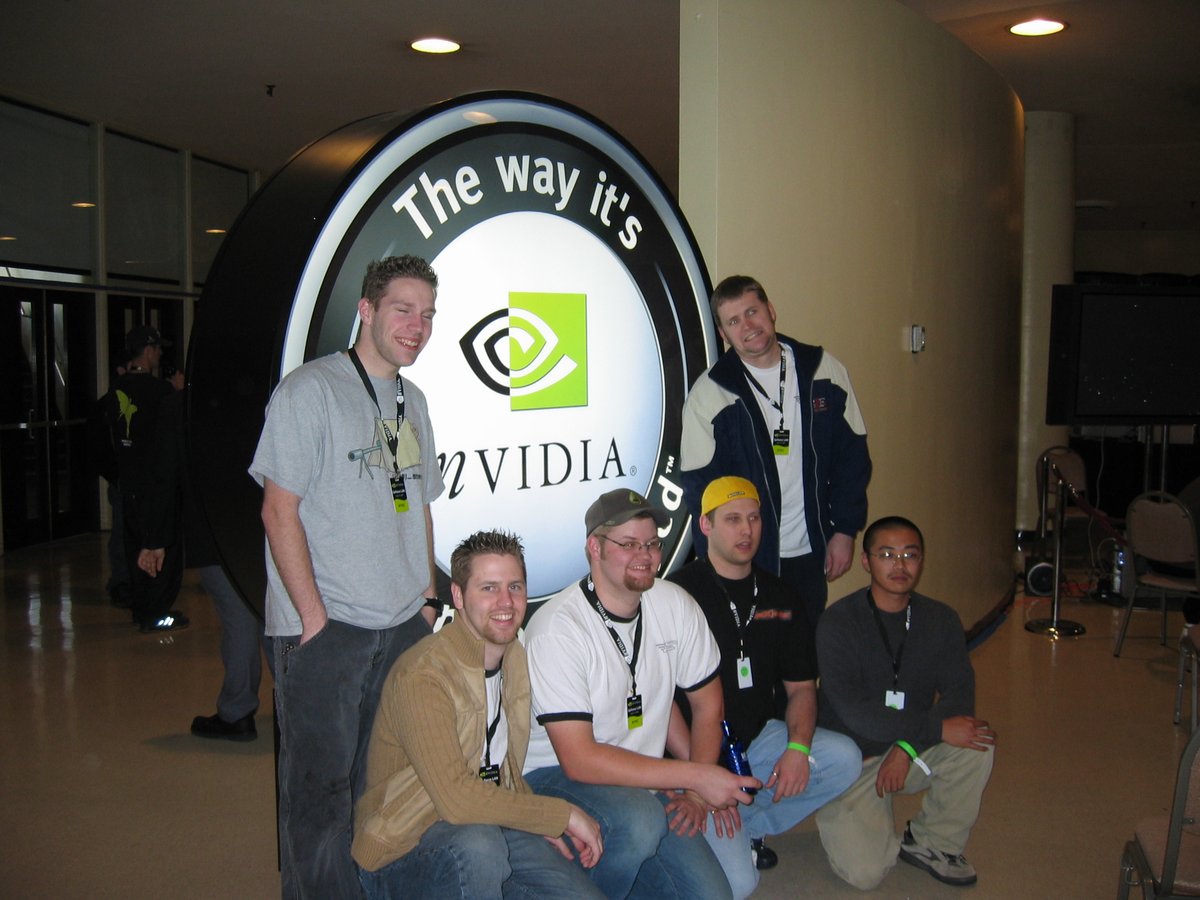
A lot has happened this week. I'm grateful to work alongside some amazing colleagues who love PC gaming, hardware, and tech. This work continues! This week we're at PDXLAN, one of the biggest LAN parties. NVIDIA and GeForce have been coming since 2003! Excited to be back 😀
@Xenaero I feel every game is asking something from us and we need to be able to answer the questions of what is optimal to play the game. It's always a fun grind to figure it out.
Do you play inverted? Interview I did with Heise talks about it all and how only one other current professional CS player uses inverted as well.
https://t.co/0rbDR8r4tL
@woutersimons81 Yes amazing times! I still tell your joke when we were in Norway hiking through the snow. ❄️
lol such good times man! Would be great to reconnect! Let’s find a padel tournament and I’ll fly out to play with ya or vise versa!
@exever lol no. Padel is played in a glass cage. You can play off the glass and is a pretty athletic game where moving is still essential to winning the point. 💪🏻