Farm Credit Services of America is dedicated to serving the credit and insurance needs of farmers and ranchers in Iowa, Nebraska, South Dakota and Wyoming.
For this fifth-generation Kansas rancher, sustainability is about more than land stewardship. It's also about avoiding burnout for producers and their families.
Regenerative ranching practices have been part of Daniel's operation for nearly a decade. Through virtual fencing and solar-powered collars, he's improving grazing management while gaining valuable time back.
Learn more about Daniel's story and others in our sustainability report. https://t.co/5GWsByqiuV
With higher interest rates and tighter margins, many producers are facing a critical question: pay down debt faster or preserve cash flow? In our upcoming webinar, we’ll walk through the real tradeoffs behind that decision, how different approaches impact risk and flexibility, and practical guidelines to help you make the right call for your operation in today’s environment.
Register to watch live or later: https://t.co/F41d52YiTI
This webinar will feature @AgEconomists co-founders David Widmar and Brent Gloy, along with Ross Hebrink, financial officer.
A strong risk management strategy goes beyond a single decision. Crop insurance, marketing, working capital, and debt management all play a role.
Before selecting coverage for the year ahead, consider:
✅ Your cost of production
✅ Projected cash flow
✅ Available working capital
✅ Planned capital purchases
Understanding your financial picture can help you weigh coverage options, costs, and risks with greater confidence.
Download our 2027 Crop Insurance Playbook: https://t.co/3gTzFVFJTv
New hog barn economics have changed dramatically.
According to @TerrainAg, rising construction costs, elevated borrowing rates, and stronger competition for capital have increased the revenue required to justify new facilities. As a result, building construction has become as much a capital allocation decision as a hog-producing decision.
The economics may increasingly favor maintaining and reinvesting in productive existing facilities relative to new construction.
If contract payments are sufficient to keep existing barns operating but insufficient to generate investment in replacement facilities, finishing capacity could gradually tighten as older barns reach the end of their useful lives.
The long-run question isn't simply whether existing finishing barns can remain economically viable. It's whether the economics of contract finishing provide sufficient incentive to replace those facilities as they age out of production. https://t.co/qNC6TctljU
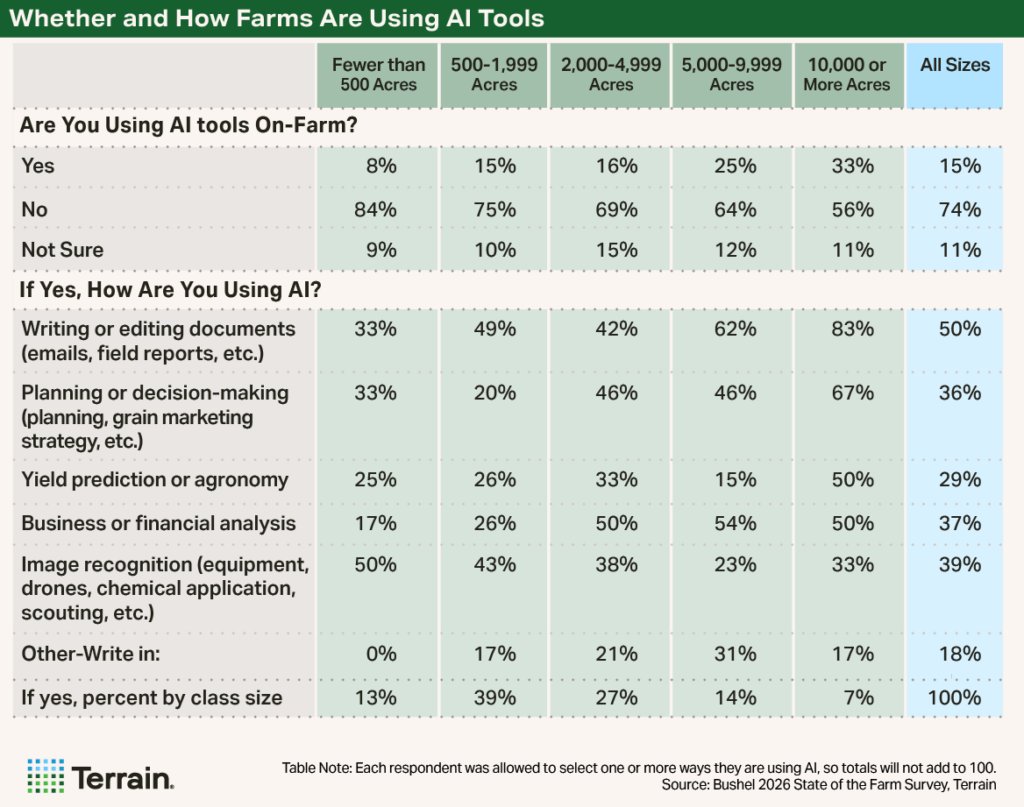
Artificial intelligence is making its way onto the farm, but adoption is still in its early stages. About 15% of farms indicate they use AI, with office tasks making up a far higher share than agronomic tasks. Common uses include drafting emails and field notes, planning and decision-making, and business or financial analysis. Yield prediction and agronomy use cases generally have a lower use rate among all farm sizes.
Farms that experiment early and build stronger data foundations may see more benefits over time as AI capabilities continue to improve.
Read more from @TerrainAg: https://t.co/2lsSWIQh6F
As drought conditions continue across parts of the region, you may be thinking about yields, cash flow, and your overall farm financial position.
Discover how higher fall harvest prices may affect your crop insurance protection and what to review before making year-end decisions. https://t.co/I0uX6EbrYx
While soybean operating margins are improving, questions around exports, trade, and South American production could shape what's next for soybean prices.
Brazilian farmers are expected to increase planted soybean area at the slowest rate in 20 years, and any changes to planting pace that reduce the size of Brazil's crop could lead to price volatility in Q4 for soybeans.
Read more from @TerrainAg: https://t.co/tWGx94sQsB
Our strength comes from who we serve. As National Co-op Month comes to a close, we're celebrating the farmers and ranchers who make our cooperative what it is. Their hard work keeps agriculture moving forward, and as customer-owners, their voices help shape the future of our cooperative.
We're proud to stand alongside them, today and for generations to come.
When school is out for summer, hundreds of children across Beadle County, South Dakota, lose access to consistent meals. The Huron Public Library Feed & Read Program distributed weekly food bags to help fill that gap, serving 150 students each week through a partnership with the United Way Heartland Region Backpack Program and support from a Working Here Fund grant.
This is just one example of how we're helping strengthen rural communities. Read our Community Impact Report to learn more: https://t.co/aaPRt1kSoF
Harvest pressure may be grabbing today's headlines, but it's not the whole story.
Despite a bearish adjustment to old-crop ending stocks, overall corn supplies remain tighter than a year ago. Combined with stronger demand and global production risks, that could provide support for a firmer market into 2027.
Read more from @TerrainAg: https://t.co/O2cUrgrEfw
Despite weak new equipment sales and aging fleets, higher repair costs continue to keep machinery cost per acre high. Looking ahead, total machinery costs in 2027 are expected to remain near or above 2026 levels.
As harvest wraps up, it's a good time to review cost of production assumptions and benchmarks to better guide equipment decisions heading into 2027. Learn more from @TerrainAg: https://t.co/tJE8uzenF1
Fixed costs are often harder to see – but they’re one of the biggest long-term drivers of competitiveness. In our upcoming webinar, we’ll break down how strong operations think about fixed cost structure, where inefficiencies tend to hide, and how to evaluate whether your cost structure is helping or holding you back.
Register to watch live or later: https://t.co/VitKkIzpyd
This webinar will feature @AgEconomists co-founders David Widmar and Brent Gloy, along with Jen Dragt, relationship officer.
🔎🥛 Our Q4 #Dairy Market Outlook: This environment will require more active #RiskManagement and a closer assessment of culling and beef breeding strategies than when feed costs were low, #milk prices were high, and #beef revenues were unprecedented.
Learn more about the factors shaping #DairyMarkets near term: https://t.co/swt32fqX2w
Farmers and ranchers make decisions today that shape their operations and communities for years to come.
Long-term planning requires long-term certainty. A five-year Farm Bill provides a policy foundation for investment in the future of agriculture. Recent progress toward a new five-year Farm Bill is an encouraging step for agriculture and rural communities.
#FinishTheFarmBill
PRF insurance is an area-based insurance program that replaces income from forage losses caused by low precipitation relative to a historic average. Because producers make several coverage selections, evaluating historical rainfall data and different coverage scenarios can help inform decision-making.
Learn more about PRF insurance: https://t.co/k85vzou6LT
No matter where in the world Daniel finds himself, he is just a click away from his ranch. A smartphone app allows him to locate his cows and adjust their pasture access to an area as small as two acres.
He can move cattle two to three times a day without having to drive across the operation’s 15,000 acres that hold around 3,000 head of cattle.
The combination of virtual fencing and solar-powered collars has the potential to be one of his most profitable ranch investments.
Learn more about Daniel's story and others in our sustainability report: https://t.co/5GWsByqiuV
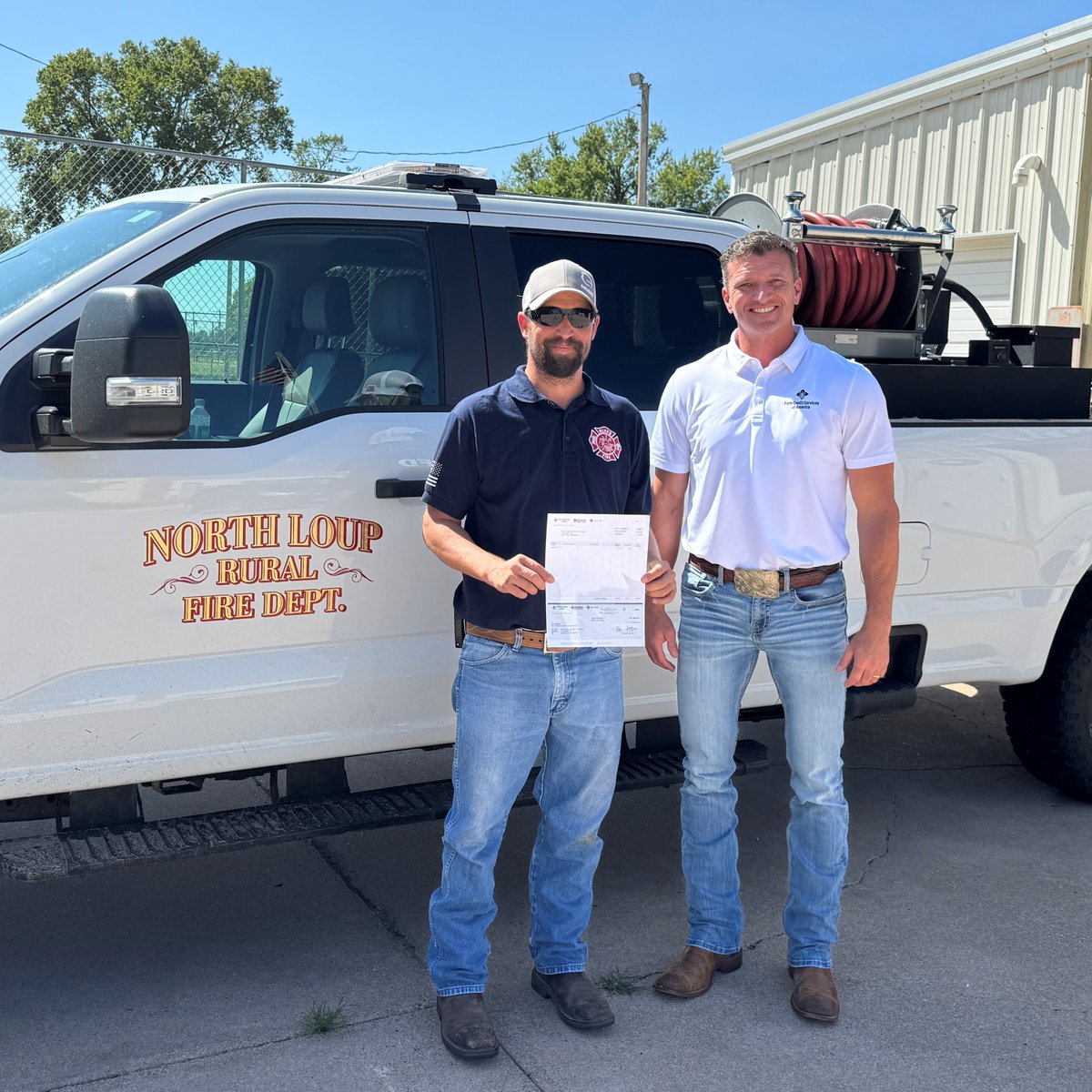
This year, volunteer fire departments across Nebraska were on the front lines as wildfires affected communities throughout the state.
In the months following the fires, our local offices delivered checks to more than 40 volunteer fire departments across central and western Nebraska. We're grateful to the firefighters who work tirelessly to protect our communities and proud to support local emergency response efforts through these donations.
Lower than average rainfall can have a significant impact on forage production. PRF insurance is designed to help livestock producers manage that risk. Swipe through to learn how this area-based coverage works.
Learn more: https://t.co/USmfCKNz7P
Over the past few years, dairy producers have enjoyed a favorable combination of strong milk prices, reasonably low feed costs, and exceptionally high beef-cross calf values. But the tailwinds supporting healthy margins are weakening.
Day-old prices have been falling rapidly, milk prices have come under pressure due to heavy supply growth, and feed markets are beginning to show signs of tightening supplies. While none of these developments are anything extraordinary on their own, together they point toward more margin pressure than has been the norm in recent years.
As margins compress, focus will need to be regained and margins will need to be more actively managed. Read more from @TerrainAg: https://t.co/amRVdo474S