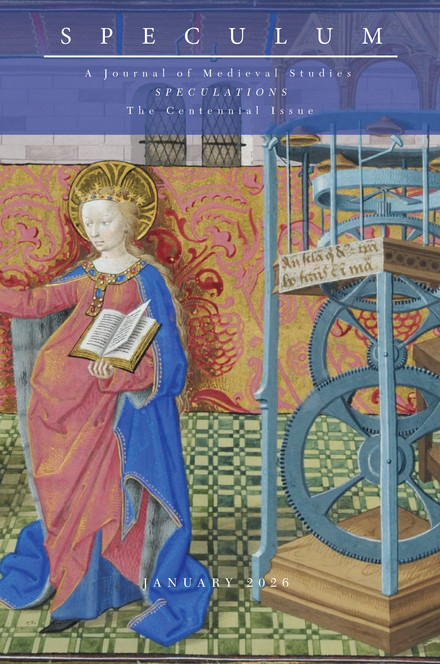
The Middle Ages are not essential -- and that is what makes them so helpful to us. Prior to the hegemony of racial capitalism, medieval cultures offer us a glimpse into other ways of thinking, revealing our own capacity to be otherwise.
This is the topic of my essay in Speculum.
I'm so happy that my piece about nonbeenary monks made it into this wonderful issue of postmedieval! Alongside some great pieces on ecotheory, gender theory, imaginative figuration, links between Italy and Asia... This issue is a dazzling picture of boundary-pushing research.
while we are on the topic of our 2025 publications, take a look at our winter issue! what’s inside?
pieces on idols and figuration, gender, ecocriticism, medievalisms, and whiteness…
while we are on the topic of our 2025 publications, take a look at our winter issue! what’s inside?
pieces on idols and figuration, gender, ecocriticism, medievalisms, and whiteness…
If I was an English professor I would teach a class on Bees in Literature. It’d probably be called something like “ENGL 470: Apiological Perspectives in Western Literature…” Syllabus would start out with bees as symbols of social cohesion in Hesiod and Virgil then move on to bees in Chaucer, Spenser, Shakespeare… I’d give a lecture about the tradition of “the telling of the bees”… finally end up at Bernard Mandeville’s Fable of the Bees and discuss how bee theory created modern liberal capitalism. Last class of the semester we’d watch The Beekeeper starring Jason Statham.
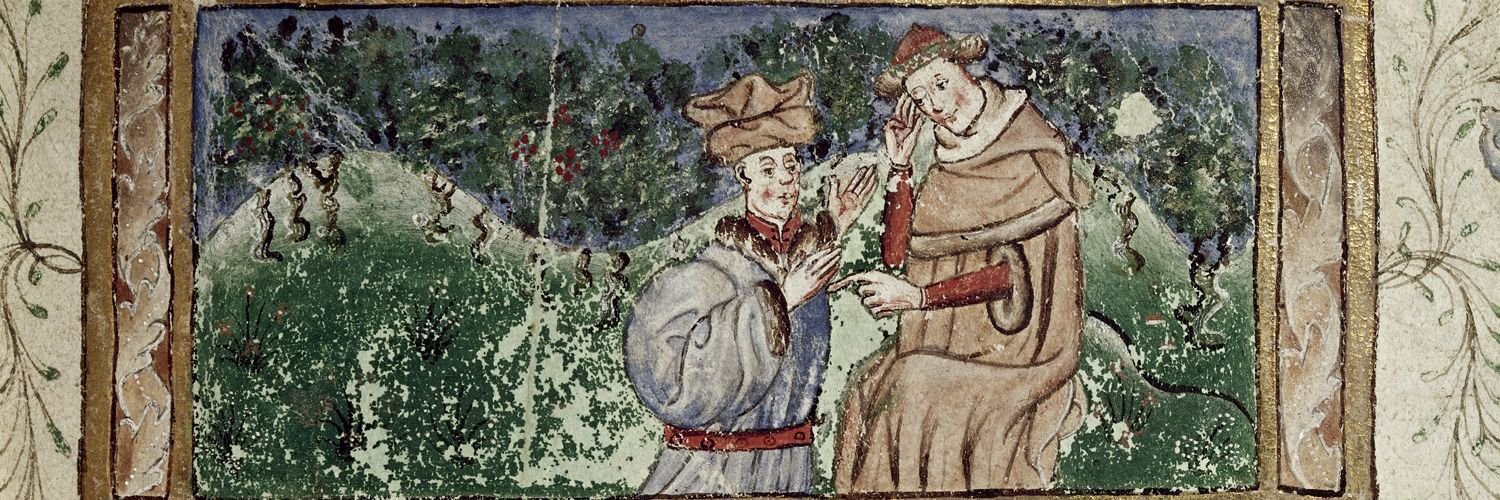
Monks in the 9th–11th centuries identified with bees to make sense of their place in medieval society. In bees, they found an ideal of communal life, selfless virtue, and chastity. By living with bees and writing about them, these monks forged a distinct, nonbeenary gender.
Read it here: https://t.co/HfcptE1CFa
And make sure to look through the whole issue. This centennial publication offers a remarkable, open-ended, prismatic panorama of new directions from across medieval studies. It is a heartening picture of a field that continues to flourish.
The Middle Ages are not essential -- and that is what makes them so helpful to us. Prior to the hegemony of racial capitalism, medieval cultures offer us a glimpse into other ways of thinking, revealing our own capacity to be otherwise.
This is the topic of my essay in Speculum.
It's an honour to contribute to the colloquium on "Psychoanalysis, Transgender Studies, and Medieval Studies" in Studies in the Age of Chaucer. I argue that Lacan's critique of metaphor allows us to join up a distinctly medieval concept of "gender" with present-day anxieties.
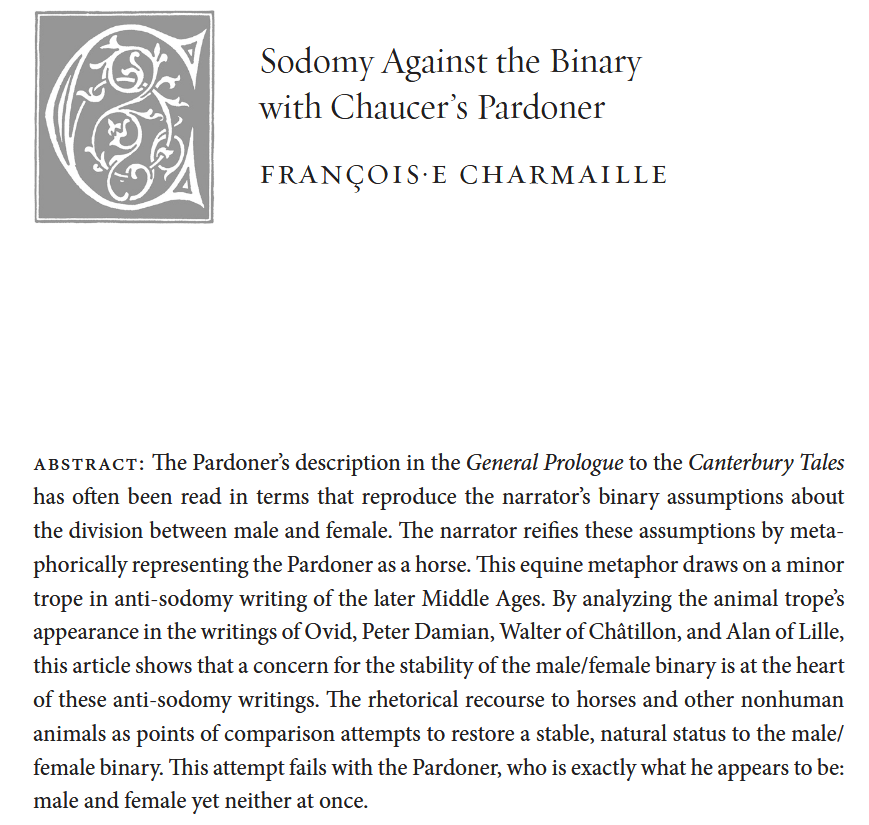
This has everything to do with horses' bones, and with the Pardoner in Geoffrey Chaucer's Canterbury Tales.
Read about it in The Chaucer Review.
https://t.co/JmKbqrhc0f
Out today! Sodomy is "the sin against nature." But what is "nature"? "Heterosexuality" seems like the obvious answer, but such a term is anachronistic... Sodomy might be better understood as the disruption of the division between male and female.
Friday 2 May, 5pm, in Cambridge: I will be speaking at the ASNC Research Seminar, about The Contingent Middle Ages. The Middle Ages are generative, are worth engaging with, because they are inessential. I'm very excited to share this work.
GR04 in the Faculty of English.
According to Turton, the queer history of languages reveals that efforts to make grammar and vocabulary more inclusive of sexual and gender differences aren't limited to the present or just one language. 3/5
‘There is much to learn from the strategies of self-expression used by authors and activists working in different times and across multiple languages.’ 4/5
Welcome to the Languages of Queer History series. We’ll be bringing you a new post each week that explores how language and literature have shaped, and continue to shape, understandings of sex and gender. 1/5