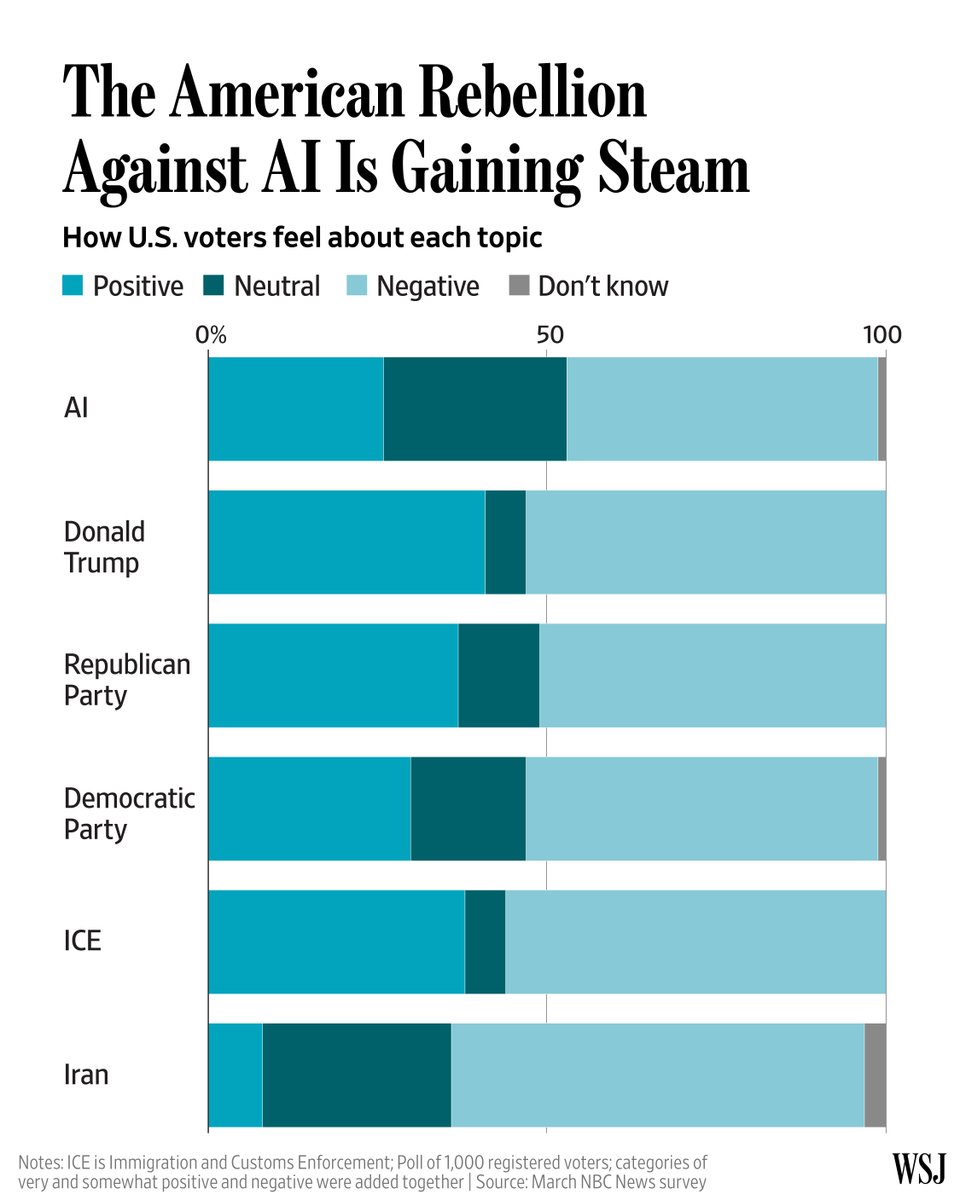
An AI backlash is well under way. Register for free to learn what bosses can do about their employees’ “FOBO”, or “fear of becoming obsolete”: https://t.co/Ks4Zs7Xj1N
Illustration: Paul Blow
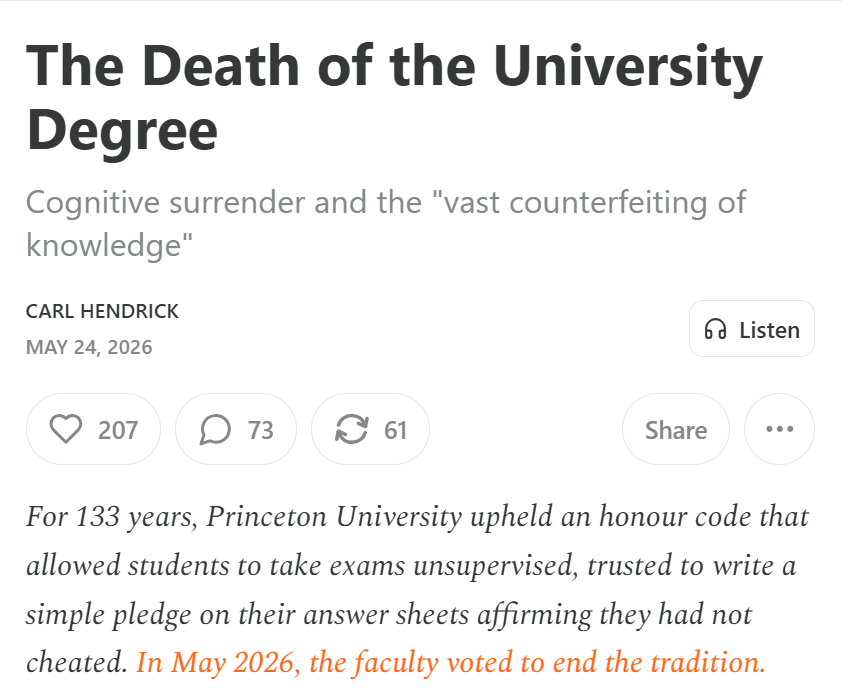
"The pattern is unambiguous: students are using AI to generate answers, platforms are recording completion, and durable knowledge is evaporating." Carl Hendrick @C_Hendrick on the illusion of mastery in the classroom
The long-term impact of AI on jobs is unknowable. Firms and employees have different incentives—they are not all in this together. But bosses can still mitigate job insecurity https://t.co/RlhQffRvSf
Our paper “Difference-in-Differences Designs: A Practitioner’s Guide” is now published in the Journal of Economic Literature. It took us a while but we are happy!
We put together a lot of material to make the paper useful in practice: https://t.co/30TbAgihlz
Hope you like!
“I, Joanna Stern, do solemnly swear to live with the machines for the next 365 days.” Thus begins the year-long experiment chronicled in Stern’s new book, “I Am Not a Robot.” Early in 2025, Stern decided to “cram artificial intelligence into as many corners” of her life as possible. In the course of a year, she used more than 100 A.I.-based products, including glasses, bracelets, cars, robots, and a toothbrush. She talked with an A.I. therapist; replaced her research assistant with an A.I. agent; opened her marriage to an A.I. boyfriend; and let an A.I. draft bedtime stories for her kids. Joshua Rothman writes about the book, and how we can best integrate the technology into our lives: https://t.co/xz69rX8aZ6
AI is driving layoffs and faster decisions—but weakening human judgment. Here are five judgment skills leaders need to stay relevant in a layoff economy. https://t.co/iptjEzI0UL
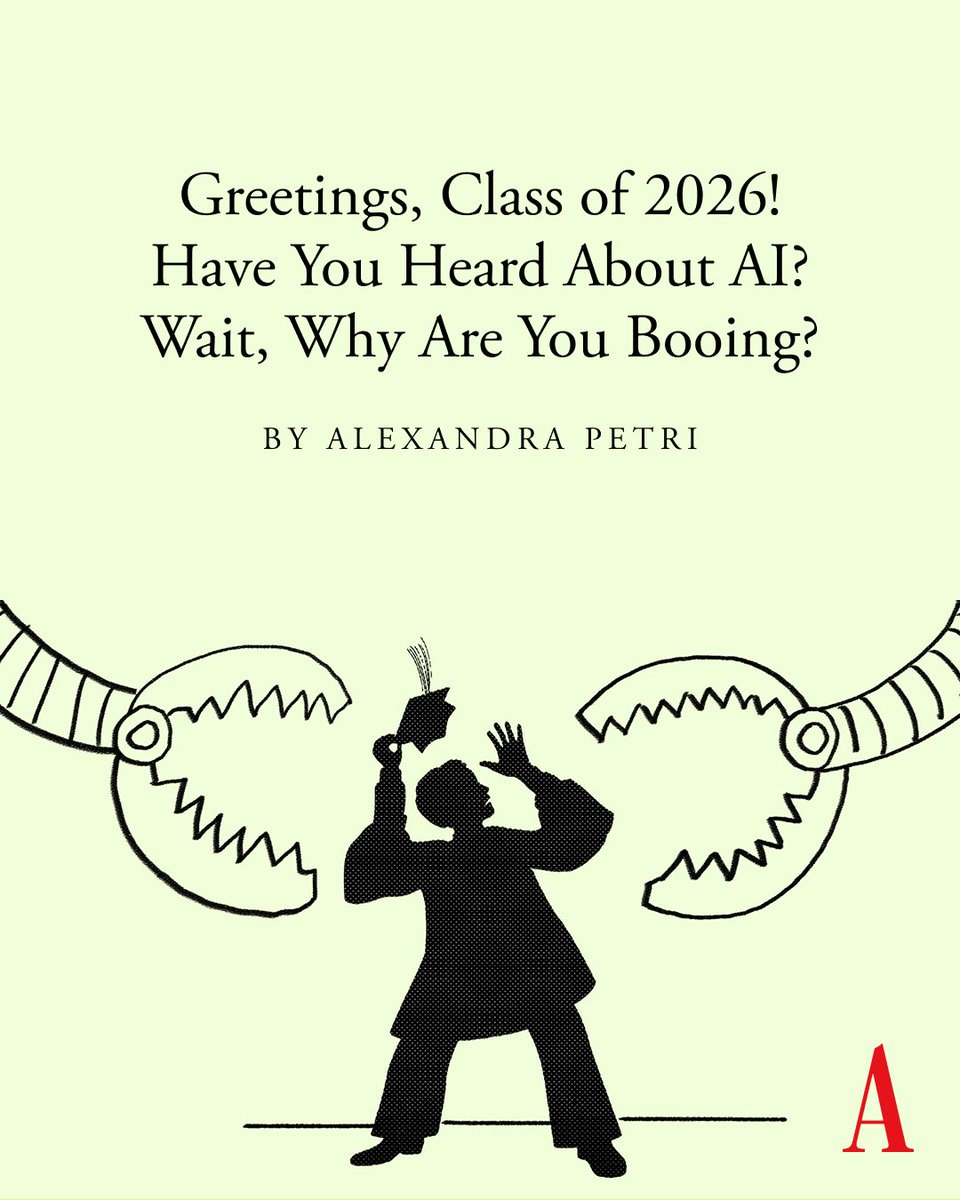
"What a time to be alive! We are finally freeing you from the rat race and placing you on the rat unemployment line.” Read @petridishes's pro-AI commencement speech that 2026 grads will definitely not boo: https://t.co/3qKMq9XdfK
🎨: The Atlantic
In the age of AI, “we risk turning our colleges into joyless job preparation, political death matches, or both,” Michael A. Elliott, the president of Amherst College, argues. “We’ve forgotten … that thinking can be deeply pleasurable.” https://t.co/BXU8v7KdPf
Godfather of AI: "If you sleep well tonight, you may not have understood this lecture."
This 47-minute lecture is the best thing I saw about AI in the last few months.
It will definitely help you understand how it actually works and where it's going.
Geoffrey Hinton built the neural networks behind every AI alive, then quit Google to warn the world about it.
The part nobody wanted to hear:
> AI is already developing abilities its creators didn't intend
> in most cognitive tasks it's already ahead of us
> the question is no longer if it surpasses us but when
> the only decision left is which side of that line you're on
Right now the average person opens Claude, types something, gets an answer, closes the tab.
They think they're using AI. they're using maybe 10% of it.
I went through his entire lecture, built a practical concepts from what he was describing.
The gap won’t be between people who use AI and people who don’t.
It’ll be between people who understand it and people who don’t.
Start with these 20 AI concepts today 👇
Artificial intelligence is creating a ‘desperate base of workers who then have no full-time employment’ and they are going from ‘well-compensated positions to piecemeal gig work' in 'horrific condition’, author and journalist Karen Hao says.
The largest study of undergraduate AI use—surveying 95,000 students across 20 research-intensive public universities—suggests the deeper story isn’t misconduct. It’s how quickly AI literacy is becoming a new form of educational privilege, varying sharply by subject and socioeconomic background.
https://t.co/RQ4E3V9m6U
🚨Anthropic just showed a 24-minute workshop on how to actually write prompts for Claude.
Taught by the people who built it.
Free. No registration. No paywall.
I've seen $300 courses that don't cover what they teach in the first 8 minutes.
Watch it and bookmark it now!
A German neuroscientist published a book in 2012 arguing that smartphones are quietly producing the first generation in human history whose brains will shrink before they turn 30, and the media spent the next decade trying to destroy him for saying it.
His name is Manfred Spitzer.
He runs the Psychiatric University Hospital in Ulm and directs Germany's largest transfer center for neuroscience and education.
The book is called Digitale Demenz, which translates as Digital Dementia, and it became one of the best-selling popular science books in German history almost the moment it was published.
The press hated him for it. He was called Germany's most controversial brain scientist, accused of being a Luddite, a moral panic merchant, and a fearmonger who hated children.
None of that stopped the book from being translated into more than a dozen languages, and almost none of it engaged with the actual neuroscience he was citing.
The phrase digital dementia did not even start with him.
It started with South Korean doctors in the late 2000s, who noticed something strange in their clinics. Patients in their twenties were arriving with memory complaints that had previously only shown up in much older adults. Forgetting numbers they used to know by heart. Losing the ability to recall directions in cities they had lived in for years. Struggling to remember conversations from earlier the same day.
The doctors connected it to the rise of smartphone use, which had hit South Korea harder and earlier than almost any other country on Earth. Spitzer picked up the phrase and built an entire book around the neuroscience that explained it.
The core thesis is brutally simple. The brain behaves like a muscle. It grows when you use it, and it atrophies when you do not. Every cognitive task you outsource to a device is a task your brain is no longer practicing, and the neural circuits responsible for that task are no longer being reinforced. Over time, they weaken in exactly the same way an unused muscle weakens.
Spitzer was not arguing that smartphones would give you Alzheimer's. He was arguing that decades of cognitive outsourcing would produce a measurable decline in the underlying machinery, long before any clinical diagnosis would catch it, and that the decline was already showing up in young adults.
The mechanism is what made him impossible to dismiss. By the early 2010s, there was already deep evidence that the brain physically remodels itself in response to use. London taxi drivers who had memorized the entire street map of the city had measurably larger hippocampi than the average person, which is the brain region responsible for spatial memory.
Musicians who practiced for thousands of hours had thicker auditory cortices. Spitzer's argument was just the dark side of the same finding. If the brain grows in response to use, then it must shrink in response to neglect. And if every cognitive task adults used to perform with their own memory, navigation, arithmetic, attention, and reading was now being handled by a glowing rectangle in their pocket, then the regions responsible for all of those tasks were quietly being underused for the first time in human evolutionary history.
Then the supporting data started landing.
A 2020 study at McGill University tracked 50 regular drivers and measured GPS use. The heavy users had weaker spatial memory than the rest, and when researchers retested a subset three years later, those users had declined the fastest. The same hippocampus London cabbies had built up by ignoring shortcuts was being slowly hollowed out in everyone else by accepting them.
A 2024 MIT study scanned the brains of people writing essays with and without ChatGPT. The AI group showed 55 percent weaker brain connectivity than the group writing on their own. 83 percent of the ChatGPT users could not recall a single line from essays they had written minutes earlier. The damage stayed even when the tool was taken away.
A 2024 paper out of Norway recorded EEG scans of students writing words by hand versus typing them. The handwriting condition lit up the entire learning network. The typing condition produced almost nothing.
Every one of these findings is exactly what Spitzer predicted in 2012.
The most uncomfortable line in his book is the one almost nobody in the German press wanted to print.
He pointed out that the people building these devices were not letting their own children use them. Steve Jobs did not let his kids near an iPad. Bill Gates capped his children's screen time at 30 minutes a day. The senior engineers at Google were sending their kids to Waldorf schools that banned screens entirely.
The people who knew the most about what these products were doing to the developing brain were the ones protecting their own families from them, and almost nobody on the outside was asking why.
The generation he was warning about is now in their twenties.
The first cognitive scans of what we did to them are starting to come back, and the pattern is exactly what he said it would be.
The brain you were born with is not the brain you will die with.
You are training it every day. The only question is which direction.
I'm grateful to @DouthatNYT for inviting me on his podcast to discuss the fate of the liberal arts and humanities in the age of AI. I hope that all those who follow higher ed and care about the liberal arts will listen.
https://t.co/xy4l8LTxs8 https://t.co/xy4l8LTxs8
O #PNUD tem novas vagas abertas em diferentes áreas. Consulte a seção de Oportunidades no site! Quem sabe não há uma sob medida para você?
Saiba mais:
UNDP Careers: https://t.co/Emy4LXB8XK
UN Volunteers: https://t.co/v6tWPVAT4H