Thanks to @Berna_Elias, @MaudeChampagne3, @CatrineDemers and Delphine Gaudin-Drouelle for the great work on this topic. You can refer to their full infographic here: https://t.co/TbQuDo0rhT
What is #powerimbalance in research, and how do we prevent it? This was the question asked by recent alumni in the @FERCourse, who developed a helpful infographic to help research teams navigate this concern and create a more #equitable environment [1/5]
Preventing #powerimbalance in #FER must be a top priority throughout each step of the research process. It can be helpful to use self-reflection questions as a preventative tool: https://t.co/RksetDJ4aA [4/5]
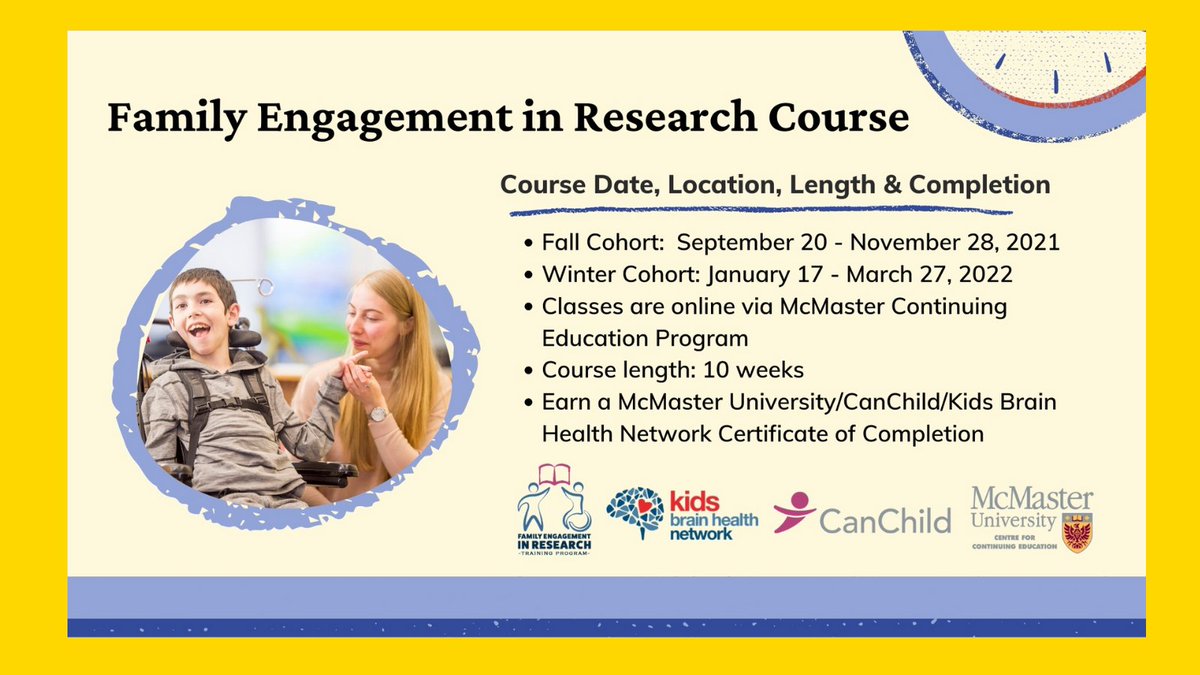
What you'll gain from @FERCourse: Collaborations with other family members, researchers & trainees interested in #FER, more confidence when engaging in research teams + a certificate of completion from @KidsBrainHealth, @CanChild & @McMasterContEd
Interested in learning more about #familyengagementinresearch? The @FERCourse is now acceptiing applications for their Fall 2021 & Winter 2022 cohorts! Apply here: https://t.co/249gAjRn7x
What you'll learn from @FERCourse: Importance of #FER + research process, how to find research #partners, how to work together effectively, how to navigate ethics of #FER and address barriers in #research
✨In #Conclusion✨ There are many benefits to engaging in patient-research partnerships, but the potential #risks of abusing power and/or not considering the already-busy lives of #patient groups should be addressed proactively and through #mutualrespect. [1/5]
✨#studyhighlight✨ Leese et al (2018) co-designed + co-conducted a #qualitative study w/ #patientpartners to understand the benefits & risks of patient-research partnerships, from the perspective of 22 patient partners in arthritis research https://t.co/in5Ntng0Vh [1/4]
#T3: The demands of participation on top of existing responsibilities (career, family) described as “spinning too many plates”. Common #struggles included feeling guilty for not doing enough, neglecting family time and responsibilities interfering with health & well-being [4/4]
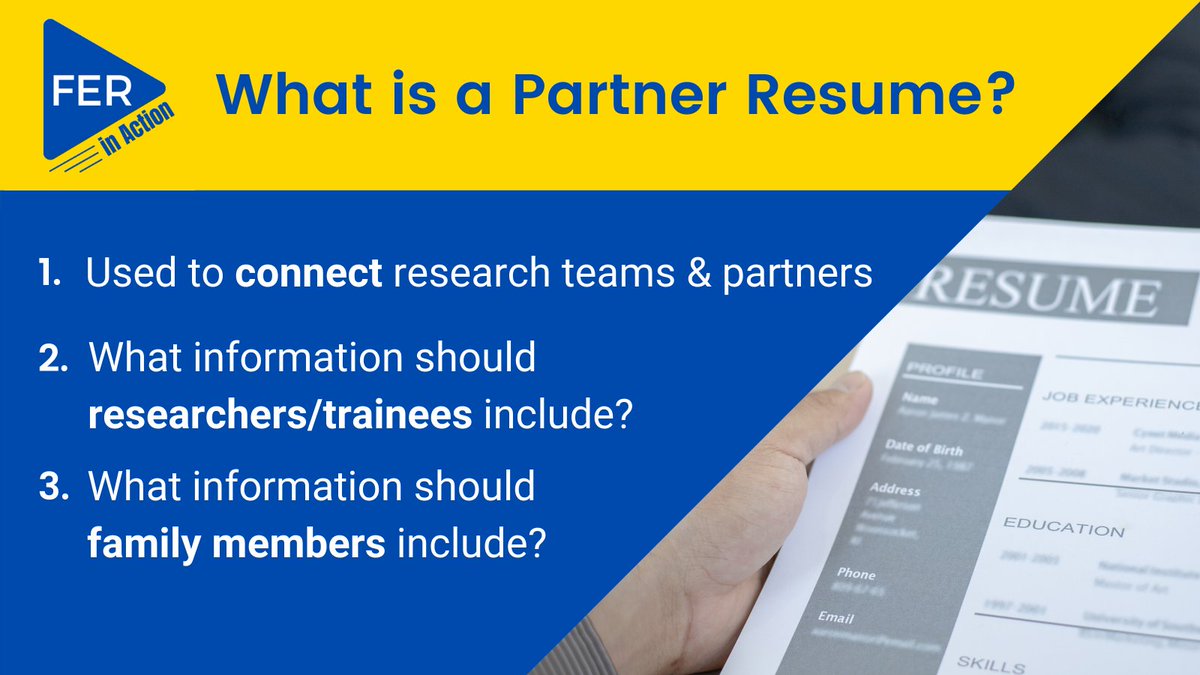
#Parent resumes should highlight the various health systems they have navigated with their child, the health providers and services they are well-versed in, special interests/skills + their personal experiences of #caregiving for a child with #specialneeds [4/4]
#Parents are invaluable stakeholders to research teams; their lived experiences are extensive as they navigate #healthcare alongside community, #disability + family connections. The resume can help identify parents’ strengths & potential role on a research team [3/4]
The different roles during the research process can be Listener, Co-Thinker, Advisor, Partner and Director. Check out the video below to learn more about the #InvolvementMatrix or visit the website: https://t.co/fUalZJsYYL [5/5]
Video Link: https://t.co/1yf6SC6LZl
Defining #roles and #expectations for each team member is a critical success factor to any project. When roles are clear, people know what’s expected of them, how to behave and what they need to accomplish [1/5]
Researchers have designed the #InvolvementMatrix to address the challenges with defining roles in #FER in different stages of the study. This tool assists the research team with clearly defining the roles of family partners at the outset. https://t.co/0dIfPrCdPf [4/5]





![FER_InAction's tweet photo. What is #powerimbalance in research, and how do we prevent it? This was the question asked by recent alumni in the @FERCourse, who developed a helpful infographic to help research teams navigate this concern and create a more #equitable environment [1/5] https://t.co/Rbb7AtYL5I](https://pbs.twimg.com/media/E0ELfgdXEAQ3NTe.jpg)
![FER_InAction's tweet photo. Preventing #powerimbalance in #FER must be a top priority throughout each step of the research process. It can be helpful to use self-reflection questions as a preventative tool: https://t.co/RksetDJ4aA [4/5] https://t.co/71KIjt0gfb](https://pbs.twimg.com/media/E0ELtXeXEAgr42l.jpg)

![FER_InAction's tweet photo. ✨#studyhighlight✨ Leese et al (2018) co-designed + co-conducted a #qualitative study w/ #patientpartners to understand the benefits & risks of patient-research partnerships, from the perspective of 22 patient partners in arthritis research https://t.co/in5Ntng0Vh [1/4] https://t.co/g6Ekix5HSK](https://pbs.twimg.com/media/ExLRPhUU8AwyfZH.jpg)
![FER_InAction's tweet photo. #T3: The demands of participation on top of existing responsibilities (career, family) described as “spinning too many plates”. Common #struggles included feeling guilty for not doing enough, neglecting family time and responsibilities interfering with health & well-being [4/4] https://t.co/3I5GcReo66](https://pbs.twimg.com/media/ExLTosSU8AESXPW.png)
![FER_InAction's tweet photo. #Parent resumes should highlight the various health systems they have navigated with their child, the health providers and services they are well-versed in, special interests/skills + their personal experiences of #caregiving for a child with #specialneeds [4/4] https://t.co/rA9Tt81NAz](https://pbs.twimg.com/media/ExLPF23VgAMkQne.jpg)
![FER_InAction's tweet photo. #Parents are invaluable stakeholders to research teams; their lived experiences are extensive as they navigate #healthcare alongside community, #disability + family connections. The resume can help identify parents’ strengths & potential role on a research team [3/4] https://t.co/pisAp9HH4p](https://pbs.twimg.com/media/ExLNiO5VcAYMVcd.jpg)
![FER_InAction's tweet photo. Defining #roles and #expectations for each team member is a critical success factor to any project. When roles are clear, people know what’s expected of them, how to behave and what they need to accomplish [1/5] https://t.co/gpQXcZLVuB](https://pbs.twimg.com/media/ExLDcgvUYBIRmb6.jpg)
![FER_InAction's tweet photo. Researchers have designed the #InvolvementMatrix to address the challenges with defining roles in #FER in different stages of the study. This tool assists the research team with clearly defining the roles of family partners at the outset. https://t.co/0dIfPrCdPf [4/5] https://t.co/XuoFkMDMs4](https://pbs.twimg.com/media/ExLEbEcVcBEN0a6.jpg)


