Millions of people in #Yemen 🇾🇪 are expected to experience food consumption deficits through at least May 2025 as they continue to experience macroeconomic shocks stemming from the country’s years-long conflict.
Learn more https://t.co/wrlYkrLUFj
Did you know #FEWSNET’s database of current and historical subnational administrative boundaries and food security classification mapping 🗺️ units are available for download?
Learn more and access the data https://t.co/hmxVZK2i2N
Emergency (IPC Phase 4) outcomes are likely currently ongoing in parts of Afar (Zones 2 and 4) #Ethiopia 🇪🇹 and are expected to spread to remote areas of Tigray early this year https://t.co/sCnO4qtGyO
#FEWSNET is using machine learning to forecast crop yields in areas lacking data.
“This innovative modeling approach will not only address challenges in data-limited regions, but will pave the way for more reliable and scalable agricultural forecasting." https://t.co/2rkP8FQle6
High levels of acute food insecurity persist in #SouthSudan 🇸🇸 amid impacts of the deteriorating economy, floods, high returnee and refugee burdens, and ongoing conflict that is disrupting livelihoods and assistance deliveries https://t.co/zLHLjlr8dM
Crisis (IPC Phase 3) outcomes are expected to persist through at least May in parts of #Lebanon 🇱🇧 due to extensive infrastructure damage, investment needed to restore key economic sectors, and cumulative effects of the year-long conflict.
Learn more https://t.co/Kj3jIrDPYP
This year, #FEWSNET is commemorating 40 years of monitoring and forecasting acute food insecurity.
Our special anniversary logo features the Ghanaian Sankofa, a symbol that shows us that the past holds wisdom for the present.
Learn more https://t.co/SZ7UKpSFXV
Crisis (IPC Phase 3) or worse outcomes persist in areas of #Ethiopia 🇪🇹 that are either currently affected by or recovering from conflict and drought.
Learn more https://t.co/jQnVQrqYvP
#FEWSNET scientists are leveraging advances in #ENSO predictions to make preseason crop yield forecasts up to a year in advance of harvest.
Learn more in our new blog https://t.co/OQQMSL1mtr
Paper: https://t.co/pDQ3mC2P7c
@FEWSNET
The rains 🌧️ returned in many areas of #SouthernAfrica in mid-to-late December, but did they come in time to save planted crops?
#FEWSNET scientist @TamukaMagadzire reflects on the 2024/2025 rainfall season to date https://t.co/i3xGUsJVLO
This rising influx of returnees and refugees, deplorable WASH conditions, widespread open defecation, and insufficient health facilities in areas of transit are contributing to the rapid spread of cholera in #SouthSudan 🇸🇸
Learn more https://t.co/KQQgm9nnYL
#FEWSNET is using machine learning to forecast crop yields in areas lacking data.
“This innovative modeling approach will not only address challenges in data-limited regions, but will pave the way for more reliable and scalable agricultural forecasting." https://t.co/2rkP8FQle6
Widespread Crisis (IPC Phase 3) and Emergency (IPC Phase 4) outcomes are expected to emerge in #Somalia 🇸🇴 during the Jan - March jilaal dry season, following extremely poor Oct - Dec deyr rains and anticipated poor harvests.
Learn more https://t.co/2V4zsZb6pB
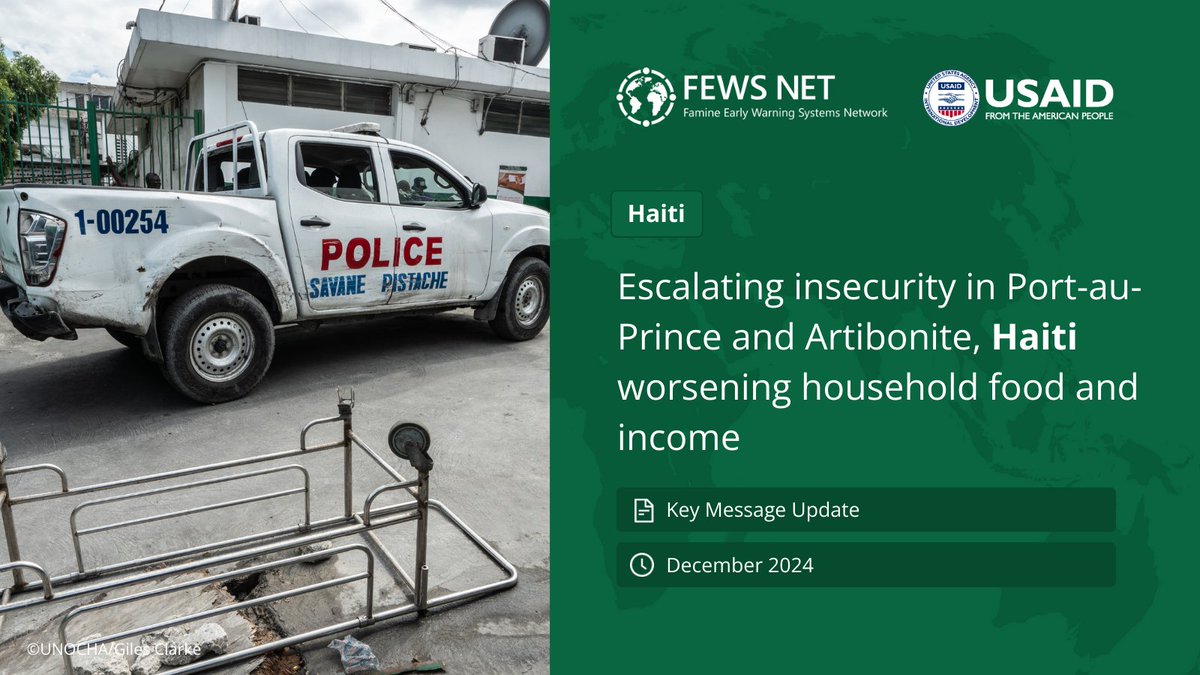
A recent surge in violence in #Haiti 🇭🇹 has adversely affected poor households’ income sources, disrupted market functioning and supply, and impeded food assistance distribution.
Learn more https://t.co/nOvJbiBvPf
#FEWSNET prioritizes data availability and transparency.
Our acute food insecurity classification data are available to download in a variety of formats. Visit our website to access these data from 2009 onwards for use in your own work 📊
Learn more https://t.co/olLLYA8GLl
The compounding impacts of conflicts, poor economic conditions, and climatic shocks — such as dry spells and flooding — remain the key drivers of acute food insecurity in #Nigeria 🇳🇬
Learn more https://t.co/llbZmIXn98
L’insécurité galopante à Port-au-Prince et Artibonite #Haiti 🇭🇹 continue de détériorer les sources de nourriture et de revenus des ménages https://t.co/691kjnsUip