My dear followers.
NEVER be scared of red days.
Even if you're DOWN, markets are DESIGNED to go up.
I promise you, you will change your life if you can handle your emotions.
1. Retirement inflows (401K's, IRA's, pension funds)
2. Corporate buy backs
3. Passive investing from millions of people around the world
4. TAX incentives for those that contribute regularly
Money is ALWAYS flowing into the markets rain or shine.
Stay INVESTED early and OFTEN.
If I could leave you with one thing going into the next few weeks...
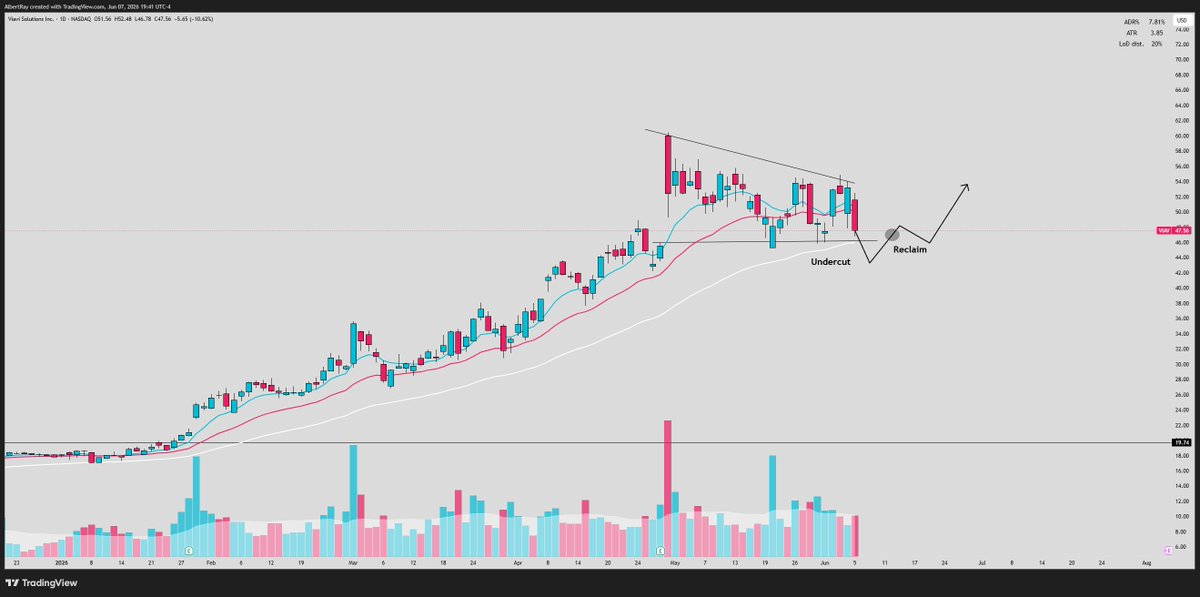
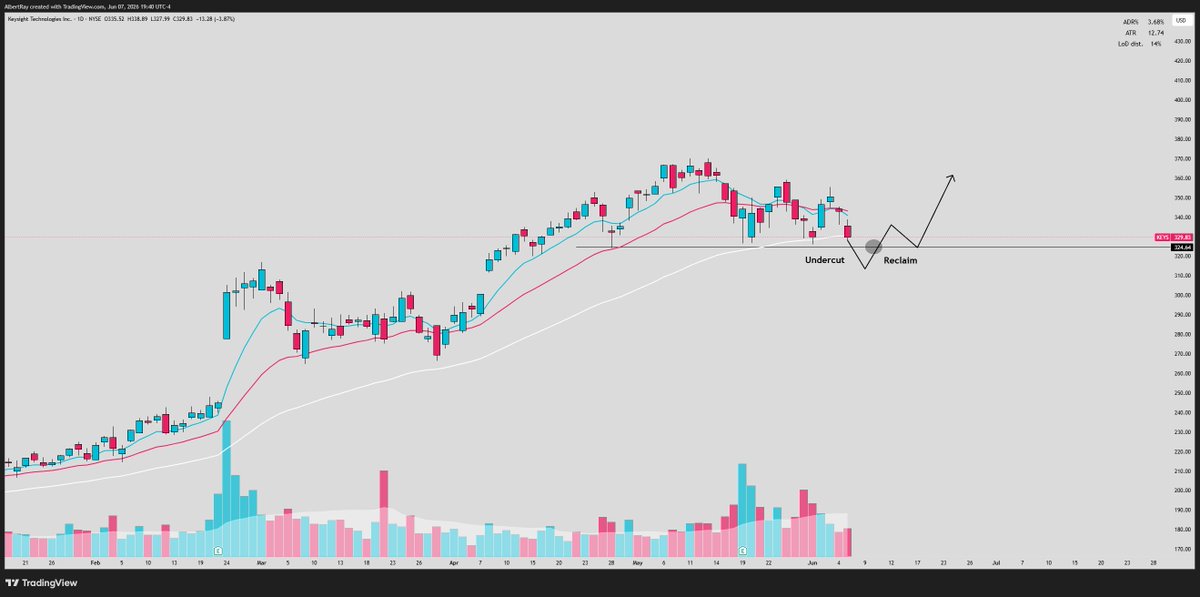
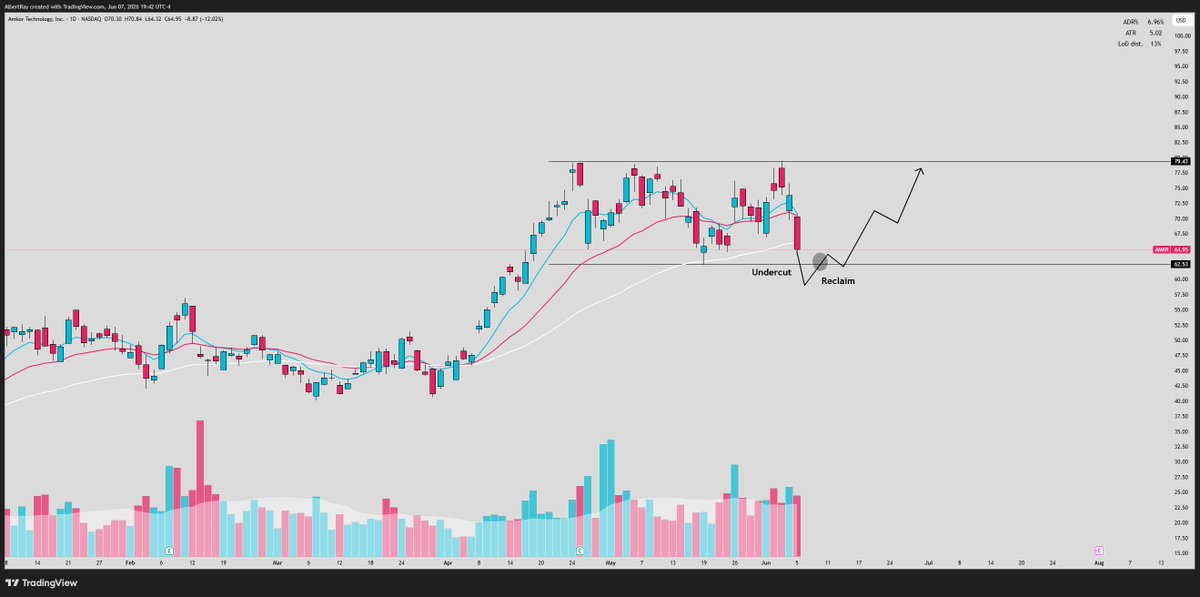
Its learn the undercut and rally strategy:
The Undercut & Rally (U&R) is one of the most powerful price action setups in momentum trading.
Most traders see a breakdown.. but this is a strong opportunity
In simple terms a UnR is a failed breakdown
Here's a deep dive into why it works, and what the market is actually telling you when it appears:
First, let's understand what an undercut actually is...
An undercut occurs when a stock trades below a prior significant low.
This could be:
• A recent swing low
• A major support level
• A breakout pivot
• A moving average support zone
• The low of a consolidation
Most traders assume lower prices are coming & that's exactly why the setup works.
Markets are designed to create the maximum amount of pain.
When a stock breaks support, several things happen simultaneously:
• Longs panic and sell
• Stop losses get triggered
• Short sellers enter positions
• Sentiment quickly turns bearish
This creates a wave of supply.
The market now has exactly what large buyers need:
Liquidity.
This is where most traders misunderstand institutional behavior.
Large funds cannot simply buy millions of dollars worth of stock whenever they want.
They need sellers.
They need liquidity.
They need shares available for purchase.
An undercut creates that liquidity.
This leads to a trap for sellers...
The most important part of the UnR.. is the reclaim part
Because a break below support doesn't guarantee the setup will work, the reclaim part is what really gets the stock moving the other way
Just like a failed breakout, traps a ton of buyers and reverses.. the UnR does the same thing the other way.
Once price moves back above the prior support level, the entire psychology of the trade changes.
The breakdown has officially failed.
The market is telling you that sellers lost control.
Now think about who is trapped.
You have three groups:
Group 1:
The traders who sold their shares during the breakdown.
Group 2:
The traders whose stops were triggered.
Group 3:
The traders who initiated short positions expecting further downside.
Every one of those groups can become future buyers.
This creates a powerful demand imbalance.
The best U&Rs create what is known as a "short-term vacuum."
There are no longer many sellers left.
-Weak holders have already exited.
-Stops have already been triggered.
The breakdown participants are trapped.
As price rises, buying pressure increases while selling pressure decreases.
This often leads to sharp momentum moves.
Not all U&Rs are equal.
The highest-quality setups usually occur:
-In strong market environments
-In leading stocks
-Near key moving averages
-Following constructive consolidations
Context matters.
A U&R in a market leader is very different from a U&R in a weak stock making new yearly lows.
One thing I've noticed over years of studying charts:
-The strongest stocks rarely make it easy.
-They shake people out first.
-They create doubt.
-They create fear.
....Then they move higher.
Many of the biggest winners in the market have produced multiple undercut and rally setups throughout their trends.
Study enough charts and you'll start seeing them everywhere.
Once you understand the psychology behind the pattern, you'll never look at a support break the same way again.
We have a ton of stocks setting up for potential UnR's in the coming days/weeks.. knowing how to enter these can you get into the best stocks with very low risk.
One of the most common questions I get is:
"How do you deal with a gap up"?
Many have a fear of gaps, but they can create some of the most explosive moves if you trade them correctly
A strong gap up doesn’t mean you should instantly chase it.
Most of the time, the open is filled with:
-profit taking from overnight holders
-emotional FOMO buyers
-volatility and fake moves
What I prefer to see first is the stock prove itself after the initial open.
I learned this process from @RealSimpleAriel and its been an incredible help buying gap ups without chasing them:
-Wait for the morning flush
-Watch for tangible bottom to form off a pivot
At some point the selling starts to dry up and price stabilizes.
This low becomes important because now risk can actually be defined.
For entry:
-Watch for a close back above VWAP
The reclaim of VWAP is key because it shows buyers are regaining control after the pullback.
If volume starts expanding during the reclaim, even better.
Once VWAP is reclaimed and the low holds, that’s when momentum traders and institutions often start stepping back in.
Using this process for gaps has helped me remain less emotional and more objective for sharper entries.
If you are not making money during this run:
You are likely trading the WRONG stocks..
For the last few weeks, all I've done was:
-Focus on strong themes (Semis, space, memory)
-Buy these names on pullbacks into the EMA's
-Hold these winners & don't sell too early
Once these start building bigger bases, now you are going to look for rotation into emerging themes.
How to know where to look?
1. Start With Relative Strength
Emerging themes always leave footprints.
You’ll notice:
-Certain groups stop selling off during weak markets
-They recover faster than indexes
-Multiple stocks in the same niche begin moving together
-Volume starts increasing across the sector
For example:
$IGV was making new highs while $QQQ was still below the previous all time highs
This showed relative strength in the ETF, and software stocks began to emerge with strong setups
2. Scan Weekly Charts First
You will start noticing that when almost every stock in a sector is setup on the weekly timeframe.. and explosive move follows.
Emerging themes usually appear first on:
-Weekly bases
-Weekly breakouts
-Multi-month consolidations
For example data centers recently.. all had a massive weekly base
3. Follow Volume Closely
Volume is one of the clearest signs of institutional participation.
You will start noticing:
-Highest volume EVER print
-Accumulation volume patterns
-Low volume sell offs
-A breakout with expanding volume often signals real demand
This tells you that institutions are piling into the trade
4. Watch for “Character Changes”
One of the earliest clues is a change in behavior.
Examples:
-Stocks stop failing on breakout attempts
-Pullbacks become shallow
-Names begin closing near highs instead of lows
-Weak sectors suddenly start holding moving averages
A new theme usually starts with:
-Better closes
-Better reactions
-Better continuation
before the headlines catch up...
For example $PLTR and $HOOD in the last few days.. starting to act much better and changing their characters.
5. Track News Narratives
Themes are often tied to macro narratives:
-AI spending
-Government backing
-Defense budgets
Follow themes, and stocks that have a REASON to go higher.
For example drone stocks last week, after the news that the government might take a stake...
Now this becomes top watch.
6. Focus on the Leader (Most important)
Every theme usually has:
-a leader
-secondary names
-laggards
The leader is where institutions concentrate first.
Your goal is to find the strongest theme, the strongest sector, and the strongest stock in that sector.
Characteristics of a leader:
-breaks out first
-has the best volume
-holds moving averages best
-reacts strongest after pullbacks
Most importantly... stack probabilities
Theme + Catalyst + Setup + Leading stock = super performance
If you still haven't added the 30m pivot to your toolbox...
You are missing out on one of the best reversal entries there is.
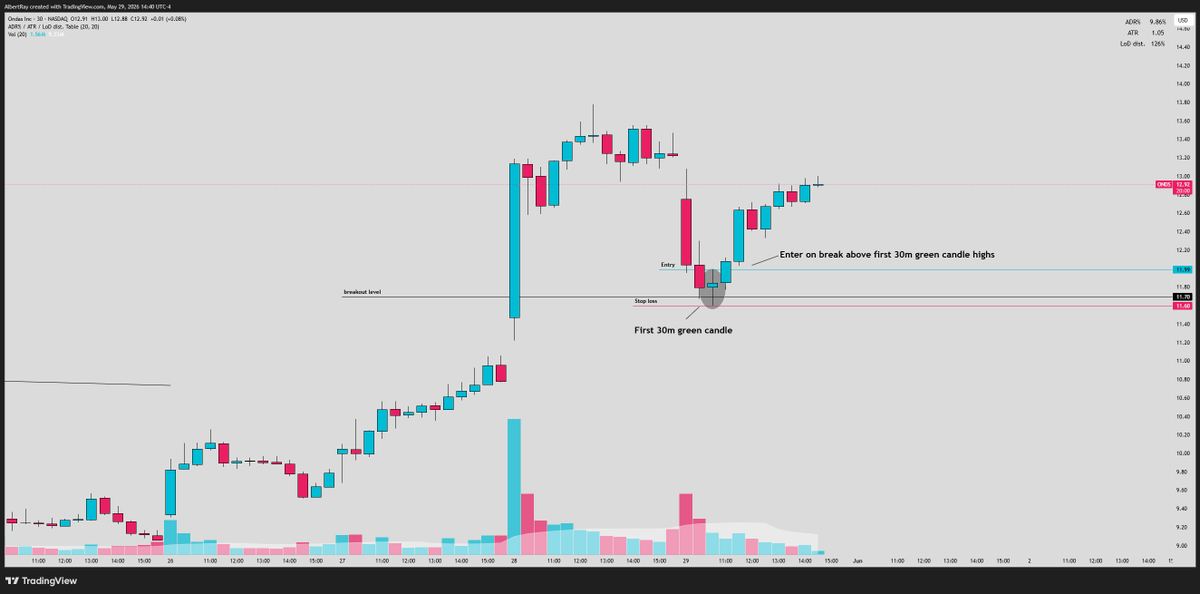
$ONDS today sold off right into the previous breakout level
Instead of guessing where it was going to turn..
You switch to the 30m timeframe
&
Wait for the first 30m green candle to print.
Once it prints:
-Mark out the high
-Mark out the low
From there you wait for the stock to break over the high of the first 30m green candle
That triggers your entry
Stop loss goes to the low of the first 30m green candle
Absolutely textbook reversal today on so many stocks using this strategy...
Tip: Its works best off a key level like prior highs, or the moving averages
Try it out and watch how you snipe the bottom on so many names.
One of the biggest misconceptions newer traders have is thinking the “easy money” is gone after a stock makes a large move.
In reality, the best stocks rarely go straight up forever.
The strongest names will impulsively expand, get extended from the 21EMA, then spend time consolidating, tightening up, and allowing the moving averages to catch up underneath price.
That reset is where the next opportunity forms.
Why?
Because institutions can’t fully build positions in one day. They accumulate over time. After a strong expansion leg, supply gets absorbed during consolidation while weak hands get shaken out.
Then eventually:
-volume contracts
-volatility tightens
-price respects the 21EMA
-demand starts stepping back in
That’s when the next leg higher can begin.
The key is understanding the difference between:
a healthy pullback into the 21EMA
vs.
Actual trend failure.
Don't be the person that chases trend extensions.. even the best stocks will eventually set back up for a move higher.
A lot of incredible opportunity on the leaders like:
$INTC
$NBIS
$ALAB
$AMD
In the coming weeks as they setup off the moving averages.
Stop selling stocks too early..
You cant outsmart the moving averages so might as well let the moving averages tell you when the momentum is gone.
Use a daily close under the EMA's to tier out of the position
Trim some into strength to finance the risk
Then let the moving averages to the heavy lifting:
-Trim 25% on a close under the 8 EMA
-Trim 25% on a close under 21 EMA
-Sell full position under the 50 EMA
Exit strategy is just as important as entry strategy.
Its very clear that this is a thematic market
After one sector runs:
It cools off --> sets back up --> money flows to other sectors
If you can stay a head of the rotation, you can catch leading names before they move
The next sectors to move:
Rare earths:
$USAR
$MP
$CRML
$UAMY
$NB
$NEXA
Quantum:
$IONQ
$RGTI
$QBTS
$XNDU
$INFQ
$QUBT
Crypto:
$IBIT
$ETHA
$MSTR
$COIN
$CRCL
$FIGR
Uranium:
$UUUU
$CCJ
$UEC
$DNN
$NLR
Data center cooling:
$CARR
$MOD
$FIX
$VRT
Cybersecurity:
$NET
$CRWD
$PANW
Agentic AI:
$ZETA
$SOUN
$BBAI
$PATH
$FSLY
One of my favorite ways to buy strong names on overall market weakness:
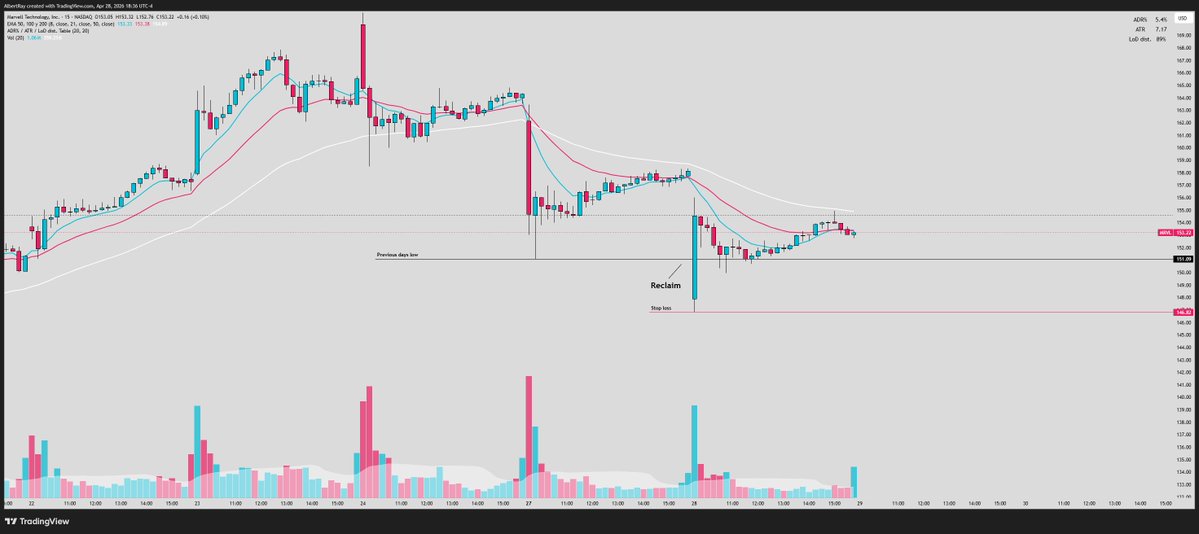
The Oops reversal
Many people are scared of gap downs
BUT
They actually create some of the best opportunities to buy strong stocks on weakness
The Oops reversal is similar to and undercut and rally but it happens on a shorter timeframe:
1. Stock gaps down below prior days low
-Gap down under previous days low
2. Stock will reclaim the previous days low
-Reclaim of previous days low
-High volume move through
3. Enter on the reclaim of previous days low -Enter right when the reclaim happens
-Use low of day as stop loss
This sets you up for a high probability reversal setup where you can put on a lot of size with small risk.
Used this today on a few names:
$MRVL
$CRWV
To get an entry.
There are so many incredible setups out there in the market
BUT
You have to remember:
Theme > setup
Theme + Setup = Holy grail
Look not only for stocks that have a setup, but also stocks that have a reason to go up..
Combine the two and you have yourself an edge.