We stayed quiet for a reason: some things take time.
Scientific rigor, architecture, validation, hard decisions, getting the right people around the table.
For the past years, we have been working on a question that felt increasingly difficult to ignore: What happens when the world becomes AI-native, while humans remain biologically driven?
We believe the answer is not another application, not another interface, not another reactive system. It requires a new foundational layer.
A new class of infrastructure designed for biological responsiveness.
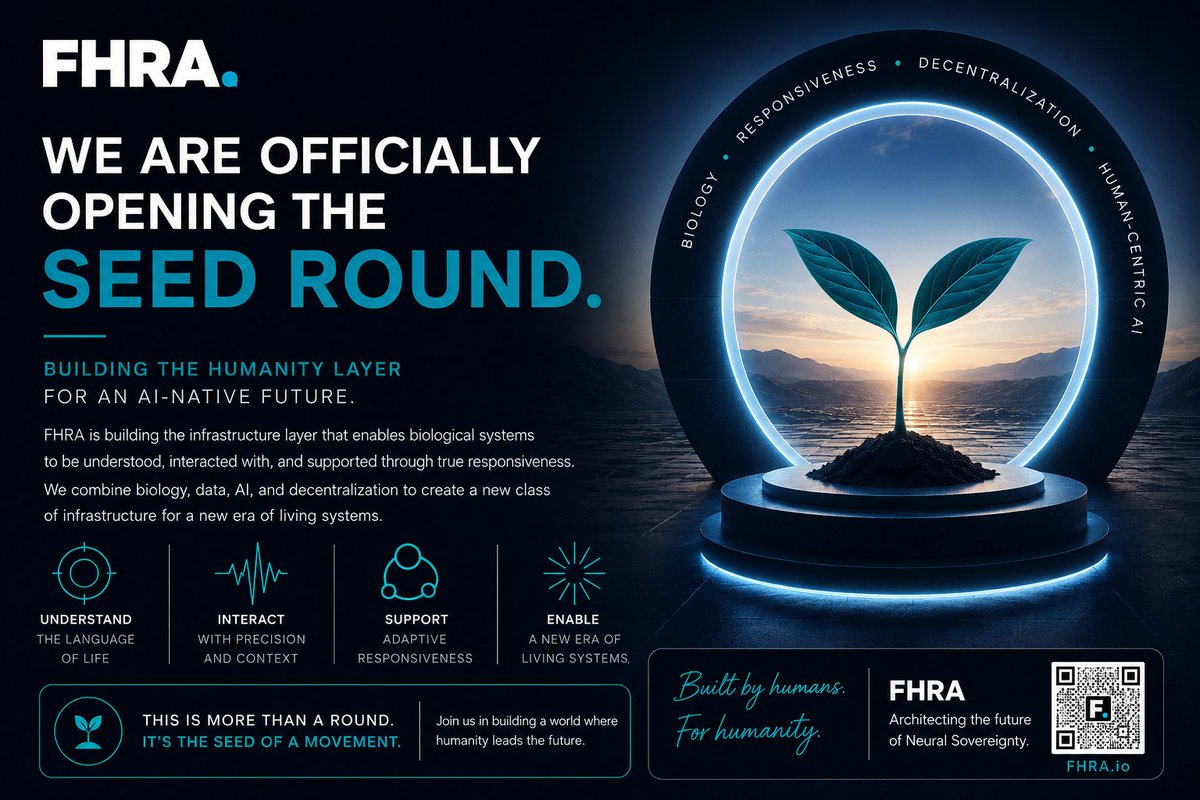
Today, after years of research, architecture design, scientific breakthroughs, ecosystem alignment, and foundational partnerships, FHRA officially opens its Seed Round.
We are building what we believe may become a foundational layer for the future of Neural Sovereignty. A future where biological systems are not simply measured, but understood, interacted with, and supported through true responsiveness.
Not human vs machine: human-centered adaptation at the speed of life !
For those who understand that paradigm shifts rarely look obvious in the beginning, my door is open. https://t.co/dFWFz5mh9P
https://t.co/1thVZlIEI1
Technology is becoming increasingly powerful.
Smarter systems. Faster decisions. Greater automation. Deeper personalization.
But as systems become more capable, an important question quietly emerges: What happens to human agency?
Because capability alone is not the same as empowerment.
A system can optimize outcomes while unintentionally reducing autonomy.
A recommendation can become dependence.
An intervention can become control.
Convenience can slowly replace intentionality.
This may become one of the defining challenges of human-centered technology.
Not simply: What technology can do?
But rather: How technology helps humans remain meaningfully in control?
The future of intelligent systems may not belong to technologies making decisions *for* humans, it may increasingly belong to systems capable of:
→ informing without overwhelming
→ supporting without replacing
→ guiding without controlling
→ adapting without diminishing choice
Because human-centered technology may ultimately depend on something deeper than intelligence: preserving agency.
At Future Human Resonance Architecture (FHRA), this is one of the long-term questions we find deeply compelling.
Because the systems closest to human biology may also carry the greatest responsibility: helping humans become more capable, not more dependent.
The conversation is only beginning.
#HumanCenteredAI #Neurotechnology #DeepTech #EthicalAI #HealthTech #ArtificialIntelligence #FHRA
For decades, technology has largely followed a simple assumption: If something can be optimized, optimize it.
More alerts. More recommendations. More interventions. More engagement. More guidance.
But when technology moves closer to human biology, a new question quietly emerges: can too much intervention become noise?
Because humans are not static systems.
Sometimes recovery matters more than optimization.
Sometimes silence matters more than input.
Sometimes support means: stepping back.
Not every signal requires interruption.
Not every fluctuation requires correction.
Not every moment needs technology demanding attention.
The future of human-centered systems may increasingly depend on something surprisingly difficult: knowing when to help and when to stay quiet.
Not removing human judgment, respecting it.
Not replacing agency, protecting it.
Not maximizing engagement, supporting well-being.
The defining shift may not simply be building smarter systems. It may be building systems wise enough to understand: when less intervention creates better outcomes.
At Future Human Resonance Architecture (FHRA), this is one of the long-term questions we find deeply compelling.
Because human-centered technology may ultimately require something deeper than intelligence: restraint.
The conversation is only beginning.
#HumanCenteredAI #Neurotechnology #DeepTech #HealthTech #ArtificialIntelligence #EthicalAI #FHRA
Humanity has never had more information.
More notifications, more inputs, more recommendations, more dashboards, more decisions, more noise.
Yet, despite having access to more intelligence than ever before, many people feel increasingly overwhelmed, because humans were never designed to process infinite complexity.
Attention has limits. Energy has limits. Cognitive bandwidth has limits. And when everything competes for attention: clarity suffers, stress compounds, focus fragments, decision fatigue grows.
This raises an important question: What if the next generation of technology helped reduce cognitive burden, instead of increasing it?
Not more dashboards, better signals.
Not more noise, better meaning.
Not more complexity, better timing.
The future of human-centered systems may not belong to technologies demanding more attention. It may increasingly belong to technologies capable of quietly helping humans navigate complexity with less friction.
Less overload, more clarity.
At Future Human Resonance Architecture (FHRA), this is one of the long-term shifts we find deeply compelling.
Because the next frontier may not simply be intelligent systems, it may be: systems that help humans think and feel better inside an increasingly complex world.
The conversation is only beginning.
#HumanCenteredAI #Neurotechnology #HealthTech #DeepTech #MentalWellness #ArtificialIntelligence #FHRA
Modern technology is becoming increasingly good at prediction.
What we may click, what we may buy, what we may watch, what we may search.
Prediction has become powerful.
But when technology begins interacting with humans more deeply with cognition, biology, behavior, and context, an important question emerges: is prediction enough?
Because humans are not probabilities, we are dynamic systems.
The same person can behave differently depending on:
→ fatigue
→ stress
→ recovery
→ cognitive state
→ environment
→ timing
Prediction may estimate behavior, understanding may explain it, and that difference matters.
Especially when systems increasingly move closer to human biology.
The future of human-centered technology may not simply belong to systems that predict outcomes.
It may increasingly belong to systems capable of understanding: why something is happening — not only what might happen next.
Not only probability, meaning.
Not only prediction, context.
Not only intelligence, understanding.
At Future Human Resonance Architecture (FHRA), this is one of the long-term shifts that deeply interests us, because when technology interacts with humans: understanding may matter more than prediction.
The conversation is only beginning.
#HumanCenteredAI #ArtificialIntelligence #Neurotechnology #DeepTech #HealthTech #SignalProcessing #FHRA
The technologies that shape civilization rarely remain visible for long.
Electricity transformed modern life, yet we rarely think about the grid.
Cloud transformed computing, yet most people never think about servers.
GPS transformed movement, yet few people think about satellites.
The most important infrastructure often disappears into everyday life.
Not because it matters less, because it works. Quietly, reliably, seamlessly.
Human-centered technology may evolve in similar ways.
Today, biological intelligence still feels fragmented.
Disconnected devices.
Disconnected signals.
Disconnected systems.
But over time, the most valuable technologies may not be the ones demanding more attention.
They may increasingly be the ones that quietly help humans navigate complexity without friction. Without overload. Without demanding constant effort.
The future may not belong to systems that feel louder, it may belong to systems that feel: natural, invisible, aligned, human.
Because the best infrastructure rarely asks to be noticed, it simply helps the world work better.
At Future Human Resonance Architecture (FHRA), this is one of the long-term shifts we find deeply compelling.
The conversation is only beginning.
#DeepTech #Infrastructure #Neurotechnology #HealthTech #HumanCenteredAI #ArtificialIntelligence #BioIntelligence #FHRA
Modern technology often assumes something simple: If we optimize enough variables, we can optimize humans.
Better sleep score, better focus score, better recovery score, better productivity; more efficiency, more output.
But humans are not machines.
We are not static systems, we are biological, contextual, emotional, adaptive, complex.
The same person can feel completely different: across days, environments, stress levels, life events, and cognitive states.
What helps one person recover may overwhelm another.
What improves performance today may create exhaustion tomorrow.
This matters.
Because the future of human-centered technology may not belong to systems designed to control humans, it may increasingly belong to systems designed to understand them.
Not optimization at all costs, better alignment.
Not replacing intuition, supporting it.
Not forcing performance, strengthening human potential.
The defining question of the coming decade may not simply be: How do we improve humans?
But rather: How do we better support what makes humans human?
At Future Human Resonance Architecture (FHRA), this is one of the long-term questions that deeply interests us.
Because human-centered technology should begin with one simple assumption: humans are not machines.
The conversation is only beginning.
#HumanCenteredAI #Neurotechnology #DeepTech #HealthTech #ArtificialIntelligence #HumanPotential #FHRA
For years, technology followed a simple assumption: if we collect enough data, understanding will emerge.
More sensors, more dashboards, more metrics, more notifications, more signals.
But something important is increasingly becoming clear: data alone is not context.
Humans are complex.
The same signal can mean very different things depending on:
→ timing
→ environment
→ physiology
→ cognition
→ stress
→ recovery
A poor night of sleep, an intense workday, emotional overload, physical fatigue.
The signal may look similar. The meaning may be completely different.
This may become one of the defining challenges of next-generation human-centered systems.
Because while collecting information is becoming easy, understanding humans remains hard.
The future may not belong to systems that simply gather the most biological signals.
It may increasingly belong to systems capable of understanding: what matters, when it matters, and why it matters.
Not more noise, more meaning.
Not more dashboards, better context.
At Future Human Resonance Architecture (FHRA), this is one of the questions that deeply interests us.
Because when technology interacts with biology: understanding may matter more than information.
The conversation is only beginning.
#HumanCenteredAI #Neurotechnology #DeepTech #ArtificialIntelligence #HealthTech #SignalProcessing #FHRA
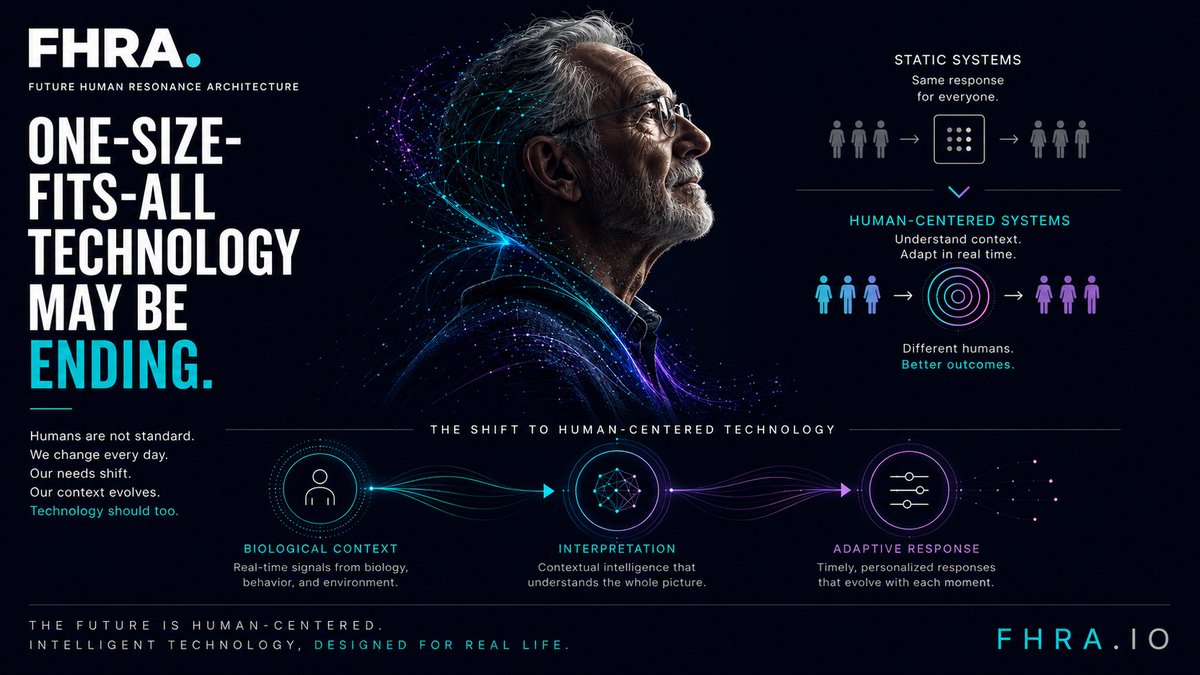
For decades, digital systems have largely operated on a simple assumption: every user receives the same experience.
The same interface, the same notifications, the same recommendations, the same timing.
At scale, this worked, but humans are not standardized.
We think differently, recover differently, focus differently, respond differently.
Even the same person changes: across days, contexts, stress levels, fatigue, and cognitive state.
Yet, most technology still behaves as though humans remain constant.
This may become increasingly difficult to justify.
Because the future of human-centered technology may not be built around static experiences, but around dynamic understanding.
Not personalization as marketing, personalization as context.
Not optimization for clicks, optimization for human conditions.
The next generation of systems may increasingly ask: What does this person need right now?
Not in theory, but in context, in reality.
The defining shift may not simply be more intelligent systems, it may be systems capable of adapting to the complexity of being human.
At Future Human Resonance Architecture (FHRA), this is one of the long-term transitions we find deeply compelling.
Because humans change.
Perhaps our technology should stop pretending otherwise.
The conversation is only beginning.
#HumanCenteredAI #Neurotechnology #ArtificialIntelligence #DeepTech #HumanComputerInteraction #HealthTech #FHRA
Scalability and precision are not the same problem.
Consumer wearables are transforming human-centered technology at global scale. Millions of people already generate biological signals every day through devices they already own.
This changes everything. But there is an important distinction: scaling biological systems is not the same as understanding them.
Because meaningful interpretation depends on signal fidelity. Noise matters. Sampling matters. Context matters.
The systems designed for global consumer adoption are not always the systems best suited for frontier R&D.
At @FHRA_official, we believe both worlds matter.
Consumer systems create scale. High-fidelity neuro-sensing creates precision.
This is one of the reasons our R&D architecture integrates @BrainBitInc as a neuro-sensing anchor — helping us explore richer multi-channel EEG signal environments while informing how the FHRA GNX orchestration layer can normalize and contextualize signals across a broader wearable ecosystem.
For us, the question is not: consumer scale or scientific precision?
It is: How do we intelligently combine both?
Because scalable systems still require rigorous foundations.
#Neurotechnology #EEG #BrainComputerInterface #HealthTech #DeepTech #NeuroComputing #BrainBit #FHRA
Biology is noisy.
That may sound obvious, but it creates one of the most demanding challenges in neuro-computing.
Because biological systems do not generate clean, structured signals. They generate complexity, variability, constant fluctuation...
The challenge is never simply collecting biological data.
The deeper challenge is determining: What is signal — and what is noise?
This is where mathematics increasingly becomes infrastructure, because meaningful interpretation cannot emerge from raw biological signals alone.
It requires:
→ structure
→ patterns
→ frequency
→ timing
History repeatedly shows the same pattern: major technological breakthroughs emerge when mathematics unlocks hidden meaning inside complexity.
Physics required equations.
Computing required algorithms.
Artificial intelligence required statistical models.
Neuro-computing increasingly requires advanced time-frequency analysis.
At @FHRA_official, this is one of the reasons we are building scientific alignment with the Numerical Harmonic Analysis Group (NUHAG) at the University of Vienna.
By grounding parts of the mathematical foundations of the FHRA GNX master engine in harmonic analysis, we explore how approaches such as the Gabor Kernel may help transform complex biological signals into more localized, interpretable time-frequency representations.
Because understanding biology requires more than signal collection, it requires mathematical rigor.
The future of human-centered technology may not belong solely to the systems collecting the most signals.
It may increasingly belong to the architectures capable of truly understanding them.
Because complexity without interpretation has limits.
#Neurotechnology #SignalProcessing #AppliedMathematics #DeepTech #NeuroComputing #FHRA #NUHAG #UniversityOfVienna
For decades, technology has largely waited for humans to act: click, search, type, tap, request…
Technology reacted, humans initiated.
But something deeper may now be emerging.
Future systems may increasingly learn to adapt.
Not only to commands, but to context. Because humans are not static.
We experience:
→ fatigue
→ cognitive load
→ stress
→ recovery
→ fluctuating focus
→ changing physiological states
Yet, most systems still behave as if humans remain constant.
The next generation of human-centered technology may increasingly evolve beyond static interaction.
Toward systems capable of sensing, interpreting, and adapting in ways that feel more contextual, more responsive, and more aligned with real human conditions.
Not replacing human decision-making: enhancing it.
Not removing agency: strengthening it.
The defining shift may not simply be smarter technology, but rather: technology capable of understanding when and how to respond.
Because timing matters. Context matters.
Humans change, perhaps our systems should too.
At Future Human Resonance Architecture (FHRA), this is one of the long-term shifts that deeply interests us.
The conversation is only beginning.
#HumanCenteredAI #Neurotechnology #ArtificialIntelligence #DeepTech #HumanComputerInteraction #HealthTech #FHRA
For years, wellness was largely treated as a lifestyle category: sleep, fitness, mindfulness, recovery.
Helpful? Certainly, but often perceived as optional, consumer-driven, too fragmented.
Something different may now be happening.
What was once considered “wellness” is increasingly becoming foundational because modern life is producing a new reality:
People are overwhelmed, fatigue is rising, attention is fragmented, stress is chronic, sleep quality is deteriorating, and increasingly, individuals want something simple: understanding.
Not more data, not more dashboards, definitely not more notifications. But more context, more meaning, way more ractical insight.
This is one reason why technologies surrounding sleep, recovery, cognition, resilience, focus, and physiological awareness are expanding so rapidly.
What was once considered self-optimization may increasingly become part of everyday human infrastructure.
Not only for athletes, not only for biohackers, but for ordinary people navigating increasingly complex lives.
The defining opportunity of the coming decade may not simply be building more wellness products.
It may be building systems capable of transforming human biological complexity into something more understandable, contextual, and useful.
Because the future of Wellness & Health may increasingly depend on helping humans better understand themselves.
At Future Human Resonance Architecture (FHRA), we believe this shift is only beginning.
#HealthTech #Wellness #DeepTech #Neurotechnology #Wearables #ArtificialIntelligence #FHRA 🟦
The next decade may fundamentally redefine the relationship between humans and technology.
For most of modern computing, technology has interacted primarily with:
→ information
→ interfaces
→ behavior
We clicked, typed, searched, streamed, optimized workflows. But something deeper may now be emerging.
Technology increasingly interacting with human biology itself.
Not abstractly, practically, through signals already generated every day:
⌚ movement
😴 recovery
🫀 physiology
🧠 cognition
This shift may prove larger than many realize.
Because once systems begin interpreting biological and cognitive signals in real time, the questions become fundamentally different.
Not only: What can technology do?
But increasingly: How should technology interact with humans?
How do systems remain aligned with human agency?
How do we preserve privacy? Trust? Meaning? Context?
At Future Human Resonance Architecture (FHRA), we believe the next generation of human-centered systems will increasingly depend on infrastructure capable of interpreting biological signals intelligently, ethically, and in ways that strengthen — rather than compromise — human sovereignty.
The coming decade may not simply introduce new products, it may very well redefine the operating model of human-technology interaction itself.
And we believe the conversation has finally started.
#Neurotechnology #HumanCenteredAI #DeepTech #HealthTech #ArtificialIntelligence #NeuroComputing #FHRA
AI Understands Language.
What Happens When It Begins Understanding Humans?
Artificial intelligence has already transformed how machines understand information.
Language, images, code, patterns.
Entire industries are now adapting to systems capable of interpreting digital reality.
But a larger shift may quietly be approaching.
Humans are not only digital beings, we mmare biological systems.
Rhythms, signals, states, cognition, emotion, recovery, attention.
This raises a profound question: What happens when artificial intelligence begins interacting not only with information — but with human biology itself?
The future of AI may not simply depend on becoming more intelligent.
It may increasingly depend on becoming more contextual, more adaptive, more biologically aware.
Because humans do not operate in static states: we fluctuate, we fatigue, we recover, we focus, we drift.
The systems capable of understanding these dynamics may fundamentally reshape how technology supports human wellbeing, cognition, and performance.
But this future introduces entirely new requirements:
→ biological context
→ trust
→ timing
→ signal interpretation
→ human agency
At FHRA, we believe this convergence between artificial intelligence and biological systems may become one of the defining infrastructure challenges of the coming decade.
Because the future of AI may not belong solely to systems that understand information. It may increasingly belong to systems capable of understanding humans.
The question is no longer simply: How intelligent can machines become?
But rather: How intelligently can technology adapt to the human system?
Because intelligence without context has limits.
#ArtificialIntelligence #Neurotechnology #HealthTech #DeepTech #HumanCenteredAI #NeuroComputing #FHRA
For most of history, humans adapted to technology.
Passwords, platforms, Terms of service (ToS), Permissions.. but something changes when technology begins interacting with human biology.
Because biological signals are fundamentally different from traditional data.
You can replace a password and cancel a credit card. But you cannot meaningfully replace your cognitive patterns or biological signatures.
This raises a new category of question:
Who remains in control?
Who governs access?
Who verifies integrity?
Who determines consent?
And, most importantly, how do humans retain sovereignty as technology becomes increasingly capable of interpreting biological and cognitive systems?
Because future human-centered technologies may not simply require intelligence, they may require verifiable trust.
History suggests that every new technological layer forces a new security model.
The internet introduced cybersecurity.
Cloud introduced resilience.
Artificial intelligence introduced alignment.
Technology interacting with biology may introduce something new: sovereign trust architecture.
At Future Human Resonance Architecture (FHRA), this is one of the reasons we explore cryptographic infrastructure approaches alongside neuro-computing systems.
Through our alignment with @riddleandcode, we examine architectures designed to help ensure highly sensitive biological signals remain verifiable, privacy-preserving and human-governed.
Because as technology moves closer to the human system, the question is no longer simply: Can technology understand us?
But rather: Can humans remain sovereign while it does?
Because intelligence without agency has limits.
#Neurotechnology #DeepTech #DataSovereignty #TrustArchitecture #PrivacyByDesign #HealthTech #FHRA #riddleandcode
A new technological frontier is emerging.
Artificial intelligence is accelerating.
Biotechnology is advancing.
Consumer wearables are becoming mainstream.
Yet, one fundamental question remains largely unresolved: How do we ensure technology strengthens human potential without ⬇️
biological signals into trusted, secure, and meaningful systems designed for real-world human impact.
We believe the future will not be defined solely by smarter devices.
It will be shaped by the infrastructure that enables human-centered, secure, and intelligent interaction ⬇️