The Review seeks to embrace a broad approach to financial, banking, and monetary history, which appeals to a wide audience of historians and economists.
"Who owned Citibank?" New research by Charles Calomiris and Elliot S. M. Oh. They study factors influencing individuals’ decisions to purchase Citibank stock during the 1920s.
https://t.co/rEo2A3zZUG
Explore the evolution of #Germany 's financial sector post-#Wirtschaftswunder. @KemmererHistory and @bankinghistory dive into the era of ‘Gentlemen’s agreements,’ national sovereignty, and global integration.
Did these informal deals shield or advance Germany’s economy?
Why wasn’t the Deutsche Mark made a global #reservecurrency?
Was limiting #foreigninvestment the right call?
This period shaped European integration and monetary power—did Germany get it right? Tune in for the full story. 🎧💡 #FinanceandHistory #eabhPodcast https://t.co/93NTSdd5IE
Just spoke on @Breakfaston1 about AI in finance—especially which jobs are future-proof and how trust in AI is evolving.
Also discussed my research on AI & trust. Check it out: https://t.co/BzK5RMifZ6
Watch the segment: https://t.co/elyLQmJ8Wd
P.S. They lied! No breakfast.
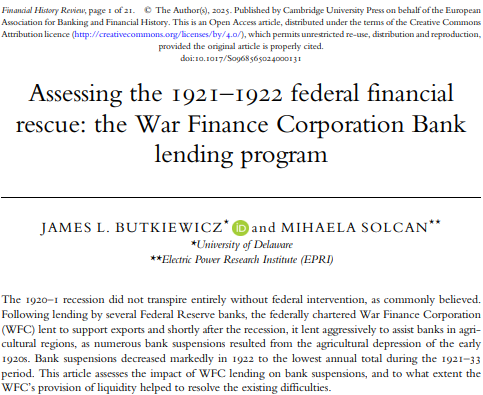
The 1920–21 recession wasn't purely laissez-faire. The War Finance Corporation (WFC) stepped in, lending to support exports & later aiding banks hit by the agricultural crisis. Bank suspensions plummeted in 1922. How much did WFC liquidity help?
https://t.co/bmaNMDtNvA
New papers!
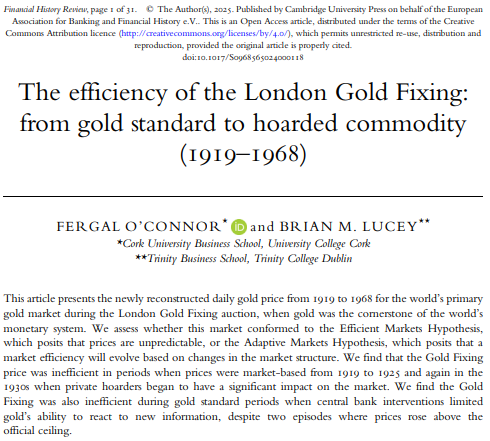
The efficiency of the London Gold Fixing
Saving for a stormy day? The Jamaican Government Savings Bank and the precautionary savings motive
Assessing the 1921–1922 federal financial rescue: the War Finance Corporation Bank lending program
https://t.co/raGhscCZgX
Was gold trading efficient when it was the backbone of the monetary system? New research reconstructs daily London Gold Fixing prices & tests market efficiency: Gold was inefficient when prices were market-driven and under central bank intervention.
https://t.co/Fu4CWpqCNQ
Did Britain's economic liberalization fuel the 1844–45 railway stock boom? As Parliament embraced free markets, railway shares soared. Policy shift or pure speculation? #History#stockmarket#crash
https://t.co/F7RBFWf1h5
The 2025 EABH Annual Meeting takes place in Paris:
Thursday, 12 June 2025
Archives, artefacts, and professional practices
Call for papers: https://t.co/NByFJUfEg1
Friday, 13 June 2025
Public Debt & Financial Stability
Call for papers: https://t.co/w2zF9e5X4g
@bankinghistory
🌍📚 Call for Papers | Corporate Heritage Collections
Join us in Paris (June 2025) to explore how archives, artifacts, & know-how shape the future of the banking & financial sectors. Submit your abstract by Jan 15, 2025!
https://t.co/ELL1bqKjcS
#CorporateHeritage #Preservation #BankingHistory #Archives #Finance #FinancialHistory @FinanceHistory1@Archivchronicle@MonnaieDeParis
Why Does the U.S. Lead Investment Banking? 🇺🇸💰
In Episode 7.2 of the #eabhPodcast, @CarolineFohlin (Emory) and Hugo Banziger (eabh) explore:
🔹 How did the U.S. outpace Europe?
🔹 Why is its dominance so resilient?
🔹 The impact of mutual funds, regulations, and political networks. Dive into the forces behind U.S. supremacy in global finance. Don't miss it! 🎧
Listen here: https://t.co/hgsh5X8ZYJ
#InvestmentBanking #MutualFunds #PensionFunds #InstitutionalInvestors #FinancialHistory #eabh @bankinghistory@GertjanV_
Did policymakers neglect monetary policy? While money supply experiments began in the late '60s, a nonmonetary view of inflation dominated early '70s decision-making—until money targets gained traction later in the decade.
https://t.co/ORbZGjp3QJ
We have some cool papers lined up:
Democratization & foreign borrowing costs in early globalization
Medieval Europe's small change problem
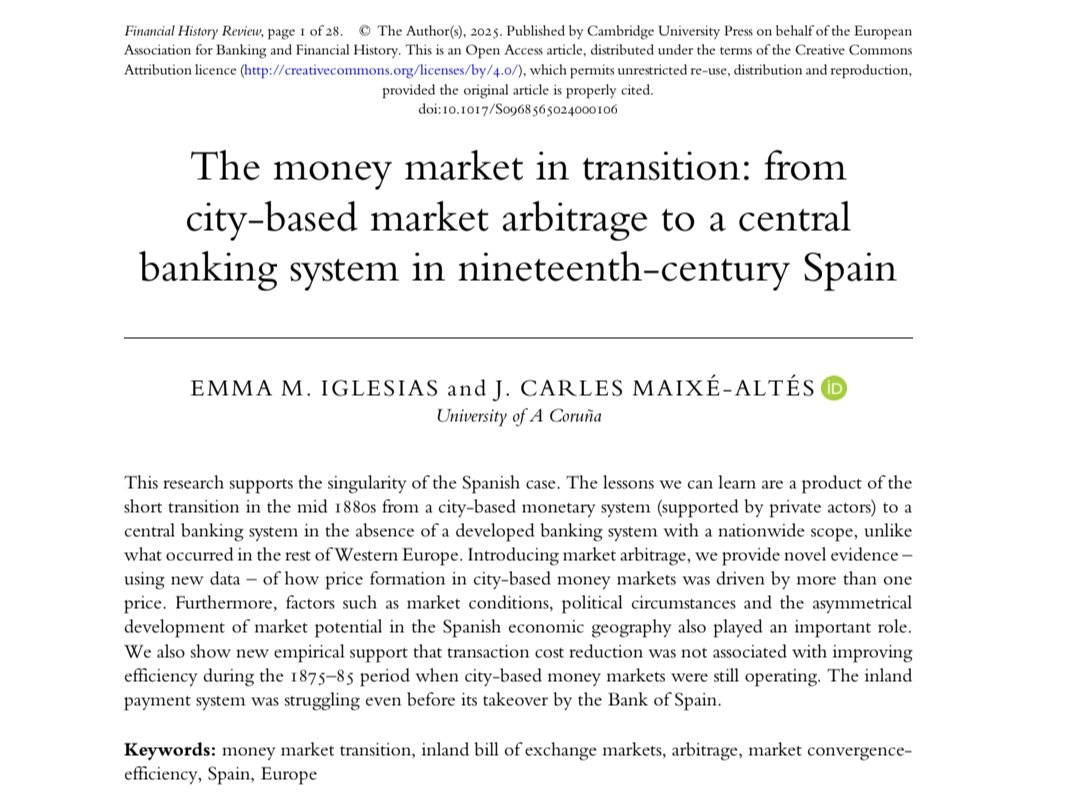
19th-c Spain: city markets → central banking
UK inflation in the 1970s: monetary vs. nonmonetary causes
A thread 🧵
Unlike Western Europe, Spain shifted from city-based money markets to central banking without a nationwide banking system. New data reveals price formation, market asymmetries & why lower transaction costs didn’t mean greater efficiency.
https://t.co/HcSDVhVe8F
A big congrats to @tylersmuir on winning the Fischer-Black prize, demonstrating significant original research that is relevant to finance practice!
Did you know that Dr. Muir also had a paper in FHR last year? Read more of "1930, First Modern Crisis": https://t.co/YYcTk62AvA
Article published in FHR: "We study the association of shareholder returns with liberalization in government policy during Britain's railway run-up of 1844–5. The findings sustain two main claims".
Read more in the paper:
https://t.co/F7RBFWfz6D