Factory Intelligence is building the brain for the next generation of industrial automation - Physical AI trained to handle assembly and logistics at scale.
Robots that feel. Deployed in the real world, not a simulation.
This is what we're building at Factory Intelligence.
#PhysicalAI#Robotics#Manufacturing
This is the physical AI story that gets less attention than humanoids.
Industrial robots do not need to look like people to learn more of the work.
They need perception, force awareness, safer motion, easier programming, and enough autonomy to handle the jobs old automation skipped.
The physical AI wedge is not only humanoids.
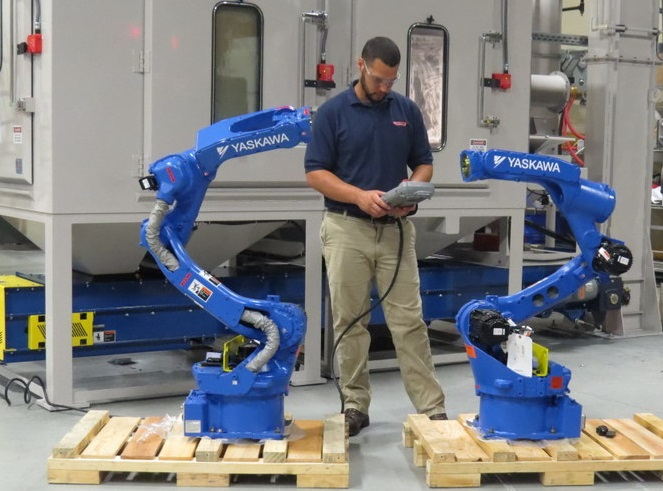
@YASKAWA's Motoman NEXT points at a less cinematic but very real target: the messy middle of automation.
Random bin picking. Variable assembly. High-mix handling. Force control. Vision. Path planning.
That is where demos become workcells.
That is the opening.
The Motoman NEXT pitch is basically: move more robot skill closer to the controller.
Yaskawa describes an integrated robot control platform with @NVIDIA#Jetson Orin NX compute, machine vision, automatic path planning, force control, and services that bridge robot control with modern software workflows.
Recently in #Robotics... 🤖
• Japan is making a long-term bet on automation. The government announced plans to deploy 10 million robots by 2040 across manufacturing, logistics, healthcare, and food production. Robotics is becoming a national priority, not just an industry one.
• @AGIBOTofficial continues to expand outside China. The company showcased its latest humanoids in the UK as it grows its international presence. The conversation is shifting from impressive demos to commercial deployments.
• Robot safety is getting more attention. Companies are investing in the software needed for robots to work safely alongside people in real environments. Safe, reliable systems will be essential for large-scale deployment. @NVIDIARobotics
• The robotics stack is attracting as much attention as the robots themselves. Sensors, compute, actuators, and developer tooling continue to draw investor interest. The biggest opportunities may sit beneath the application layer.
• One thing hasn't changed. The companies gaining traction are the ones putting robots into production. Reliability and uptime still matter more than flashy demos.
Robotics has a data problem. Text scaled because the internet is vast and aligned. Manipulation data is scarce, narrow, and heterogeneous. Qwen-RobotManip tries a completely different approach. They align first, then scale. This is how they built a 38,100hrs VLA foundation model 🧵👇 (1/8)
Video Credits: Qwen
This is why the humanoid conversation needs less theater and more deployment vocabulary.
Can the robot handle soft parts?
Can it recover when a wire does not behave?
Can it learn the work without turning the line into a lab?
That is where physical AI earns the name.
@Hyundai 's Georgia #Metaplant is the kind of factory people imagine when they hear physical AI.
300+ robots. Autonomous movers. Spot inspections. Plans for Atlas.
And yet the hardest automation problem is still surprisingly human: feel.
That is the soft-parts test.
Robots are strong at repetition, weight, and precision.
They still struggle when objects bend, sag, snag, compress, or need the tiny judgment call a trained worker makes without thinking.
The factory floor is not one problem. It is thousands.
Unitree Robotics just cleared the final hurdle to go public on Shanghai's tech exchange.
The Chinese humanoid robot maker got regulatory approval to raise ~$620M at a $6B valuation.
The company posted $250M in revenue and $41M in profit last year, with humanoids now driving most of its business.
The arm is being shaped around dynamic instruction, not just fixed paths.
That is the quiet frontier in industrial robotics.
Not just bigger models.
Not just better demos.
Robots whose bodies, controllers, APIs, and sensors are designed for AI-native workcells from the start.
Physical AI is not just a smarter policy on the same old arm.
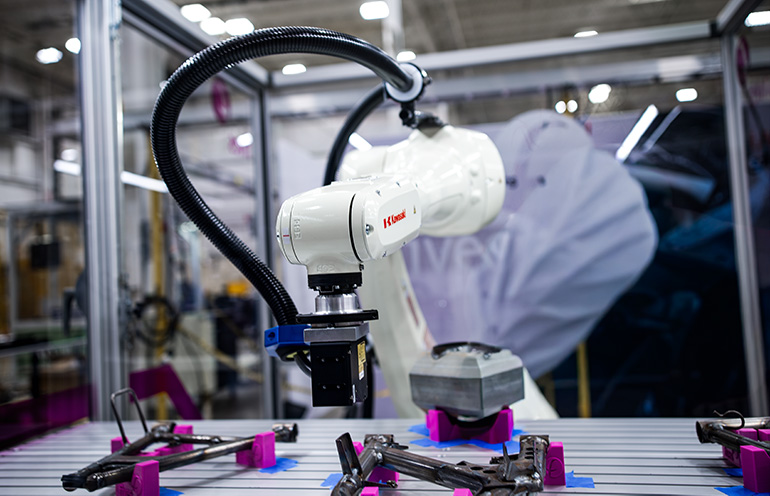
Kawasaki's #RL030N is a useful signal: an eight-axis robot built for high-speed packaging and parcel work, with camera or sensor feedback driving motion in real time.
The hardware is starting to adapt to the AI.
The interesting part is not the buzzword.
It is the geometry.
Kawasaki added unusual kinematics to avoid failure modes like singularities when commands stream continuously from cameras and sensors.