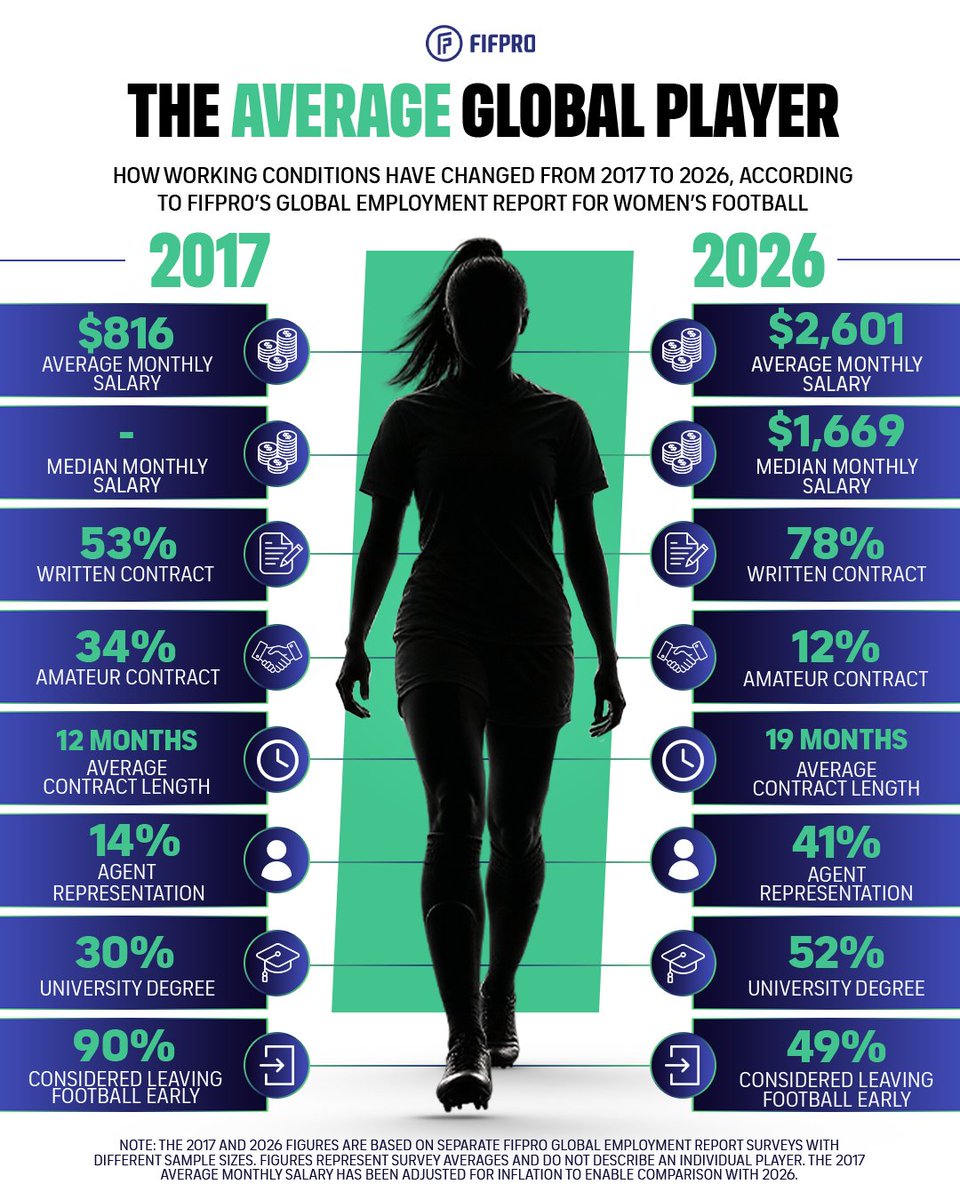
Women’s football is growing. But are players’ working conditions keeping pace?
FIFPRO surveyed 791 players across 40 countries for its new Global Employment Report.
Here’s what they told us ↴
“I believe that you can be more than a professional athlete.”
Finnish goalkeeper Milla-Maj Majasaari takes us behind the scenes as she begins a master’s degree in Women’s Football Management via @ThePFABusiness while continuing her playing career. 🎓⚽️
José María Giménez dejó el colegio a los 17 años cuando le resultaba demasiado difícil compaginar los estudios con el fútbol.
Años más tarde, el central de @Uruguay ha vuelto a los estudios para completar su educación secundaria gracias al programa organizado por el sindicato de futbolistas @Mutual_Uru.
Leer: https://t.co/EKAJXRnRs4
“Studying helps you on the pitch and in everyday life.”
@Uruguay defender Jose Maria Gimenez left school at 17. Years later, he's returned to complete his secondary education through @Mutual_Uru.
🔗 Read his story: https://t.co/FM8x8SWcGK
What is life really like as a professional women’s footballer?
FIFPRO surveyed 791 players across 40 countries for its new Global Employment Report.
Here’s what they told us 👇
Women’s football is growing. But are players’ working conditions keeping pace?
FIFPRO surveyed 791 players across 40 countries for its new Global Employment Report.
Here’s what they told us ↴
Where you play can dramatically affect your experience as a professional footballer.
Newcastle United and Wales defender @LoisJoel_ reflects on regional differences in pay, contracts and working conditions in women's football, as highlighted in FIFPRO's Global Employment Report.
Women’s football is growing. But are players’ working conditions keeping pace?
FIFPRO surveyed 791 players across 40 countries for its new Global Employment Report.
Here’s what they told us ↴
Women’s football is growing. But are players’ working conditions keeping pace?
FIFPRO surveyed 791 players across 40 countries for its new Global Employment Report.
Here’s what they told us ↴
Better conditions give players the opportunity to focus on football and perform at their best.
In light of FIFPRO’s 2026 Global Employment Report, Guatemala captain @AnaluMartinz20 reflects on the progress she has seen in the women’s game.
Women’s football is growing. But are players’ working conditions keeping pace?
FIFPRO surveyed 791 players across 40 countries for its new Global Employment Report.
Here’s what they told us ↴
FIFPRO’s Global Employment Report found that almost half of the women's players surveyed have considered leaving football early.
The three most-cited reasons:
��� Financial reasons – 59%
🧠 Psychological stress – 46%
⚖️ Better work-life balance – 39%
Players need the conditions and security to build sustainable careers.
Women’s football is growing. But are players’ working conditions keeping pace?
FIFPRO surveyed 791 players across 40 countries for its new Global Employment Report.
Here’s what they told us ↴
FIFPRO’s latest Global Employment Report found that 57% of professional women’s players surveyed have struggled with their mental health.
Of those, half were not provided with supportive resources by their club.
Millie Bright explains why clubs need to create a consistent, supportive environment where players feel comfortable speaking up.
Women’s football is growing. But are players’ working conditions keeping pace?
FIFPRO surveyed 791 players across 40 countries for its new Global Employment Report.
Here’s what they told us ↴
Global averages don’t tell the whole story.
Where a player plays can dramatically affect their pay, security and working conditions.
Explore the 2026 FIFPRO Global Employment Report, hear directly from players and discover what needs to change next.
https://t.co/ZiU1kBa5oS
Women’s football is growing. But are players’ working conditions keeping pace?
FIFPRO surveyed 791 players across 40 countries for its new Global Employment Report.
Here’s what they told us ↴
There has been progress.
The proportion of players considering leaving football to start a family has fallen from 47% in 2017 to 19% in 2026.
The report highlights global maternity regulations as an example of how regulatory intervention can positively affect careers.
“There are so many young people looking at us as examples. That’s something I don’t take lightly.”
@GothamFC's Ryan Campbell and Andrea Kitahata on mental health and using their platforms for good.
https://t.co/LB70c98Xs8
Andrea Kitahata and Ryan Campbell lost their Stanford team-mate Katie Meyer to suicide in 2022.
This #WorldMentalHealthDay, they reflect on how that experience shaped their commitment to mental health advocacy and supporting others ❤️
“When I was feeling at my worst, I was probably the loudest and happiest person in the changing room.”
This #WorldMentalHealthDay, Cillin Gilmour shares why struggling isn’t always visible and why players shouldn’t wait until breaking point to ask for help.
🔗 https://t.co/rAEQRaoXTk
@PFA_NI