1/ Introducing Filecoin Onchain Cloud: an open, verifiable cloud built on content-addressed data, transparent service delivery, and programmable payments.
All onchain. No vendor lock-in.
A new semiconductor fab costs $10 billion to $20 billion and takes four to five years from groundbreaking to volume production.
SK Hynix CEO says even that isn't enough, supply won't catch demand beyond 2030.
Filecoin's storage capacity didn't wait on one being built.
Western Digital's own CEO said in February 2026 the company is sold out on nearline hard drives for all of calendar 2026, agreements locked through 2028.
Cloud and AI customers now make up 89% of its revenue, up from 40% in 2022.
Filecoin needs no new drives built to grow.
$156 billion across 48 US data center projects was blocked or delayed by local opposition in 2025, per Data Center Watch.
57 active opposition groups in Virginia alone.
Filecoin bypasses this geographic risk entirely. The enterprise capacity is already deployed.
@btaylor proprietary context remains yours when it sits in durable, verifiable storage the company controls, so the moat has more behind it than a policy promise.
@1Password@AnthropicAI@claudeai once an agent authenticates, tamper-evident proof of what it touched and changed has to sit outside the session that ran it
@coinbureau sub-dollar machine payments can’t go through human dispute queues, so the proof around what was paid for and why has to stand without pulling a person in over fractions of a cent
Cost overtook security as the top concern about public cloud for the first time this year, rising from 26% to 31% among IT leaders surveyed by Broadcom.
Filecoin storage pricing comes from an open, competitive market. No single vendor can raise it unilaterally.
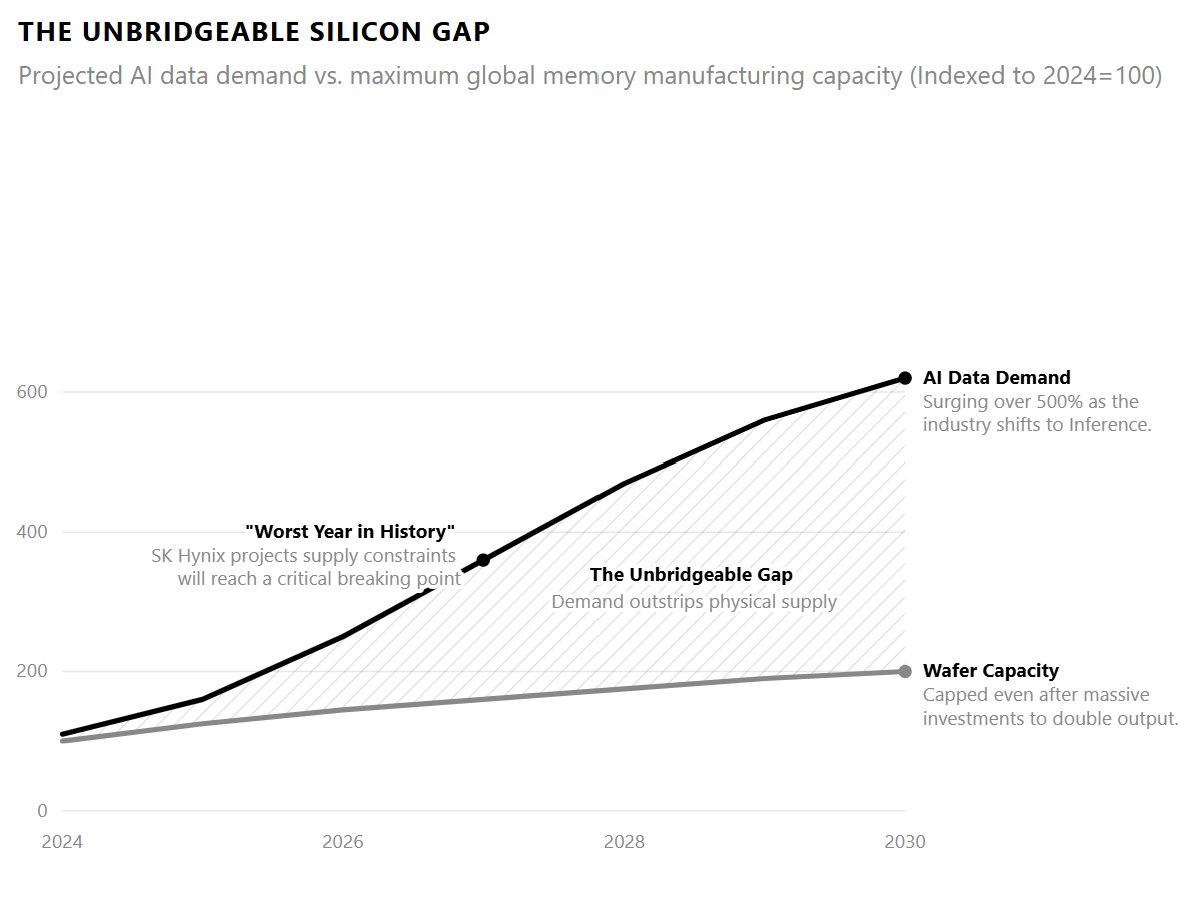
2027 will be the memory industry’s worst year for supply, SK Hynix’s CEO says. Demand will remain above capacity beyond 2030, even as it doubles wafer capacity.
Jensen Huang says shortages will last years.
Filecoin is built for storage demand that cannot wait until 2030.
A Union of Concerned Scientists analysis projects US data center capacity growing from 31 gigawatts in 2023 to 78-104 gigawatts by 2030, accounting for 46% to 59% of all electricity demand growth.
Filecoin distributes storage across providers already running today.
82% of enterprises in Asia Pacific and Japan are considering repatriating workloads to private cloud, and 54% already have, ahead of the global average, per Broadcom's own regional lead.
Filecoin storage providers never had a public cloud dependency to repatriate away from.
1,000% more compute is required for agentic AI, with NVIDIA warning that memory demand is now actively outpacing global capacity.
Hyperscalers face multi-year supply delays for scarce silicon.
Filecoin bypasses the queue. The enterprise capacity is already deployed.
EPRI's latest estimate puts data centers at 9% to 17% of US electricity by 2030, about 60% higher than its own forecast two years ago.
The number keeps climbing because new construction keeps accelerating.
Filecoin runs on hardware already deployed, not that buildout race.
🧵A hard drive ordered today might not ship until 2028
TL;DR: DRAM prices rose up to 95% quarter over 1Q in early 2026.
Western Digital and Seagate are sold out of hard drives into 2028. Prices are up nearly 50%.
Filecoin capacity was already built before any of this started.