Footage captures President Abdel Fattah El-Sisi's motorcade arriving at Egypt's Strategic Command Headquarters, the Octagon, under the escort of two AH-64 Apache attack helicopters during today's official inauguration.
A short reel of the Z113 Factory's final production line for artillery shells or Loading, Assembly, and Packaging (LAP). Z113 Factory can mass produce large artillery shells: 105mm, 122mm, 130mm and 152mm.
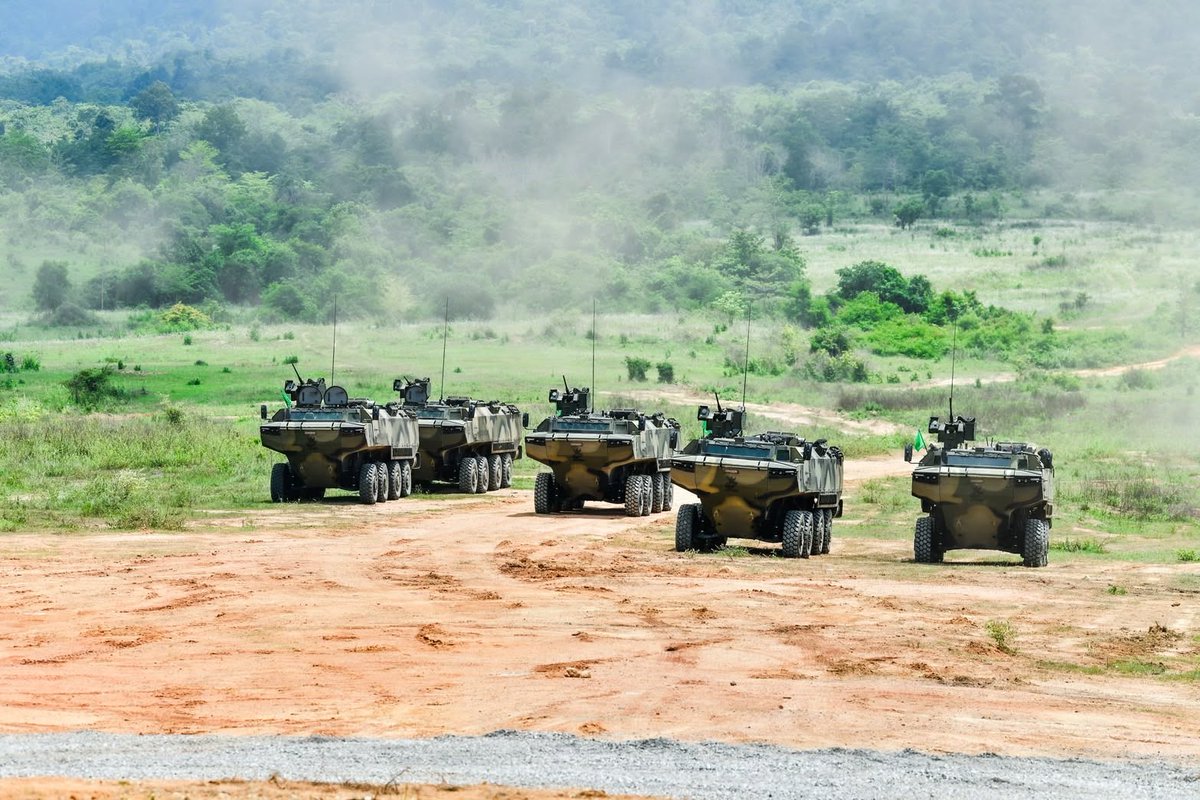
A Thai amphibious vehicle has beaten Korean, Turkish and Czech rivals to win a deal with the Philippine Marines, its maker's first ever export sale.
https://t.co/DZxJrAPqbE
In 1872, an eighteen-year-old girl arrived in a remote gold mining camp in Idaho. Legally, she was not even considered a human being. She did not have money, she did not speak a word of English.
She had been sold by her starving family in China during a famine, smuggled across the ocean, and bought by a wealthy Chinese saloon owner to work as a slave.
Her birth name was Lalu Nathoy, but the miners quickly gave her a simpler name: Polly.
The odds against Polly were overwhelming. Under American law at the time, she was invisible. The local government considered her presence illegal, and the men in the camp viewed her as property.
But Polly possessed a quiet determination that no one saw coming.
While she spent long, exhausting hours scrubbing heavy canvas pants on a washboard, she listened. She memorized every word spoken around her.
She learned English in complete silence, without anyone realizing it until it was too late to stop her.
Polly looked at the rugged miners around her and noticed something crucial.
They had gold in their pockets, but absolutely nothing else.
They had no one to feed them properly, no one to nurse them when they fell ill, and no one to make the brutal survival in the canyon bearable.
She saw a massive void in the market and decided to fill it.
She started cooking, sewing, and providing basic medical care. Every single coin she earned from these side jobs went straight into the dirt floor underneath her bed.
While the men squandered their fortunes on gambling and alcohol, Polly was buying something much more permanent: her independence.
Her life took a dramatic turn when a local saloon keeper named Charlie Bemis was shot in the face during a gambling dispute.
The camp doctor took one look at the horrific wound and declared him a dead man. Polly refused to accept that. She boiled water, sterilized a common crochet hook, and spent hours carefully extracting the bullet from Charlie’s skull.
Against all medical logic, Charlie lived.
Eventually, Polly and Charlie left the mining camp together and moved to Hells Canyon, the deepest river gorge in North America.
The Snake River cut through granite walls so steep that sunlight only hit the valley floor for a few hours a day. On a piece of land that seemed impossible to cultivate, Polly planted a fruit orchard.
She grew cherry and apple trees against the harsh rock cliffs.
When miners down the river got sick with fever or suffered terrible injuries, Polly took them in, becoming the ultimate healer of the canyon.
But her greatest battle was yet to come. In 1892, the U.S. government passed the Geary Act, a harsh law requiring all Chinese residents to carry certificates of residence or face immediate deportation. Polly had no papers.
A federal official traveled down into the canyon specifically to deport her. But when he arrived, he saw the thriving orchard, the vegetable gardens, and the sick men Polly was actively nursing back to health.
Realizing she was the backbone of the entire canyon community, the officer sat at her table, filled out the residence paperwork, and signed it as her witness instead of arresting her.
Polly Bemis lived in her canyon until her death in 1933 at the age of eighty. Today, her cabin is protected as a National Historic Site, and the cherry trees she planted still bear fruit.
Polly Bemis proved that when your spirit is strong enough, human law becomes nothing more than a suggestion.
She began her life in America with absolutely nothing, yet she chose to fill the harsh canyon with sweet fruit, warm meals, and a safe place for people who had no one else to care for them.
Enslaved, isolated, and stripped of every legal right, Polly faced a harsh wilderness and an even harsher society with absolutely no fear. She chose to fight back not with malice, but by building a life of profound purpose and protecting those around her.
Footage from KPA exercises in the early 1990s.
In the video you can see: ZPU-4, M-1992 SPAAGs, Type 73 (VTT-323) APCs, Type 59 tanks, MiG-29 fighters, Project 183R missile boats, 122 mm M-1977 and 130 mm M-1975/1981 SPHs, 103 mm M-1972s, BM-11 MLRSs, SA-2 ADS and S-201 ASCM.
Woah. The PTH-130 self-propelled howitzer just got a total makeover.
130mm M46 gun on Kamaz-6560 8x8 chassis.
Still in development but it's looking great so far.
Photo by HYKTQSVN
To all who think new North Korean weapons are only mockups or for parades, the KPA has begun fielding its new Cheonma-20 medium tank in its 105th Guards Armored Division, which is stationed in the southwest facing the flatlands of Gyeongi Province & Seoul.
Crazy footage from Nigeria shows what is reported to be a suicide bomber detonating in the midst of a firefight between Nigerian troops and Islamic Militants.
Puedo reconocer a un adicto a la pornografía y a la masturbación cuando veo uno.
No es por lo que dicen...
sino porque siempre tienen las mismas características evidentes:
1. Sus ojos se ven débiles...
🇻🇳 Upcoming Vietnamese MLRS.
Jointly developed by Viettel and VPA research institutes. Carries twelve 300mm precision-guided rockets in two 6-rounds pods. 2 types of rounds with ranges 70 and 150km. Enclosed launcher with integrated loading crane on 8x8 Kamaz 6560 chassis.