studying this universal behavior may provide useful insights into the equilibration of the quark-gluon plasma. Many thanks to my collaborators Lucas Hörl and Kirill Boguslavski!
Check it out here: https://t.co/ORXYb9gRg3
Excited to share that our paper ‘Jet energy loss in anisotropic plasmas meets limiting attractors’ is now published in Physical Review D: https://t.co/ORXYb9gRg3
This paper is set in the world of
hard-probe evolution in heavy-ion collisions, opening new avenues for understanding QCD matter under extreme conditions.
Thanks a lot to my collaborators João Barata, Kirill Boguslavski and Andrey V. Sadofyev!
Check out the paper at https://t.co/Y1TH2rHuDk
Excited to share that our paper “Jet quenching in out-of-equilibrium QCD matter” is now published in Physical Review D.
When heavy ions collide at large energies, they create a rapidly evolving, out-of-equilibrium plasma of quarks and gluons, the quark-gluon plasma. Most
using the Improved Opacity Expansion, taking into account the medium evolution during the emission process.
We find that the nonequilibrium early stages imprint a signature on the substructure within the jet. These results provide a foundation for more accurate descriptions of
I'm thrilled to share that our paper "Minijet thermalization and jet transport coefficients in QCD kinetic theory" is now published open-access in the Journal of High Energy Physics (JHEP).
Heavy-ion collisions produce a hot, dense state of matter known as
We find that the thermalization time scales remarkably well with these transport coefficients, enabling a phenomenological estimate of the minijet quenching time in heavy-ion collisions.
Since this quantity enters the modeling of jet quenching simulations, studying this universal behavior may provide useful insights into the equilibration of the quark-gluon plasma.
Many thanks to my collaborators Lucas Hörl and Kirill Boguslavski!
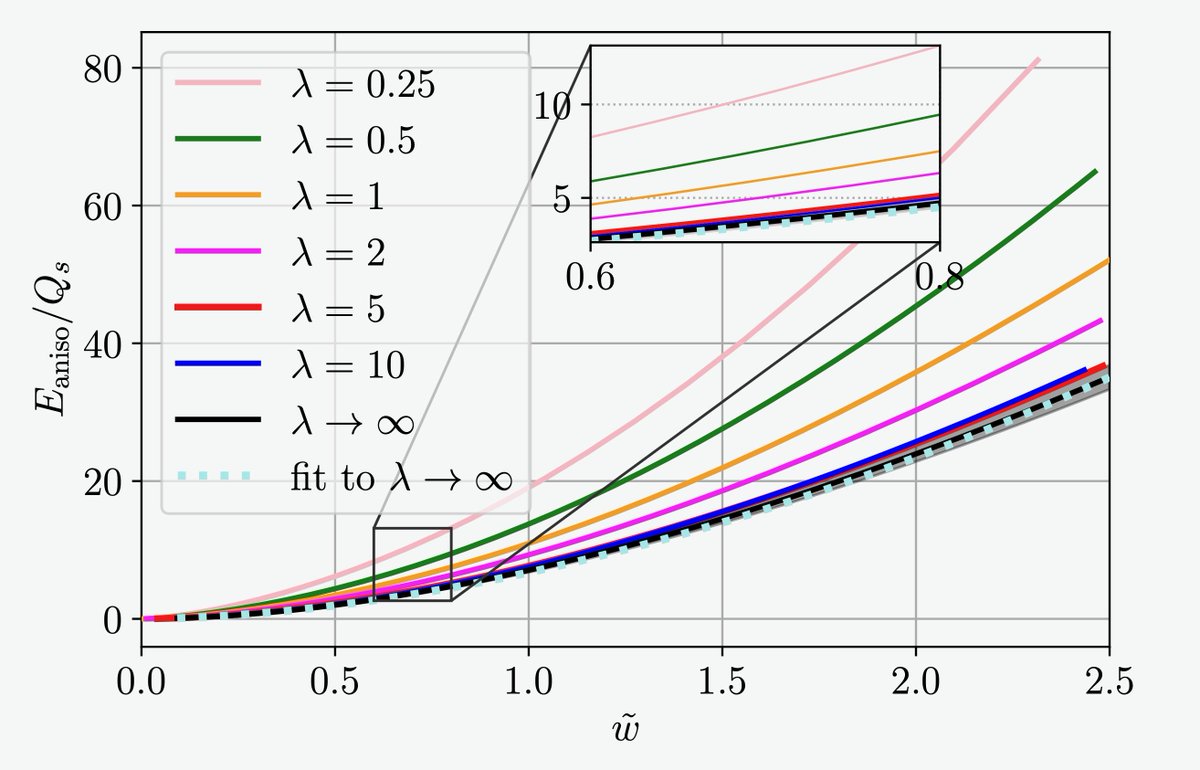
I’m excited to share our latest paper ‘Jet energy loss in anisotropic plasmas meets limiting attractors’, which you can check out here: https://t.co/hiPQNMvBvi
This paper is set in the world of heavy-ion collisions, where atomic nuclei are brought to collision at high energies,
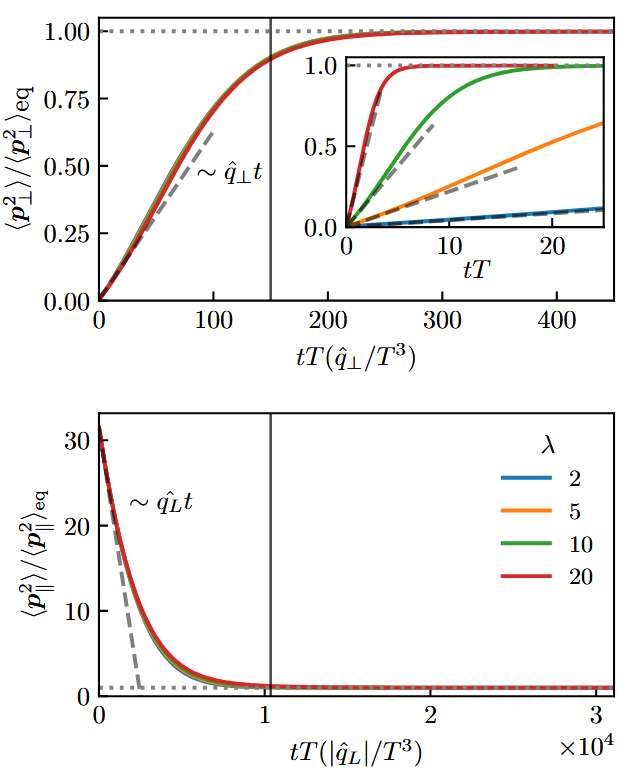
a universal curve. A similar phenomenon occurs for larger couplings with a different time scale. This phenomenon has been previously called ‘limiting attractors’, and here we see the first instance of this phenomenon in a numerical computation of the gluon emission probability.