The secondaries story is not just volume. Across 2005–2020 vintages, median net IRR nearly matched PE (12.6% vs 13.5%) with an outcome band about 39% narrower. Competitive return. Tighter risk shape.
Asia's family offices want liquidity tools. Funds investing in Asia were only 4% of global LP secondary volume in H1 2026. North America: 78%. Demand is here. Depth isn't.
Through-line at recent events: Asia's secondaries market isn't short of sellers. The mix is shifting - more corporations and family offices, not only overseas LPs. Liquidity is becoming an allocation decision, not a discount hunt.
And nobody even agrees why the correlation dropped. Inflation, government borrowing, the debt behind the AI build, doubts about central banks. You cannot fix something when you cannot agree on what broke. So there need to be other things in the portfolio. Private companies are the obvious candidate.
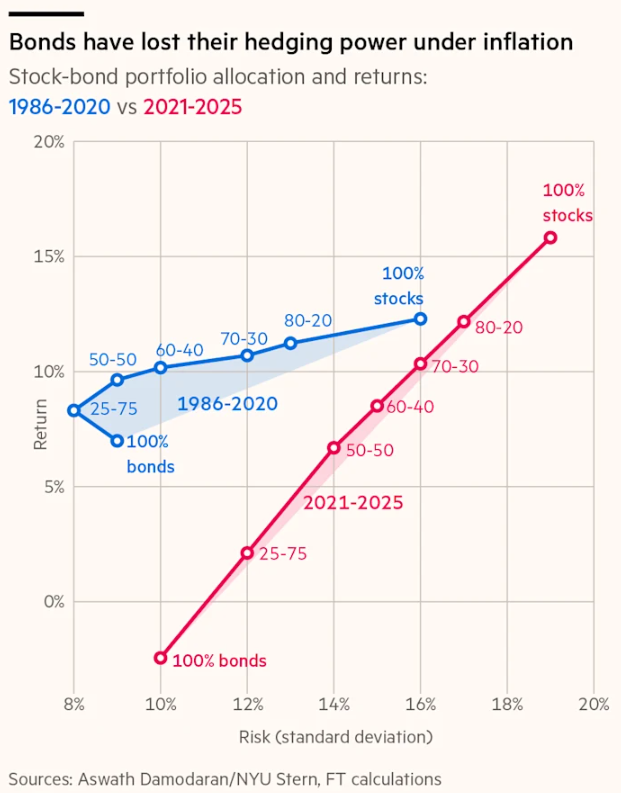
Since 2021, holding nothing but 10-year Treasuries produced a negative average annual return. Not disappointing. Negative. And it was not just bonds. Every mix got worse: more risk, less return, whatever the split.
I stopped when I saw this chart. The half of the portfolio that exists to keep you safe lost money. 60/40 worked for decades because shares and bonds moved in opposite directions. When one fell, the other rose. That is no longer the case.
Some news I'm genuinely happy about: Ben McQuhae and his team are joining EVIDENT.
Ben becomes Chief Business Officer and Head of Transactions. His law firm, Ben McQuhae & Co, joins forces with us and will act exclusively for our Private Markets transaction business.
The next decade in private markets belongs to full-stack players. This is a big step toward being one.
Welcome, Ben.
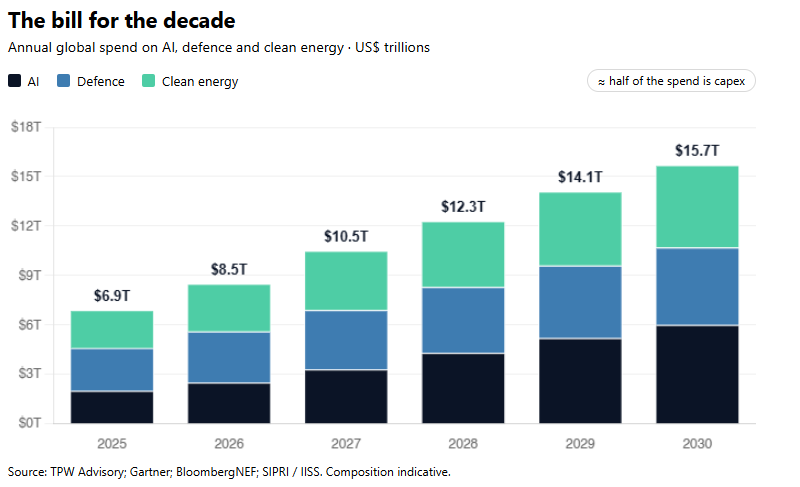
The world will spend $16 trillion a year building AI, defence, and clean energy at once. The money will be made financing the build, not buying the stocks. Half of it is capex: heavy, long-dated assets. The capital to fund it exists. The rails to move it don't. That gap is the decade's real bottleneck.
I was on a panel discussing AI in asset management with @charlesdhaussy and @fmspiegl hosted by @HenriArslanian and @FintechBalerina sometime around 2016 (nostalgic image below) and that was a turning point. AI was able to caption images meaning they were becoming context aware.
The 60/40 portfolio is a 1980s artefact. Its logic was diversification: bonds rising when equities fell. That broke; in the last shocks, both fell together. Private assets follow fundamentals, not only market-wide flows. Add them and the whole risk-return curve lifts: higher return, steadier path.
#HSCLifeRules - Florian M Spiegl (@fmspiegl), Founder & CEO at @EVIDENT_Capital, HSC Asset Management Hong Kong, April 23
Right now, if you're a private investor trying to access private markets, you're breaking your thumbs on WeChat and WhatsApp all day, texting people in your network. It's local and limited. Tokenization does what e-commerce did - it connects dispersed liquidity pools and builds capital bridges across them
#HSCAssetManagement
1/ Hong Kong is now the world's largest cross-border wealth hub. Sooner than most expected. $2.9 trillion of international wealth booked in 2025, a 10.7% jump in a single year. BCG expects the gap to Switzerland to widen by another $600B by the end of the decade. (Chart sources: @BCG wealth report)
3/ But that is only half the story. The other half: excellent investment opportunities powered by relentless innovation. Robotics and physical AI, GPUs, biotech, renewable and nuclear energy, batteries — and more.
Private markets are no longer a sitting business.
The industry is shifting from a stock model - capital sitting for a decade - to a flow model, where it moves continuously. Private wealth investors and the need for liquidity and secondary markets are powerful drivers.
Two revolutions enable it: blockchain as a new system of record, AI as a new system of orchestration.
Our 2025 letter is out where I lay out the details of how private markets are rewired.
https://t.co/qatM7Lmt9q
Some of the most interesting allocations sit outside the barbell: AI on one end. HALO on the other. Culture in between.
World's first tokenized Pokémon card fund — by @MemeStrategy — closed oversubscribed on @EvidentCapital .
Truly alternative!
Top 20 pre-IPO companies are now worth $3T+ combined. Secondary trading hit $1B on a single platform. This isn't a niche anymore. It's a capital market running on broken infrastructure. Time to upgrade.
We are pleased to welcome Florian M. Spiegl, Founder and CEO of EVIDENT, to #Cosmoverse26
Florian leads EVIDENT, the first fully integrated SFC-licensed investment platform for alternative assets in Hong Kong, and one of Asia's most active digital market infrastructures for private markets. EVIDENT operates the full asset lifecycle on blockchain: from primary issuance and structuring through to secondary market transactions, serving asset managers, wealth managers, and institutional investors across the region.
His earlier career spans strategy consulting at Boston Consulting Group in Vienna and New York, and senior roles in wealth and asset management at Credit Suisse across Switzerland, London, and Singapore.
Beyond his work at EVIDENT, Florian co-founded the Hong Kong FinTech Association, taught the FinTech MBA course at the University of Hong Kong, and served on the FinTech Advisory Board of Hong Kong's Securities and Futures Commission.
His presence at Cosmoverse brings a practitioner's perspective on what licensed, production-grade digital market infrastructure for private assets looks like in practice, and what it takes to build it in a regulated environment.