Zcash: Bitcoin-Like Money, Cash-Like Privacy
Most blockchains are surveillance systems disguised as freedom tech.
Bitcoin promised censorship resistance but delivered a public ledger where governments can track every dollar you've ever touched.
Anyone can see who paid who.
Anyone can see how much.
Anyone can follow your full history.
Transparency helps verification. But it also makes surveillance trivial.
@Zcash exists to finish what Bitcoin started.
━━━━━━━━━━━━━━━━━━━━━━
► Understanding Zcash
$ZEC keeps Bitcoin-style monetary rules:
– Fixed supply: 21m
– Proof-of-Work security
But it adds something Bitcoin doesn’t have: private transfers.
Zcash has two “modes” for transactions.
❶ Transparent mode
▸ Works like Bitcoin
▸ Balances and transfers are public
❷ Shielded mode
▸ Works more like cash
▸ Sender, receiver, and amount are hidden
Users choose which one to use.
━━━━━━━━━━━━━━━━━━━━━━
► How privacy works
$ZEC uses zero-knowledge proofs (zk-SNARKs).
Simple idea:
You can prove a payment is valid without revealing any details.
The network can still verify:
▸ No double spend
▸ No new coins created
▸ Fees paid
All without learning who you are or what you sent.
━━━━━━━━━━━━━━━━━━━━━━
► Product Layer
@zashi_app is the flagship wallet built by Electric Coin Company.
Design goals:
▸ Privacy by default
▸ Normal payments-app UX
Zashi supports:
▸ Retail payments (via Flexa)
▸ Swaps
▸ Cross-chain payments via NEAR Intents
No user metadata leakage.
━━━━━━━━━━━━━━━━━━━━━━
► Governance Evolution
Old Model (2016–2024):
▸ Fixed developer subsidies
▸ Two organizations (ECC + ZF) controlled everything
▸ Limited community input
New Model (2025+):
▸ 12% of block rewards → protocol lockbox
▸ $ZEC holders vote on funding allocation
▸ Grants require 420,000 ZEC quorum + majority approval
Decision-making power has shifted from founding orgs to holders.
━━━━━━━━━━━━━━━━━━━━━━
► Roadmap: Tachyon
Today's privacy chains have a scaling problem.
Your wallet must download the entire blockchain and decrypt every transaction just to find your own payments. As the chain grows, syncing gets slower.
Validators must store every piece of history forever, making nodes expensive to run.
Tachyon flips the model.
Instead of the network carrying all the burden:
▸ Wallets carry recursive ZK proofs of their own solvency
▸ Encrypted data moves offchain (peer-to-peer)
▸ Validators can prune old history
Goal: Privacy that scales to billions of users without the chain growing forever.
━━━━━━━━━━━━━━━━━━━━━━
► TLDR
▸ Bitcoin's supply discipline with protocol-level privacy
▸ Users choose: transparent or fully encrypted
▸ Roadmap focuses on scaling private payments without surveillance
Simmer x World Cup 2026 is live 🏆
Describe any trading strategy in plain English, or just paste an X thread. Simmer turns it into a runnable skill for your agent.
The World Cup is the arena.
Our first featured skill: the Worldcup Shock Ladder. It fades panic-driven price moves in live match markets on @Polymarket.
Every week of the tournament, a $250 rewards pool is split between the skills driving the most volume and the members bringing in the most active traders. The pool grows as sponsors come on board.
Kickoff June 11 ⚽️
https://t.co/mDEWSDQPub
Zcash: Bitcoin-Like Money, Cash-Like Privacy
Most blockchains are surveillance systems disguised as freedom tech.
Bitcoin promised censorship resistance but delivered a public ledger where governments can track every dollar you've ever touched.
Anyone can see who paid who.
Anyone can see how much.
Anyone can follow your full history.
Transparency helps verification. But it also makes surveillance trivial.
@Zcash exists to finish what Bitcoin started.
━━━━━━━━━━━━━━━━━━━━━━
► Understanding Zcash
$ZEC keeps Bitcoin-style monetary rules:
– Fixed supply: 21m
– Proof-of-Work security
But it adds something Bitcoin doesn’t have: private transfers.
Zcash has two “modes” for transactions.
❶ Transparent mode
▸ Works like Bitcoin
▸ Balances and transfers are public
❷ Shielded mode
▸ Works more like cash
▸ Sender, receiver, and amount are hidden
Users choose which one to use.
━━━━━━━━━━━━━━━━━━━━━━
► How privacy works
$ZEC uses zero-knowledge proofs (zk-SNARKs).
Simple idea:
You can prove a payment is valid without revealing any details.
The network can still verify:
▸ No double spend
▸ No new coins created
▸ Fees paid
All without learning who you are or what you sent.
━━━━━━━━━━━━━━━━━━━━━━
► Product Layer
@zashi_app is the flagship wallet built by Electric Coin Company.
Design goals:
▸ Privacy by default
▸ Normal payments-app UX
Zashi supports:
▸ Retail payments (via Flexa)
▸ Swaps
▸ Cross-chain payments via NEAR Intents
No user metadata leakage.
━━━━━━━━━━━━━━━━━━━━━━
► Governance Evolution
Old Model (2016–2024):
▸ Fixed developer subsidies
▸ Two organizations (ECC + ZF) controlled everything
▸ Limited community input
New Model (2025+):
▸ 12% of block rewards → protocol lockbox
▸ $ZEC holders vote on funding allocation
▸ Grants require 420,000 ZEC quorum + majority approval
Decision-making power has shifted from founding orgs to holders.
━━━━━━━━━━━━━━━━━━━━━━
► Roadmap: Tachyon
Today's privacy chains have a scaling problem.
Your wallet must download the entire blockchain and decrypt every transaction just to find your own payments. As the chain grows, syncing gets slower.
Validators must store every piece of history forever, making nodes expensive to run.
Tachyon flips the model.
Instead of the network carrying all the burden:
▸ Wallets carry recursive ZK proofs of their own solvency
▸ Encrypted data moves offchain (peer-to-peer)
▸ Validators can prune old history
Goal: Privacy that scales to billions of users without the chain growing forever.
━━━━━━━━━━━━━━━━━━━━━━
► TLDR
▸ Bitcoin's supply discipline with protocol-level privacy
▸ Users choose: transparent or fully encrypted
▸ Roadmap focuses on scaling private payments without surveillance
Polymarket may be building the biggest upgrade prediction markets have ever seen
I’ve been digging through the new Polymarket v2 contracts and found something much bigger than “parlays are coming.”
Under the hood, this looks like infrastructure for trading entire probabilistic scenarios.
A new contract called Combinatorial Module was deployed and verified on Amoy testnet, and the deployer is linked to an address Polygonscan labels as Polymarket: Deployer 1.
So this does not look theoretical anymore.
The core idea is simple:
instead of trading isolated events, traders could trade entire chains of outcomes as a single position.
Right now prediction markets mostly work like this:
1. Trump wins
2. BTC above $150k
3. Fed cuts rates
4. Recession in 2026
Each market exists independently.
But real traders rarely think in isolated events.
They think in causal chains.
For example:
If Trump wins, crypto gets a regulatory tailwind, BTC rallies, risk-on returns, and capital rotates back into high-beta assets.
The interesting part is that the new module allows this exact structure to become one position:
1.1 Trump wins
1.2 AND BTC > $150k
1.3 AND Fed cuts rates
Not three separate bets.
One asset, one payout, one expression of a worldview.
And if all legs resolve correctly, the position pays out $1.
That means traders can buy cheap convex exposure to an entire macro thesis.
If the market prices the scenario at 8¢ and the full chain plays out, the position settles for $1.
This is where prediction markets start looking less like betting apps and more like probability derivatives.
What makes this even more interesting is that the module appears to work cross-category.
Sports, politics, crypto, macro, geopolitics — anything represented as binary/negrisk conditions can theoretically be combined.
The contract supports up to 50 legs in a single structure. And the positions are not static.
The code includes mechanics for:
– splitting positions
– merging them
– extracting legs
– recombining scenarios
– compressing resolved conditions
– and wrapping existing binary markets into combinatorial positions.
In other words:
this is not just “build a parlay and wait.”
It is closer to building dynamic scenario structures that evolve as the world changes.
The NO-side is where things become especially interesting!
There is a very important distinction here:
NO(A AND B AND C) is NOT the same thing as:
NO(A) AND NO(B) AND NO(C)
The first one is the complement of the entire scenario:
NOT(A AND B AND C)
meaning the structure fails if any part of the chain breaks.
That subtle difference is why these markets become much more sophisticated than standard YES/NO betting.
The market is no longer pricing isolated outcomes.
It is pricing the stability of an entire connected narrative.
This opens the door to a completely different class of products.
At that point, prediction markets stop being “Will X happen?”
They become:
“Which version of the future is currently mispriced?”
There are still two massive open problems.
The first is liquidity.
Every scenario gets its own conditionId / positionId, but the contract itself does not imply that every combination will have its own standalone orderbook.
And if liquidity fragments across millions of possible scenarios, the system breaks immediately.
Which means the real unlock is probably synthetic pricing and routing:
using liquidity from underlying markets to construct and price scenario positions dynamically.
The second challenge is UX.
Because probability algebra gets confusing very quickly.
Most users will not intuitively understand the difference between:
NO(A AND B) and: NO(A) AND NO(B)
So the challenge is no longer just building markets.
It is building interfaces that make complex probabilistic structures understandable to humans.
If Polymarket solves liquidity and UX, v2 may become much more than a prediction market upgrade.
It could become the first real probability trading layer for the internet.
Bullish.
Huge W @devjoshstevens@mustafap0ly@Polymarket@PolymarketDevs@SuhailKakar
As we look forward to @THORChain trading to be resumed, @THORSwap is honored to continue providing best-in-class crosschain swaps for Native Bitcoin and more across a number of leading providers.
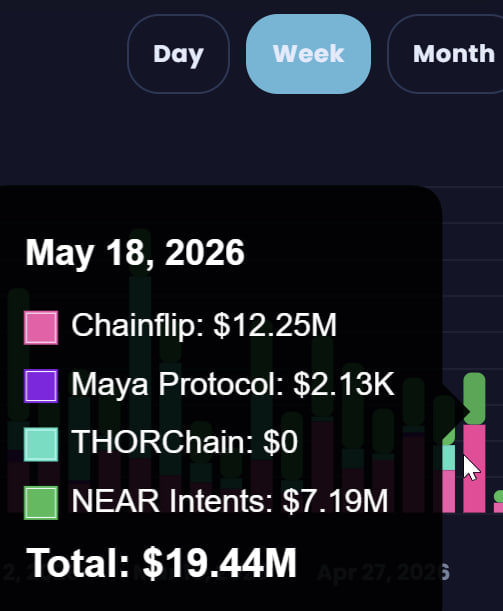
Last week we processed over $20M in volume (some providers not counted on this chart). It's encouraging to see that users still choose @THORSwap for their no-KYC, non-custodial trading needs.
Shout out to @SwapKitPowered and our partners @Chainflip@near_intents@Harbor_DEX@1inch@flashnet and more.
Our thesis for the past number of years has been to always ensure our users have access to the best native asset onchain swapping rails, without reliance on bridged IOU assets or broker/custodial services.
A diverse range or providers allows us to provide the best balance of price vs time execution and ensure there's always redundancy in case of downtimes.
We're not in a race to the bottom, there's trillions of monthly spot trading volume still stuck on centralized exchanges.
It's time to bring everyone onchain, this is how DeFi wins 🫡 Let's get it.
Good things come to those who HODL.
2 years ago, @KhunJoe5 was introduced to @Beezie (pka,The Colony) and that led us to add TCG RWA meta into the bags.
This strong show up in Seoul, a lucrative and hard to crack market, is a strong early signal of its bull szn potential.
We’ve always said we want to meet collectors where they are.
Today we took over Seoul 🇰🇷
The Claw sold out IRL.
Thousands of collectors came out.
Huge thank you to @SolanaFndn for believing in where digital collectibles are headed 🫡
Where should we bring the Claw next?
Let me tell you the full story of @MANTRA_Chain that nobody is telling properly.
April 13, 2025. A Sunday night. Low liquidity hours. @jp_mullin888 was asleep in his hotel room when his phone started blowing up.
By the time he woke up, $OM had already crashed over 90%. A token that was sitting comfortably in the top 20 on CoinGecko, that had delivered a 400% run in 2024, that had reached a $6 billion market cap, was trading below $0.50. Over $5 billion in market capitalization erased in a matter of hours.
CT immediately went feral.
Rug pull. Insider dump. LUNA 2.0. Every accusation you can imagine was flying. People went through every wallet, every transaction, every address looking for proof that the team had sold. @zachxbt weighed in. @coffeebreak_YT did an interview. @okx 's founder pointed at $220 million in token deposits to exchanges before the crash. The noise was deafening.
And in the middle of all of this, very recently, JP Mullin posted a video giving a full update on everything @MANTRA_Chain has been building.
The ecosystem expanding. The infrastructure shipping. The team executing.
And instead of engaging with any of that, people went straight to the comments to talk about his watch.
The man built a project that reached the top 20 on CoinGecko. A chain that secured a VARA license from Dubai. A team that signed a $1 billion deal with DAMAC. And the best criticism available is what's on his wrist?
When your project is top 20 on CoinGecko, when you've spent years building regulated infrastructure for trillions in real world assets, you can wear whatever watch you want.
The watch crowd missed the entire point of the video. Which was that @MANTRA_Chain is still here, still building and still executing while everyone else moved on.
Here is what actually happened based on everything that came out afterward.
@binance quietly updated OM's collateral factor two days before the crash, cutting the Loan-To-Value ratio from 65% to 40% without notifying MANTRA. That single change put massive leveraged positions under immediate pressure. Then on a Sunday night when liquidity was at its thinnest, cascading forced liquidations started. Market depth on OM collapsed from $290 million to $473,000. $21 million in long positions were liquidated on @okx alone in hours. The token had no chance.
Mullin's response in the aftermath was not the response of someone who had just taken money and run.
He went on Cointelegraph live. He did in person interviews. He published a detailed post mortem. He burned 150 million tokens from his own personal allocation, worth around $80 million at the time, and asked the community to decide if he'd earned them back. He said on camera his eyes welling up that MANTRA was his baby and that he felt responsible even if he hadn't done anything malicious. He said "I will never quit."
That is not how a rug pull ends.
Now let me tell you what happened after.
Because this is the part everyone conveniently skips when they're writing the obituaries.
The team kept building.
VARA confirmed MANTRA's license remained active after the crash. The regulator was one of the first calls Mullin made when it happened. DAMAC and MAG confirmed their institutional partnerships remained in place. The $1 billion tokenization pipeline in the UAE was still alive.
Then the recovery roadmap started executing.
@mantraUSD launched in January 2026. A stablecoin backed by actual short term US Treasury Bills. Not algorithmic. Not overcollateralized crypto. Real government debt as collateral. Designed to be the native settlement layer for the entire MANTRA RWA ecosystem including vaults, launchpad and a DEX.
The @MANTRA_Chain x @goldskyio partnership went live, bringing high performance blockchain data indexing and real time infrastructure to the MANTRA EVM ecosystem for builders.
@PyseEarth and MANTRA Finance received a VARA NOC to launch a Shariah compliant RWA backed by Dubai electric motorcycles. A real world asset product, fully regulated, live under VARA.
The $OM to $MANTRA token migration executed in March 2026. One of the most technically complex token upgrades in crypto history. A 1:4 non dilutive redenomination coordinated across 25+ centralized exchanges simultaneously. Triggered at block 13,000,000 by on chain governance. Wallets, custody systems, trading pairs, all synced automatically. No chaos. It just worked.
Fourteen days after the migration, an L2 was deployed.
@InveniamIO Chain. A purpose built Layer 2 for commercial real estate tokenization backed by one of the strongest blockchain patent portfolios in Web3 covering document verification, federated data rooms, programmatic collateralization and heterogeneous multi chain frameworks. AI agent passports deployed. MarketRegistry live. A full agentic prediction and intelligence layer being built on top of the $27 trillion private CRE market.
RWA perps closed alpha went live. Long and short on Dubai real estate, stocks, commodities, bonds and indices. All fully compliant. Revenue share paid in real $mantraUSD.
wmantraUSD vaults shipping. Fluxtra running liquid staking, LP vaults and RWA vaults. The MANTRA hub live. The bridge live.
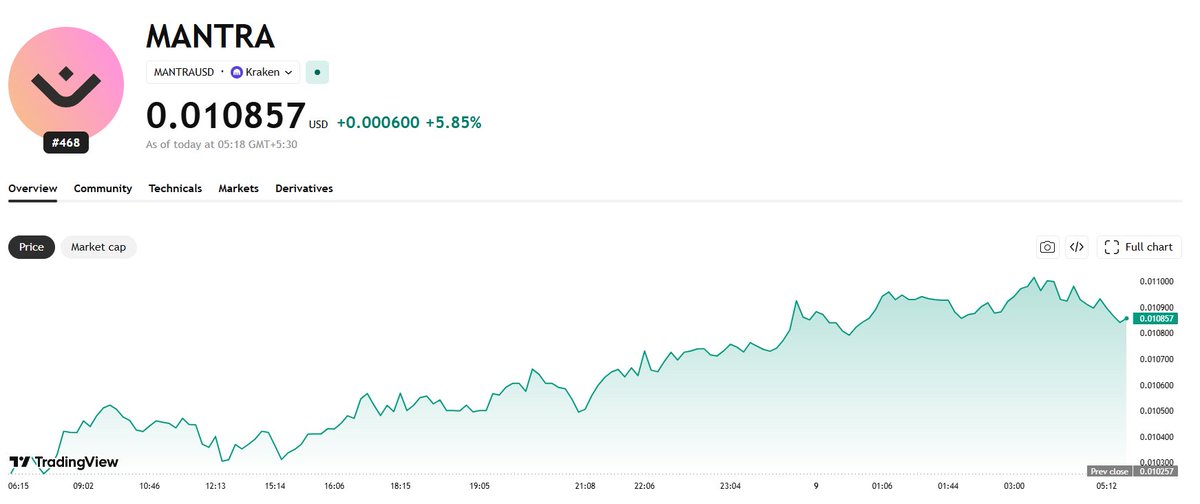
$51 million market cap sitting on top of all of that right now.
The people who called this dead after April 2025 missed the entire rebuild. They missed the migration. They missed the L2. They missed the stablecoin. They missed the perps. They missed the patent portfolio. They missed the AI x RWA infrastructure being assembled quietly while they were busy writing threads about a watch.
@jp_mullin888 Mullin said he would never quit.
He wasn't lying.
$MANTRA 🕉️
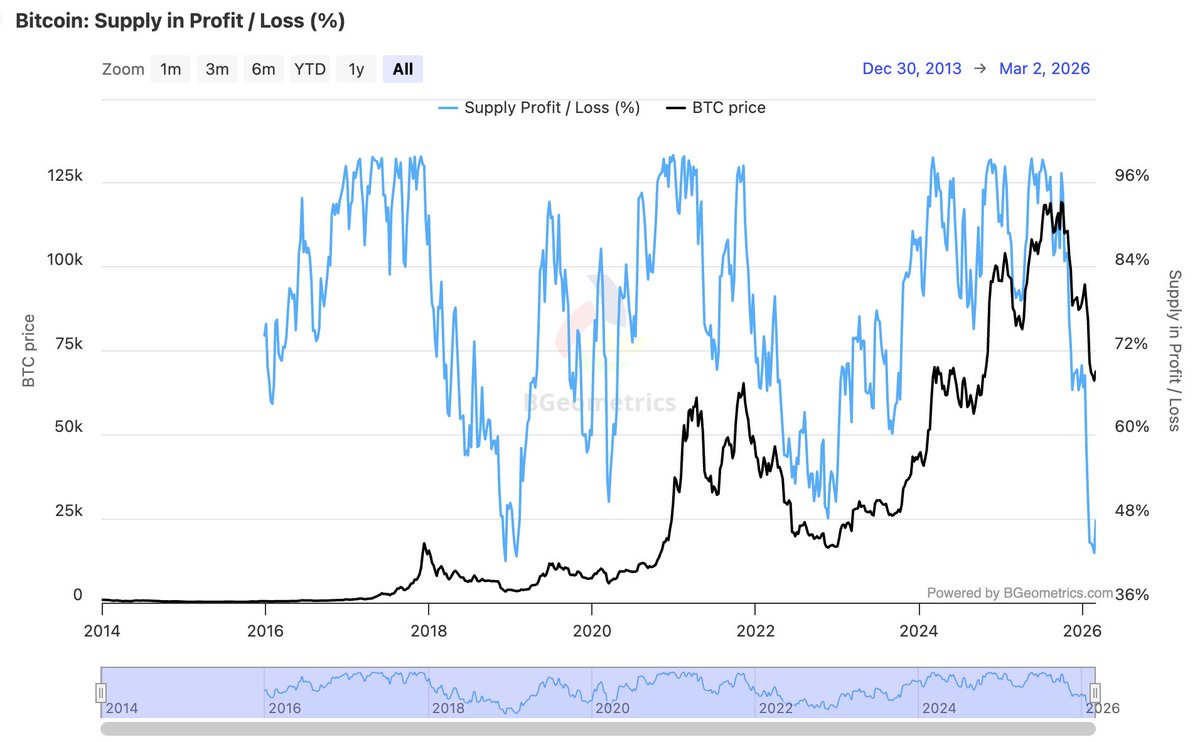
When the charts look scary, the data looks promising!
Right now, a record low number of Bitcoin holders are in profit. The majority are HODLing through the red.
It’s tough to watch, but history shows the best buying opportunities come when paper hands turn to paper losses.