Don't stop here!
Click the link in our bio and get the full scoop!
⛓️💥https://t.co/Yk3YvOwB7w
See you in the next insight drop!💫
FPCI Chapter Unsoed 2026
Leaping ahead🚀
New diplomatic efforts emerged on June 24th. Israeli and Lebanese representatives reportedly began discussing a US-backed proposal that could transfer parts of southern Lebanese territory currently controlled by Israeli forces to the Lebanese Army.
As recent events have shown, peace in the Middle East cannot be achieved through bilateral agreements alone, it requires cooperation among all major regional actors.
Meanwhile, humanitarian concerns remain significant. Human rights organizations have accused Israel of actions that may violate international humanitarian law, including attacks causing civilian casualties and large-scale displacement.
Others argue that excluding Israel from parts of the diplomatic process has generated frustration among Israeli officials and increased political tensions between Washington and its closest Middle Eastern ally.
Some observers believe the arrangement gives too much attention to US–Iran relations while failing to address the security concerns of regional actors.
Critics of the US–Iran deal argue that the agreement remains incomplete because it does not directly resolve the underlying disputes involving Israel, Lebanon, and Hezbollah.
Iranian officials repeatedly stated that continued attacks on Lebanon has threatened the entire diplomatic process and warned that the future of the US–Iran agreement depended on reducing violence on the Israel–Lebanon front.
Ceasefire was intended to prevent the failure of ongoing diplomatic efforts and create conditions for further negotiations. However, reports indicated that clashes and isolated strikes continued even after the truce officially began, highlighting the fragility of the agreement.
In the days following the agreement, Israel continued carrying out air strikes in southern Lebanon despite growing international pressure to de-escalate.These attacks created tensions between Washington and Jerusalem
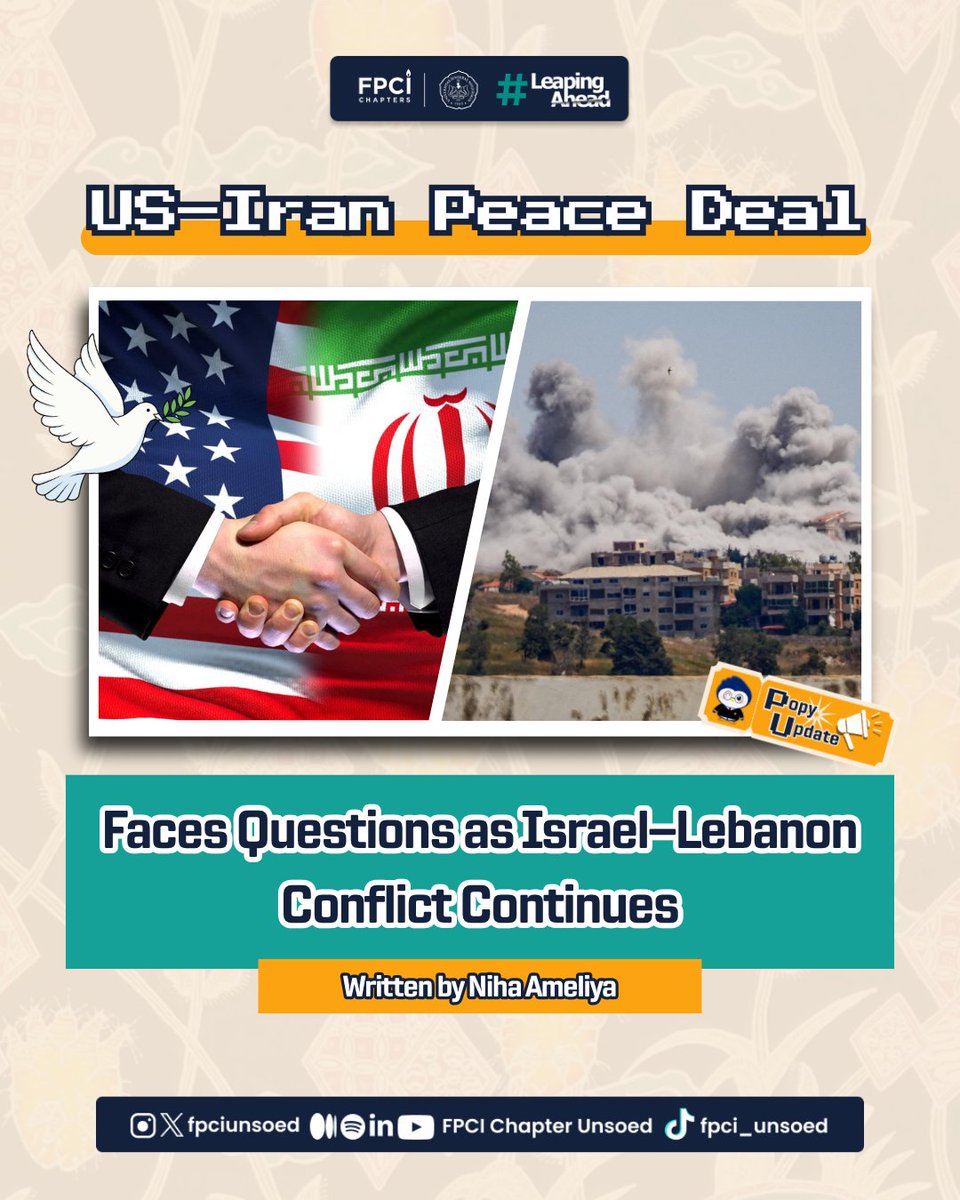
However, developments during the past week have revealed that achieving peace may be far more complicated than reaching an agreement between the United States and Iran. The continuing conflict between Israel and Lebanon has become the biggest challenge to the success of the deal.
After months of military escalation and political tensions, Washington and Tehran agreed to a framework aimed at reducing hostilities and opening a path toward broader negotiations on regional security.
Don't stop here!
Click the link in our bio and get the full scoop!
⛓️💥https://t.co/Yk3YvOwB7w
See you in the next insight drop!💫
FPCI Chapter Unsoed 2026
Leaping ahead🚀
-ini tidak lagi hanya tentang pertahanan di garis pantai atau udara, melainkan juga di dalam setiap baris kode, enkripsi, dan server data yang kita gunakan sehari-hari.