@PaulaMc007 This is good news! I hope it makes them realise how much more they need to learn & understand. The #DWP#Accesstowork experience for people with LD leaves a lot to be desired 😭
Is it just me, or is “practice learning in a community setting across health and social care” too vague? Community healthcare, community social care & residential social care are very different. And residential social care nursing still isn’t given parity of esteem???
Nursing students could see their practice learning cut by 500 hours, as the NMC seeks to launch a consultation on education standards.
The plans include mandatory community placements and limits on simulated hours.
https://t.co/dZmJdiD1Tc
Honestly, I’m troubled by the “shock” the public feel. It means we’re still in the low awareness & denial phase of these wicked problems. TY for raising societal awareness hopefully folk challenge these issues with their local Cllrs, MPs and others in power.
For the past year we’ve investigated how the care system, NHS and courts are failing and neglecting learning disabled people, with fatal consequences.
They consistently tell us: we don’t have a voice.
We decided to listen. Their words should shame us all https://t.co/BjxbKMY7si
@DanielHewittITV Honestly, I’m troubled by the “shock” the public feel. It means we’re still in the low awareness & denial phase of these wicked problems. TY for raising societal awareness hopefully folk challenge these issues with their local Cllrs, MPs and others in power.
A fund has been set up in the memory of a much-loved nurse lecturer who was murdered by her estranged husband in January.
The Claire Chick Nursing Fund aims to support nursing students in memory of Ms Chick, who has also been awarded a posthumous PhD.
https://t.co/gWfWU6JnLQ
The mum of a severely autistic man, whose unpaid work at his local Waitrose store has been stopped, says she wants to 'raise awareness' of the lack of rights volunteer workers have.
Francis Boyd tells #BBCWato the 'dream goal' now is to get some paid work for her son Tom.
If we want sustainable organisational change, which group is more important?
(a) People who are active in response to the change (even if they are resistant); or
(b) People who accept the change?
Newly published research suggests (a); it is more important to get people active in change than it is to get favourable responses to it. Active dissenters/resisters/opponents are preferable to passive, seemingly accepting people who go along with the change.
Many existing change frameworks focus on “valence”: the extent to which people are positive or negative about the change. This research highlights the importance of another dimension: “activation” - the energy or action level in people’s response to change - whether they are engaged, energetic & visible (active) or quiet, withdrawn, & non-participative (passive).
The authors have created a four box framework called “the Change Response Circumplex Scale”. I’ve added some strategies for working with the different categories alongside their graphic.
Active resistance is preferable to passive disengagement because it:
-keeps the lines of feedback & dialogue open
-surfaces important information & risks that passive compliance might hide
-enables leaders to create psychological safety for diverse reactions to change.
-Creates the conditions for long term engagement in change.
Implications of this research for leaders of change:
1. Go beyond reducing resistance: Don’t just focus solely on minimising resistance or seeking passive agreement; aim to foster active, positive engagement from people -what the authors term “change proactivity.”
2. Understand engagement levels: Differentiate between passive acceptance, disengagement & truly active, positive support. Use the framework to understand people’s responses to your change initiative.
3. Create interventions accordingly: Disengaged people need approaches to increase involvement, passive assent can become active support & resistance can become constructive dialogue.
4. Leverage the value of dissent: Rather than viewing resistance solely as an obstacle, explore what motivates active dissent & use it as a resource for learning & adaptation.
I appreciate this model because it challenges so much of the existing (dubious) advice for change leaders to “overcome resistance to change”. Instead we should work to activate engagement in change. The research shows that both high activation responses (change proactivity & change resistance) show the most promise for long term change engagement. Activism is what changes the world.
There are two research articles about this framework.
The 1st, from 2024, validates the framework (This is a version from Scrid so it is it accessible): https://t.co/YVuM0zgfKf.
The 2nd, which sets the framework in a wider change context, is from 2025 & is attached to this LinkedIn post from Cheese Cheeseman: https://t.co/E0Sf7GzFVI. By Shaul Oreg & Noga Sverdlik.
Access to Work: are claimants 'set up to fail'? From personal employer experience it’s almost impossible to navigate for people with learning disabilities.TY @BBCBreakfast for highlighting this https://t.co/Vk31BXFUKy
The abandoned call process is for hoax/untraceable calls. If a caller gives address, phone no. & symptoms, an ambulance must be sent even if the call ends early or there's an accent. #LearningDisabilities#Vulnerability#RaceBasedHealth#AwaitingInquest
https://t.co/yLe6JqbV0w
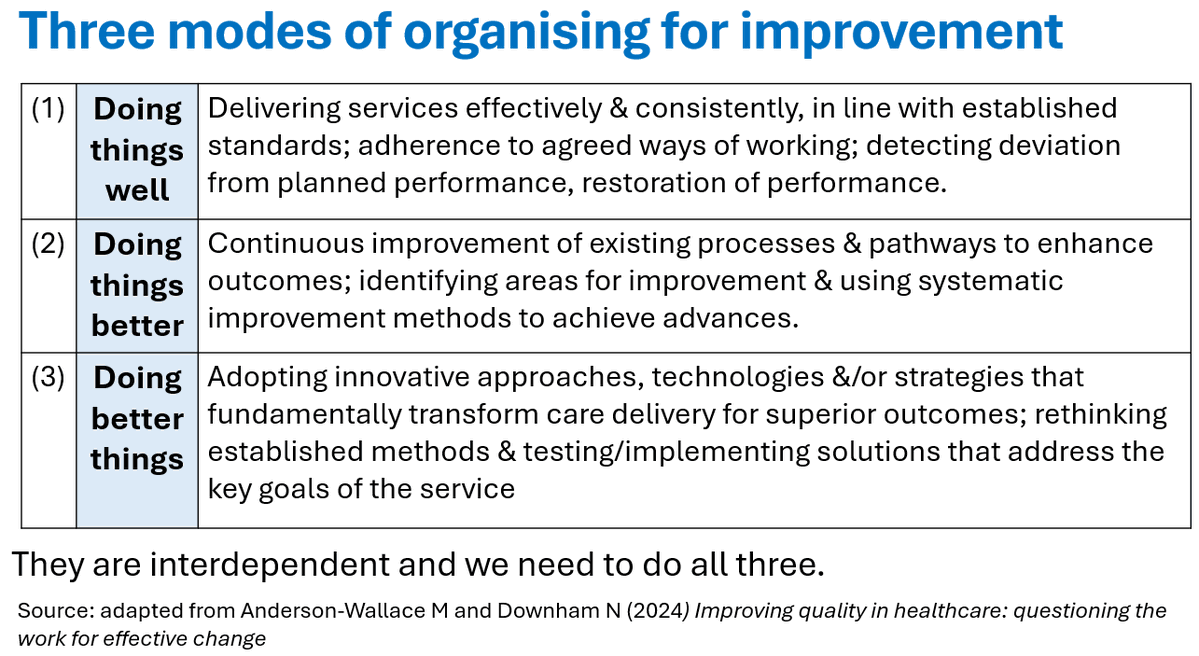
Three modes of organising for improvement:
(1) Doing things well
(2) Doing things better
(3) Doing better things
An organisational improvement strategy should focus on all three. Many organisations currently are overfocussed on (1) & (2) and under focussed on (3). This is risky because we can end up focused on improving the "wrong" or suboptimal things. The environment of change that we find ourselves in means that we have to focus increasingly on (3). It won't happen unless we build in the time & space for connection, collaboration, experimentation & learning into daily work.
I adapted this table from content in "Improving quality in healthcare: questioning the work for effective change" by Murray Anderson-Wallace & Nick Downham. I really like this book, written by highly experienced practitioners: https://t.co/HfBU4n5U85.
@virginmedia I’ve sent a DM & screenshot to show you the error message I’m getting. Judging by X this is not a new problem to you as lots of people have shared same problem. I hope this means you have a ready & quick solution. Many thanks.