@coingecko $eGLD @ElrondNetwork The Internet Scale Blockchain set for mass adoption through high scalability, low costs, ease of deploying smart contracts and great UX @getMaiar The Financial Freedom Starts Here DeFi2.0!https://t.co/DoNTrlZWzw https://t.co/4zT8AHXi4r
Open settlement infra used to come with a tax: it was slow.
Supernova removes that tradeoff.
600ms blocks. <200ms intra-shard finality.
Decoupling consensus from execution, validators agree on ordering, execution runs parallel across shards. The architectural payoff of sharding from day one.
A monolithic chain wanting sub-second finality has to make every validator do everything faster. A sharded chain distributes the work.
At agentic scale, that's the difference between a blockchain that holds and one that doesn't.
$EGLD is the settlement layer.
100+ security issues. Identified. Neutralized.
AI in its current form is a nuclear force. Channeled right, it delivers pure, unadulterated, unmatched, productivity gains. Channeled wrong, it ships weapons, with attack vectors the world has never had to defend against.
The next chapter will be defined by this duality: breathtaking productivity unlocks, colliding with deep, surgical, systemic attacks unlike anything we've seen.
For any blockchain team, any open-source team, security is THE PRIORITY.
The MultiversX team has been operating around the clock. Nights. Weekends. Relentless. Methodically filtering, triaging, and eliminating, in record time, a long list of material issues and protocol-level improvements. Every fix is another layer of hardening ahead of Supernova.
To put things in perspective: in the last few months, we've surfaced and closed more issues than in the previous 3 - 4 years combined. This is the preparation phase. And the fact that AI has crossed a new capability threshold cannot be overstated.
Supernova is not an upgrade. It is a complete rewrite of what a blockchain can be, instant performance, radical scalability, human UX that actually feels seamless, and just works. It also opens a new verifiable agentic highway. Real. Live. Working today.
Continuously adaptive security will define the AI era—and almost no one is treating it that way.
Static firewalls defended the old internet. Continuously adaptive security is what defines survival in the AI era.
Our engineering team, along with a resourceful network of builders, validators, and community members, is doing the surgical, disciplined, vital work that shapes what comes next.
This is MultiversX. This is SUPERNOVA.
Supernova isn't just a protocol upgrade.
It's the force making every serious app on MultiversX to level up.
xExchange just rebuilt their backend from scratch. 7x faster. Ready for 600ms blocks before they even land.
This is how ecosystems win. Building ahead.
/faster
MultiversX is the only blockchain that enforces dual-signature requirements at the protocol layer.
When Guardian is active, validators reject any transaction missing a valid co-signature.
Not the wallet enforcing it.
Not a smart contract.
The chain itself.
Six AI commerce protocols now run on MultiversX.
The organizations behind them include @Google, @stripe, @AnthropicAI, @OpenAI, the @linuxfoundation, @Visa, and @Shopify.
Each solving a different layer of the autonomous agent commerce stack: tool access, commerce discovery, checkout execution, payment authorization, machine-to-machine payment requests, HTTP-native micropayment settlement.
They were built by different coalitions, at different times, with no shared governance between them.
What they share is a common dependency:
A settlement layer that is fast enough for agent decision loops, cheap enough for micropayment economics, and open enough to serve all of them without picking a winner.
This is what we are building toward with Supernova.
All agentic commerce protocols will run on MultiversX.
6 of them are running right now.
everyone can use it. easily. with one line.
all the agents.
We are building all the layers so that agents can simply work and build trust and give trust.
Make it work. Code more.
FRESH OFF THE PRESS: EGLD POSITIONED FOR US INSTITUTIONAL ADOPTION 🇺🇸
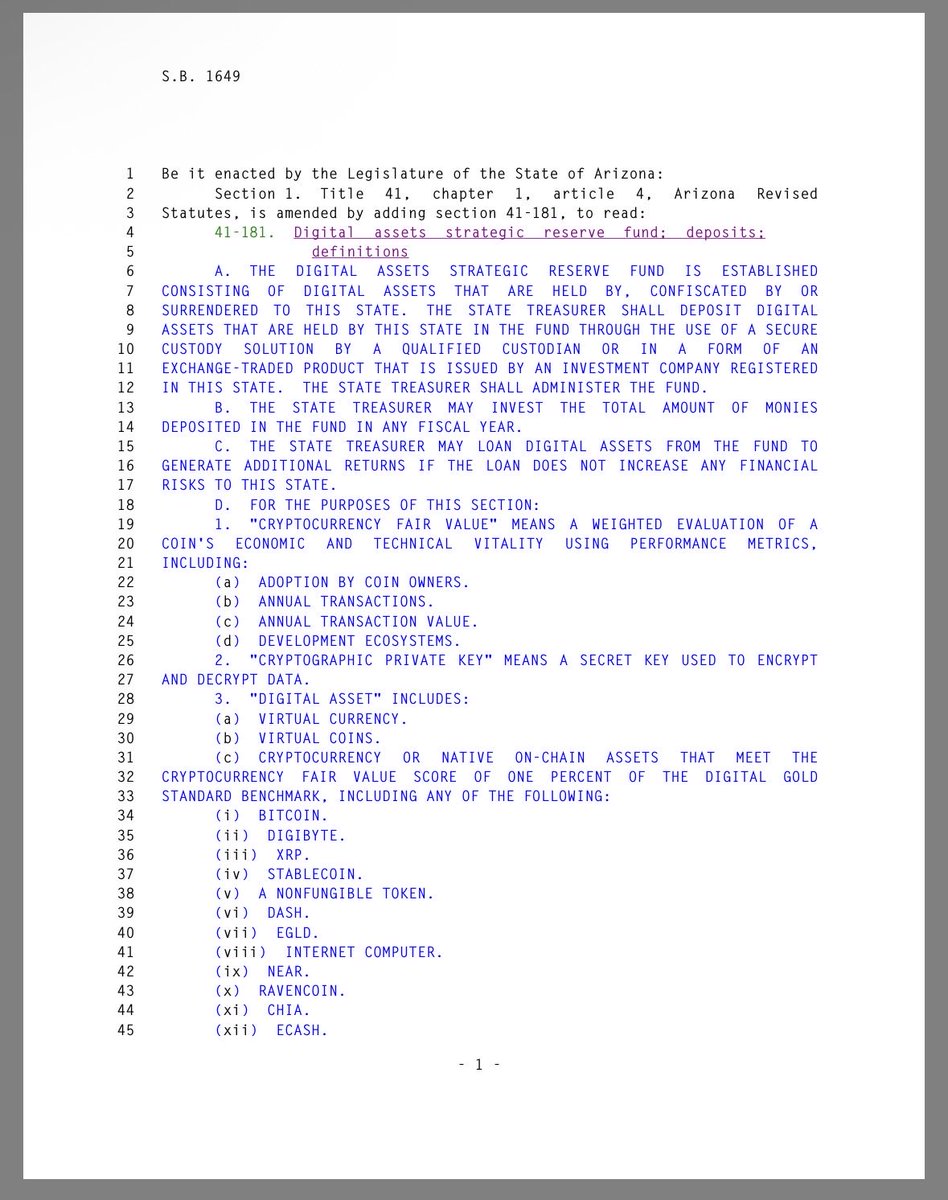
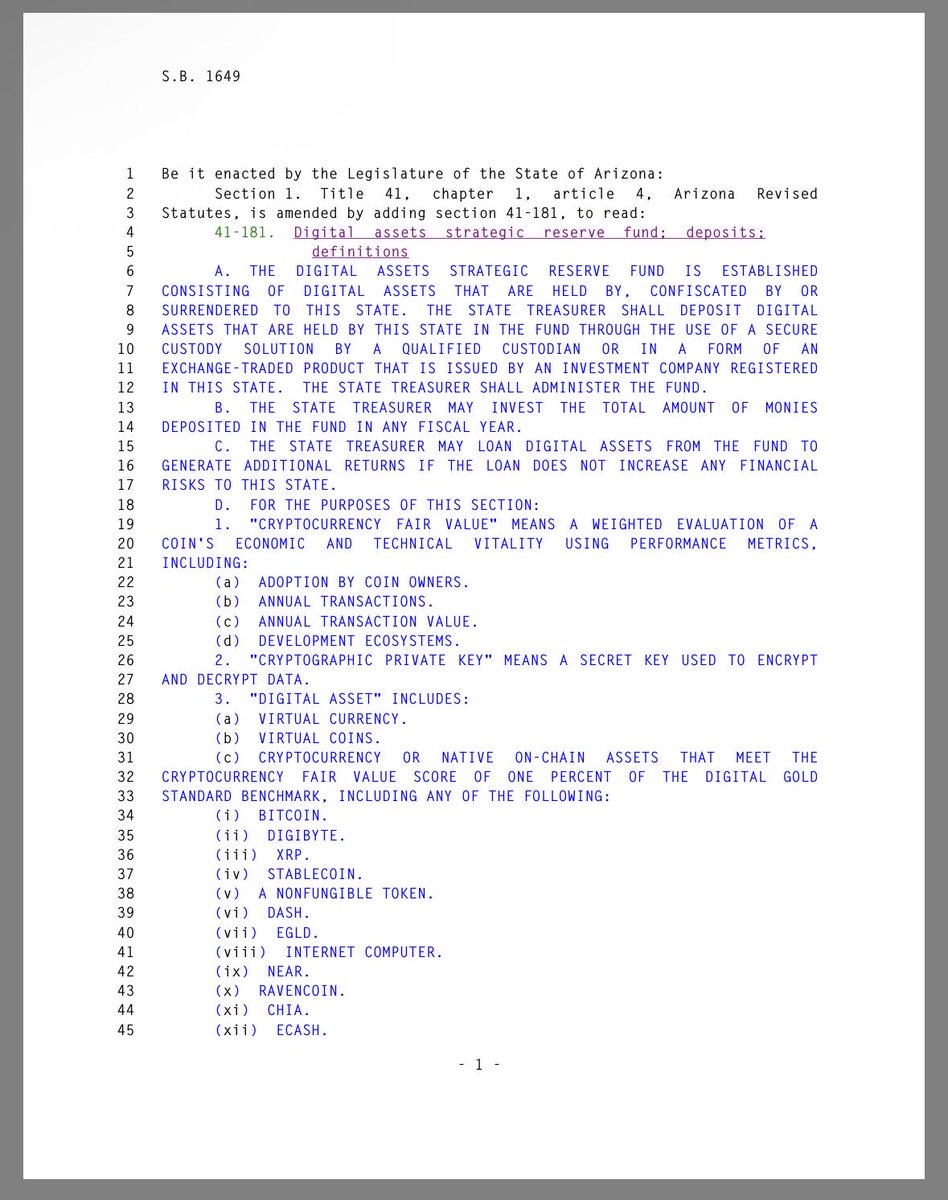
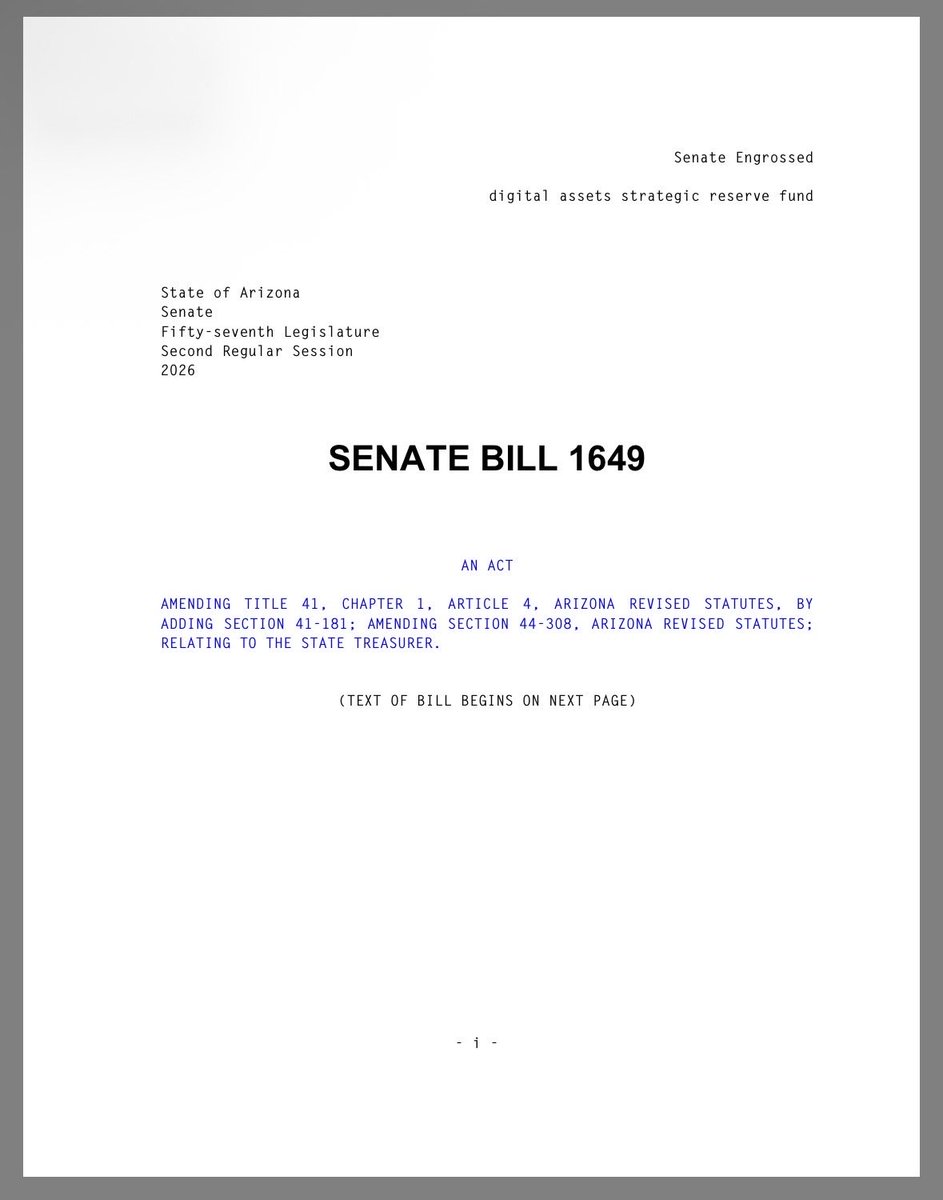
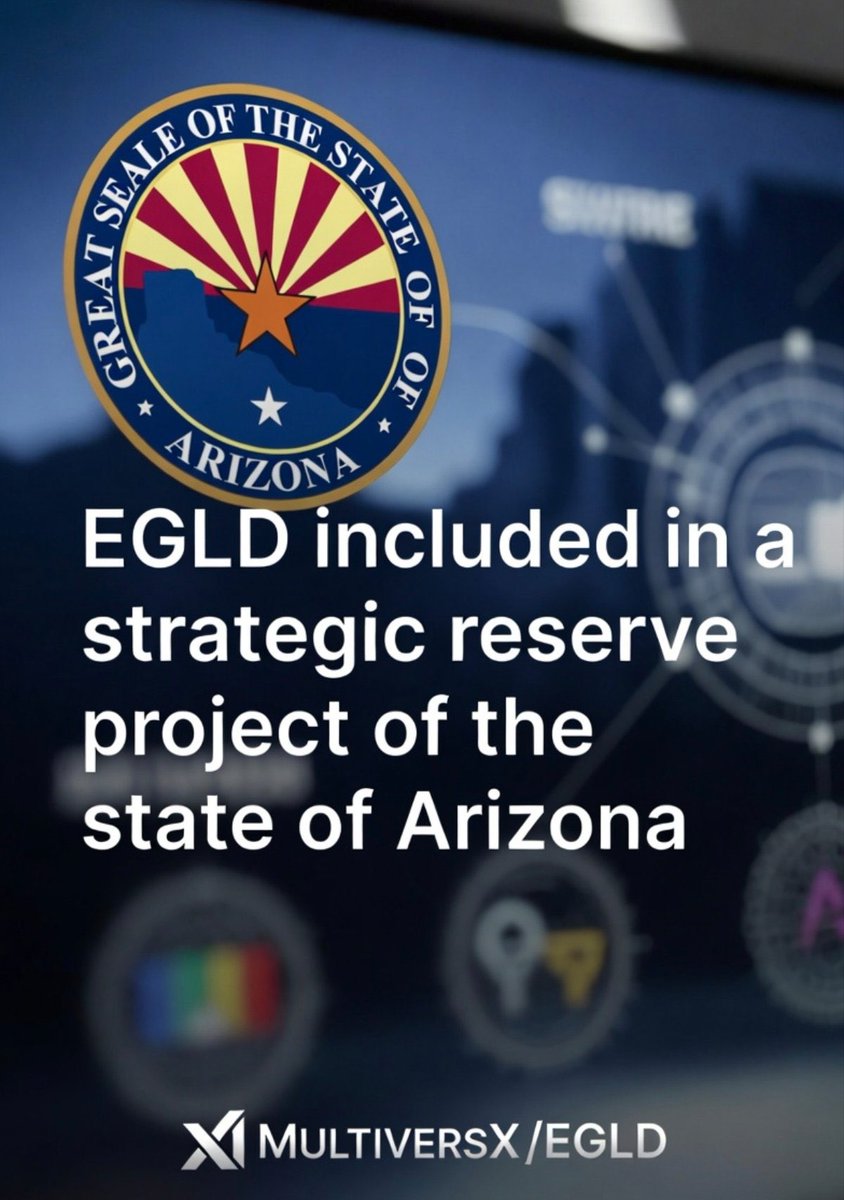
Arizona Senate Bill 1649 establishes the first Digital Assets Strategic Reserve Fund in the United States, with EGLD named directly in the bill text. The bill introduces an evaluation framework written into law, measuring network strength, development improvements, performance benchmarks.
Fourteen assets made the cut. EGLD one of them. This matters far beyond a single state. SB1649 sets a legal precedent for how governments can evaluate and hold digital assets following a deep review of fundamental measurable criteria. The fact that Arizona’s legislature looked at the data and included MultiversX technology alongside Bitcoin and other assets speaks volumes to what the team has been building for years: real infrastructure, real usage, real resilience.
If this passes the full House vote, Arizona becomes the first US state to hold a diversified crypto reserve, and EGLD is eligible from day one.
Institutional frameworks are being built around networks and assets enabling a robust and resilient foundation to build on for the future.
A great example of long efforts from people who care, builders and entrepreneurs from around the world, showing up, and finding new ways to bring contributions to the ecosystem. cc @DigitalGoldTalk
Public source: https://t.co/SOWV5DSCiM
🇺🇸 EGLD Enters the US Institutional Conversation
———
State of Arizona advanced two crypto bills to a full House vote.
SB1042 allows 10% of state public funds into digital assets. SB1649 creates a Digital Assets Strategic Reserve Fund, first of its kind in the US.
SB1649 names 14 cryptocurrencies by name. Selection criteria: adoption, transactions, transaction value, development ecosystem.
EGLD is one of the 14.
———
If passed, Arizona creates the first US state crypto reserve. EGLD eligible from day one. The precedent opens the door for other states and bigger institutional adoption.
source: https://t.co/SC9QZCBMqU
Things are happening. People are not sleeping.
We code, we cook, we build.
But the community is even more important, when they come and add value on top of that. @DigitalGoldTalk was pushing this for a long time. Amazing to see it.
Thanks and congrats.
For the last years, we have been working toward a new breakthrough. A ground-up rearchitecting to set new records in speed, and UX (in addition to unprecedented throughput).
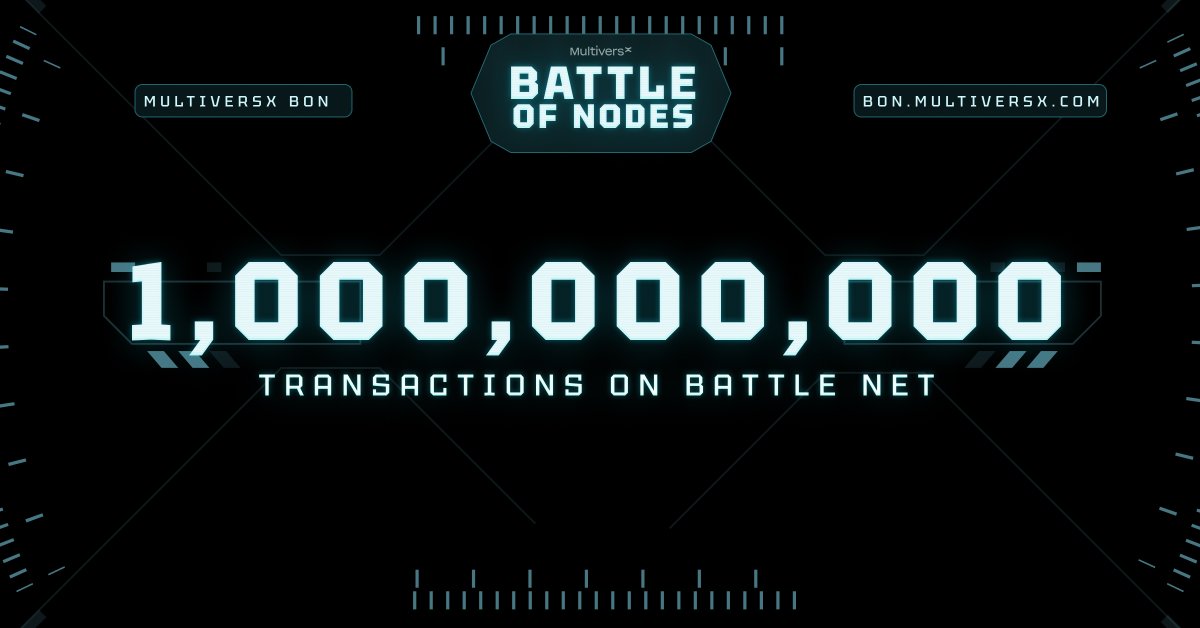
Yesterday, with the same minimal technical specs, we have processed 1 Billion transactions, achieving a peak of 120k transactions/second in a LIVE community battlenet, with only 3 shards + metachain.
This is SUPERNOVA 🔥
The game has changed.
This is what we call leapfrogging everyone in technology.
There is no other system which achieves sub second, one shot finality, with 120K TPS, running on thousands of nodes, decentralised, permissionless, composable.
Not an L2. Not servers which need thousands of dollars per month. Not a low amount of nodes.
3.2K validators. 3 shards + metachain. Consumer grade, low spec hardware. And running at avg 200ms finality or lower with 120K TPS.
This is @MultiversX
two weeks ago I wrote: "finality faster than the block slot. 120K TPS. same hardware."
today: 1 billion transactions processed on Battle Net. 120K TPS confirmed live.
still think nobody's building? RT this and tag someone who needs to see it.
A Bet We Made in 2018
This is me and Vitalik in 2018. ETH Devcon.
We were at a table talking about sharding and how blockchains could actually scale by running execution in parallel.
At the time, Ethereum and Elrond had the same thesis. Both believed execution sharding was the path forward.
Since then, Ethereum changed direction multiple times. Sharding gave way to rollups. Rollups gave way to "we need to scale L1 again." The roadmap shifted, the promises changed, the technical approach pivoted more than once.
And through all of it - the Ethereum community stayed. They gave the team the space to find the right path. They didn't kill the project when the roadmap changed. They believed the builders would figure it out.
That patience is what kept Ethereum alive. Not the technology. The community.
───
We made a different bet. We bet on execution sharding from day one and we never left that path.
Adaptive state sharding shipped on mainnet in 2020. Three execution shards plus a metachain. State, network, transactions - all sharded from genesis.
Supernova shipped this year. Consensus decoupled from execution. 600ms blocks. achieved 88ms finality. 120,000 TPS burst mode on the same validator hardware. 3,200+ validators on consumer-grade machines.
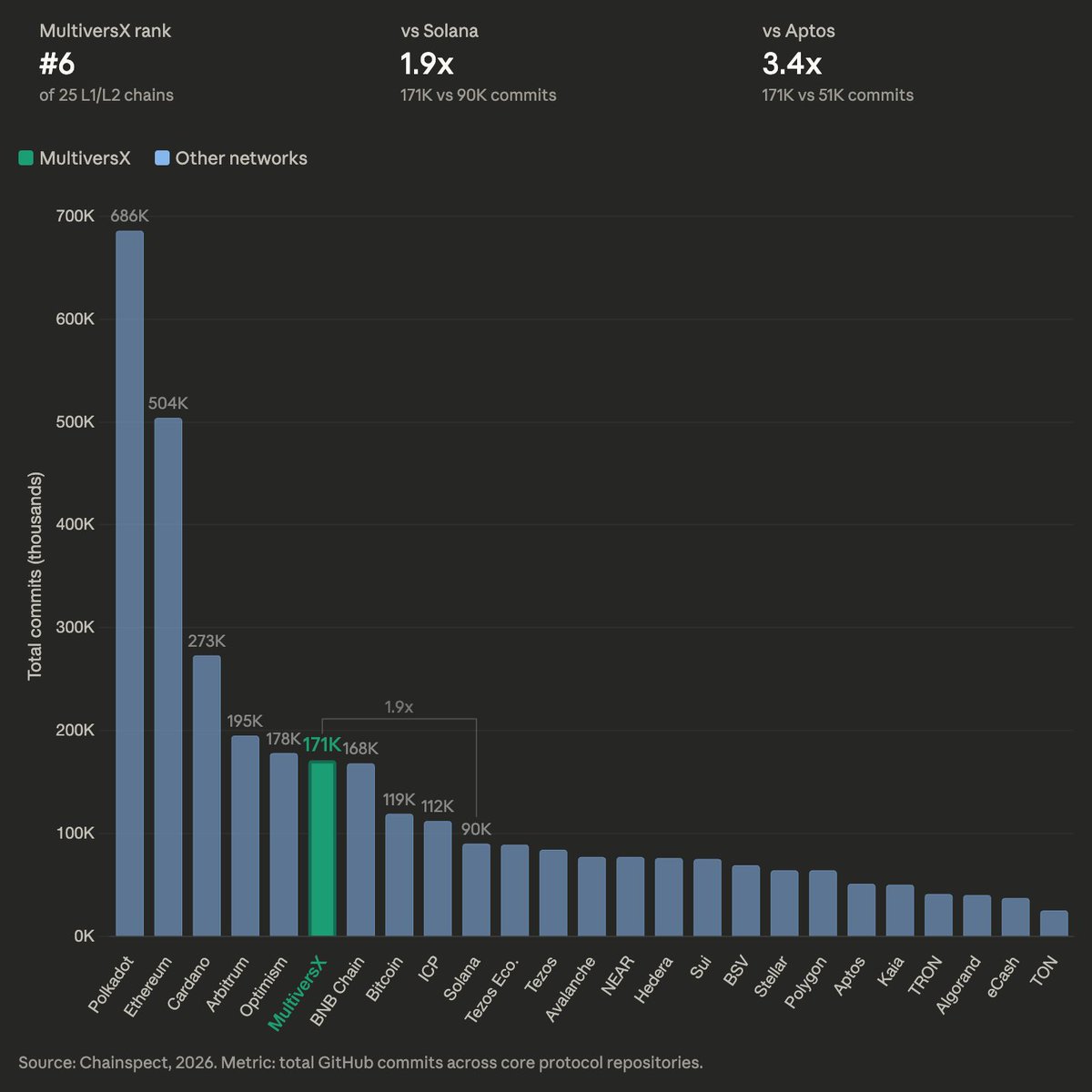
171,000 commits. #6 in the entire industry. Ahead of Solana, Avalanche, Sui, Polygon, Aptos, and TON.
Tier-one infrastructure providers on board, distribution partners like Cointelegraph are running validator nodes. Stripe's Machine Payments Protocol is settling on MultiversX. EGLD is named in an Arizona state strategic reserve bill. The agentic commerce stack - x402, MPP, MX-8004, UCP, ACP, MCP - is live on one chain. xMoney is building regulated stablecoin issuance under MiCA.
The infrastructure underneath has never been stronger.
───
And yet the market prices EGLD like none of this exists.
Every blockchain community is going through the same thing right now. EGLD is down. ETH is down. SOL is down. The market doesn't differentiate between chains that shipped paradigm-shifting infrastructure and chains that shipped a landing page.
But here's what's different about right now.
Bitcoin survived 2014. Ethereum survived 2018. Solana survived 2022. In each case, the community stayed long enough for the technology to matter. In each case, the community that held wrote the next chapter.
And in each case, the ones who fractured, who turned on their own builders, who let the loudest voices - the ones who already sold - define the narrative? Those communities don't exist anymore. You don't remember their names.
The perception of value has been distorted. By cycles. By speculation. By narratives that reward noise over engineering. And by us - divided when we should be united. Turning on each other instead of building forward together.
Look at what's underneath. Not the chart. The infrastructure.
88ms finality. 120K TPS. #6 in developer activity globally. Tier-one infrastructure partners. Stripe settling on-chain. EGLD in US state legislation. Regulated stablecoins under MiCA. An agentic commerce stack that Visa, Coinbase, and Mastercard are racing to replicate.
This is not a project searching for relevance. This is a project that shipped the relevance and is waiting for its community to match it.
If this fails, it won't be because the technology wasn't good enough. It will be because we weren't united enough to carry it forward.
I've been here since 2018. That table with Vitalik. Every pivot, every cycle, every doubt. Still here. Still building.
Now it's your turn. Not to believe. To show up.
$EGLD is the most scalable L1 ready for agentic payments. Future is agents, and they will choose the most scalable, decentralized, fast, secure, fully ready network with 600ms block time. AI agents will be smarter than humans, they care about value, not price.
"Look at what happened in the last 90 days: Visa launched agentic payment tools. Mastercard acquired BVNK for $1.8B. Coinbase is pushing x402 hard. Circle is racing for stablecoin dominance. Stripe built ACP with OpenAI, and built MPP with Tempo.
They're all building pieces of the same stack: identity, payments, settlement, stablecoins.
We built the whole thing. On one chain.
x402, MPP for autonomous agent payments. MX-8004 for on-chain agent identity. UCP, ACP, AP2, MCP for agent communication and commerce.
xMoney for regulated stablecoin issuance and fiat-to-crypto connectivity under MiCA.
Relayed v3 for gasless transactions so agents don't need to hold tokens to start. *Seven protocols. Regulated stablecoins. Fiat rails. One network. The stack that Visa, Stripe, and Coinbase are assembling from separate pieces, we shipped as a unified layer."
Who's Actually Building?
171,000 commits. #6 in the entire blockchain industry.
Ahead of Bitcoin. Ahead of Solana. Ahead of Avalanche, NEAR, Sui, Polygon, Aptos, and TON. Almost 2x Solana. Nearly 3.5x Aptos. The data is public.
I'm not writing this to flex. I'm writing it because the people doing the real work deserve to see it reflected somewhere other than a Git log.
───
Building through a market like this is brutal.
The price bleeds. Liquidity gets extracted by professionals who've never deployed a contract. Narratives rotate every two weeks. The projects that survive aren't the loudest, they're the ones that refuse to stop shipping.
We shipped Supernova while the market did everything it could to make us irrelevant. 150,000 lines of new protocol code. 20 months. A complete rearchitecture of how consensus and execution interact.
88ms block finality on 600ms slots. The block finalizes before the round ends. 120,000 TPS burst mode on the same validator hardware. 3,200+ nodes. Full sharding intact.
We didn't build this because the market asked for it. We built it because it was the right thing to build.
───
The market rewards narratives. It rewards projects that rename themselves to match whatever's trending.
It doesn't reward the team that designed inclusion proofs so blocks finalize before execution completes. It doesn't reward 171,000 commits. It barely notices.
But here's the thing, infrastructure doesn't need the market's permission to work. Over 500 million transactions processed. 3,200+ validator nodes across four continents. And now, sub-second finality on every transaction type.
───
People ask: "What's left for blockchain when AI takes over everything?"
Wrong question.
AI agents need to transact autonomously. They need identity. They need programmable money that settles in milliseconds. They need micropayments at scale without a human clicking "approve."
Credit cards can't do this. Bank wires can't do this. These rails were built for humans, not machines.
This is where the entire stack is converging. Look at what happened in the last 90 days:
Visa launched agentic payment tools. Mastercard acquired BVNK for $1.8B. Coinbase is pushing x402 hard. Circle is racing for stablecoin dominance. Stripe built ACP with OpenAI.
They're all building pieces of the same stack:
identity, payments, settlement, stablecoins.
We built the whole thing. On one chain.
x402 for autonomous agent payments. MX-8004 for on-chain agent identity. UCP, ACP, AP2, MCP for agent communication and commerce. xMoney for regulated stablecoin issuance and fiat-to-crypto connectivity under MiCA. Relayed v3 for gasless transactions so agents don't need to hold tokens to start.
Six protocols. Regulated stablecoins. Fiat rails. One network.
The stack that Visa, Stripe, and Coinbase are assembling from separate pieces, we shipped as a unified layer.
───
And the community.
Every validator who kept running through the drawdown. Every builder who deployed when nobody was watching. Every staker who stayed.
171,000 commits. Supernova. Battle of Nodes. Cointelegraph joining as a validator. EGLD named in an Arizona state strategic reserve bill.
The signals are there. The infrastructure is live. The convergence between AI, payments, and blockchain isn't five years away. It's happening now.
The teams that built through the hard part don't need to pivot when the opportunity arrives. They're already there.
We're already there.