Digging into Jesus, the Gospels, and the resurrection with skeptics in mind.
Skeptic, doubter, or curious Christian—follow for honest evidence-based threads.
@Arnold172061@AbaddonSpeaks@ProudYTBoy And no, Christianity doesn’t teach that Jesus is the Father. The Father and Son are distinct persons who share the one divine nature.
So Jesus praying to the Father isn’t “praying to Himself.” You’re criticizing modalism, not the Trinity.
@Arnold172061@AbaddonSpeaks@ProudYTBoy Divine jealousy and humility aren’t opposites. Exodus is about God demanding the worship due to Him rather than idols.
Philippians 2 describes the Son voluntarily humbling Himself by taking the form of a servant.
@Arnold172061@AbaddonSpeaks@ProudYTBoy Also, Jesus’ ministry is characterized by humility, not self-exaltation. Philippians 2:6–8 says that although He existed in the form of God, He humbled Himself and took the form of a servant. We shouldn’t expect Him to walk around “bragging” that He is God.
@Arnold172061@AbaddonSpeaks@ProudYTBoy Cryptic to us, maybe. Not to His 1st-century Jewish audience. Jesus used OT divine language and claimed divine prerogatives they understood, which is precisely why He was accused of blasphemy.
@AbaddonSpeaks@ProudYTBoy Then explain John 8:58, John 20:28, Mark 2:5–12 and Mark 14:61–64. Jesus takes the divine “I am” language, accepts Thomas calling Him “my God,” claims authority to forgive sins, and identifies Himself with Daniel 7’s heavenly Son of Man. This wasn’t invented by later philosophy.
If you’re looking for historical information and have primary sources written within 50 years of the person, why would you prioritize a source written 600 years later?
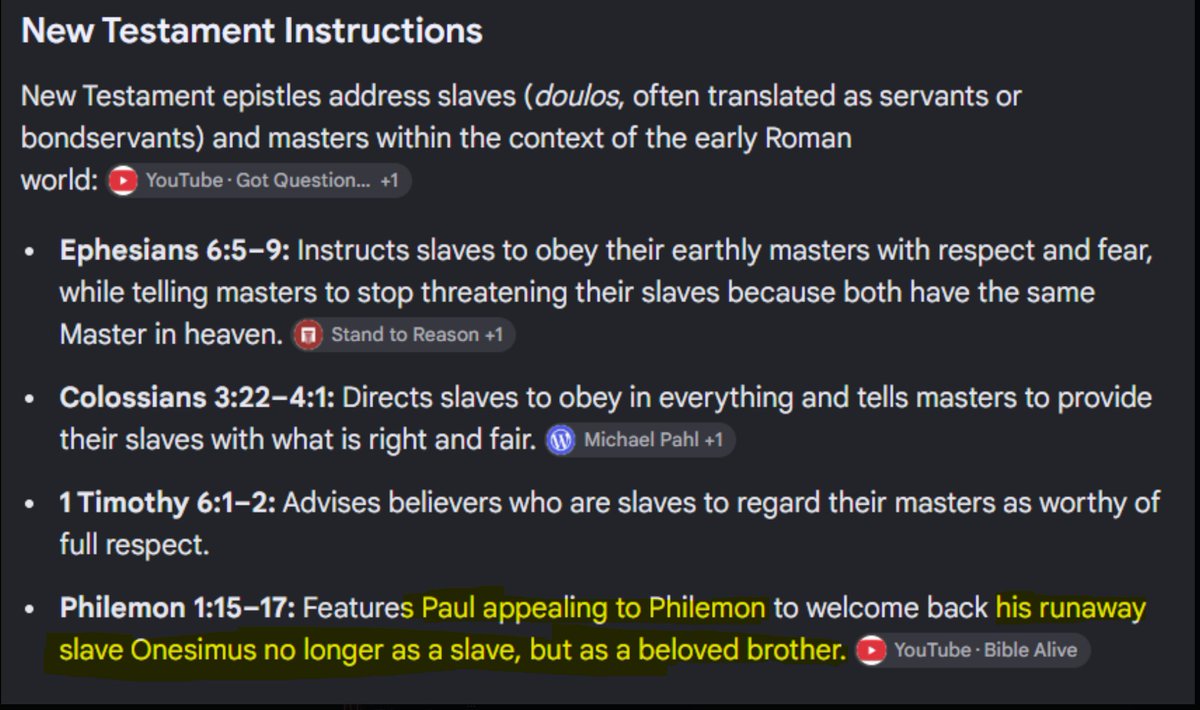
@JohnnyBlaz3_90@UnaniAnonymou@Kryptotajeer American-style race-based chattel slavery is NOT identical to ANE slavery in the OT or Roman slavery in the NT. Different legal systems, social structures, and bases for enslavement. “The Bible mentions slavery” doesn’t establish your claim.
@JohnnyBlaz3_90@UnaniAnonymou@Kryptotajeer Calling me an idiot while completely missing the qualifier is wild 😂 I said race-based hereditary chattel slavery. Yes, the Bible addresses slavery. Now show me where Christ or the apostles teach that one race may enslave another because of their race.
@abdulafandii@lizzygrantgroyp Your inability to understand the Trinity doesn’t magically turn Christianity into polytheism. That’s just an argument from personal incredulity, not an argument against the Trinity.
@HardenBetter_@DontBeBobby Numbers 31:18 doesn't command rape, and Deuteronomy 21:10–14 doesn't command forced intercourse. You're adding claims the texts don't explicitly make.
These are difficult passages, but if you're going to criticize them, at least represent what they actually say.
@HardenBetter_@TheLaziestJap You’re quoting Jesus quoting Mosaic Law as if he’s giving Christians a new command. Matthew 15:3–9 is about the Pharisees using their traditions to undermine God’s law. It isn’t an instruction for Christians to kill their children.
@JohnnyBlaz3_90@UnaniAnonymou@Kryptotajeer A practice being carried out by Christians doesn’t make it biblical. Race-based hereditary chattel slavery has no basis in the teachings of Christ or the apostles.
@sirdaab45070@Kryptotajeer Yes, and what happens next? God rebukes Miriam and Aaron, vindicates Moses, and Miriam is punished (Num. 12:4–10). The text also never says their objection was racial. Describing Miriam and Aaron criticizing Moses isn’t the Bible endorsing their behavior.
@Kryptotajeer Sahih Muslim 1050: Abu Musa says they used to recite a surah comparable in length to Surah al-Bara'ah, but that he had forgotten it, except for part of it. That material isn't in the Qur’an today.
@fimanallah@OneWayApologetc@Kryptotajeer Sahih al-Bukhari 4987: reports disagreements in Qur’anic recitation serious enough that Uthman standardized copies and ordered other Qur’anic manuscripts/materials burned.
@fimanallah@OneWayApologetc@Kryptotajeer Sahih Muslim 1050: Abu Musa says they used to recite a surah comparable in length to Surah al-Bara'ah (Surah 9), but that he had forgotten it, except for part of it. That material isn't in the Qur’an today.