🇬🇧 GBP/CHF, 🇺🇸 USD/CHF, 🇦🇺 AUD/CHF - Long
These are the pairs I will be watching next week 📈
I wrote about the narrative for GBP and AUD in my weekly. But since I didn't find any interesting currencies to pair them with, I turned to the CHF, which I don't usually trade.
❗️ First of all, it's worth noting that I will only open these positions if signs of positivity appear in the market. While risk-off sentiment dominates, shorting the CHF, which is a safe-haven currency, against the trend is a bad idea.
🇨🇭 Why CHF?
From the central bank's perspective, the story is very simple: the SNB rate sits at zero, and they have no reason to change that. It is the only major central bank that isn't changing its rate. All others are hiking.
There are no grounds for a hike either. It would be disadvantageous for Swiss exporters.
Although October headline inflation jumped to 1.5%, this is purely a story about expensive imported goods and energy. Core inflation, which the central bank actually looks at, is stuck at 0.5%, and the labor market with 3.0% unemployment shows no signs of overheating.
Add to this the fact that speculative positioning in the franc is currently at a three-year high (the market is heavily overbought), and the zero interest rate makes holding CHF longs unprofitable due to interest rate differentials.
📷 Photo @BeSomebodyFX
@Zitere6 Well, it's quite likely that the Fed will have time to see another release before the December meeting, so I don't think today's release should put a definitive end to the decision
I still lean toward the scenario where the rate will be hiked in December
🇺🇸 What came out in the economic calendars for CPI is completely disconnected from reality
Right now, the market is rushing to price in USD longs, but a reversal could happen very soon, as the growth is based solely on seasonally adjusted figures.
The actual dynamics are entirely different.
I’ve attached two screenshots comparing today's release with last month's 👇
🇬🇧 GBP/CHF, 🇺🇸 USD/CHF, 🇦🇺 AUD/CHF - Long
These are the pairs I will be watching next week 📈
I wrote about the narrative for GBP and AUD in my weekly. But since I didn't find any interesting currencies to pair them with, I turned to the CHF, which I don't usually trade.
❗️ First of all, it's worth noting that I will only open these positions if signs of positivity appear in the market. While risk-off sentiment dominates, shorting the CHF, which is a safe-haven currency, against the trend is a bad idea.
🇨🇭 Why CHF?
From the central bank's perspective, the story is very simple: the SNB rate sits at zero, and they have no reason to change that. It is the only major central bank that isn't changing its rate. All others are hiking.
There are no grounds for a hike either. It would be disadvantageous for Swiss exporters.
Although October headline inflation jumped to 1.5%, this is purely a story about expensive imported goods and energy. Core inflation, which the central bank actually looks at, is stuck at 0.5%, and the labor market with 3.0% unemployment shows no signs of overheating.
Add to this the fact that speculative positioning in the franc is currently at a three-year high (the market is heavily overbought), and the zero interest rate makes holding CHF longs unprofitable due to interest rate differentials.
📷 Photo @BeSomebodyFX
@Tradewithc81911@BeSomebodyFX Because these are two strong currencies, that's why there was a range.
The GBP was monetarily strong, while the CHF received inflows as a safe-haven asset.
Therefore, GBP/CHF is purely subject to the narrative of positive sentiment emerging in the market.
Every central bank is hiking rates except 1
The Swiss National Bank
If you know, you know
In 2022 every central bank was hiking except 1... The Bank of Japan, go watch what happened to the Yen at that time
A quick look at my key narratives for this week:
🇺🇸 USD
USD sold off nicely from Monday through Thursday against the backdrop of a stock market sell-off, which was directly triggered by the Democrats' victory. Short-term U.S. rates have dropped by nearly 50 bps since late September, and the USD yield advantage over other major pairs has narrowed somewhat.
BUT, what's important to understand is that this is not a flight from the buck. As ING notes, we are seeing a rotation into cash rather than an exit from USD. This is supported by a return to more traditional correlations, where U.S. Treasuries are once again performing their role as a safe haven. In other words, this is unlikely to develop into a full-blown, powerful trend. It's more of a reaction to risk-off. And as soon as equities start recovering, the USD could regain support, which will be fully backed by monetary factors, such as rising inflation, a strong labor market, and a likely rate hike as early as December.
The labor market report released on Friday is also bullish for the buck, at least until the next CPI release. It is worth noting that this growth is entirely genuine (i.e., not some rounding in the calculations), all secondary labor market reports also hinted at growth, along with the September NFP revision, which forces the market to reprice previous narratives of a weak labor market that, in fact, never existed.
🇪🇺 EUR
My short outlook on the EUR is becoming less confident, as both the CPI and PPI show acceleration while PMIs are weakening, though remaining above 50. It is also worth acknowledging that Core CPI, which will be a primary focus for the ECB in particular, remains anchored at 2.5%.
The correlation between the EUR and oil remains strong, putting downward pressure on the EUR while Brent trades below $100.
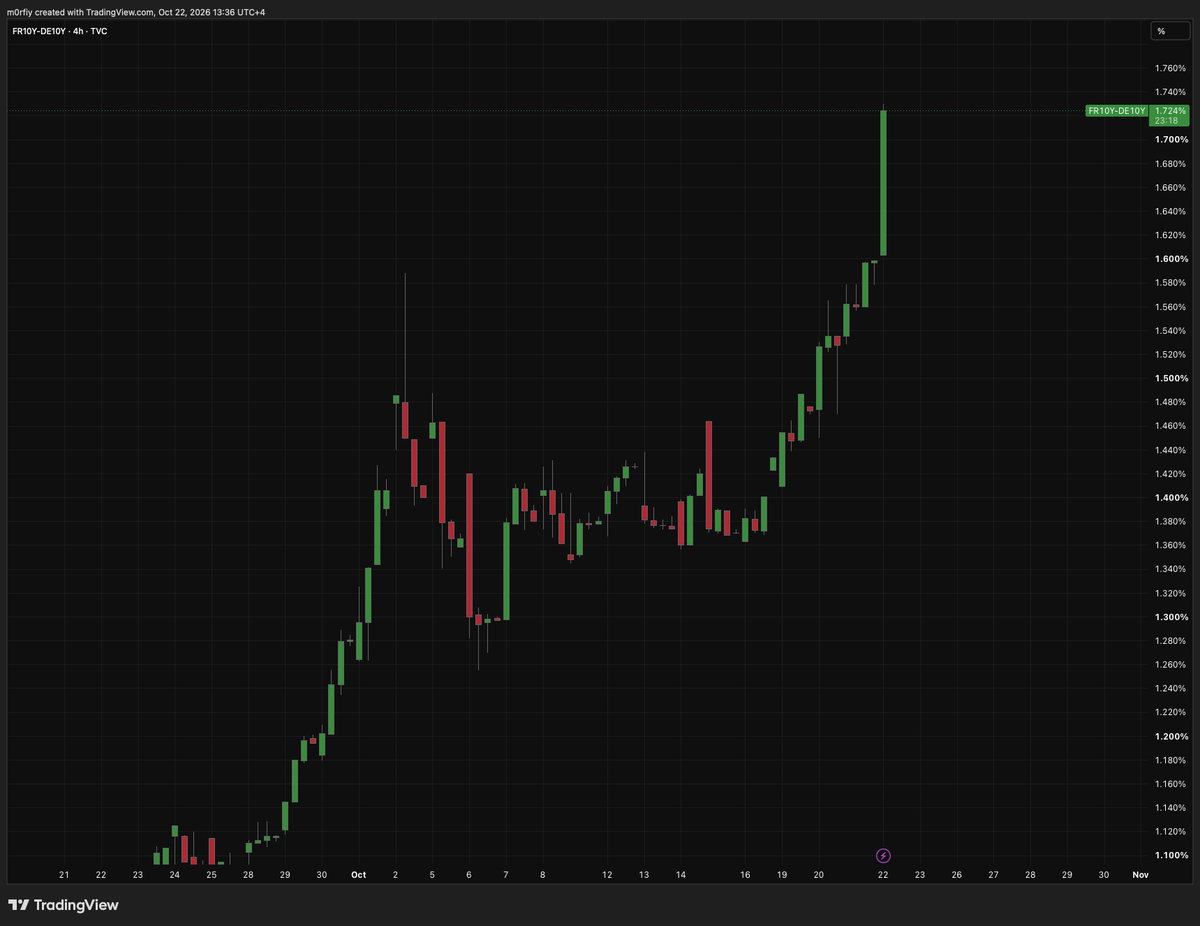
The OAT-Bund spread, which was previously a major driver for EUR shorts, has dropped to 1.5% from a peak of 1.7%. And while this is still a very high spread, as a factor in itself, it appears to be taking a back seat.
🇬🇧 GBP
The GBP delivered a very hawkish meeting: the first rate hike in 3 years with a 9/0 vote. In other words, all central bank members voted in favor of the hike, forecasting a new wave of inflation ahead.
In my view, this solidly underpins the previous rally in the GBP and will act as a factor to remain bullish on the currency in the near term.
However, this is definitely not a sign of the beginning of a new tightening cycle. It is worth keeping in mind that some of those who voted for the hike immediately commented that this was purely a precautionary measure and future hikes are not guaranteed. That is why my short-term expectation is hold or bullish, while the dynamics closer to December will depend on upcoming CPI figures and oil price movements.
🇨🇦 CAD
I remain bullish on the CAD and will be ready to enter longs once the FUD regarding the stock market correction leaves the market and the decline in oil prices stops. Overall, from a monetary standpoint, the CAD is a long for me: the Bank of Canada is raising rates with hawkish forecasts, and the trade balance is growing, which also points to economic development potential.
Central Bank Governor Macklem reiterated that inflation has proven too sticky and another hike may be needed.
🇦🇺 AUD
NZD and AUD sold off nicely this week against the backdrop of risk-off sentiment and falling oil prices. However, I plan to look for a counter-trend setup at the first signs of positive market sentiment, and playing the long side in AUD is the better fit here.
New Zealand released a weak labor market report, whereas Australia boasts a high trade balance and a PMI higher than expected (though it is worth noting that it dropped below 50). We should also mention the RBA's rate hike, which turned out somewhat dovish. We'll see if the market is ready to keep longing the currency. If so, and if this is backed by a return to risk-on in the broader market along with strong inflation and trade balance data from China, I will be ready to go long on AUD.
🇪🇺 Regarding the EUR, there are two points worth mentioning:
- New ECB President
Klaas Knot made several statements yesterday after the Netherlands officially backed his candidacy for the ECB presidency. He took a distinctly hawkish stance, stating that secondary inflation effects are likely to intensify and that the ECB will have to respond with higher rates to minor shocks pushing inflation upward.
- Fresh Inflation Data
Meanwhile, Eurozone inflation in October accelerated from 3.8% to 4.0%, as expected. This brings the ECB closer to a December rate hike, even though core inflation remained anchored at 2.5%.
🇬🇧 The BoE hiked rates by 25 bps for the first time in three years. All factors at this meeting were hawkish.
- All 9 central bank members voted for a hike, and no one proposed leaving the rate unchanged.
- The Bank of England warns that UK inflation could rise to 6.2% if the conflict in the Middle East escalates.
This reinforces our view that the Bank of England will raise rates again by February, potentially as early as December.
In the short term, this is solid confirmation of the previous aggressive GBP pricing that we managed to trade successfully over the last two months.
There are still prospects for further growth, but the bar for it will now be high. Future growth will depend on incoming data and oil prices.
A quick look at my key narratives for this week:
🇺🇸 USD
The news flow for the USD has not yet provided me with a clear trend direction, but I am currently leaning toward the downside. This takes into account Warsh's remarks following the rate decision, where he stated that while inflation remains high, market conditions have tightened since the last meeting in September and significantly more than the Fed likely anticipated. Right now, we are seeing the market price in a higher probability of a rate pause in December.
The higher-than-expected m/m PCE reading was primarily driven by a surge in the energy component, whereas the annualized Q3 PCE Price Index came in at a record-low 2.1%.
Additionally, USD is facing pressure from a correction in the AI sector, which is prompting investors to flee to safe-haven assets.
Another key factor to watch is next week's midterm elections. ING notes that the primary risk for USD right now is the preemptive unwinding of net long positions ahead of the vote. A clean sweep by the Democrats is currently priced at roughly 68% in prediction markets, which could be perceived as somewhat negative for the dollar from several angles: ranging from a higher risk of a government shutdown and political gridlock in debt ceiling negotiations, to potential damage to the already fragile sentiment surrounding AI.
🇪🇺 EUR
Based on a bearish bias for the USD, the EUR could receive a boost in major pairs. However, in cross pairs, I would view it as neutral or weak.
The ECB left rates unchanged, and Lagarde's speech did not provide me with any clear insight into the central bank's stance. Overall, the bond market has effectively done the ECB's job for it, driven largely by France. That said, as previously anticipated, a rate hike in December remains a possibility.
Recent data shows stronger-than-expected GDP alongside a weak labor market.
As for France, despite the elevated spread persisting, we are no longer seeing the same downward pressure on the currency as before. At the same time, this is preventing EUR from rallying against the broader market, which is also worth keeping in mind.
Until the situation in France is resolved and oil prices start to decline, I am not ready to go long on the EUR in cross pairs.
🇬🇧 GBP
I am still bullish on GBP. Next week brings the rate decision, where a hike is priced in at nearly 100%, which makes sense given the lack of previous hikes and the latest labor market and inflation readings. We’ll need to watch Bailey’s rhetoric and ensure we don't see a speculative reversal on GBP if the market turns out to have been overly aggressive on the hike expectations.
Overall, however, I am ready to continue going long on the pound.
This week brought the Autumn Budget, which reaffirmed the narrative of fiscal discipline, turning into a supportive factor for GBP.
Why the market reacted positively to this budget:
• Deficit control and disinflationary effect: The 2027 deficit forecast was lowered to 3.4% (down from 4.2% this year). The UK looks like the only G7 economy consistently shrinking its deficit.
• Gilt issuance volume came in below consensus.
• Synchronization with the Bank of England (BoE): The Chancellor did not add fuel to the inflation fire. The BoE remains on track to raise rates, but now without the risk of panic in the debt market.
🇨🇦 CAD
The BoC raised rates this week as expected, even though recent inflation figures came in softer. The hike was built precisely on the forecast that prices would trend higher and that producers would begin passing cost increases on to consumers.
Overall, the door remains open for another rate hike, especially conditional on rising oil prices and a resurgence in inflation.
Provided there is no correction in oil, I am ready to go long on CAD.
🇳🇿 NZD
The RBNZ surprised the market and left the rate unchanged in a 4-to-3 vote. This came as Q3 inflation turned out lower than expected and medium-term inflation expectations remained well-anchored.
The rhetoric itself was also dovish, opening up the possibility for a continuation of the NZD downtrend, although a December hike remains on the table.
Focus:
EURGBP - Short
EURCAD - Short
GBPNZD - Long
🇪🇺 The ECB kept interest rates unchanged, which was largely expected. However, a rate hike in December is looking increasingly likely.
Headline inflation rose again in September, and most leading indicators point to continued resilience in the euro area economy. However, the surge in bond yields amid the French crisis is already creating a new restrictive stance for monetary policy.
Or, in other words, the bond market has taken over the ECB's job.
Until the situation in France is resolved and oil prices start to fall, I won't be ready to go long on EUR.
Quick fresh update on commodity currencies for today:
🇳🇿 NZD
The RBNZ did not cut rates (with 4 votes for a hold versus 3 for a hike), even though the market had priced in almost a guaranteed rate hike. Moreover, the rhetoric itself turned out to be dovish as well, creating potential for the NZD downtrend to continue, although a December hike remains on the table.
The "doves'" argument today was that Q3 inflation came in lower than expected, while medium-term inflation expectations remain well-anchored. Most importantly, they are paying closer attention to downside risks to economic growth, particularly regarding household consumption and investment.
🇦🇺 AUD
Today saw the release of CPI figures, where the Trimmed Mean, the central bank's primary focus, came in 10 bps above expectations. Headline figures also exceeded expectations.
The market had already been anticipating a rate hike prior to this. This pricing is now gaining even more momentum. For now, the sentiment for the AUD remains long.
🇨🇦 CAD
As expected, the BoC hiked rates by 25 bps, even despite the latest inflation release showing softness. This is because central bank economists are placing greater emphasis on forecasts of strong future inflation, which is why they are taking this preemptive step.
Overall, the door to the next hike remains wide open, especially conditional on rising oil prices and a recovery in price growth. The Governor of the Bank of Canada himself stated that there is a strong consensus regarding rising inflation risks, and businesses are planning to pass higher costs on to consumers.
A quick look at my key narratives for this week:
There are too many central bank meetings next week, which makes it difficult to establish any clear narratives. Any new ideas will only emerge once the meetings take place.
🇺🇸 USD
USD is range-bound heading into the week of the upcoming FOMC meeting. Any clear narratives will likely have to wait until the decision is out. Here is the backdrop we are entering the meeting with, which will serve as our starting point: the greenback is softening amid a tech correction and capital rotation into bonds, pulling 10-year yields below 5%, with markets notably pricing in a 90% probability of a pause. Additionally, the elevated September CPI and softening labor market should be kept in mind. A hold in October followed by a hike in December remains the base case for now. With no SEP release this time around, all takeaways will hinge entirely on Warsh’s rhetoric.
🇪🇺 EUR
The OAT-Bund spread is widening toward 170 bps, which has been my primary focus throughout October. This is precisely why I have been holding EUR shorts via cross pairs, particularly against GBP. While the impact of this driver has softened somewhat, a further widening of the spread should renew downward pressure on the EUR. Among recent data points, the drop in ZEW Economic Sentiment and softer flash PMIs warrant attention, while secondary, they provide a clear tailwind for EUR shorts. With the ECB meeting next week, it will be interesting to track not only the eurozone economic outlook, but also Lagarde’s rhetoric regarding France.
🇬🇧 GBP
I maintain a bullish stance on GBP, as the BoE appears to be the most hawkish among major central banks. That said, I would not rush to view this as the start of a sustained tightening cycle, but rather as an adjustment aimed at managing localized risks. Provided oil does not continue its sharp rally, the BoE could resume rate cuts toward the end of next year. Among recent releases, key focus should be on the tight labor market, where the unemployment rate ticked down by 20 bps for the first time in a while, accelerating CPI (which, despite being largely driven by airfares, remains elevated even on an ex-airfare basis), and an uptick in flash PMIs, all of which lend strong support to a bullish GBP thesis. The primary headwind is subdued consumer activity, with Retail Sales sliding to 0.8% from 2.7%, suggesting that second-round effects from higher oil prices may face friction in passing through to households. Nonetheless, BoE economists note that clear signs of second-round effects have yet to materialize.
🇨🇦 CAD
The market is currently pricing in roughly a 75% probability of a rate hike at the October 28 meeting, even in the wake of September’s soft CPI print. This is largely driven by the Bank of Canada’s own quarterly business and consumer outlook surveys, which completely offset the disinflationary signal. They revealed that long-term household inflation expectations are picking up once again, while firms intend to pass their rising costs, spurred by elevated gasoline prices and disrupted trade negotiations, directly onto consumers. As a result, we are caught between expectations of economic resilience on one side and hard data indicating the opposite on the other. For now, I remain on the sidelines regarding CAD. Adding to the mix, recent headlines suggest Trump is planning to significantly ease tariffs on Canada. While structurally bullish for CAD, it remains to be seen whether the market will buy into this or dismiss it as just another head fake ahead of the midterms.
🇳🇿 NZD
Despite the RBNZ’s dovish tilt in September and the deceleration in quarterly CPI from 4.1% to 3.7%, ING forecasts another rate hike as soon as next week, driven by the following factors:
• Higher energy prices. The RBNZ’s September projections assumed a gradual decline in oil prices. Instead, they have rallied roughly 20% since the September meeting. This materially increases the probability of Q4 inflation printing above 4.0% (versus the RBNZ's 3.9% forecast) and proving more persistent moving forward.
• A weaker Kiwi dollar. The trade-weighted value of the NZD tumbled 4% in September, hitting its lowest level since 2009 (chart below). The RBNZ itself was a key catalyst for this softness, and while the central bank typically looks through FX volatility, this depreciation exacerbates the risk of imported inflation.
• Resilient economic growth. Q2 GDP surprised to the upside at 2.6% YoY versus the RBNZ’s 2.1% projection.
Hawkish repricing abroad. US 2-year swap rates are up roughly 35 bps since early September, with NZD 2-year swaps closely tracking the move with a 33 bps rise.
Focus:
EURGBP - Short
Woah, the OAT-Bund spread is already at 170 bps
I think the only thing holding up the euro right now is the drop in the buck and US equities, especially tech.
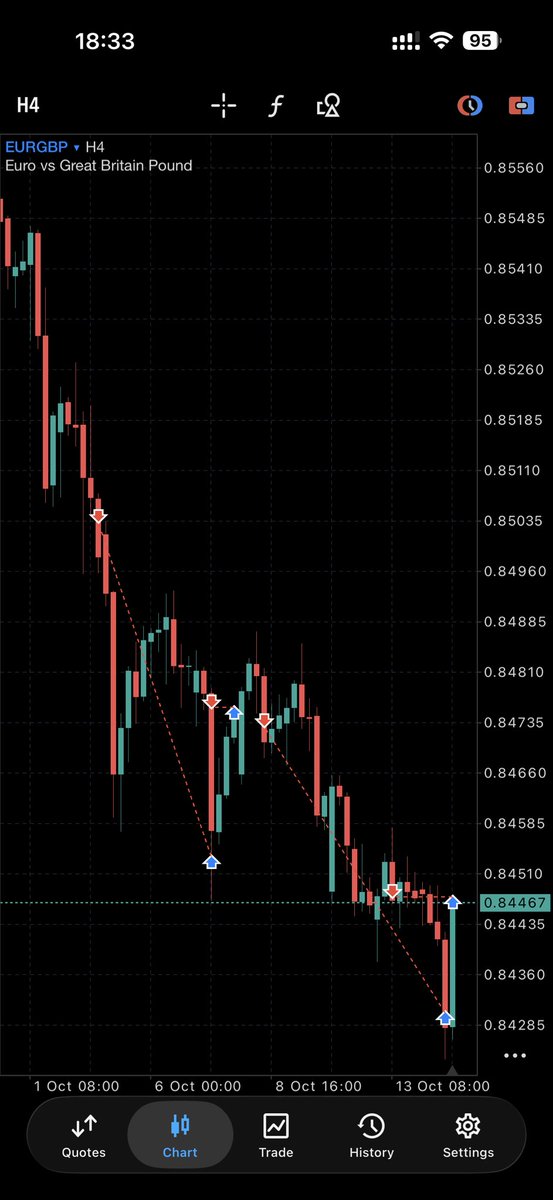
Given the recent UK labor market and CPI releases, I'm actively continuing to short EUR/GBP
Well EUR/USD would get nuked to the downside if this happens, OATs into double digits and CAC40 would also go lower.
France well on track to become next Greece.
🇬🇧 The UK labour market is finally plateauing
📉 Keeping short EUR/GBP in focus
Private sector employment rose in September for the first time since January, albeit by a modest 8k. Officially, this also reflects a drop in the unemployment rate from 4.9% to 4.7%.
A rate hike is becoming increasingly likely, though I don't expect it to signal the full onset of a monetary tightening cycle.
A quick look at my key narratives for this week:
🇺🇸 USD
The upside turn in CPI and PPI has priced in a new wave of higher rates. While I believe there is a chance risk appetite could return to the market, I expect the dollar to remain strong over the coming week. Retail Sales data supports this, showing robust consumer activity. Since there are no major events scheduled for the USD next week, I would look to pair it against weaker currencies. It’s also worth noting that the stock market sell-off drove investors back into bonds, sending yields sharply down to 5.1%, which could exert some downward pressure on the dollar.
🇪🇺 EUR
I maintain my bearish stance on the EUR as the OAT-Bund spread holds at 130 bps. Lagarde stated that France's fiscal situation wouldn't affect ECB actions, so this narrative requires close monitoring.
🇬🇧 GBP
GBP remains bullish for me. While I was previously only comfortable going long on GBP against weaker currencies, I am now ready to long it against neutral currencies as well. Confidence was spurred by fresh data showing GDP is still growing strongly, along with upward revisions to previous readings and a narrowing trade deficit. Part of this strength is already priced in, so caution is needed with aggressive longs, but it is undeniably a positive factor. Overall, all eyes will be on the UK next week due to the upcoming CPI and Unemployment Rate releases, with inflation naturally being the main focus
🇨🇦 CAD
I maintain a bearish stance on CAD, but I am only looking to take short positions against strong currencies, such as GBP.
🇦🇺 AUD
I'm ready to short AUD again after a brief retracement, as the currency has already dropped significantly. I missed picking up shorts last week, but I’m looking to consider them starting next week. The meeting minutes brought no dovish or hawkish surprises, but the global risk-off tone following the US CPI became a new catalyst for moves into risk-sensitive currencies, while a weak labor market served as a tailwind. If equities continue to show weakness, I'll be expecting AUD shorts.
Focus:
EURUSD - Short
USDCAD - Long
AUDUSD - Short
EURGBP - Short (top priority pair)
GBPCAD - Long
AUDGBP - Short
Still focusing on EUR/GBP shorts. Staying out of other pairs to avoid over-exposing to the EUR or GBP narrative.
OAT-Bund spread remains at 140 bps.
Looks like Lagarde stated today that France's fiscal troubles won't affect ECB actions whatsoever.
So if you're shorting EUR, definitely track this rhetoric closely.
🇦🇺 RBA Meeting Minutes:
- There are grounds for prompt rate action to keep inflation expectations anchored.
- Rate hikes abroad could ease domestic financial conditions through a depreciation of the Australian dollar.
- Some upside inflation risks have already materialized or emerged since August.
Overall, the minutes offered nothing new beyond what we heard during Bullock's speech. The minutes themselves are hawkish, and it would be logical to consider a short on EUR/AUD.
However, I don't feel like stepping into such positions just yet, considering we lack a clear risk-on market sentiment and the pair itself is already quite oversold. This forces me to wait for a pullback, if we even get one.