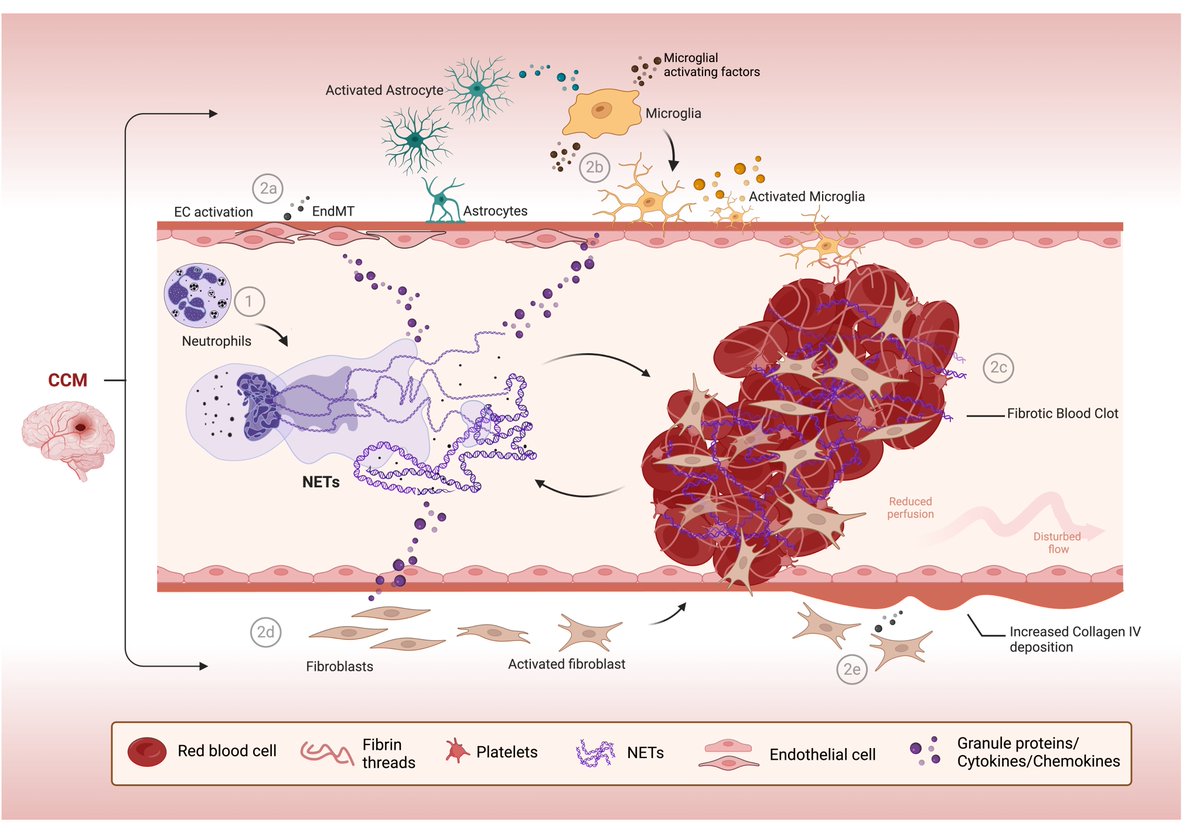
I'm pleased to announce that our #NCVR publication has now been released. @MagnussonLab we present the roles of #NETs in the progression of cerebral cavernous malformations (CCM)
Read at: https://t.co/L7187l1mKE
#NETosis#CureCCM#TreatCCM#rarediseases
Thanks to patient organizations like @AllianceToCure, more interactions between patients and researchers is now possible.
#fundsciece, support science, support rare disease research like #ccm
7/7
#scicommUU23#rarediseases
Access to patients' biopsies is limited. thus, we use #micemodels and #invitro cell cultures to understand how the #CCM disease occurs.
Check out our recent review to see how far we've come in understanding #CCM
https://t.co/JSYOhvrPE6
6/7
#scicommUU23#rarediseases
The road to finding a cure isn't easy because of the #heterogeneity seen in this disease.
#CCM occurs from different mutations in 3 main genes: CCM1/KRIT1, CCM2, CCM3/PDCD10
Although these mutations result in the same disease, symptoms differ
5/7
#scicommUU23#rarediseases
The only way to treat #CCM is via neurosurgery.
but lesions can occur in sensitive places like the brain stem and then, surgery might not be an option.
Scientists around the world are actively trying to find a cure for this disease
4/7
#scicommUU23#rarediseases
40% of people with #CCM will never develop symptoms, but for the rest (including kids), they'll live their lives with symptoms such as #stroke and #hemorrhages.
In many ways, having CCM is like having a ticking bomb in your brain
3/7
#scicommUU23#rarediseases