Kemi Badenoch wants to exempt the family home from inheritance tax.
But that creates a perverse incentive for elderly people to *upsize* to save IHT.
That could double the cost of the policy, and push £100bn+ from savings into housing.
A 🧵 on bad tax cuts.
The 2024 Budget raised the rate of capital gains tax. CGT receipts from that tax year *doubled*.
Looks like a triumph - but actually it was a failure.
And it means CGT reform is dead. A prudent Chancellor won't touch CGT.
A 🧵 on the CGT paradox:
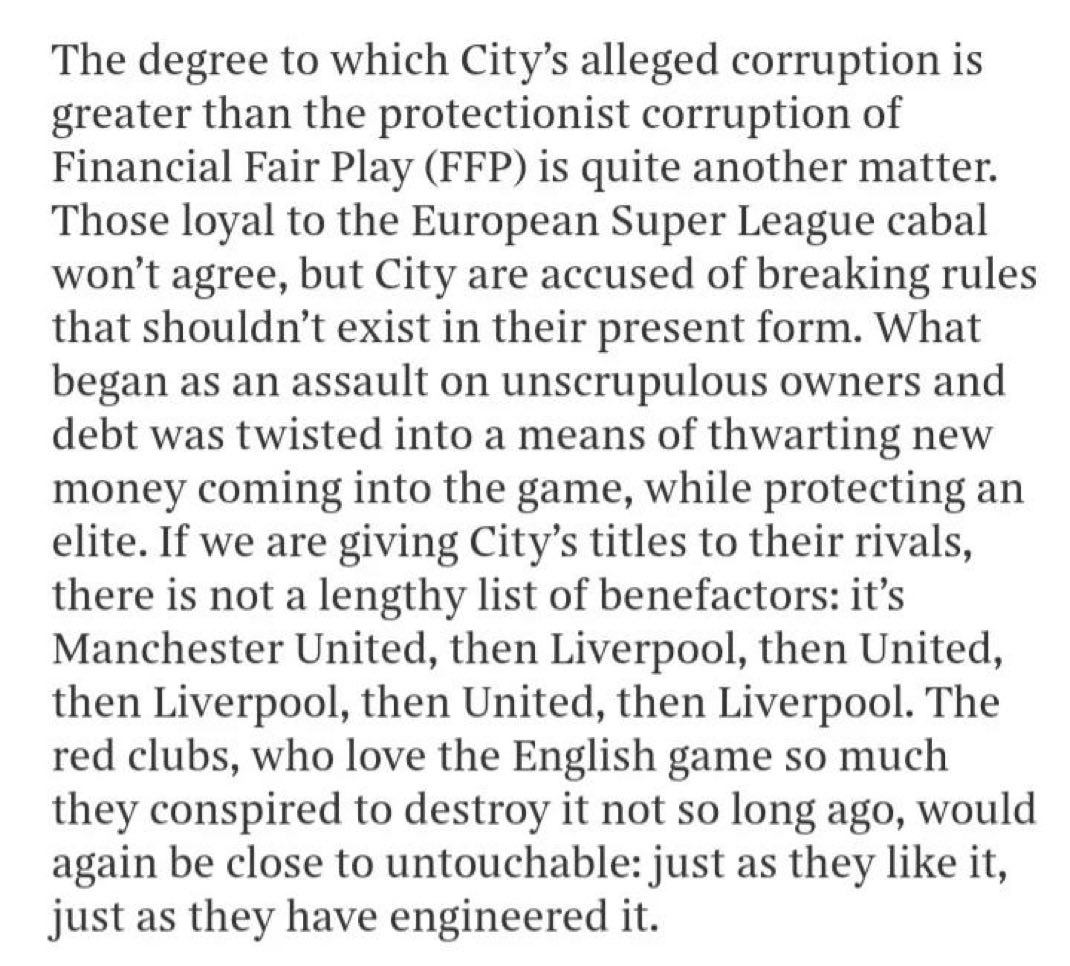
I don’t know much about Martin Samuels — but this is the worst drivel I’ve ever read.
1. FFP was created and implemented by UEFA. Mainly driven by Germany, France, Belgium and other continental Europe, and on the club side, Bayern and Real.
It takes 5 minutes of fact checking by anyone to find out that Arsenal, Liverpool and United had nothing to do with implementing the FFP rules in football. It is not in touch with reality in any way, shape or form.
It’s just dishonest or delusional — I don’t know what is worse — to claim anything else. To see it come from reporters at big newspapers is just remarkable.
What is most absurd is that reality is the complete opposite. The owners of Arsenal, Liverpool and United would tomorrow jump on a proposal to implement a strict salary cap in the PL where all clubs could spend exactly the same. Nobody even talk about this because it doesn’t suit their agenda.
2. Samuel also drives the thesis that City should not get punished because Man City, Man Utd, Arsenal, Chelsea, Liverpool and Tottenham agreed to join the Super League. A project that was stopped by fans of Liverpool and United taking things into their own hands.
The Super League was a betrayal of the very soul of football.
But the least of the concerns with a Super League was that it breached rules. Any club can leave the Premier League whenever it wants. When you say goodbye to the Premier League — you say goodbye to football the way every fan on the planet wants to see it played. But there is no law that you have to compete in it.
3. Facts are that Martin Samuels and his pals — that “care so much about English football” — were more than happy to look the other way when Malcom Glazers set up a ridiculous scheme to plunder England’s greatest football club. Why? Because everyone realized that it in the long run would cripple United’s ability to compete on the pitch.
4. An indisputable fact is that the Premier League supposedly run by this “Red Cartel” — always — have had the most fair distribution of wealth of all top leagues in Europe. And it is not even close.
67% of the PL’s revenue is divided equally between all PL clubs. If the highest income in a league is divided with the lowest, you get an income quota. The lower number, the more equal the wealth is divided. In the PL it is 1.6. In Serie A it’s 2.9. In Ligue 1 it’s 3.3. In Bundesliga it’s 3.8. In La Liga it’s 3.8 (and for a long time, up until 2015, it was 12-15).
@EdConwaySky It feels like gross negligence that we’ve pursued a policy of isolation whilst simultaneously closing down critical infrastructure which deepens our reliance on other nations. How could our governing class ever let this happen. A dereliction of leadership
Wales has had another troubling set of school results.
My analysis finds England’s most disadvantaged quarter scored higher in reading than the Welsh average.
The gap extends across social backgrounds. Here’s why that matters...and the questions facing ministers.
Teenagers in Wales work just as hard if not harder in schools than they've ever done. But the latest data suggests the system is not setting them up to succeed.
For 20 years, the level 15-year-olds reach in Wales has fallen backs when benchmarked against the rest of the world
Coventry and Ipswich have spent more than #MUFC. PL, CL and x 2 domestic cup competitions on the way. United need a minimum of two new players. LB and a CM. ASAP. Could cost Carrick and the club CL qualification.
Part of the reason we made this long film about the North Sea is that this topic is going to be in the news a LOT in the coming months.
And the approval decision on Jackdaw/Rosebank is coming soon (Rosebank consultation closes today).
But partly it's about something else...
A glorious day for opponents of transparency in public life.
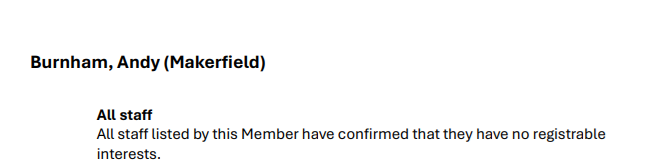
MPs have removed the names of their parliamentary staff from a decades-old public register - meaning we do not know who these people are and are left to accept the word of their employer when they say (as in the case of the prime minister, here) that said staff do not have any outside earnings or private interests.
"All staff have confirmed they have no registrable interests": oh, well that's that then.
No way of determining if true; no way of finding out if MPs employing family members; no way for anyone other than MPs themselves to uphold standards or examine who is operating in the Palace of Westminster on their behalf.
The decision was driven by ... you guessed it ... MPs themselves, following behind-closed-door consultations with staff trade union representatives - not media or anti-corruption organisations.
Echoes of the time that decided among themselves - with nil meaningful debate - to exempt themselves from the centuries-old system by which those arrested would be named before the Commons.
Parliament being sovereign it is always free to take such steps without consultation or engagement with the public - the hope is they decide not to abuse their positions and proactively seek criticism or counter-views.
In this instance, sadly, MPs have demonstrated they cannot be trusted to do so - they have put us out of step with comparable democracies without anything approaching scrutiny:
I will instruct our intelligence to share with our partners the information we have regarding Russia’s new assistance to the Iranian regime. Since the beginning of July, we have recorded active Russian satellite surveillance of the Gulf states and U.S. military facilities located there. These images subsequently appear in Iran. At the same time, there is a clear correlation between Russia’s satellite imagery of these sites and Iranian strikes – both before the attacks, in preparation for them, and afterward, to assess the damage inflicted.
On July 19 and 20 alone, four air bases fell within the area of interest of Russian satellites – two in Bahrain, one in Jordan, and one in Kuwait. The purpose is clear. None of us in the world should turn a blind eye to one very simple fact: evil always seeks ways to make things worse and spread further. Russia must be stopped. This war must be stopped. Pressure on the aggressor must work.
From the evening address. (3/3)
Reliably informed that the decision to scrap DSIT originated in the Cabinet Office, where Antonia Romeo wants to have control over AI - although of course it was signed off by Team Burnham, who don't see AI as a major priority
Apparently this goes right back to Starmer's decision to move GDS away from the Cabinet Office and into DSIT
Not just the politicians who play politics
@AJ_Journo Time to start holding the coaches to account. They rightfully got a free pass at the start but the attack is woeful, the dogmatic persistence with a olaymaking 12 when the evidence shows it’s not working, our best centre out of position at 13. A underpowered Mann the first choice
@AsaFoodAndWine It’s dogmatic. Sherratt had over a year to learn at this level - considering his short stint as HC. Yet reverts back to the non-functioning Thomas/ Llew, which got out worked & out performed vs Japan. Time for EJ at 12. Mann gutsy but less physical than Botham. Strange selection.
@AJ_Journo I’m shocked at this selection. Feels like they’ve learnt very little in the last 12.months. Thomas & Llewellyn don’t work, Hawkins has been better at 12 but not sure the dual playmaker works at all. Botham always adds physicality but Mann in against the world most physical team.
@cgroderick Thomas & Llewellyn just hasn’t worked, why he thinks it work against the world champions is beyond me. Hawkins & James has been better but also not working. Eddie James has start at 12, he’s our best centre. Sherratt is not up learning quick enough.
@AJ_Journo Only difference I’d have from your XV is Grady at 13. Never seen Llewellyn impose himself on a game, his work rate is never particularly high.
It always astonishes me how there is virtually ZERO public debate - or even public awareness - in Europe about the decisions that will most shape ordinary people's lives.
These days, the EU is drafting a new anti-China legal framework where - quite literally - the more affordable and competitive Chinese products are, the more illegal they'd become.
You'd think EU citizens would want to be informed about such things - as it couldn't be more consequential for their prosperity.
Yet I bet virtually no EU citizen is even aware of it, beyond a vague sense that there is some sort of trade dispute going on.
So what's going on exactly? It all centers around a new legal instrument the EU is drafting called the "overcapacity instrument" (https://t.co/mNpCMudYyS).
First of all, the very notion of "overcapacity" is pretty ridiculous to begin with, especially the way it's being defined by the EU, as it basically means being competitive enough to export.
By this definition of "overcapacity," pretty much every European industry that's ever run a trade surplus - German cars, French wine, Italian fashion - has been guilty of "overcapacity."
I'm not even exaggerating: if you read this study by the EU Parliament on "Industrial overcapacities, with a focus on China" (https://t.co/TcwEBoL8mD), they define "overcapacity" as building more capacity than your domestic market can absorb. So the moment you build capacity to export abroad, you're in "overcapacity."
Utterly ridiculous.
And what this "overcapacity instrument" is about is creating a permanent legal mechanism for the EU to block Chinese competition across whole sectors of the economy, if they happen to be in "overcapacity."
In effect, this means that if China is competitive globally in a given sector in such a way that it exports a lot, that's proof of overcapacity, and legally it'd mean that the entire sector can be restricted from the EU market.
Which means it really, factually, is a legal framework where the more affordable and competitive your products are, the more illegal they become.
Which is a CRAZY economic concept! 🤦♂️
Please note that it's different from the anti-subsidy legal instrument, which the EU has already put in place in 2023 (the "Foreign Subsidies Regulation": https://t.co/SvPKFyN0zo).
This "overcapacity instrument" would be above and beyond this: it wouldn't even matter if a particular sector was subsidized by the Chinese government or not, the mere fact of its competitiveness in exports would be grounds for restrictions in the EU.
It doesn't take a genius to understand how badly this could impact everyday people: this is European consumers being forced to pay more for worse products by law, so that uncompetitive European firms don't have to improve.
Politicians frame it as avoiding a "China shock 2.0" but really this is choosing an even steeper self-inflicted decline than is already the case, where EU citizens would subsidize mediocre EU companies that would have even less pressure to catch up. It's a hidden tax: subsidies for uncompetitive firms paid by consumers instead of governments, which in turn makes them less incentivized to become competitive.
The first "China shock" did de-industrialize Europe somewhat, but at least it made things cheaper for European consumers. If this becomes Europe's response to a second "China shock" not only it'd make everything more expensive but it'd do nothing for EU industry: you don't become competitive by banning the competition...
Look at China itself: the way it industrialized was NOT by banning Western firms but on the contrary by welcoming them strategically and learning from them. You learn to compete by... competing, duh!
What I find most shocking in all of this isn't even the policy itself - you can make arguments for and against protectionism, and reasonable people can disagree.
What's shocking is that virtually no European media outlet is explaining any of this to the public. This is unarguably one of the single most consequential economic decisions the EU will make this decade, affecting the price of everything, and it's being drafted in near-total silence.
No newspaper is running the headline "EU plans to make Chinese goods illegal if they're too affordable" - even though that's essentially what's happening.
But that's what you call a "democracy" with "freedom of expression" these days apparently...