Delighted to co-lead today’s @reformthintank roundtable discussion on how smart use #healthcare+#wearable data & #AI can transform public health & care @ai4healthcentre @FaisalLab https://t.co/qqCynFLpSc
DISCLAIMER: We have prior to publication patented the pipeline, the movement fingerprint features, the sensor placements & the biomarker discovery process of the AI, https://t.co/ayCuQj9KCZ
THANKS: This would have not been possible as a team effort, with fantastic PostDoc, PhDs, and close collaborators in neurology, paediatrics, physiotherapy, genetics. Not fundable without our funders (BRCs, DRF, UKRI, MRC, EPSRC) and last but not least our wonderful patients!
THANKS: This would have not been possible as a team effort, with fantastic PostDoc, PhDs, and close collaborators in neurology, paediatrics, physiotherapy, genetics. Not fundable without our funders (BRCs, DRF, UKRI, MRC, EPSRC) and last but not least our wonderful patients!
BONUS 4/4: A holistic picture of health, requires the complete study of human behaviour, movement behaviour is the ultimate phenotype, it is the sole driver of evolutionary fitness of biological mechanisms (and their disease failures). This is Ethology + Omics = #Ethomics
BONUS 4/4: A holistic picture of health, requires the complete study of human behaviour, movement behaviour is the ultimate phenotype, it is the sole driver of evolutionary fitness of biological mechanisms (and their disease failures). This is Ethology + Omics = #Ethomics
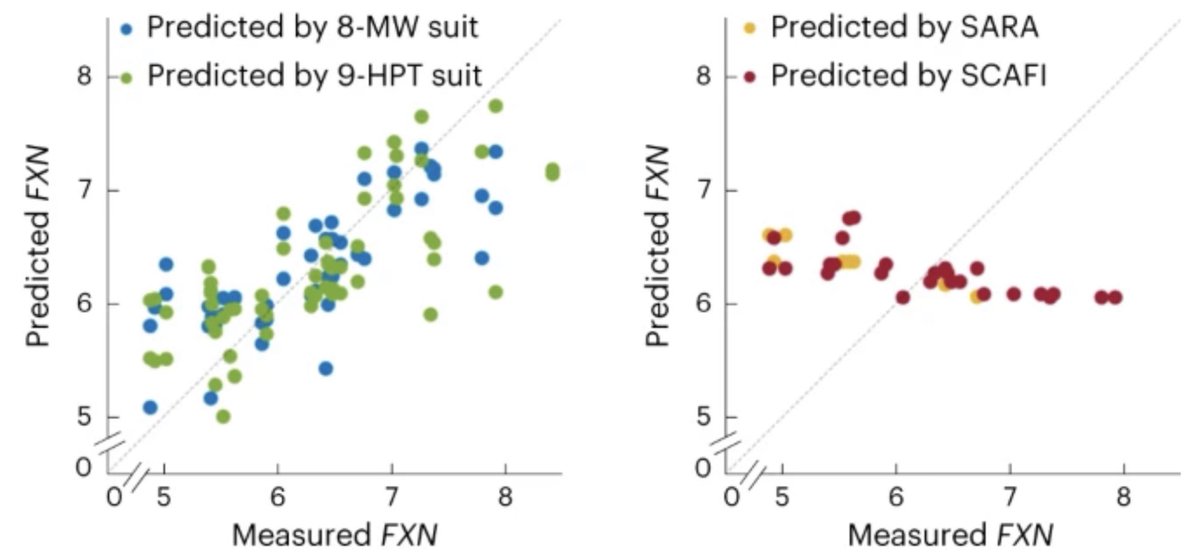
BONUS 3/4 We can measure gene expression rates from the behavioural fingerprints alone (no biosamples needed, left) VS best ML model using “gold”standard showed correlation with gene expression (right). This result kicks-off what we call #behavioral#transcriptomics
BONUS 3/4 We can measure gene expression rates from the behavioural fingerprints alone (no biosamples needed, left) VS best ML model using “gold”standard showed correlation with gene expression (right). This result kicks-off what we call #behavioral#transcriptomics
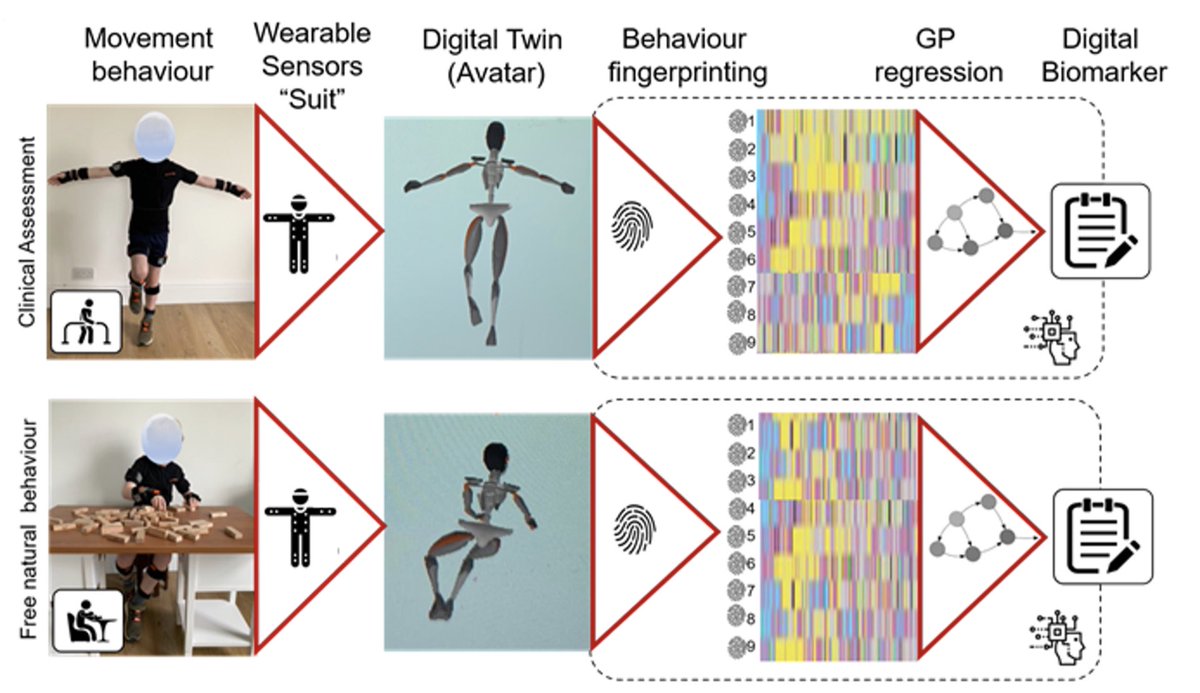
BONUS 2/4: Our approach works both with natural behaviour data, e.g. when patients were eating or in playroom as well as during clinical assessments. This may be the start of a universal approach to disease monitoring in general, especially outside the clinic in our daily lives.
BONUS 2/4: Our approach works both with natural behaviour data, e.g. when patients were eating or in playroom as well as during clinical assessments. This may be the start of a universal approach to disease monitoring in general, especially outside the clinic in our daily lives.
BONUS 1/3: 1. Our full-body behaviour fingerprints are not affected by patients loosing the ability to walk (unlike the need for 2 “gold”standard markers before/after). 2. Our is not confused by aging (DMD “gold”standard goes up&down as child grows paralysed), our’s only progress
BONUS 1/3: 1. Our full-body behaviour fingerprints are not affected by patients loosing the ability to walk (unlike the need for 2 “gold”standard markers before/after). 2. Our is not confused by aging (DMD “gold”standard goes up&down as child grows paralysed), our’s only progress
With the vast majority of drugs & treatments not making it to market & failing in the 3 clinical trial stages, our view is to be hollistic about patient capabilities. This allows for shorter, smaller & less risky trials, making treatment development viable for #neglected#diseases
With the vast majority of drugs & treatments not making it to market & failing in the 3 clinical trial stages, our view is to be hollistic about patient capabilities. This allows for shorter, smaller & less risky trials, making treatment development viable for #neglected#diseases
What does this mean: First of all,we basically showed how poor established gold-standard clinical behavioural/observational assessments operate when compared to AI derived biomarkers. The gold-standard ain’t so golden, yet they are used as primary endpoints in drug development.
What does this mean: First of all,we basically showed how poor established gold-standard clinical behavioural/observational assessments operate when compared to AI derived biomarkers. The gold-standard ain’t so golden, yet they are used as primary endpoints in drug development.
We used much larger clinical trial data (big thanks EFACTS & Gemelli) to boost prediction of clinical scores from clinical scores. Still our method performed far better at predicting future clinical scores & used at equal precision far fewer patients: FA 7 vs 160+ & DMD 9 vs 50+
We used much larger clinical trial data (big thanks EFACTS & Gemelli) to boost prediction of clinical scores from clinical scores. Still our method performed far better at predicting future clinical scores & used at equal precision far fewer patients: FA 7 vs 160+ & DMD 9 vs 50+
Predicting gold-standard clinical scales is ceiling limited by the quality of the traditional “gold”-standard itself. So, we showed that we could predict disease progression 6-12 months into the future for every individual patients, unlike the gold-standard itself … 8/10
Predicting gold-standard clinical scales is ceiling limited by the quality of the traditional “gold”-standard itself. So, we showed that we could predict disease progression 6-12 months into the future for every individual patients, unlike the gold-standard itself … 8/10
7/10 In both diseases we were able to reconstruct cross-sectionally the whole range of “gold”-standard clinical scales, i.e. movement data from the same day as the assessment predicted the clinical scale without requiring an expert clinical observer rating the patient by-eye…
7/10 In both diseases we were able to reconstruct cross-sectionally the whole range of “gold”-standard clinical scales, i.e. movement data from the same day as the assessment predicted the clinical scale without requiring an expert clinical observer rating the patient by-eye…
6/10 From our previous work on capturing real-world motor behaviour in 100s of volunteers we identified sets of digital behaviour fingerprints that characterise human movements. Thus, one pipeline analysed clinical assessment & natural human behaviour in 2 very different diseases
6/10 From our previous work on capturing real-world motor behaviour in 100s of volunteers we identified sets of digital behaviour fingerprints that characterise human movements. Thus, one pipeline analysed clinical assessment & natural human behaviour in 2 very different diseases
5/10 In both papers we did longitudinal natural history studies with patients drawn from range of disease progression states of FA & DMD. Among other things we measured full-body movement data & clinical assessments (ie “gold”-standard measures) @ trial start, middle & end.
5/10 In both papers we did longitudinal natural history studies with patients drawn from range of disease progression states of FA & DMD. Among other things we measured full-body movement data & clinical assessments (ie “gold”-standard measures) @ trial start, middle & end.
3/10 In the 1st @NatureMedicine paper https://t.co/YWyO3qH4Wr we focus on FA, which has a gene disfunction that results in impaired mitochondrial function, results in motor & heart dysfunction.
4/10 In the 2nd @NatureMedicine paper we work with children that have #DuchenneMuscularDystrophy, where muscle loss leads to increasing stiffness & paralysis, here in a cohort with & without loss ambulation https://t.co/ow0GvH2L76
3/10 In the 1st @NatureMedicine paper https://t.co/YWyO3qH4Wr we focus on FA, which has a gene disfunction that results in impaired mitochondrial function, results in motor & heart dysfunction.
3/10 In the 1st @NatureMedicine paper https://t.co/YWyO3qH4Wr we focus on FA, which has a gene disfunction that results in impaired mitochondrial function, results in motor & heart dysfunction.
We focus on two very different rare, degenerative, genetic diseases that affect movement & eventually lead to paralysis & death. There are currently no cures for either disease, the practical benefit is to lower risk, cost, patients needed & duration of drug trials.
2/10
We focus on two very different rare, degenerative, genetic diseases that affect movement & eventually lead to paralysis & death. There are currently no cures for either disease, the practical benefit is to lower risk, cost, patients needed & duration of drug trials.
2/10